Key Takeaways
When generative AI meets product development, it creates a shift from traditional execution-driven workflows to intelligence-driven product building. Instead of relying on manual effort, disconnected tools, and delayed insights, product teams can now operate with real-time intelligence, automation, and predictive capabilities built into every stage.
Generative AI accelerates product development by automating repetitive tasks like documentation, coding, and testingFaster time-to-market with AI-driven workflows and reduced manual effortImproves decision-making using real-time, data-driven insights instead of assumptionsEnhances creativity and innovation by generating multiple ideas, designs, and solutions quicklyActs as a co-pilot for teams, supporting developers, product managers, and designers—not replacing themEnables continuous product improvement through user data analysis and feedback loopsBoosts operational efficiency by reducing costs, errors, and resource dependencyRequires strong data quality and governance to ensure accurate and unbiased outputsIntegration and scalability need planning, especially with existing systems and infrastructureSuccessful adoption depends on strategy, collaboration, and continuous optimization—not just tools
Why Generative AI Matters in Product Development
Generative AI is not just another layer of technology—it acts as a multiplier for speed, creativity, and decision-making. It enables teams to move from idea to execution faster while maintaining quality and scalability.
In today's competitive landscape, this matters because:
- Product cycles are shrinking, and speed is critical
- Users expect personalized and continuously evolving experiences
- Engineering teams are under pressure to do more with fewer resources
- Businesses need data-backed decisions, not assumptions
Generative AI closes the gap between planning and execution by transforming how teams ideate, design, build, test, and optimize products.
Key Use Cases Across the Product Lifecycle
Generative AI is not limited to a single phase — it integrates across the entire product lifecycle, enhancing every function within a product team.
1. Ideation & Market Research
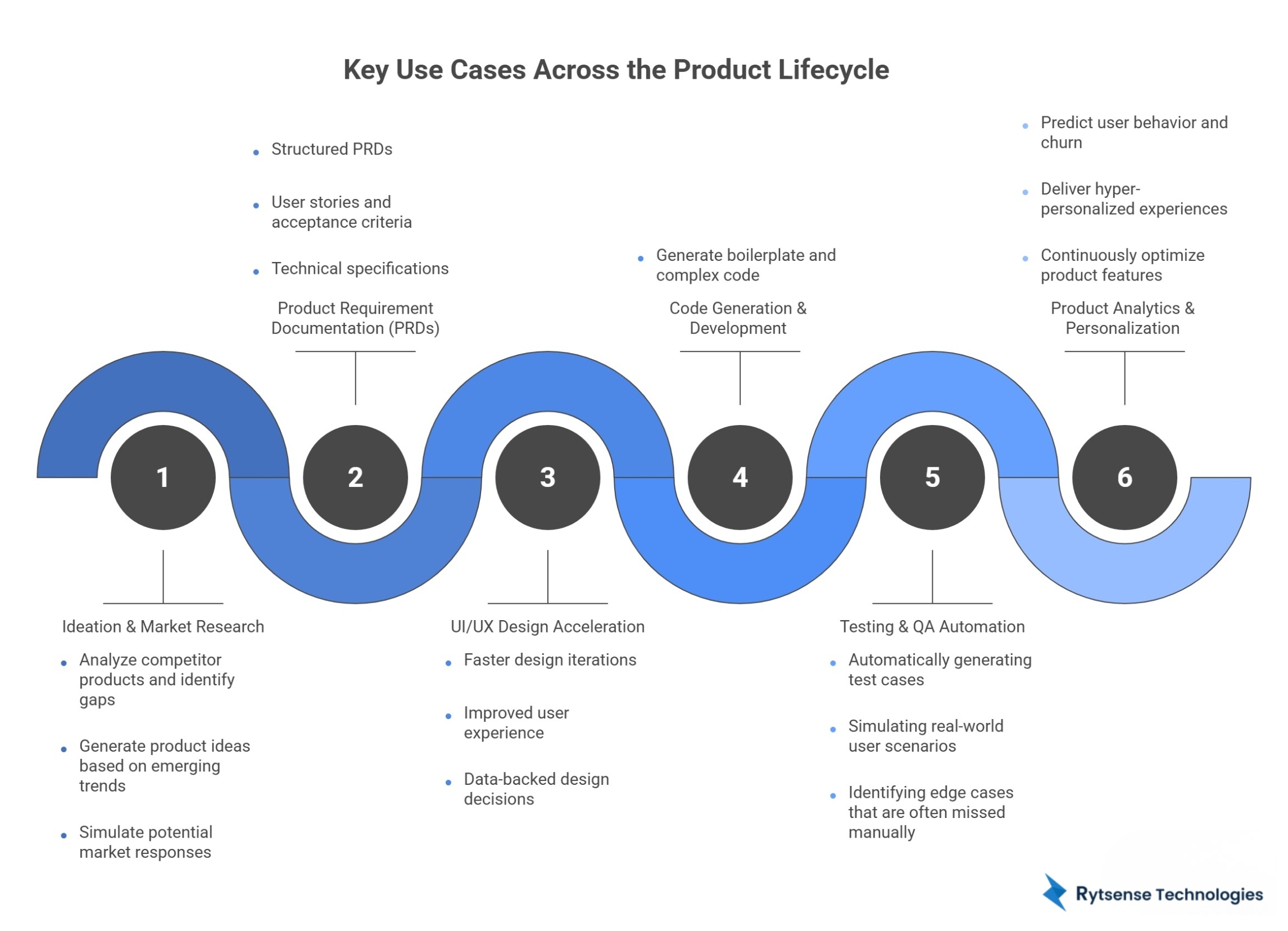
Traditionally, ideation depends on brainstorming, user interviews, and market reports. Generative AI enhances this by processing massive datasets in seconds to uncover hidden opportunities.
It can:
- Analyze competitor products and identify gaps
- Generate product ideas based on emerging trends
- Simulate potential market responses
This reduces guesswork and allows teams to validate ideas before investing resources.
2. Product Requirement Documentation (PRDs)
PRDs often become bottlenecks due to the time required to write and refine them. Generative AI accelerates this process by instantly generating:
- Structured PRDs
- User stories and acceptance criteria
- Technical specifications
This ensures consistency while freeing up product managers to focus on strategic thinking.
3. UI/UX Design Acceleration
Design is no longer a slow, iterative process. Generative AI tools can generate wireframes, suggest layouts, and even recommend UX improvements based on behavioral data. This leads to:
- Faster design iterations
- Improved user experience
- Data-backed design decisions
4. Code Generation & Development
Developers can significantly increase productivity by using AI-assisted coding tools. These tools can:
- Generate boilerplate and complex code
- Suggest optimizations
- Detect and fix bugs in real time
Instead of replacing developers, AI acts as a co-pilot that reduces repetitive work and improves code quality.
5. Testing & QA Automation
Testing is one of the most resource-intensive phases of product development. Generative AI simplifies this by:
- Automatically generating test cases
- Simulating real-world user scenarios
- Identifying edge cases that are often missed manually
This improves product reliability while reducing testing time.
6. Product Analytics & Personalization
Generative AI enables continuous learning from user data. It helps teams:
- Predict user behavior and churn
- Deliver hyper-personalized experiences
- Continuously optimize product features
This creates a feedback loop where products evolve based on real usage patterns.
Benefits for Modern Product Teams
Generative AI delivers measurable business impact by improving speed, efficiency, and innovation across teams.
Faster Time-to-MarketBy automating repetitive tasks such as documentation, coding, and testing, teams can significantly reduce development cycles and launch products faster.Data-Driven Decision MakingGenerative AI transforms raw data into actionable insights, enabling teams to make informed decisions rather than relying on assumptions.Enhanced Innovation & CreativityAI-generated suggestions allow teams to explore multiple ideas, variations, and solutions quickly, leading to more innovative products.Continuous Product ImprovementWith AI-driven analytics, products can continuously evolve based on real-time user feedback and behavior.Operational Efficiency & Cost ReductionAutomation reduces manual effort, minimizes errors, and optimizes resource utilization, leading to lower operational costs.
Accelerate Product DevelopmentReady to accelerate your product development with generative AI? Transform your workflows with intelligent automation and faster delivery. Get Started with Generative AI
Challenges & Considerations
Despite its advantages, generative AI adoption requires careful planning and execution.
Data Privacy & ComplianceHandling sensitive user and business data requires strict adherence to security standards and regulatory compliance.Accuracy, Bias & ReliabilityAI-generated outputs are only as good as the data they are trained on. Poor data can lead to biased or inaccurate results.Integration with Existing SystemsLegacy systems may not be designed to support AI, making integration complex and time-consuming.Initial Investment & InfrastructureSetting up AI models, infrastructure, and tools requires upfront investment, though it delivers long-term ROI.Talent & Skill GapOrganizations need skilled AI engineers, data scientists, and product leaders to successfully implement and manage AI systems.
How to Successfully Integrate Generative AI
To unlock the full potential of generative AI, organizations need more than just tools — they need a clear strategy, the right processes, and strong alignment across teams. Successful integration is not a one-time implementation but an ongoing transformation.
1. Start with High-Impact Use Cases
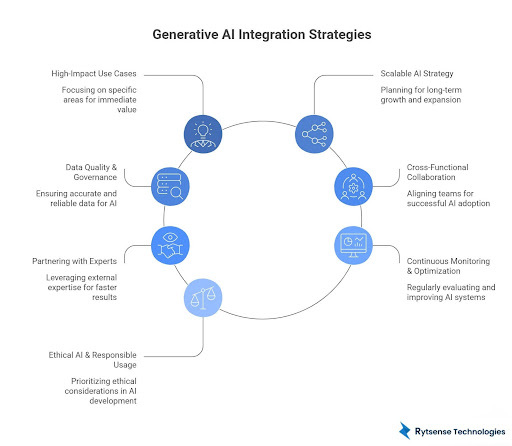
The biggest mistake teams make is trying to apply AI everywhere at once. Instead, focus on specific, high-impact use cases where generative AI can deliver immediate and measurable value.
Examples include:
- Automating PRDs and user stories for product teams
- AI-assisted coding for faster development
- Generating test cases in QA
- Customer support automation using AI chat systems
Why this matters: Quick wins help build internal confidence, justify investment, and create momentum for broader adoption.
2. Build a Scalable AI Strategy
Generative AI should not be treated as an experiment — it must be part of your long-term product and technology roadmap.
A strong AI strategy includes:
- Selecting the right AI models (LLMs, domain-specific models)
- Choosing scalable infrastructure (cloud, APIs, or on-premise)
- Defining clear use cases aligned with business goals
- Planning for future expansion across products and teams
Think long-term: What works for a small feature today should scale across your entire product ecosystem tomorrow.
3. Invest in Data Quality & Governance
Generative AI is only as powerful as the data it learns from. Poor-quality data leads to inaccurate, biased, or unreliable outputs.
Organizations must focus on:
- Cleaning and structuring datasets
- Ensuring data consistency and accuracy
- Implementing data governance policies
- Maintaining compliance with regulations (GDPR, HIPAA, etc.)
Key insight: High-quality data is not optional — it's the foundation of every successful AI initiative.
4. Enable Cross-Functional Collaboration
Generative AI adoption is not just a technical initiative — it's a business transformation. It requires close collaboration across multiple teams.
Key stakeholders include:
- Product Managers → define use cases and priorities
- Developers & Engineers → build and integrate AI systems
- Designers → ensure user-friendly AI interactions
- Business Leaders → align AI with strategic goals
Why this matters: Without alignment, AI projects often fail due to disconnects between technical execution and business objectives.
5. Partner with AI Experts
Building and scaling generative AI solutions requires specialized expertise. Partnering with an experienced generative AI development service can significantly reduce risk and accelerate outcomes.
Benefits of working with experts:
- Faster implementation with proven frameworks
- Access to experienced AI engineers and architects
- Reduced trial-and-error costs
- Best practices in security, scalability, and performance
For businesses looking to scale quickly, partnering is often more efficient than building everything in-house.
6. Focus on Continuous Monitoring & Optimization
Generative AI is not a "set it and forget it" system. Models need continuous monitoring, evaluation, and improvement. Teams should:
- Track performance metrics (accuracy, response quality, latency)
- Collect user feedback
- Retrain models with updated data
- Optimize prompts and workflows
Continuous improvement ensures your AI systems stay relevant, accurate, and aligned with user needs.
7. Ensure Ethical AI & Responsible Usage
As generative AI becomes more powerful, ethical considerations become critical. Organizations must:
- Prevent biased outputs
- Ensure transparency in AI-generated content
- Protect user data and privacy
- Define clear guidelines for AI usage
Responsible AI builds trust with users and protects your brand in the long run.
Future of Product Development with AI
As generative AI continues to evolve, it will move beyond assistance to active collaboration in product development.
In the near future, we can expect:
- AI-driven product managers that generate and prioritize features
- Self-optimizing applications that adapt automatically
- Real-time personalization at scale
- Faster innovation cycles with minimal manual intervention
The companies that embrace this shift early will not just improve efficiency—they will redefine how products are built and experienced.
Partner with AI ExpertsWant to build smarter, scalable products? Partner with experts to integrate generative AI seamlessly into your product lifecycle. Talk to AI Experts
Conclusion
When generative AI meets product development, it unlocks a new level of speed, intelligence, and innovation. From ideation to deployment, AI is transforming how modern teams build products and deliver value.
For product leaders, developers, and enterprises, adopting generative AI is no longer optional — it's a strategic move to stay competitive. The sooner you integrate AI into your product lifecycle, the faster you can innovate, scale, and lead in your market.
Meet the Author

Co-Founder, Rytsense Technologies
Karthik is the Co-Founder of Rytsense Technologies, where he leads cutting-edge projects at the intersection of Data Science and Generative AI. With nearly a decade of hands-on experience in data-driven innovation, he has helped businesses unlock value from complex data through advanced analytics, machine learning, and AI-powered solutions. Currently, his focus is on building next-generation Generative AI applications that are reshaping the way enterprises operate and scale. When not architecting AI systems, Karthik explores the evolving future of technology, where creativity meets intelligence.