Key Takeaways
- Define your business goals before evaluating any ML development company.
- Look beyond pricing and assess technical expertise, industry experience, and MLOps capabilities.
- Choose a partner with proven deployment experience and transparent communication.
- Verify security, compliance, and post-launch support before signing a contract.
- Use a structured evaluation checklist to compare vendors and reduce project risks.
How to Choose the Right Machine Learning Development Company
Selecting a machine learning development company is one of the most important technology decisions a business can make. The right partner can help you automate workflows, improve predictions, reduce costs, and create new revenue opportunities. The wrong one can leave you with expensive prototypes that never reach production.
With hundreds of AI and ML vendors in the market, comparing companies based only on price or portfolio is no longer enough.
This guide explains exactly how to evaluate a machine learning development company, what questions to ask, warning signs to avoid, and a practical checklist to help you make the right decision.
Why Choosing the Right Machine Learning Development Company Matters
Machine learning projects are different from traditional software development.
Unlike standard applications, ML solutions require:
- High-quality data
- Model training and validation
- Continuous monitoring
- Regular model improvements
- Infrastructure for deployment
- Business-focused performance metrics
A capable development partner understands both machine learning engineering and business strategy.
Instead of simply building a model, they should deliver measurable business outcomes
Before Contacting Any Vendor, Define These Five Things
Many businesses start vendor discussions without clearly defining their own requirements.
Before requesting proposals, identify:
| Requirement | Questions to Answer |
|---|---|
| Business Goal | What problem are you solving? |
| Available Data | Do you have enough historical data? |
| Success Metrics | How will success be measured? |
| Budget | What investment is realistic? |
| Timeline | When should the solution go live? |
Vendors can only recommend the right solution after understanding these basics.
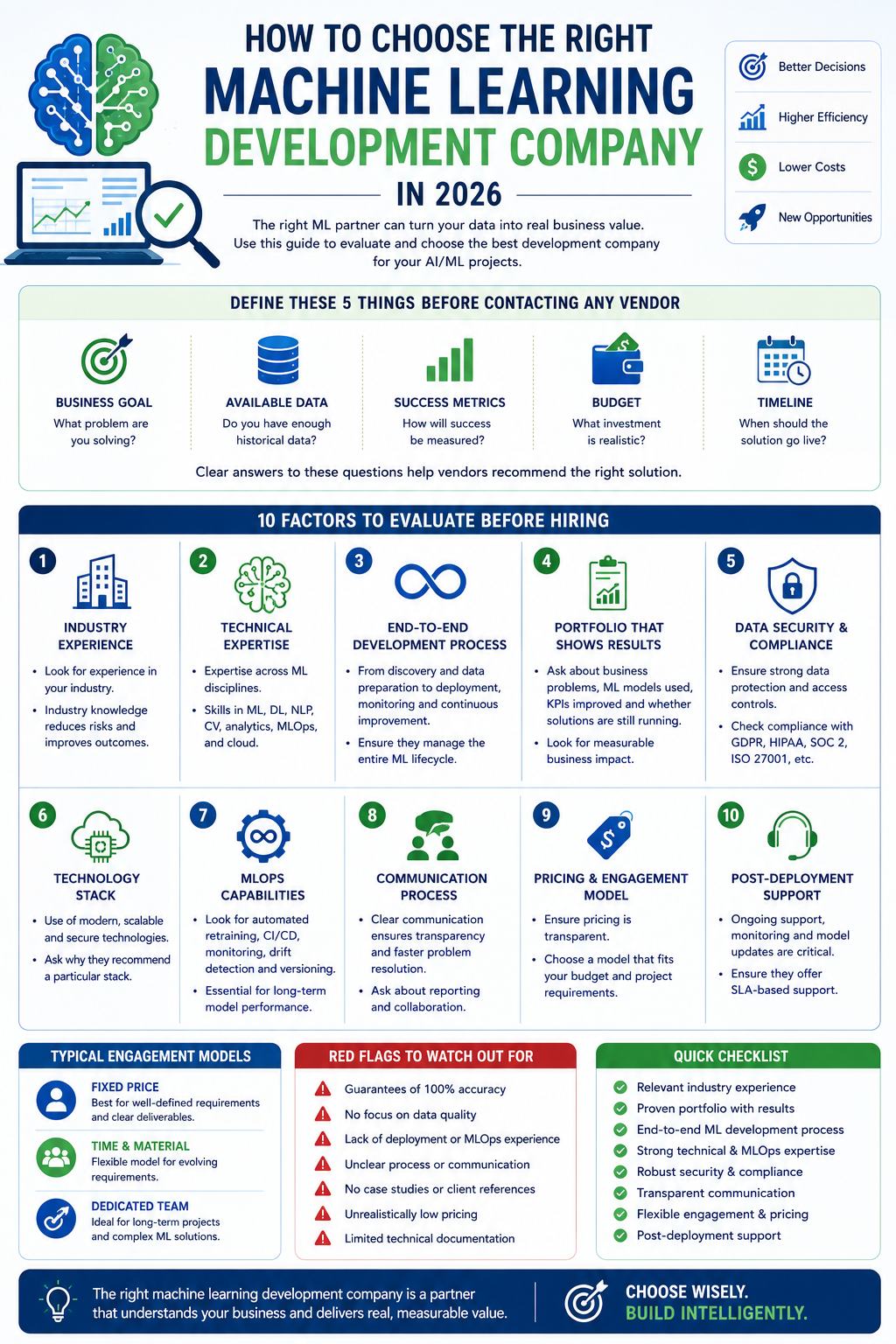
10 Factors to Evaluate Before Hiring a Machine Learning Development Company
1. Industry Experience
Not every ML company has experience in your industry.
Ask whether they have delivered solutions for:
- Healthcare
- Manufacturing
- Retail
- Logistics
- Finance
- Insurance
- Real Estate
- SaaS
Industry expertise reduces project risks because the team already understands common business challenges.
2. Technical Expertise
A reliable machine learning development company should have expertise across multiple ML disciplines instead of focusing on only one technology.
Look for experience in:
- Predictive analytics
- Computer Vision
- NLP
- Recommendation systems
- Time-series forecasting
- Generative AI
- Deep Learning
- Reinforcement Learning
They should also understand:
- MLOps
- Data Engineering
- Cloud Deployment
- Model Monitoring
3. End-to-End Development Process
Many vendors focus only on building machine learning models. However, a reliable machine learning development service company manages the entire lifecycle to ensure your solution is accurate, scalable, and ready for production.
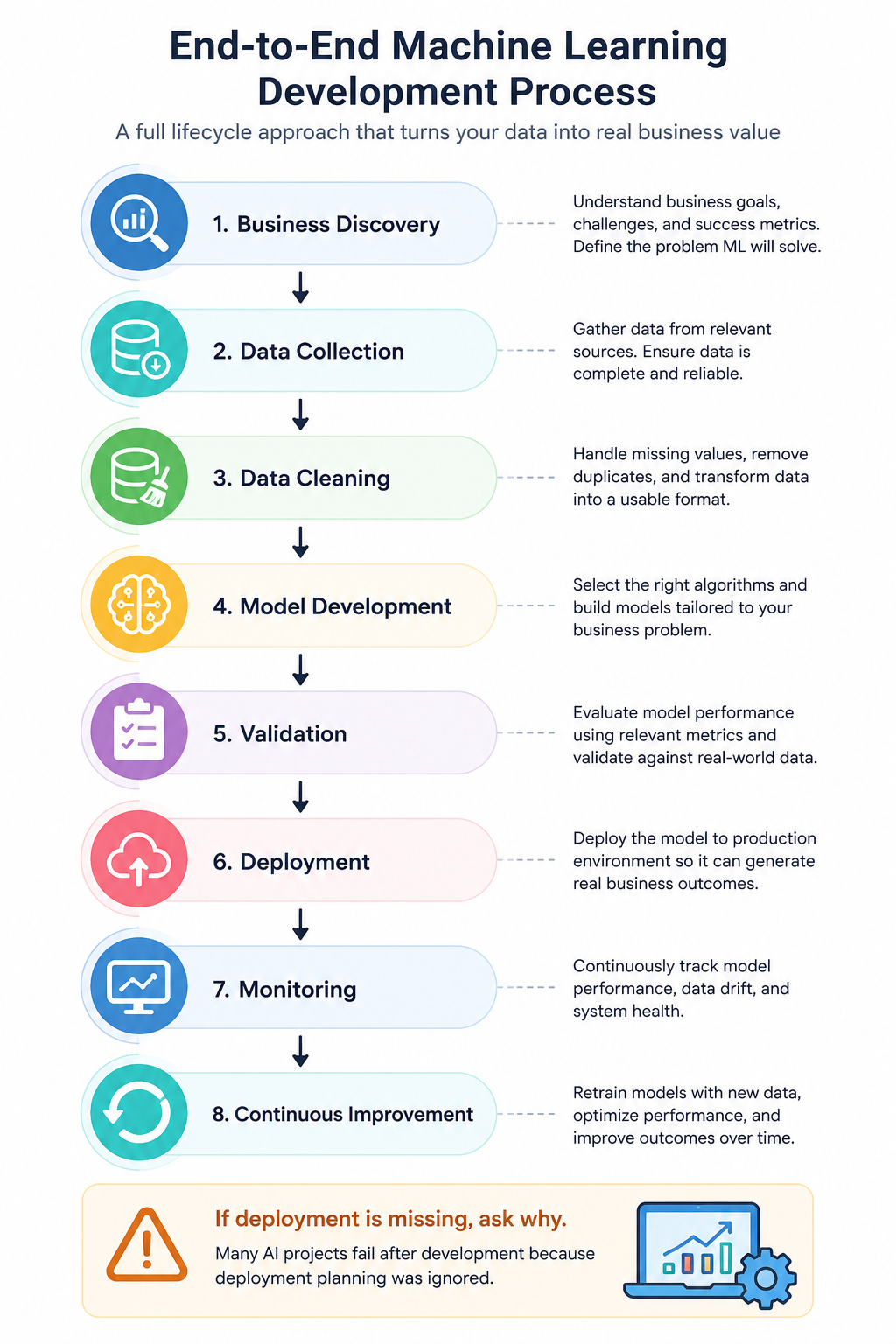
A typical end-to-end machine learning development process includes:
- Business Discovery – Understand business objectives, project requirements, and define measurable success metrics.
- Data Collection – Gather structured and unstructured data from relevant sources needed for model training.
- Data Cleaning & Preparation – Remove inconsistencies, handle missing values, and prepare high-quality datasets for accurate predictions.
- Model Development – Select the appropriate algorithms, train machine learning models, and optimize their performance.
- Validation & Testing – Evaluate the model using performance metrics to ensure it delivers reliable and accurate results.
- Deployment – Integrate the trained model into your production environment so it can support real business operations.
- Monitoring – Continuously monitor model performance, detect data drift, and identify opportunities for improvement.
- Continuous Improvement – Retrain and optimize the model using new data to maintain accuracy and adapt to changing business needs.
4. Portfolio That Shows Business Results
Instead of asking,
"Can I see your portfolio?"
Ask:
- What business problem did the client face?
- Which ML model was used?
- What KPIs improved?
- Was the model deployed successfully?
- Is it still running?
Look for measurable outcomes such as:
- Reduced manual work
- Higher prediction accuracy
- Faster processing
- Lower operational costs
- Increased revenue
5. Data Security and Compliance
Your ML partner will likely access sensitive business data.
Verify their approach toward:
- Data encryption
- Secure cloud infrastructure
- Access control
- NDA agreements
- Compliance requirements
- Backup policies
For regulated industries, ask about:
- GDPR
- HIPAA
- SOC 2
- ISO 27001
6. Technology Stack
Technology changes quickly.
Instead of asking which framework they use, ask why they recommend it.
Common technologies include:
| Category | Popular Technologies |
|---|---|
| Programming | Python, Java |
| Frameworks | TensorFlow, PyTorch, Scikit-learn |
| Cloud | AWS, Azure, Google Cloud |
| Deployment | Docker, Kubernetes |
| Data | Snowflake, PostgreSQL, BigQuery |
Modern stacks improve scalability and maintenance.
7. MLOps Capabilities
Many companies can build models.
Fewer can manage them after deployment.
Strong MLOps practices include:
- Automated retraining
- CI/CD pipelines
- Drift detection
- Performance monitoring
- Version control
- Model rollback
Without MLOps, production models gradually lose accuracy.
8. Communication Process
Machine learning projects involve frequent iterations.
Ask:
- Who is your point of contact?
- How often are progress meetings?
- Which project management tools are used?
- How are risks communicated?
Clear communication often determines project success.
9. Pricing Transparency
The cheapest proposal is rarely the best.
Instead, understand:
- Fixed price vs dedicated team
- Licensing costs
- Cloud expenses
- Infrastructure costs
- Maintenance fees
- Support plans
Always request a detailed cost breakdown.
10. Long-Term Support
Machine learning models require ongoing maintenance.
Ask whether they provide:
- Performance monitoring
- Model retraining
- Bug fixes
- Feature improvements
- Cloud optimization
- Technical support
A long-term partnership usually delivers more value than one-time development.
Questions to Ask Before Signing a Contract
Use these questions during vendor discussions.
Business Understanding
- How will you understand our business goals?
- How do you define project success?
- What KPIs will be measured?
Technical Capability
- Which ML models would you recommend?
- Why is that approach suitable?
- How will model performance be measured?
Delivery
- What is the estimated timeline?
- Who owns the source code?
- How are changes handled?
Post Deployment
- Will you monitor production models?
- How frequently will retraining occur?
- What support is included?
Red Flags That Should Make You Reconsider
Avoid companies that:
- Promise unrealistic accuracy
- Guarantee AI results without reviewing data
- Cannot explain technical decisions in simple language
- Lack deployment experience
- Have no measurable case studies
- Ignore security discussions
- Offer unusually low pricing without justification
These are common indicators of inexperienced vendors.
Machine Learning Development Company Evaluation Scorecard
Rate each vendor from 1 to 5.
| Evaluation Area | Score |
|---|---|
| Industry Experience | ☐ |
| Technical Skills | ☐ |
| Data Engineering | ☐ |
| MLOps | ☐ |
| Deployment Experience | ☐ |
| Security | ☐ |
| Communication | ☐ |
| Pricing Transparency | ☐ |
| Support | ☐ |
| Client References | ☐ |
A higher overall score indicates a stronger long-term partner.
Common Mistakes Businesses Make
Many organizations focus only on technical expertise.
Other factors matter just as much.
Avoid these mistakes:
- Choosing the lowest-cost proposal
- Ignoring data quality
- Skipping proof of concept
- Not planning deployment
- Underestimating maintenance
- Failing to define business KPIs
- Hiring vendors without industry experience
What Makes a Great Machine Learning Development Company?
The best partners typically demonstrate:
- Strong business understanding
- Transparent development process
- Proven deployment experience
- Secure development practices
- Scalable cloud architecture
- Continuous optimization
- Clear communication
- Long-term support
Final Decision Checklist
Before signing with any machine learning development company, confirm that they can answer "Yes" to these questions:
- Do they understand your business objectives?
- Have they built similar ML solutions?
- Can they deploy models into production?
- Do they provide MLOps support?
- Are security and compliance documented?
- Is pricing transparent?
- Do they offer post-launch support?
- Can they demonstrate measurable client success?
If the answer is "Yes" across these areas, you are more likely to choose a partner capable of delivering lasting business value.
Conclusion
Choosing a machine learning development company is about more than evaluating technical skills. The right partner combines industry knowledge, a proven development process, secure engineering practices, and long-term support to ensure your machine learning investment delivers measurable business results.
Rather than selecting a vendor based on cost alone, evaluate their ability to understand your goals, deploy production-ready solutions, and continuously improve model performance. A structured evaluation today can reduce project risk and help your organization gain a stronger competitive advantage from machine learning.
Meet the Author

Co-Founder, Rytsense Technologies
Karthik is the Co-Founder of Rytsense Technologies, where he leads cutting-edge projects at the intersection of Data Science and Generative AI. With nearly a decade of hands-on experience in data-driven innovation, he has helped businesses unlock value from complex data through advanced analytics, machine learning, and AI-powered solutions. Currently, his focus is on building next-generation Generative AI applications that are reshaping the way enterprises operate and scale. When not architecting AI systems, Karthik explores the evolving future of technology, where creativity meets intelligence.