Key Takeaways
- ML deployment turns trained models into real-world business solutions.
- Production systems require APIs, monitoring, infrastructure, and scalability.
- Common deployment methods include batch, real-time, edge, and streaming deployment.
- Docker and cloud platforms simplify deployment and scaling.
- Continuous monitoring helps maintain model accuracy and performance.
- Data drift and model drift can impact prediction quality over time.
- MLOps improves deployment efficiency, reliability, and model management.
- A structured deployment strategy ensures long-term AI success.
How to Deploy Machine Learning Models in Production
Building a machine learning model is only part of the journey. The real challenge begins when you need to deploy that model into a production environment where it can generate predictions, support business decisions, and serve real users.
Many organizations invest significant time in model development but struggle with deployment due to infrastructure complexity, scalability concerns, monitoring requirements, and integration challenges.
This guide explains how machine learning models are deployed in production, the deployment methods available, common challenges, and best practices for successful implementation.
What Does Machine Learning Model Deployment Mean?
Machine learning model deployment is the process of integrating a trained model into a live application or business environment so it can process new data and generate predictions automatically.
Once deployed, a model can:
- Predict customer behavior
- Detect fraud in real time
- Forecast sales demand
- Automate document processing
- Recommend products
- Support intelligent decision-making
Deployment transforms a machine learning model from an experimental project into a business-ready solution.
Why Production Deployment Matters
A highly accurate model provides little value if it remains in a development environment.
Production deployment allows organizations to:
- Deliver predictions to users instantly
- Automate business workflows
- Generate measurable business value
- Scale AI capabilities across departments
- Continuously improve model performance
This is why deployment is often considered one of the most important phases of the machine learning lifecycle.
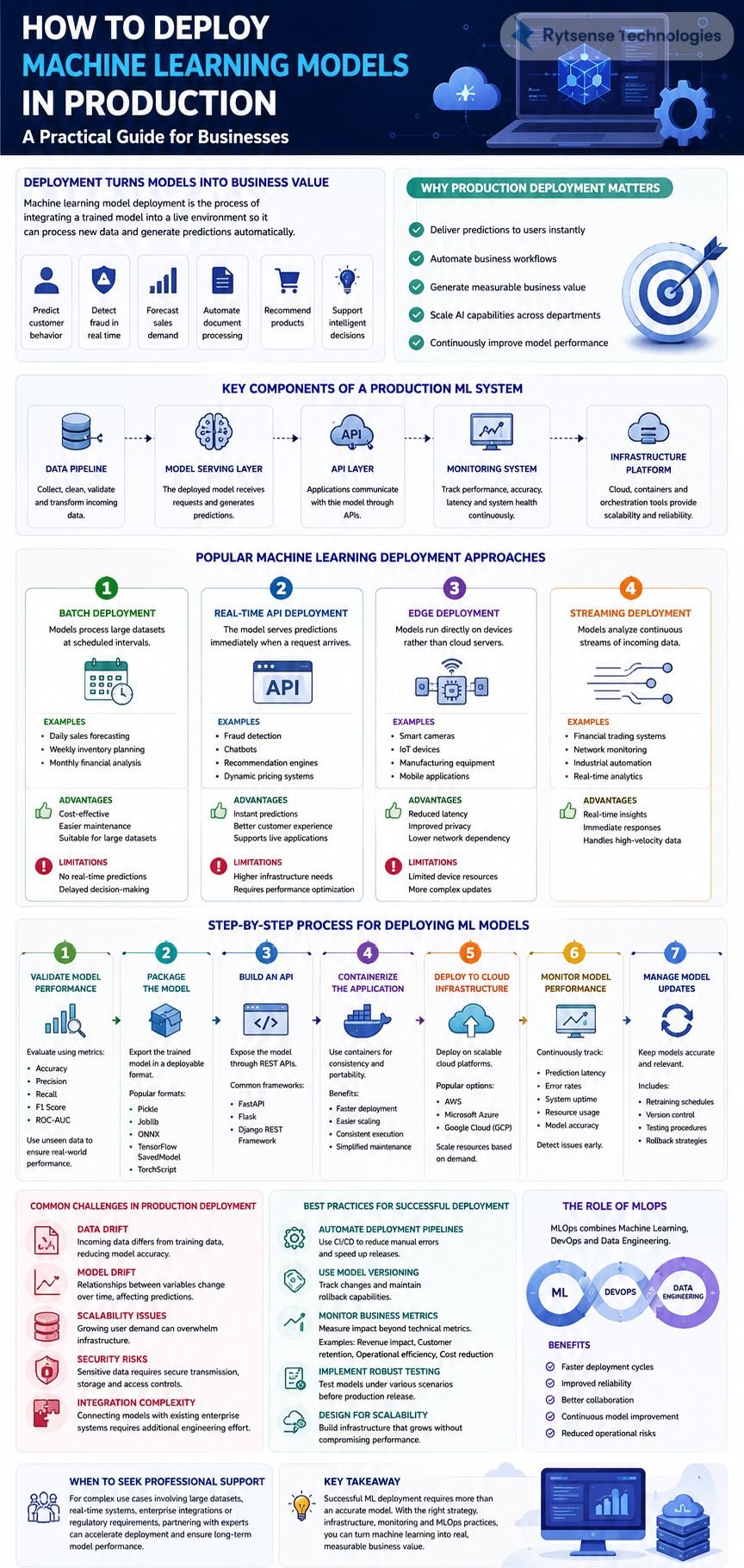
Key Components of a Production ML System
Successful deployment involves more than simply uploading a model to a server.
A production-ready machine learning system typically includes:
Data Pipeline
The system must collect, clean, validate, and transform incoming data before it reaches the model.
Model Serving Layer
The deployed model receives requests and generates predictions.
API Layer
Applications communicate with the model through APIs that handle requests and responses.
Monitoring System
Performance metrics, prediction accuracy, latency, and system health are tracked continuously.
Infrastructure Platform
Cloud services, containers, and orchestration tools provide scalability and reliability.
Popular Machine Learning Deployment Approaches
Different deployment methods suit different business requirements.
1. Batch Deployment
Models process large datasets at scheduled intervals.
Examples include:
- Daily sales forecasting
- Weekly inventory planning
- Monthly financial analysis
Advantages:
- Cost-effective
- Easier maintenance
- Suitable for large datasets
Limitations:
- No real-time predictions
- Delayed decision-making
2. Real-Time API Deployment
The model serves predictions immediately when a request arrives.
Common use cases include:
- Fraud detection
- Chatbots
- Recommendation engines
- Dynamic pricing systems
Advantages:
- Instant predictions
- Better customer experience
- Supports live applications
Limitations:
- Higher infrastructure requirements
- Requires performance optimization
3. Edge Deployment
Models run directly on devices rather than cloud servers.
Examples include:
- Smart cameras
- IoT devices
- Manufacturing equipment
- Mobile applications
Advantages:
- Reduced latency
- Improved privacy
- Lower network dependency
Limitations:
- Limited device resources
- More complex updates
4. Streaming Deployment
Models analyze continuous streams of incoming data.
Common applications include:
- Financial trading systems
- Network monitoring
- Industrial automation
- Real-time analytics
This approach enables immediate responses to changing conditions.
Step-by-Step Process for Deploying Machine Learning Models
Step 1: Validate Model Performance
Before deployment, evaluate the model using:
- Accuracy
- Precision
- Recall
- F1 Score
- ROC-AUC
Testing should use unseen data to ensure the model performs well in real-world conditions.
Step 2: Package the Model
The trained model is exported into a deployable format.
Popular formats include:
- Pickle
- Joblib
- ONNX
- TensorFlow SavedModel
- TorchScript
Packaging ensures the model can be reused consistently across environments.
Step 3: Build an API
Most production systems expose models through REST APIs.
Common frameworks include:
- FastAPI
- Flask
- Django REST Framework
Applications send data to the API and receive predictions in return.
Step 4: Containerize the Application
Containers simplify deployment and environment consistency.
Benefits include:
- Faster deployment
- Easier scaling
- Consistent execution
- Simplified maintenance
Docker is widely used for this purpose.
Step 5: Deploy to Cloud Infrastructure
Cloud platforms provide scalable environments for machine learning workloads.
Popular options include:
- Amazon Web Services (AWS)
- Microsoft Azure
- Google Cloud Platform (GCP)
Organizations can scale resources based on demand while reducing infrastructure management overhead.
Step 6: Monitor Model Performance
Deployment is not the final step.
Monitoring should track:
- Prediction latency
- Error rates
- System uptime
- Resource consumption
- Model accuracy
Continuous monitoring helps identify issues before they affect users.
Step 7: Manage Model Updates
As data changes over time, model performance can decline.
A structured update process should include:
- Retraining schedules
- Version control
- Testing procedures
- Rollback strategies
This ensures long-term reliability.
Common Challenges in Production Deployment
Many machine learning projects face deployment obstacles.
Data Drift
Incoming data differs from training data, reducing model accuracy.
Model Drift
Relationships between variables change over time, affecting predictions.
Scalability Issues
Growing user demand can overwhelm infrastructure.
Security Risks
Sensitive data requires secure transmission, storage, and access controls.
Integration Complexity
Connecting models with existing enterprise systems often requires additional engineering effort.
Organizations should address these challenges during deployment planning rather than after launch.
Best Practices for Production ML Deployment
To maximize success, follow these proven practices:
Automate Deployment Pipelines
Automated CI/CD pipelines reduce manual errors and accelerate releases.
Use Model Versioning
Track model changes and maintain rollback capabilities.
Monitor Business Metrics
Measure outcomes beyond technical metrics.
Examples include:
- Revenue impact
- Customer retention
- Operational efficiency
- Cost reduction
Implement Robust Testing
Test models under various scenarios before production release.
Design for Scalability
Build infrastructure that can handle increasing workloads without performance degradation.
MLOps: The Foundation of Modern Deployment
As machine learning adoption grows, organizations increasingly rely on MLOps practices.
MLOps combines:
- Machine learning
- DevOps
- Data engineering
Benefits include:
- Faster deployment cycles
- Improved reliability
- Better collaboration
- Continuous model improvement
- Reduced operational risks
MLOps helps organizations move from experimental AI projects to scalable production systems.
When Should Businesses Seek Professional Support?
Deploying machine learning models can become complex when dealing with:
- Large datasets
- Real-time prediction systems
- Multiple deployment environments
- Enterprise integrations
- Regulatory requirements
Many organizations work with experienced teams offering machine learning development services to streamline deployment, reduce risk, and accelerate time-to-value. A specialized team can help design scalable infrastructure, implement MLOps workflows, and ensure long-term model performance.
Conclusion
Machine learning deployment is the bridge between model development and business value. A successful deployment strategy involves far more than simply training an accurate model. Organizations must consider infrastructure, scalability, monitoring, security, and ongoing maintenance.
By following proven deployment practices and adopting MLOps principles, businesses can transform machine learning initiatives into reliable production systems that drive measurable results.
Whether deploying a simple predictive model or a large-scale AI platform, a structured deployment approach ensures long-term success and sustainable growth.
Meet the Author

Co-Founder, Rytsense Technologies
Karthik is the Co-Founder of Rytsense Technologies, where he leads cutting-edge projects at the intersection of Data Science and Generative AI. With nearly a decade of hands-on experience in data-driven innovation, he has helped businesses unlock value from complex data through advanced analytics, machine learning, and AI-powered solutions. Currently, his focus is on building next-generation Generative AI applications that are reshaping the way enterprises operate and scale. When not architecting AI systems, Karthik explores the evolving future of technology, where creativity meets intelligence.