Key Takeaways
- Generative AI software enables businesses to create intelligent, interactive, and user-focused applications.
- AI-powered software can automate tasks, generate content, and improve decision-making.
- Common solutions include AI SaaS platforms, AI assistants, copilots, knowledge management systems, and customer-facing applications.
- Core technologies such as Large Language Models (LLMs), RAG, vector databases, and AI agents power modern AI software.
- Generative AI software development follows a structured process that includes strategy, development, AI integration, testing, and optimization.
- Businesses across healthcare, finance, retail, education, real estate, and logistics are adopting AI-powered software solutions.
- Choosing an experienced Generative AI software development company is essential for building scalable, secure, and future-ready applications.
- AI-native software products help organizations improve productivity, enhance user experiences, and unlock new growth opportunities.
Introduction
Generative AI is transforming the way software is built and used. Businesses are no longer limited to traditional applications that follow predefined rules. Today, organizations can develop intelligent software that generates content, understands natural language, automates tasks, and delivers personalized experiences.
From AI-powered SaaS platforms and virtual assistants to intelligent knowledge management systems and AI copilots, Generative AI Software Development Services help businesses create software products that provide greater value to users while improving operational efficiency.
This guide explores how generative AI software is developed, its benefits, use cases, and the technologies that power next-generation AI applications.
What Are Generative AI Software Development Services?
Generative AI Software Development Services involve designing, developing, and deploying software applications that use advanced AI models to generate content, provide recommendations, answer questions, automate workflows, and support decision-making.
Unlike conventional software, AI-powered applications can learn from interactions, process unstructured data, and produce human-like outputs.
These services help businesses build:
- AI-powered SaaS products
- AI assistants and copilots
- AI content generation platforms
- Knowledge management systems
- Customer-facing AI applications
- AI-powered productivity tools
The goal is to create software that enhances user experiences while delivering measurable business value.
Why Businesses Are Investing in AI-Native Software
Traditional software requires users to manually search for information, complete repetitive tasks, and navigate complex workflows. Generative AI changes this by making software more interactive, intelligent, and user-focused.
Businesses are adopting AI-powered software to:
- Improve customer experiences
- Increase employee productivity
- Automate repetitive processes
- Deliver personalized recommendations
- Accelerate innovation
- Create new revenue opportunities
As AI capabilities continue to evolve, software products are becoming smarter and more adaptive to user needs.
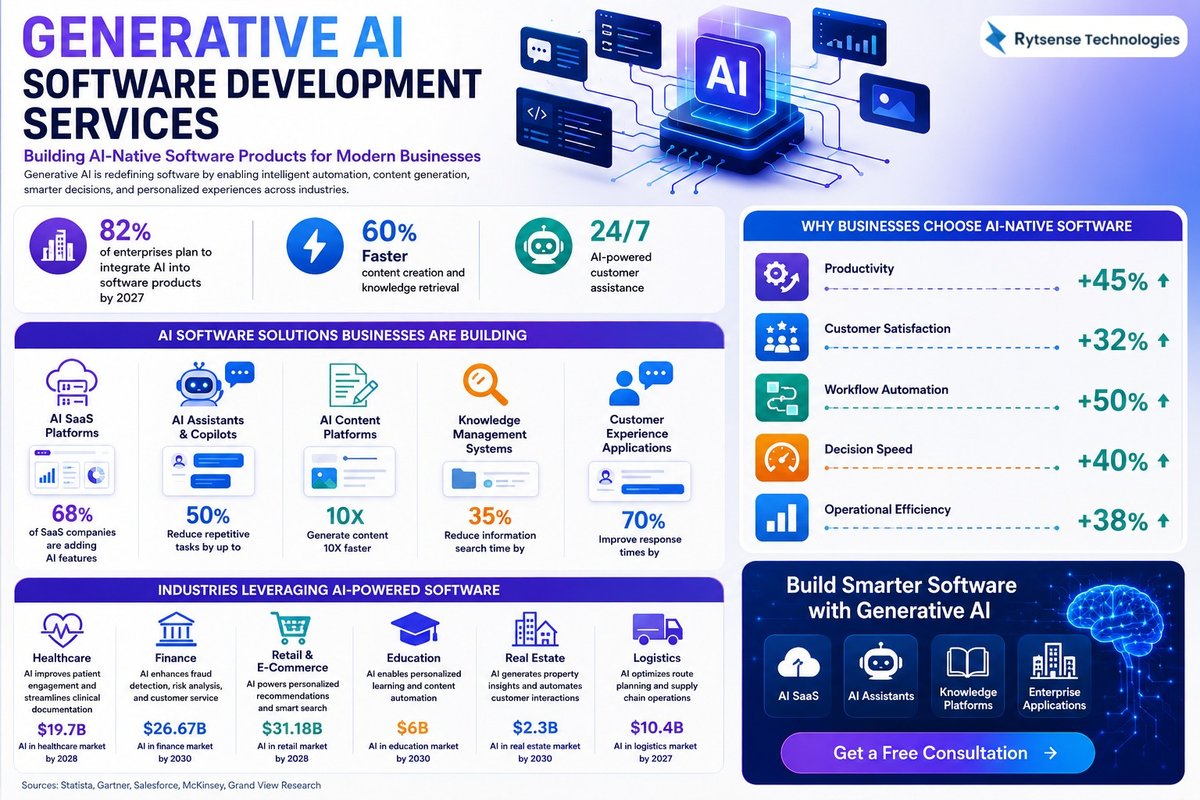
Types of Software Built Using Generative AI
AI-Powered SaaS Platforms
Software-as-a-Service products are increasingly integrating generative AI to provide intelligent features such as content creation, automated reporting, and data analysis.
Examples include:
- Marketing automation platforms
- Sales enablement tools
- Customer engagement software
- Project management solutions
AI Assistants and Copilots
AI copilots help users complete tasks faster by providing suggestions, generating content, and answering questions within software applications.
Common use cases include:
- Sales assistants
- Coding assistants
- Customer support assistants
- Research assistants
- Internal business copilots
AI Content Generation Platforms
Organizations are building software that can generate various types of content, including:
- Blog articles
- Product descriptions
- Marketing copy
- Social media content
- Business documentation
These platforms help businesses streamline content production while maintaining quality and consistency.
AI Knowledge Management Systems
Finding information quickly can be challenging in growing organizations. AI-powered knowledge management software helps users retrieve relevant information using natural language queries.
Benefits include:
- Faster information access
- Improved employee productivity
- Better knowledge sharing
- Reduced search time
AI Customer Experience Applications
Generative AI can improve customer interactions by providing instant support and personalized recommendations.
Examples include:
- AI chat assistants
- Virtual support agents
- Customer onboarding tools
- Personalized recommendation systems
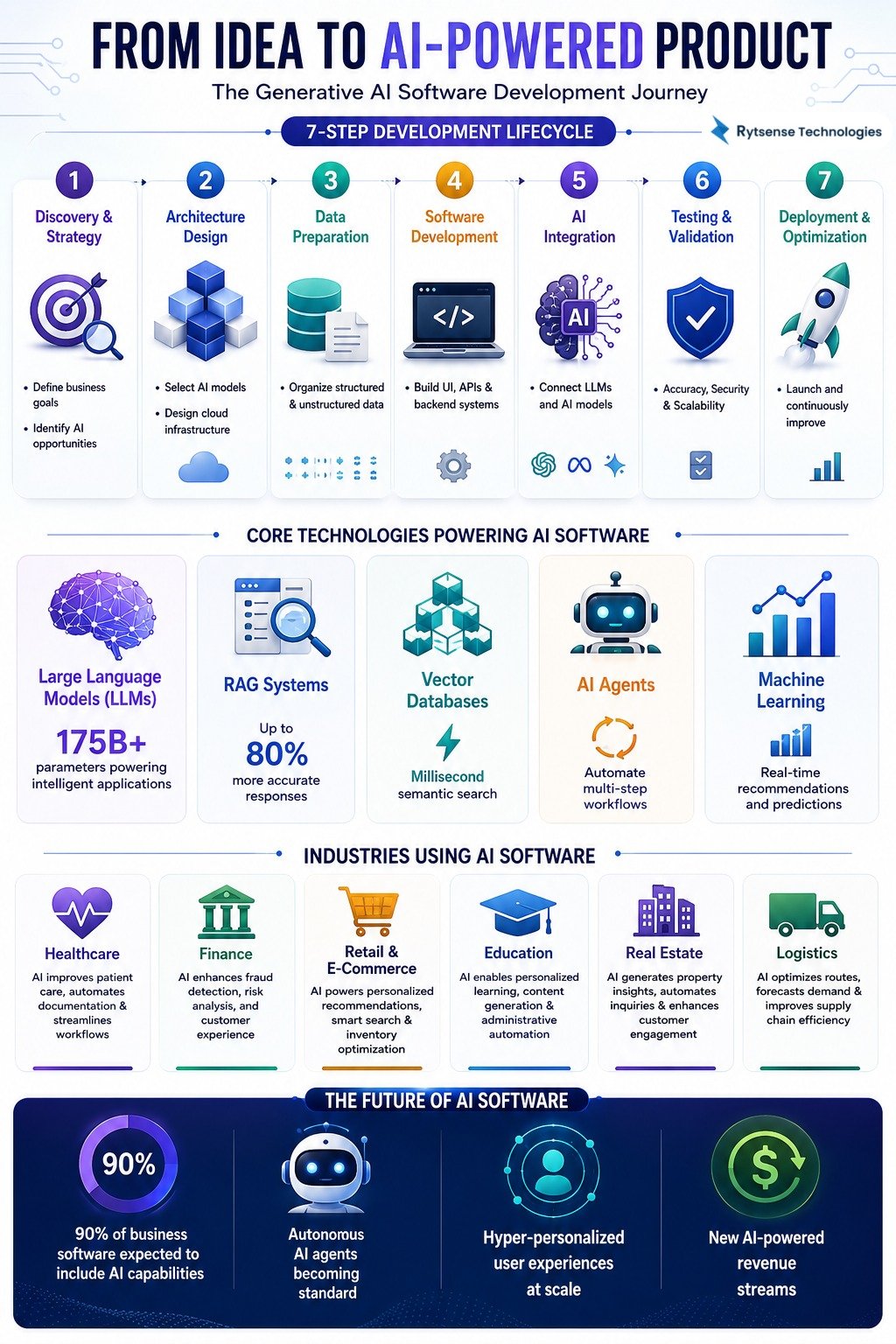
Key Technologies Behind Generative AI Software
Successful AI software development relies on several advanced technologies.
Large Language Models (LLMs)
Large Language Models serve as the foundation for generating text, answering questions, and understanding user intent.
Retrieval-Augmented Generation (RAG)
RAG enables AI systems to retrieve information from business data sources and provide accurate, context-aware responses.
Vector Databases
Vector databases help AI systems efficiently search and retrieve relevant information from large datasets
AI Agents
AI agents can perform tasks, make decisions, and interact with multiple systems with minimal human intervention.
Machine Learning Models
Machine learning enhances prediction, personalization, and automation capabilities within software applications.
Benefits of Generative AI Software Development Services
Enhanced User Experience
AI-powered software creates more intuitive and personalized interactions, helping users accomplish tasks more efficiently.
Increased Productivity
Automation reduces manual work and allows teams to focus on higher-value activities.
Faster Decision-Making
AI can analyze information and provide recommendations in real time.
Scalability
AI software can handle increasing workloads without requiring significant operational expansion.
Competitive Advantage
Organizations that incorporate AI into their products can offer innovative features that differentiate them from competitors.
Generative AI Software Development Process
Discovery and Requirement Analysis
The development process begins by identifying business goals, target users, and AI opportunities.
AI Strategy and Architecture Design
Teams define the technology stack, AI models, and system architecture required for the project.
Data Preparation
Relevant data is collected, organized, and prepared to support AI functionality.
Software Development
Developers build application features, user interfaces, APIs, and backend infrastructure.
AI Integration
Generative AI models are integrated into the software to deliver intelligent capabilities.
Testing and Validation
Applications are tested for performance, accuracy, security, and scalability.
Deployment and Continuous Improvement
After launch, software performance is monitored and optimized based on user feedback and business requirements.
Industries Leveraging Generative AI Software
Healthcare
AI-powered applications support patient engagement, medical documentation, and healthcare workflows.
Finance
Financial organizations use AI software for reporting, customer service, and data analysis.
Retail and E-Commerce
AI enhances shopping experiences through recommendations, search, and customer support.
Education
Educational platforms use AI to create personalized learning experiences and automate content generation.
Real Estate
AI software helps generate property descriptions, manage inquiries, and improve customer engagement.
Logistics
Logistics companies use AI applications to improve planning, communication, and operational efficiency.
How to Choose a Generative AI Software Development Company
When selecting a development partner, consider:
- Experience in Generative AI development
- Expertise in AI frameworks and technologies
- Custom software development capabilities
- Security and compliance practices
- Scalability and long-term support
- Industry-specific experience
A strong development partner can help transform an idea into a reliable and scalable AI-powered software product.
Future of AI-Powered Software
The next generation of software will be increasingly conversational, intelligent, and proactive. Instead of simply responding to user commands, AI-powered applications will assist users, automate workflows, and provide actionable insights.
Businesses investing in generative AI software today are laying the foundation for future innovation and digital growth.
Conclusion
Generative AI Software Development Services enable organizations to build intelligent software products that improve user experiences, automate tasks, and create new business opportunities. Whether developing an AI-powered SaaS platform, virtual assistant, content generation system, or productivity tool, generative AI can help businesses deliver more value through innovative software solutions.
Meet the Author

Co-Founder, Rytsense Technologies
Karthik is the Co-Founder of Rytsense Technologies, where he leads cutting-edge projects at the intersection of Data Science and Generative AI. With nearly a decade of hands-on experience in data-driven innovation, he has helped businesses unlock value from complex data through advanced analytics, machine learning, and AI-powered solutions. Currently, his focus is on building next-generation Generative AI applications that are reshaping the way enterprises operate and scale. When not architecting AI systems, Karthik explores the evolving future of technology, where creativity meets intelligence.