Key Takeaways
- Custom LLMs are trained on proprietary business data for higher accuracy and relevance.
- They offer greater control over security, compliance, and data governance.
- Fine-tuning existing models is often faster and more cost-effective than training from scratch.
- Private deployment options include on-premise, private cloud, and hybrid environments.
- Industries such as healthcare, finance, legal, manufacturing, and SaaS benefit significantly from custom LLMs.
- Development costs vary based on model complexity, infrastructure, and deployment requirements.
- Custom language models provide long-term competitive advantages through industry-specific intelligence.
- Partnering with an experienced custom LLM development company helps reduce implementation risks and accelerate ROI.
Artificial intelligence is moving beyond generic chatbot integrations. Many organizations now need AI systems that understand their industry, terminology, workflows, and proprietary knowledge.
While public large language models (LLMs) can handle general tasks, they often struggle with domain-specific requirements, strict compliance standards, and private business data. This is why enterprises increasingly partner with a Custom LLM Development Company USA to build tailored AI models designed for their unique needs.
From healthcare providers managing clinical documentation to financial institutions analyzing sensitive data, custom language models provide greater control, accuracy, security, and long-term value than one-size-fits-all AI solutions.
In this guide, we'll explore what custom LLM development involves, when businesses should consider it, associated costs, challenges, and how to choose the right development partner.
What Is Custom LLM Development?
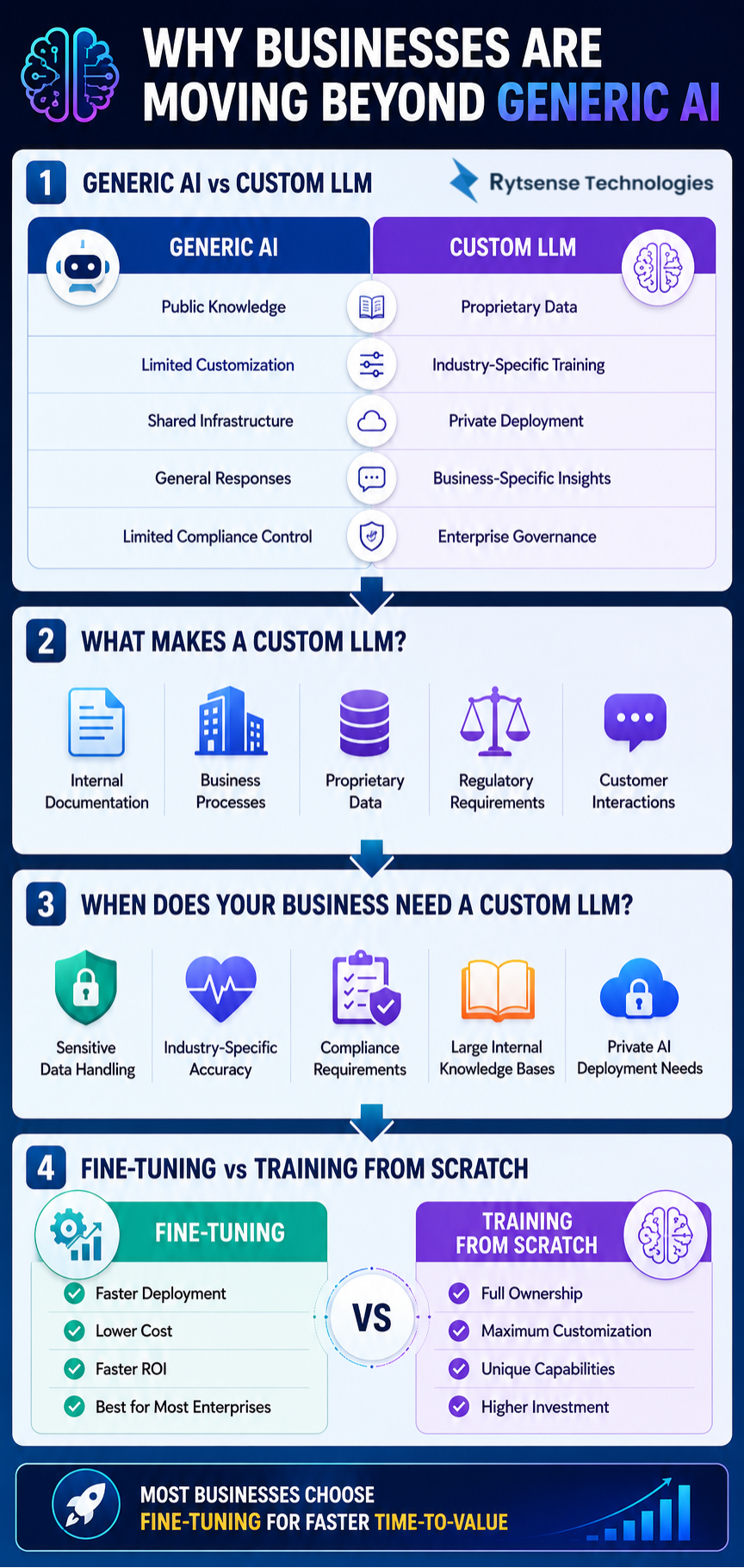
Custom LLM development refers to creating, training, fine-tuning, or optimizing large language models specifically for a business or industry.
Instead of relying solely on publicly available models, organizations build AI systems that understand:
- Internal documentation
- Industry terminology
- Business processes
- Proprietary datasets
- Regulatory requirements
- Customer interactions
These models can be trained from scratch or adapted from existing foundation models to achieve better performance in specialized tasks.
Key Components of Custom LLM Development
- Data collection and preparation
- Model architecture selection
- Fine-tuning on proprietary datasets
- Knowledge base integration
- Security and governance implementation
- Deployment and monitoring
- Continuous model optimization
The result is a highly specialized AI system capable of producing more relevant and accurate outputs than general-purpose models.
Custom LLM vs GPT API Integration
Many organizations begin their AI journey using GPT APIs. While API-based solutions are suitable for general applications, they have limitations when dealing with specialized business requirements.
| Factor | GPT API Integration | Custom LLM Development |
|---|---|---|
| Setup Time | Fast | Longer |
| Customization | Limited | Extensive |
| Data Privacy | Depends on provider | Full control |
| Domain Expertise | General knowledge | Industry-specific |
| Compliance Control | Limited | High |
| Infrastructure Ownership | Provider-owned | Business-owned |
| Long-Term Flexibility | Moderate | High |
GPT API Integration Works Best For
- Customer support chatbots
- Content generation
- Internal productivity tools
- General automation
Custom LLM Development Works Best For
- Enterprise knowledge systems
- Medical AI assistants
- Financial analysis platforms
- Legal document processing
- Research automation
- Secure internal AI systems
Organizations handling sensitive information often choose private LLM development to maintain complete control over their data and infrastructure.
When Does Your Business Need a Custom LLM?
Not every company needs a custom model. However, there are situations where building a tailored AI solution becomes essential.
Your Business Uses Proprietary Data
If your competitive advantage comes from unique datasets, a custom model can learn from information unavailable to public AI systems.
Industry Accuracy Is Critical
Sectors like healthcare, finance, and legal services require highly accurate outputs that general models may not consistently provide.
Strict Compliance Requirements Exist
Organizations subject to regulations often need greater visibility into how AI processes and stores data.
Internal Knowledge Is Complex
Large enterprises frequently maintain thousands of documents, SOPs, manuals, and policies that generic models cannot fully understand.
AI Must Operate in Private Environments
Many organizations prefer on-premise or private cloud deployments to meet security and governance requirements.
Fine-Tuning vs Training From Scratch
One of the biggest decisions in custom language model development is whether to fine-tune an existing model or build one from scratch.
Fine-Tuning Existing Models
Fine-tuning involves adapting a pre-trained foundation model using industry-specific or company-specific datasets.
Benefits
- Faster implementation
- Lower development costs
- Reduced computational requirements
- Faster ROI
Best For
- Enterprise chatbots
- Knowledge assistants
- Customer support automation
- Document analysis
Training From Scratch
Training a model from scratch involves building a new foundation model using extensive datasets and computational resources.
Benefits
- Full ownership
- Complete customization
- Unique model capabilities
- Maximum flexibility
Best For
- Large enterprises
- Research organizations
- Specialized industries
- Proprietary AI products
For most organizations, LLM fine-tuning services offer the most practical path to deployment.
Private LLM Development for Enterprises
Data security remains one of the primary concerns in enterprise AI adoption.
Private LLM development enables organizations to deploy models within their own infrastructure while maintaining complete control over:
- Data storage
- Model access
- Security policies
- Governance frameworks
- Compliance requirements
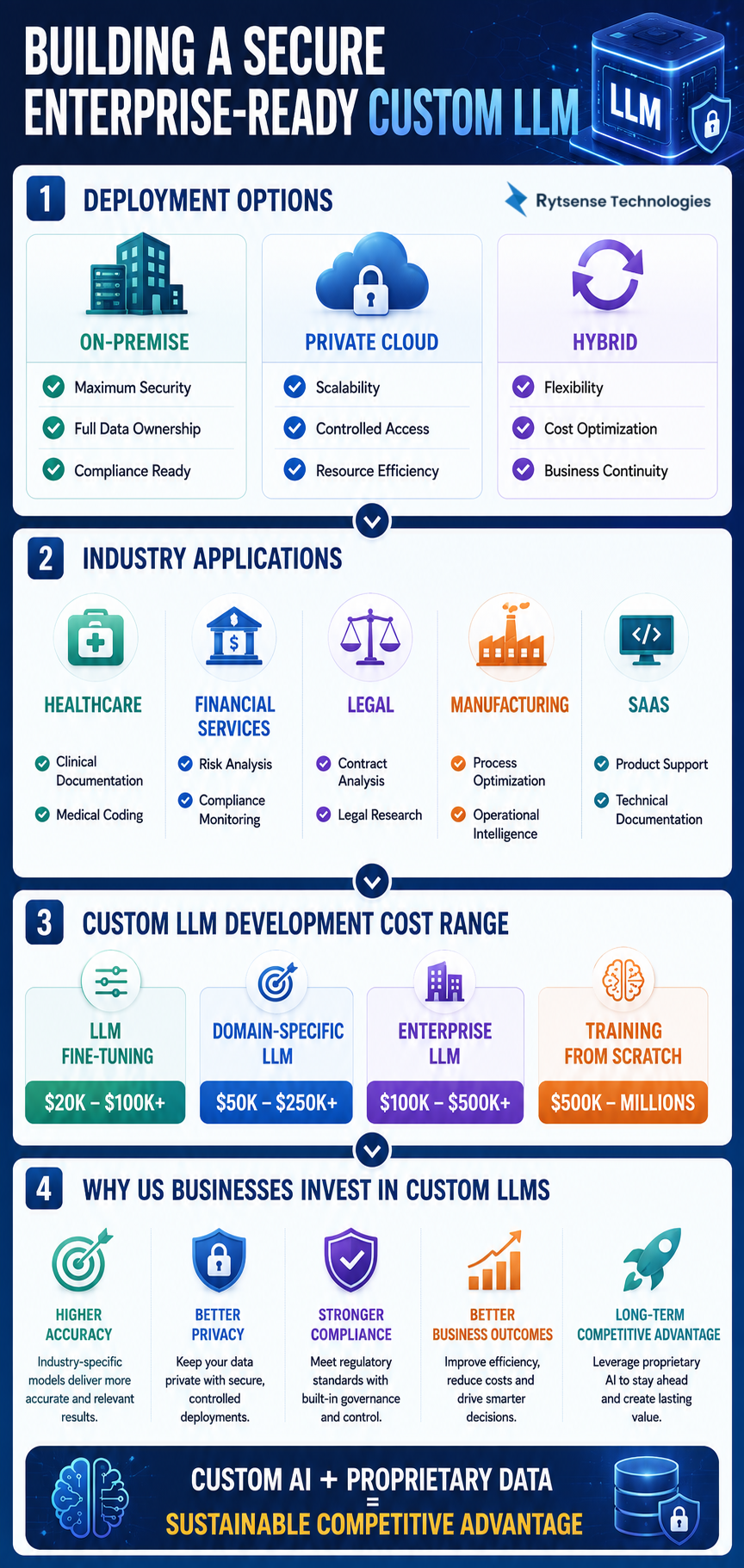
Common Deployment Options
On-Premise Deployment
The model runs entirely within company-owned infrastructure.
Benefits:
- Maximum security
- Full data ownership
- Regulatory compliance
- Minimal third-party dependency
Private Cloud Deployment
The model operates within a dedicated cloud environment.
Benefits:
- Scalability
- Enhanced security
- Better resource management
- Controlled access
Hybrid Deployment
Combines on-premise and cloud resources.
Benefits:
- Flexibility
- Cost optimization
- Business continuity
- Scalability
Industry-Specific LLM Applications
Healthcare
Healthcare organizations use domain specific LLM solutions for:
- Clinical documentation
- Medical coding
- Patient communication
- Research analysis
- Healthcare knowledge management
Financial Services
Financial institutions deploy custom models for:
- Risk analysis
- Compliance monitoring
- Fraud detection support
- Investment research
- Financial reporting
SaaS Companies
Software companies leverage custom language models for:
- Product support automation
- Technical documentation
- User onboarding
- Developer assistance
- Customer success operations
Manufacturing
Manufacturers use enterprise LLM systems for:
- Maintenance documentation
- Process optimization
- Quality management
- Operational intelligence
Legal Services
Law firms and legal departments implement custom models for:
- Contract analysis
- Legal research
- Case documentation
- Regulatory compliance
Cost of Custom LLM Development
The cost of building a custom language model depends on several factors.
Key Cost Drivers
Data Preparation
High-quality datasets require:
- Collection
- Cleaning
- Annotation
- Validation
Model Complexity
Larger models require more:
- Compute resources
- Storage
- Engineering effort
Infrastructure
Costs vary based on:
- Cloud deployment
- Private cloud environments
- On-premise infrastructure
Fine-Tuning Requirements
Additional training cycles increase overall project costs.
Typical Investment Range
| Project Type | Estimated Range |
|---|---|
| LLM Fine-Tuning | $20,000 – $100,000+ |
| Domain-Specific LLM | $50,000 – $250,000+ |
| Enterprise LLM Development | $100,000 – $500,000+ |
| Training From Scratch | $500,000 – Several Million Dollars |
Actual costs vary significantly based on business objectives, model size, and deployment requirements.
Challenges of Building Enterprise LLMs
Custom AI projects can deliver substantial value, but they also present technical and operational challenges.
Data Quality Issues
Poor-quality datasets can reduce model performance.
Infrastructure Requirements
Training and deploying large models require significant computing resources.
Security Risks
Organizations must implement robust controls to protect sensitive information.
Model Hallucinations
Even advanced models can occasionally generate incorrect outputs.
Regulatory Compliance
Businesses operating in regulated sectors must ensure adherence to legal requirements.
Ongoing Maintenance
Models require continuous monitoring, retraining, and optimization.
Partnering with an experienced enterprise LLM development provider helps mitigate many of these risks.
How to Choose a Custom LLM Development Company
Selecting the right development partner plays a major role in project success.
Evaluate Technical Expertise
Look for experience in:
- Custom language models
- LLM fine-tuning
- RAG architectures
- Enterprise AI systems
Review Industry Experience
A company familiar with your industry can accelerate implementation and improve outcomes.
Assess Security Capabilities
Ensure the provider supports:
- Private deployment
- Data governance
- Access controls
- Compliance frameworks
Examine Deployment Options
Choose a partner capable of supporting:
- On-premise deployment
- Private cloud deployment
- Hybrid environments
Verify Post-Deployment Support
Successful LLM implementations require ongoing optimization and maintenance.
Why US Businesses Are Investing in Custom Language Models
As AI adoption matures, organizations increasingly recognize the limitations of generic AI systems.
Custom language models offer:
- Greater accuracy
- Enhanced privacy
- Better compliance
- Industry-specific intelligence
- Improved business outcomes
- Long-term competitive advantages
For enterprises seeking secure, scalable, and highly specialized AI solutions, partnering with a Custom LLM Development Company USA provides a practical path toward building AI systems aligned with business goals.
Conclusion
The future of enterprise AI lies in customization. Businesses no longer want generic AI tools that provide broad answers. They need intelligent systems trained on their own knowledge, optimized for their workflows, and deployed according to their security requirements.
Whether through private LLM development, LLM fine-tuning services, or fully customized enterprise models, organizations can create AI solutions that deliver measurable business value while maintaining control over data and infrastructure.
As demand for industry-specific AI continues to grow, investing in custom language models can help businesses build sustainable competitive advantages and unlock new opportunities for innovation.
Meet the Author

Co-Founder, Rytsense Technologies
Karthik is the Co-Founder of Rytsense Technologies, where he leads cutting-edge projects at the intersection of Data Science and Generative AI. With nearly a decade of hands-on experience in data-driven innovation, he has helped businesses unlock value from complex data through advanced analytics, machine learning, and AI-powered solutions. Currently, his focus is on building next-generation Generative AI applications that are reshaping the way enterprises operate and scale. When not architecting AI systems, Karthik explores the evolving future of technology, where creativity meets intelligence.