Key Takeaways
- Machine learning software development services cover the complete lifecycle, from business discovery to deployment and ongoing optimization.
- High-quality data preparation is essential for building accurate and reliable machine learning models.
- End-to-end development improves scalability, reduces implementation risks, and accelerates time to value.
- Continuous monitoring and MLOps ensure machine learning models remain accurate as data and business conditions evolve.
- Industries such as healthcare, finance, retail, manufacturing, logistics, and insurance are using machine learning to improve efficiency and drive innovation.
- Choosing an experienced development partner with expertise in data engineering, deployment, security, and governance increases the likelihood of long-term project success.
- Businesses that treat machine learning as a continuous improvement process are better positioned to achieve sustainable growth and competitive advantage.
Introduction
Machine learning is no longer an experimental technology reserved for large enterprises. Businesses of every size are using machine learning to automate operations, improve customer experiences, predict outcomes, and make faster, data-driven decisions. However, building a successful machine learning solution requires much more than creating an algorithm. It involves understanding business objectives, preparing high-quality data, selecting the right models, deploying them into production, and continuously monitoring their performance.
This is where machine learning software development services play a vital role. These services help organizations transform raw data into intelligent applications that solve real business challenges. Instead of focusing only on model development, experienced development teams manage the complete lifecycle, from strategy and data engineering to deployment and optimization.
Many organizations invest in artificial intelligence initiatives but fail to achieve measurable outcomes because they overlook essential stages such as data preparation, infrastructure planning, governance, or post-deployment monitoring. A structured development approach minimizes these risks while improving model accuracy, scalability, and return on investment.
Whether you're a startup building your first AI-powered product or an enterprise modernizing business operations, understanding the end-to-end machine learning development process can help you make informed technology decisions.
This guide explains how machine learning software development services work, what happens during each development phase, the benefits they provide, common implementation challenges, and how to select the right development partner for long-term success.
What Are Machine Learning Software Development Services?
Machine learning software development services encompass the design, development, deployment, and maintenance of intelligent software applications that learn from data and improve performance over time. Unlike traditional software that follows predefined rules, machine learning systems identify patterns, make predictions, and continuously improve using historical and real-time data.
A complete machine learning development service typically includes:
- Business requirement analysis
- Data collection and preparation
- Feature engineering
- Model selection and training
- Model validation
- Deployment into production
- Performance monitoring
- Continuous optimization
- Security and governance
Rather than delivering only an AI model, experienced development teams create production-ready systems that integrate with existing business applications, cloud environments, APIs, and enterprise workflows.
The goal is not simply to build an intelligent model but to create a scalable business solution that delivers measurable value.
Why Businesses Are Investing in Machine Learning
Organizations generate massive amounts of data every day. Without machine learning, much of this information remains underutilized. Machine learning converts raw business data into actionable insights that improve efficiency and decision-making.
Businesses invest in machine learning to:
Improve Decision-Making
Machine learning analyzes historical and real-time data to identify patterns that humans may overlook. These insights help organizations make faster and more informed decisions.
Automate Repetitive Processes
Tasks such as document classification, customer support, fraud detection, invoice processing, and inventory forecasting can be automated, reducing manual effort and operational costs.
Enhance Customer Experience
Machine learning enables personalized product recommendations, intelligent chatbots, predictive support, and customized marketing campaigns that improve customer engagement.
Predict Future Outcomes
Predictive analytics helps organizations forecast sales, estimate customer demand, identify maintenance requirements, and anticipate potential business risks.
Reduce Operational Costs
Automation and predictive capabilities minimize errors, reduce downtime, optimize resource allocation, and improve operational efficiency.
Gain Competitive Advantage
Organizations adopting machine learning often respond faster to market changes, improve innovation, and deliver better customer experiences than competitors relying solely on traditional analytics.
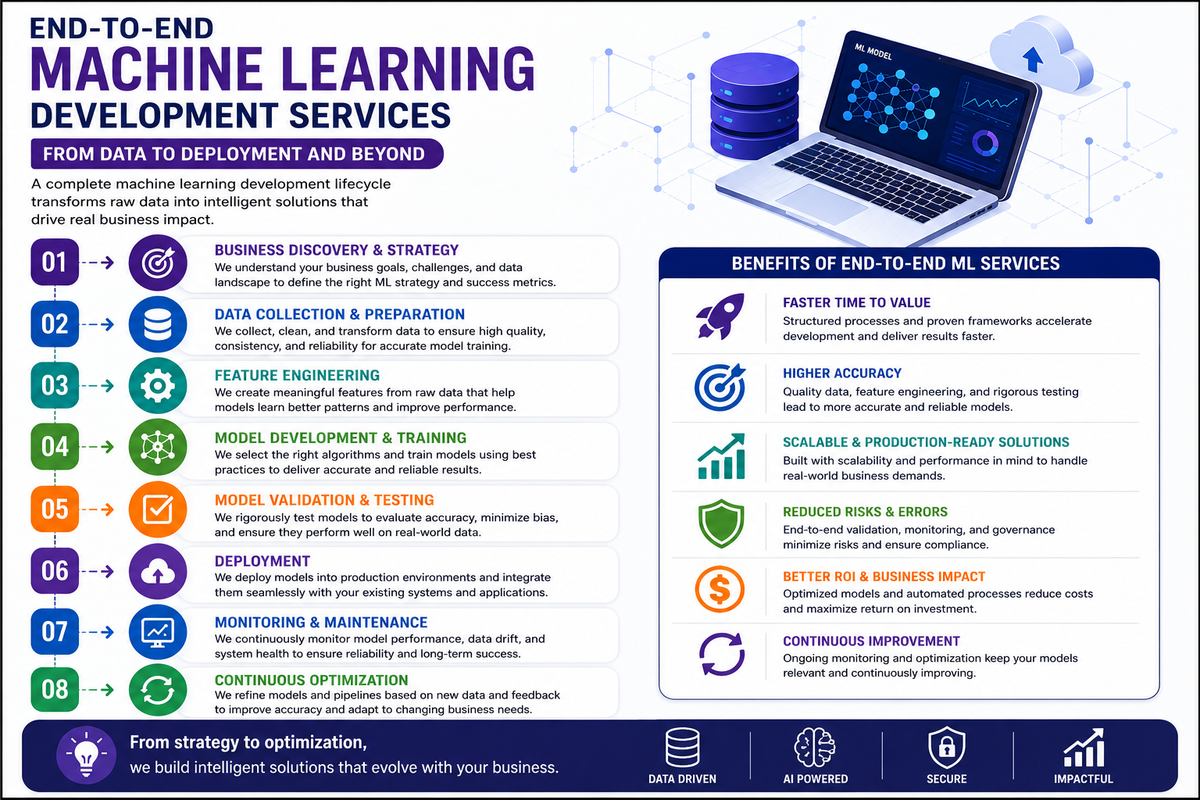
The Complete Machine Learning Development Lifecycle
Successful machine learning projects follow a structured lifecycle rather than jumping directly into model development.
1. Business Discovery and Requirement Analysis
Every successful project begins with understanding the business problem.
Instead of asking, "Which algorithm should we use?", experienced ML consultants ask:
- What business challenge needs solving?
- What outcome defines success?
- What data is currently available?
- How will the model integrate into existing workflows?
- What KPIs will measure project success?
Clearly defining objectives ensures that development efforts align with measurable business goals rather than technical experimentation.
For example, an eCommerce company may aim to increase product recommendations, while a healthcare provider may focus on improving disease prediction accuracy.
2. Data Collection
Data serves as the foundation of every machine learning system.
Development teams collect information from multiple sources, including:
- CRM platforms
- ERP systems
- IoT devices
- Cloud databases
- Mobile applications
- Web applications
- Customer interactions
- Third-party APIs
The quality, diversity, and relevance of collected data directly influence model performance.
Even the most sophisticated algorithms cannot compensate for incomplete or inaccurate datasets.
3. Data Preparation and Cleaning
Raw data rarely arrives in a usable format.
Before training begins, developers clean and prepare datasets by:
- Removing duplicate records
- Handling missing values
- Correcting inconsistencies
- Eliminating outliers
- Standardizing formats
- Labeling training data
- Balancing datasets
- Transforming features
Industry experts often estimate that data preparation consumes the majority of effort in machine learning projects because clean data significantly improves prediction accuracy.
4. Feature Engineering
Feature engineering transforms raw variables into meaningful inputs that help machine learning algorithms recognize patterns more effectively.
Examples include:
- Customer lifetime value
- Purchase frequency
- Average transaction amount
- Time-based trends
- Behavioral indicators
- Sensor-derived metrics
Well-designed features often contribute more to model performance than switching between different algorithms.
5. Model Development
Once the dataset is prepared, machine learning engineers begin building predictive models.
Depending on project requirements, teams may develop:
- Classification models
- Regression models
- Recommendation engines
- Computer vision solutions
- Natural language processing systems
- Anomaly detection models
- Forecasting systems
Multiple algorithms are typically evaluated to identify the most suitable solution based on accuracy, speed, interpretability, and scalability.
Hyperparameter tuning and iterative experimentation further improve model performance before deployment.
6. Model Validation and Performance Evaluation
Developing a machine learning model is only half the journey. Before deployment, every model must undergo rigorous validation to ensure it performs reliably on unseen data. A model that performs well during training may fail in real-world scenarios if it has learned patterns that are too specific to the training dataset.
Machine learning engineers evaluate models using various performance metrics based on the use case. For example, classification models are assessed using precision, recall, F1-score, and accuracy, while regression models are evaluated using Mean Absolute Error (MAE), Root Mean Square Error (RMSE), and R² scores.
Beyond performance metrics, validation also includes:
- Cross-validation to test model stability
- Bias and fairness assessment
- Error analysis
- Explainability testing
- Security validation
- Compliance checks
For regulated industries such as healthcare, banking, and insurance, model explainability is just as important as prediction accuracy. Decision-makers need to understand how a model arrives at its predictions to ensure transparency and regulatory compliance.
A well-validated model minimizes business risks and increases stakeholder confidence before production deployment.
7. Model Deployment
A machine learning model creates value only when it becomes part of everyday business operations. Deployment is the process of integrating the trained model into production environments where it can process live data and generate predictions in real time or batch mode.
Depending on business needs, deployment can occur through:
- Cloud platforms
- Web applications
- Mobile applications
- REST APIs
- Enterprise software
- Edge devices
- IoT infrastructure
Modern deployment pipelines use containerization technologies like Docker and orchestration platforms such as Kubernetes to improve scalability, reliability, and portability across environments.
Organizations also implement CI/CD (Continuous Integration and Continuous Deployment) pipelines for machine learning, commonly referred to as MLOps. These pipelines automate testing, deployment, version control, and rollback processes, enabling faster updates while reducing operational risks.
Successful deployment ensures that machine learning models integrate seamlessly with existing workflows and continue delivering business value without disrupting day-to-day operations.
8. Monitoring and Continuous Improvement
Deployment is not the end of the machine learning lifecycle. Once a model is live, its performance must be continuously monitored to maintain accuracy and relevance.
Over time, changes in customer behavior, market trends, or business processes can cause model drift, where prediction quality gradually declines. Without ongoing monitoring, businesses may rely on outdated predictions that negatively impact decision-making.
Continuous monitoring involves tracking:
- Prediction accuracy
- Data quality
- Latency and response time
- Resource utilization
- Error rates
- User feedback
- Business KPIs
When performance drops below acceptable thresholds, data scientists retrain the model using fresh datasets, refine features, or optimize algorithms. This iterative approach ensures the model continues delivering reliable results as business conditions evolve.
Organizations that adopt continuous monitoring and improvement often achieve better long-term ROI from their machine learning investments.
Key Technologies Used in Machine Learning Software Development
Modern machine learning solutions rely on a combination of programming languages, frameworks, cloud platforms, and data engineering tools. Choosing the right technology stack depends on project complexity, scalability requirements, and deployment goals.
Programming Languages
Python remains the preferred language for machine learning due to its simplicity and extensive ecosystem. Other languages such as R, Java, Scala, and C++ are also used in specific scenarios requiring statistical analysis or high-performance computing.
Machine Learning Frameworks
Popular frameworks include:
- TensorFlow
- PyTorch
- Scikit-learn
- XGBoost
- LightGBM
- Keras
These frameworks simplify model development, training, testing, and deployment.
Cloud Platforms
Cloud infrastructure enables organizations to scale machine learning workloads without investing heavily in on-premises hardware.
Common cloud environments include:
- AWS
- Microsoft Azure
- Google Cloud Platform
Cloud services provide managed machine learning environments, GPU resources, automated deployment pipelines, and integrated monitoring capabilities.
Data Engineering Tools
Reliable data pipelines are essential for maintaining high-quality datasets. Technologies such as Apache Spark, Apache Kafka, Airflow, and Snowflake help organizations process, transform, and manage large volumes of structured and unstructured data.
MLOps Platforms
MLOps tools streamline the deployment and maintenance of machine learning models.
Common platforms include:
- MLflow
- Kubeflow
- Vertex AI
- SageMaker
- Azure Machine Learning
These platforms simplify version control, experimentation, deployment automation, and monitoring.
Industries Benefiting from Machine Learning Software Development Services
Machine learning is transforming nearly every industry by enabling organizations to make smarter decisions and automate complex processes.
Healthcare
Healthcare providers use machine learning for disease prediction, medical image analysis, patient risk assessment, treatment recommendations, and operational optimization.
Financial Services
Banks and financial institutions leverage machine learning for fraud detection, credit scoring, algorithmic trading, anti-money laundering, and personalized financial recommendations.
Retail and E-commerce
Retailers use intelligent recommendation systems, inventory forecasting, customer segmentation, demand prediction, and dynamic pricing to improve customer experiences and increase revenue.
Manufacturing
Manufacturers implement predictive maintenance, quality inspection, production forecasting, and supply chain optimization to reduce downtime and improve operational efficiency.
Logistics and Transportation
Machine learning supports route optimization, fleet management, demand forecasting, warehouse automation, and predictive maintenance for transportation networks.
Education
Educational institutions use intelligent tutoring systems, student performance prediction, automated grading, and personalized learning experiences.
Insurance
Insurance companies apply machine learning to claims processing, fraud detection, underwriting, customer retention, and risk assessment.
Telecommunications
Telecom providers optimize network performance, predict equipment failures, detect anomalies, and improve customer service using machine learning-powered analytics.
Across industries, organizations increasingly view machine learning as a strategic capability rather than a standalone technology initiative.
Benefits of Machine Learning Software Development Services
Investing in machine learning is about more than adopting advanced technology. It is about creating measurable business value through automation, predictive intelligence, and smarter decision-making. Organizations that implement machine learning successfully often see improvements across productivity, customer satisfaction, operational efficiency, and long-term growth.
1. Faster and Smarter Decision-Making
Machine learning analyzes large volumes of structured and unstructured data much faster than traditional analytical methods. Instead of relying solely on historical reports, businesses gain real-time insights that support quicker and more accurate decisions.
For example, sales teams can forecast customer demand, finance departments can identify spending trends, and operations managers can optimize resources based on predictive insights.
2. Improved Operational Efficiency
Many repetitive and time-consuming business processes can be automated using machine learning. Tasks such as document classification, invoice processing, customer support, quality inspection, and inventory management require less manual effort, allowing employees to focus on strategic work.
Automation also reduces processing time, minimizes human errors, and improves overall productivity.
3. Personalized Customer Experiences
Modern customers expect personalized interactions across every touchpoint. Machine learning helps businesses understand customer behavior, preferences, and purchasing patterns.
With intelligent recommendation systems, personalized marketing campaigns, and AI-powered chatbots, organizations can deliver experiences that increase engagement, improve customer satisfaction, and encourage long-term loyalty.
4. Predictive Analytics for Better Planning
Instead of reacting to events after they occur, businesses can anticipate future outcomes through predictive analytics.
Machine learning models can forecast:
- Sales demand
- Equipment failures
- Customer churn
- Inventory requirements
- Financial risks
- Market trends
These insights enable organizations to plan proactively, reduce uncertainty, and make informed business decisions.
5. Scalability for Growing Businesses
As businesses expand, the volume of data they generate also increases. Machine learning solutions are designed to scale with growing datasets and evolving business requirements.
Whether processing thousands or millions of transactions, modern machine learning systems can handle increasing workloads while maintaining performance and reliability.
6. Reduced Business Risks
Machine learning identifies patterns and anomalies that may indicate fraud, cybersecurity threats, operational issues, or compliance risks.
Early detection allows organizations to respond quickly, reducing financial losses and protecting sensitive business information.
7. Continuous Learning and Improvement
Unlike traditional software, machine learning models improve as they receive new data. Continuous monitoring and retraining help systems adapt to changing customer behavior, market conditions, and business requirements.
This ability to evolve ensures long-term value and sustained business performance.
Common Challenges in Machine Learning Development
While machine learning offers significant opportunities, successful implementation requires overcoming several technical and organizational challenges.
Poor Data Quality
Machine learning models depend heavily on accurate, complete, and relevant data. Missing values, duplicate records, inconsistent formats, and outdated information can reduce model accuracy.
Solution: Establish strong data governance practices, implement automated validation processes, and invest in robust data engineering before model development begins.
Lack of Skilled Talent
Building production-ready machine learning systems requires expertise across multiple disciplines, including data science, software engineering, cloud architecture, DevOps, and MLOps.
Many organizations struggle to hire professionals with experience in all these areas.
Solution: Partner with an experienced machine learning software development company that provides cross-functional expertise throughout the project lifecycle.
Integration with Existing Systems
Many organizations operate on legacy systems that were not designed to support AI or machine learning.
Integrating intelligent models with ERP platforms, CRM systems, databases, and business applications can be complex.
Solution: Use API-first architectures, cloud-native services, and modular development approaches to simplify integration and reduce disruption.
Model Drift
Customer behavior, market trends, and business environments change over time. As these changes occur, model performance may decline if the system continues using outdated training data.
Solution: Implement continuous monitoring, automated alerts, scheduled retraining, and performance evaluation to maintain prediction accuracy.
Security and Compliance
Machine learning systems often process sensitive customer and business data. Organizations must comply with regulations while protecting information from unauthorized access.
Solution: Implement encryption, secure authentication, access controls, audit logs, and compliance frameworks throughout the development lifecycle.
How to Choose the Right Machine Learning Software Development Partner
Selecting the right development partner has a significant impact on project success. Beyond technical expertise, businesses should look for a team that understands industry-specific challenges, follows proven development methodologies, and provides long-term support.
When evaluating a potential partner, consider the following:
Industry Experience
Choose a company with experience delivering machine learning solutions for businesses similar to yours. Industry knowledge helps teams understand regulatory requirements, common challenges, and practical use cases.
End-to-End Development Capabilities
Some providers focus only on model development, while others manage the entire lifecycle—from strategy and data engineering to deployment, monitoring, and optimization.
An end-to-end approach reduces coordination challenges and ensures accountability throughout the project.
Strong Data Engineering Expertise
Successful machine learning projects depend on clean, well-structured data. Assess whether the development team has experience building scalable data pipelines and managing large datasets.
MLOps and Deployment Expertise
Developing a model is only part of the process. Your partner should also be skilled in deploying models, automating workflows, monitoring performance, and managing production environments.
Security and Governance
Ensure the provider follows industry best practices for data security, privacy, and compliance. Organizations handling sensitive information should prioritize partners with experience implementing governance frameworks and secure AI practices.
Scalability
Your business needs will evolve over time. Choose a partner capable of developing scalable architectures that can support future growth without requiring major system redesigns.
Transparent Communication
Successful machine learning projects require ongoing collaboration between business stakeholders and technical teams. A reliable partner provides clear project updates, realistic timelines, and measurable success metrics.
Why End-to-End Machine Learning Development Delivers Better Results
Organizations often underestimate the complexity of machine learning projects by focusing only on algorithm development. In reality, long-term success depends on how effectively every stage of the development lifecycle is managed.
An end-to-end approach ensures:
- Better alignment with business goals
- Higher-quality data preparation
- More accurate and reliable models
- Faster deployment into production
- Continuous monitoring and optimization
- Improved return on investment
- Reduced operational risks
- Easier scalability as business needs grow
Rather than treating machine learning as a one-time implementation, organizations should view it as a continuous process that evolves alongside their business.
The Future of Machine Learning Software Development
Machine learning continues to evolve as organizations demand more intelligent, scalable, and business-focused solutions. What once required large data science teams and months of development can now be accelerated through cloud-native platforms, automation tools, and advanced AI frameworks. However, the focus is no longer just on building models—it is on delivering measurable business outcomes.
As businesses generate increasing amounts of data, machine learning software development services will become even more important for transforming that data into actionable insights. Organizations that invest in modern ML solutions today will be better prepared to adapt to changing customer expectations, market conditions, and technological advancements.
Here are some trends shaping the future of machine learning development:
1. AutoML for Faster Development
Automated Machine Learning (AutoML) simplifies tasks such as data preprocessing, feature selection, model training, and hyperparameter tuning. While it does not replace experienced ML engineers, it helps reduce development time and allows teams to focus on solving business problems rather than repetitive technical tasks.
2. MLOps as a Standard Practice
As more machine learning models move into production, MLOps is becoming a core part of software development. Automated deployment pipelines, continuous monitoring, version control, and retraining workflows help organizations maintain reliable and scalable ML systems.
3. Responsible and Explainable AI
Businesses are increasingly expected to develop AI systems that are transparent, fair, and accountable. Explainable AI techniques help stakeholders understand how predictions are made, while governance frameworks ensure compliance with industry regulations and ethical standards.
4. Edge Machine Learning
Instead of processing all data in the cloud, edge machine learning enables intelligent models to run directly on mobile devices, IoT sensors, and industrial equipment. This reduces latency, improves real-time decision-making, and supports environments with limited internet connectivity.
5. Generative AI and Machine Learning Integration
Generative AI is complementing traditional machine learning by enabling intelligent content generation, code assistance, document summarization, and conversational interfaces. Organizations are increasingly combining predictive machine learning models with generative AI capabilities to create smarter business applications.
6. Industry-Specific AI Solutions
Rather than adopting generic AI tools, businesses are investing in machine learning solutions tailored to their specific industries. Healthcare providers, manufacturers, financial institutions, retailers, and logistics companies are developing custom models designed to address their unique operational challenges.
Conclusion
Machine learning has become a strategic business capability rather than an emerging technology. Organizations across industries are using machine learning to automate operations, improve customer experiences, optimize resources, and uncover valuable insights hidden within their data.
However, achieving meaningful results requires more than selecting the right algorithm. Success depends on managing the entire development lifecycle—from understanding business objectives and preparing high-quality data to building accurate models, deploying them into production, and continuously improving performance.
By partnering with an experienced machine learning software development company, businesses gain access to the technical expertise, data engineering capabilities, and deployment experience needed to deliver scalable, secure, and future-ready AI solutions. An end-to-end development approach not only reduces implementation risks but also ensures that machine learning initiatives generate measurable business value over the long term.
Whether your goal is to automate workflows, enhance decision-making, deliver personalized customer experiences, or build intelligent digital products, investing in comprehensive machine learning software development services can help transform your data into a competitive advantage.
Meet the Author

Co-Founder, Rytsense Technologies
Karthik is the Co-Founder of Rytsense Technologies, where he leads cutting-edge projects at the intersection of Data Science and Generative AI. With nearly a decade of hands-on experience in data-driven innovation, he has helped businesses unlock value from complex data through advanced analytics, machine learning, and AI-powered solutions. Currently, his focus is on building next-generation Generative AI applications that are reshaping the way enterprises operate and scale. When not architecting AI systems, Karthik explores the evolving future of technology, where creativity meets intelligence.