Key Takeaways
- AI workflow automation helps businesses automate repetitive processes using existing software and delivers faster implementation with lower upfront costs.
- Custom AI development creates AI solutions tailored to unique business requirements, proprietary data, and long-term scalability.
- Workflow automation is ideal for improving operational efficiency, while custom AI development is better suited for building competitive advantages and AI-powered products.
- The right choice depends on your business goals, process complexity, data maturity, budget, and future AI strategy, not just implementation cost.
- Many organizations achieve the best results by starting with AI workflow automation and gradually moving to custom AI development as their AI capabilities mature.
- Businesses should evaluate their workflows, integration needs, and expected ROI before selecting an AI implementation approach.
- A phased AI adoption strategy reduces implementation risk while providing measurable business value at every stage.
- Investing in the right AI approach today creates a stronger foundation for future digital transformation and enterprise growth.
AI Workflow Automation vs Full Custom AI Development: Where Should You Start?
Artificial intelligence is no longer a future investment. It has become a practical business tool for reducing operational costs, improving customer experiences, and helping teams make faster decisions.
The challenge for most organizations isn't deciding whether to adopt AI, it's deciding how to start.
Should you automate existing workflows using AI tools? Or should you invest in building a fully customized AI solution designed specifically for your business?
Many companies make the mistake of jumping into expensive custom development before validating their processes. Others rely on automation platforms for too long and eventually hit limitations that slow growth.
The right choice depends on your business maturity, data readiness, operational complexity, and long-term AI strategy.
This guide explains the differences between AI workflow automation and full custom AI development, the advantages and limitations of each, and a practical framework for choosing the right path.
What Is AI Workflow Automation?
AI workflow automation improves existing business processes by combining artificial intelligence with automation platforms.
Instead of replacing your software, AI becomes another layer that performs repetitive tasks, analyzes information, generates responses, or makes recommendations automatically.
Examples include:
- Automatically classifying incoming customer emails
- AI-powered invoice processing
- Lead qualification
- Document summarization
- Customer support chatbots
- Employee onboarding automation
- CRM updates
- Meeting transcription and action-item generation
These solutions usually integrate with software your business already uses, such as:
- CRM systems
- ERP platforms
- Email platforms
- Microsoft 365
- Google Workspace
- Slack
- Salesforce
- HubSpot
- SAP
The primary goal is improving efficiency without rebuilding your existing technology stack.
What Is Full Custom AI Development?
Custom AI development involves building AI applications specifically for your organization's requirements instead of adapting existing automation platforms.
Rather than connecting pre-built tools, developers design models, workflows, integrations, APIs, user experiences, and business logic around your unique processes.
Custom AI projects may include:
- AI-powered recommendation engines
- Healthcare diagnostic assistants
- Predictive maintenance systems
- Intelligent manufacturing optimization
- AI copilots for employees
- Financial fraud detection
- Personalized learning platforms
- Legal document intelligence
- Supply chain optimization
- Industry-specific generative AI applications
Unlike workflow automation, these solutions become part of your core business infrastructure.
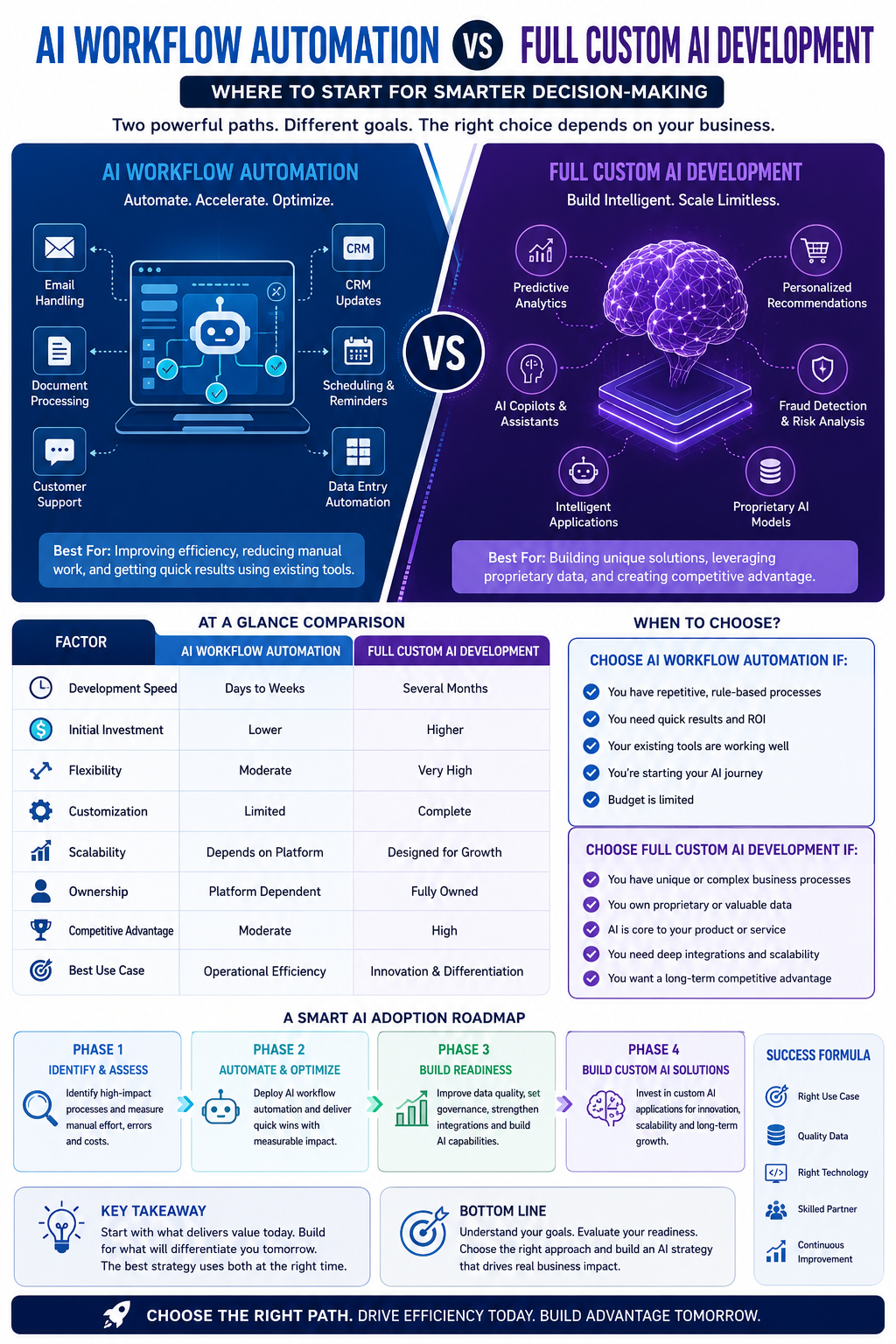
AI Workflow Automation vs Full Custom AI Development
| Factor | AI Workflow Automation | Full Custom AI Development |
|---|---|---|
| Development Speed | Days to weeks | Several months |
| Initial Investment | Lower | Higher |
| Flexibility | Moderate | Very High |
| Business Customization | Limited | Complete |
| Scalability | Depends on platform | Designed for growth |
| Competitive Advantage | Moderate | High |
| Ownership | Platform dependent | Fully owned |
| Competitive Advantage | Moderate | High |
| Ownership | Platform dependent | Fully owned |
| Integration Depth | Standard connectors | Deep system integration |
| AI Model Customization | Limited | Fully customizable |
| Long-Term ROI | Good | Often significantly higher |
The decision should not be based only on cost. It should be based on how important AI will become to your business over the next three to five years.
When AI Workflow Automation Is the Better Starting Point
AI workflow automation works best when the objective is operational improvement rather than product innovation.
Consider automation first if your organization has:
Repetitive Manual Processes
Teams spend hours performing predictable work such as:
- Copying data between systems
- Reviewing documents
- Responding to routine customer inquiries
- Updating spreadsheets
- Processing forms
- Scheduling appointments
AI automation can remove much of this manual effort quickly.
Existing Software That Already Works Well
If your CRM, ERP, or internal applications meet your business needs, there may be no reason to replace them.
Instead, AI can extend these systems by adding intelligent automation without disrupting operations.
Limited Internal AI Experience
Organizations beginning their AI journey often benefit from smaller automation projects before investing in enterprise-scale AI development.
This approach allows teams to understand:
- Data quality
- User adoption
- Process optimization
- AI governance
- Change management
before expanding into larger initiatives.
Fast ROI Requirements
Workflow automation projects usually produce measurable improvements within weeks.
Common results include:
- Faster response times
- Reduced manual effort
- Fewer processing errors
- Lower operational costs
- Higher employee productivity
These early successes often help secure executive support for broader AI initiatives.
When Full Custom AI Development Makes More Sense
Automation platforms have limits.
As organizations grow, they often require capabilities that cannot be achieved through pre-built workflows.
Custom AI development becomes the better investment when AI directly supports competitive differentiation.
Your Business Has Unique Processes
Many industries operate with specialized workflows that generic AI platforms cannot fully understand.
Examples include:
- Healthcare clinical workflows
- Insurance claims evaluation
- Manufacturing quality inspection
- Legal contract analysis
- Pharmaceutical research
- Industrial maintenance
Custom AI solutions are built around these domain-specific requirements.
You Need Proprietary Intelligence
If your company owns valuable business data, custom AI allows you to build models trained around your proprietary knowledge.
Examples include:
- Internal documentation
- Historical customer interactions
- Product knowledge
- Technical manuals
- Research databases
- Operational metrics
This creates AI capabilities competitors cannot easily replicate.
AI Will Become Part of Your Product
Many SaaS companies now embed AI directly into customer-facing applications.
Examples include:
- AI copilots
- Predictive analytics dashboards
- Intelligent search
- Personalized recommendations
- Automated content generation
- Voice assistants
These products require custom architecture instead of workflow automation.
Complex Enterprise Integrations
Large organizations often operate across dozens of systems.
Custom AI development enables integration with:
- Legacy applications
- Internal APIs
- ERP platforms
- Data warehouses
- Security frameworks
- Identity management systems
This creates a unified AI ecosystem instead of isolated automation.
Cost Comparison: Automation vs Custom AI Development
One of the biggest misconceptions is that workflow automation is always cheaper.
Initially, this is true.
However, long-term costs tell a different story.
Workflow automation platforms typically involve:
- Monthly subscriptions
- Per-user licensing
- API usage charges
- Automation execution limits
- Third-party integration costs
As usage increases, recurring expenses also increase.
Custom AI development generally requires:
- Higher upfront investment
- Development resources
- Infrastructure
- Ongoing maintenance
However, businesses gain ownership, flexibility, and the ability to scale without being constrained by platform pricing models.
For organizations planning to expand AI across multiple departments, custom development often provides better long-term value.
Questions Every Business Should Ask Before Choosing
Instead of asking,
"Which option is cheaper?"
Ask these questions instead.
1. Is the process standardized?
If yes, workflow automation may be enough.
If every customer requires different logic, custom AI is usually a better fit.
2. Do we own quality business data?
Custom AI performs best when organizations have valuable proprietary data.
Without quality data, automation may deliver faster results.
3. Will AI become a competitive advantage?
If AI is simply improving operations, automation is sufficient.
If AI will differentiate your products or services, custom development becomes strategic.
4. How fast do we need results?
Automation projects typically launch much faster.
Custom AI projects require planning, architecture, testing, and model optimization.
5. Can our solution scale over the next five years?
Today's automation should not become tomorrow's limitation.
Think beyond immediate requirements.
A Practical AI Adoption Roadmap
Many successful organizations do not choose one approach over the other.
Instead, they follow a phased AI strategy.
Phase 1: Identify High-Impact Workflows
Map repetitive processes across departments.
Measure:
- Processing time
- Error rates
- Manual effort
- Operational costs
Phase 2: Deploy AI Workflow Automation
Automate routine business operations.
Collect performance data and user feedback.
Improve governance.
Phase 3: Build Internal AI Readiness
Improve:
- Data quality
- Security
- Integration capabilities
- AI governance
- Team adoption
Phase 4: Develop Custom AI Solutions
Once business value is proven, invest in custom AI applications that deliver strategic differentiation.
This staged approach minimizes risk while creating a clear path toward enterprise AI maturity.
Common Mistakes Businesses Make
Many AI initiatives fail because organizations focus on technology instead of business outcomes.
Avoid these common mistakes:
- Building custom AI before validating business needs
- Automating inefficient processes without redesigning them
- Ignoring data quality
- Choosing platforms that cannot scale
- Failing to involve end users during implementation
- Measuring success only by implementation speed instead of business impact
A successful AI strategy aligns technology investments with measurable operational and financial outcomes.
How to Decide Between AI Workflow Automation and Custom AI Development
There is no universal answer.
If your goal is to eliminate repetitive work, improve productivity, and achieve faster operational improvements, AI workflow automation provides an excellent starting point.
If your business depends on proprietary processes, industry-specific intelligence, or customer-facing AI capabilities, investing in custom AI development creates greater long-term value and competitive differentiation.
For many organizations, the smartest strategy is not choosing one over the other, it is using workflow automation to generate immediate business value while building the foundation for custom AI solutions that support future growth.
By starting with clear business objectives rather than technology trends, companies can create an AI roadmap that delivers measurable results today while remaining adaptable for tomorrow.
Meet the Author

Co-Founder, Rytsense Technologies
Karthik is the Co-Founder of Rytsense Technologies, where he leads cutting-edge projects at the intersection of Data Science and Generative AI. With nearly a decade of hands-on experience in data-driven innovation, he has helped businesses unlock value from complex data through advanced analytics, machine learning, and AI-powered solutions. Currently, his focus is on building next-generation Generative AI applications that are reshaping the way enterprises operate and scale. When not architecting AI systems, Karthik explores the evolving future of technology, where creativity meets intelligence.