Key Takeaways
- Generative AI makes applications smarter, more interactive, and highly personalized.
- Businesses use AI-powered apps to automate tasks and improve user experiences.
- Common use cases include AI assistants, chatbots, content generation, and workflow automation.
- Industries like healthcare, retail, finance, and education are rapidly adopting Generative AI.
- Successful AI applications require security, scalability, and quality data.
- Generative AI is shaping the future of modern mobile, web, and SaaS applications.
Generative AI is changing the way modern applications are built and used. What started as AI-powered chatbots and content generators has evolved into intelligent applications that can create content, automate workflows, assist users, and deliver personalized experiences in real time.
Businesses across industries are integrating Generative AI into mobile apps, web platforms, SaaS products, and enterprise software to improve efficiency, enhance customer engagement, and unlock new revenue opportunities.
In this guide, we'll explore how Generative AI application development is transforming modern apps, its key benefits, real-world use cases, challenges, and what businesses should consider when building AI-powered applications.
What Is Generative AI Application Development?
Generative AI application development refers to the process of building software applications that use artificial intelligence models to generate content, responses, recommendations, insights, or actions based on user inputs and data.
Unlike traditional applications that follow predefined rules, Generative AI applications can:
- Understand natural language
- Generate text, images, code, audio, and videos
- Learn from large datasets
- Deliver personalized interactions
- Automate complex business processes
These applications typically leverage technologies such as:
- Large Language Models (LLMs)
- Natural Language Processing (NLP)
- Machine Learning (ML)
- Computer Vision
- Speech Recognition
- Retrieval-Augmented Generation (RAG)
The result is software that can interact more naturally with users and continuously improve experiences.
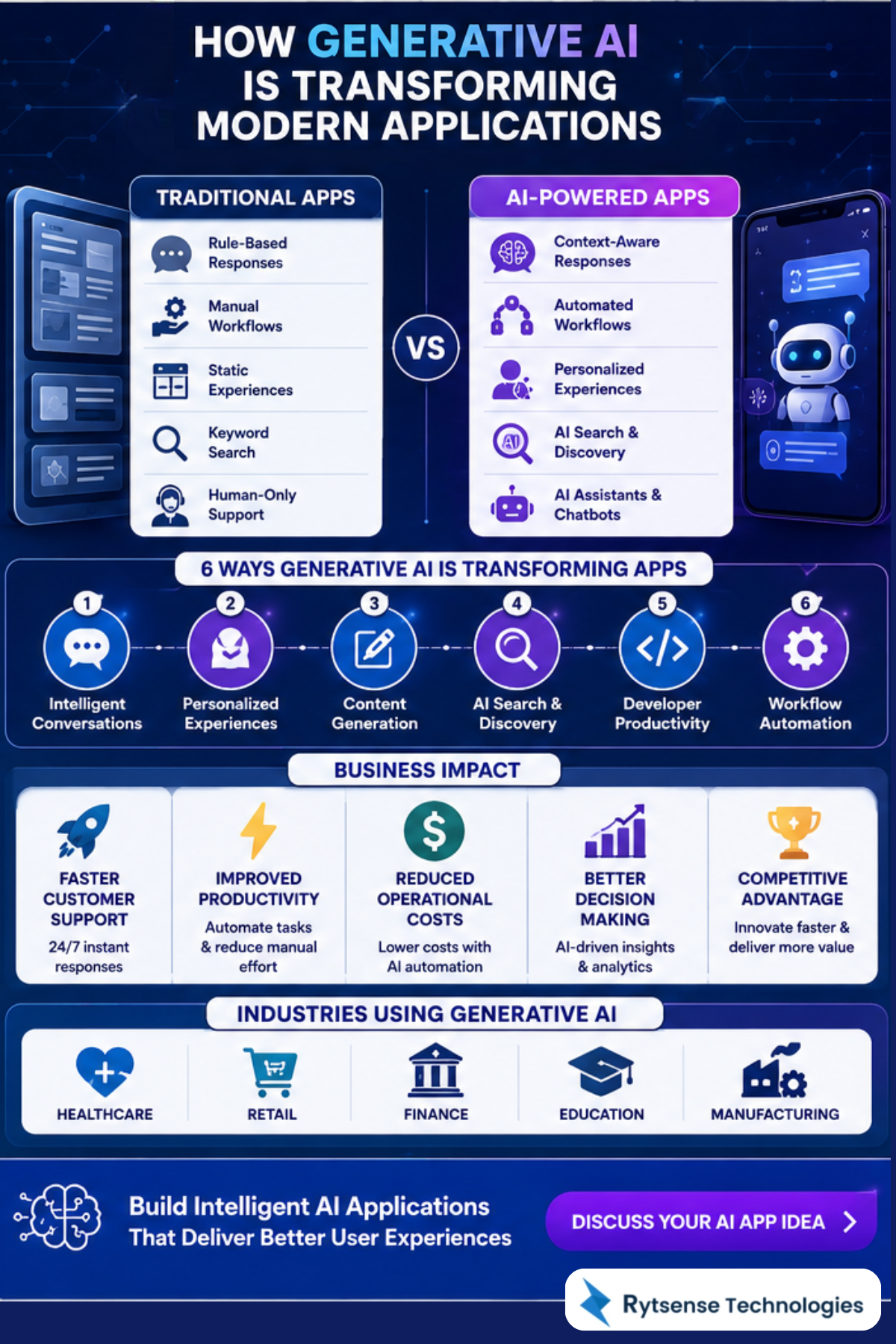
Why Generative AI Is Reshaping Modern Applications
Today's users expect applications to be intelligent, responsive, and personalized. Traditional software often requires users to navigate menus, search through information, or perform repetitive tasks manually.
Generative AI changes this experience by making applications more adaptive and user-centric.
Instead of searching through multiple pages, users can simply ask a question and receive an accurate response. Instead of manually creating content, users can generate drafts within seconds. Instead of relying on static recommendations, users receive personalized suggestions based on behavior and preferences.
This shift is transforming how applications are designed and how users interact with technology.
Key Ways Generative AI Is Transforming Modern Apps
1. Intelligent Conversational Interfaces
One of the most visible applications of Generative AI is conversational AI.
Modern applications now include AI assistants capable of understanding user intent and providing meaningful responses.
Examples include:
- Customer support chatbots
- Virtual assistants
- AI-powered help centers
- Internal employee assistants
- Knowledge management systems
These systems provide instant support while reducing the workload on customer service teams.
2. Personalized User Experiences
Personalization has become a major competitive advantage.
Generative AI can analyze user behavior, preferences, purchase history, and interactions to create tailored experiences.
Examples include:
- Personalized product recommendations
- Customized content feeds
- Individual learning paths
- Adaptive user interfaces
- Personalized marketing campaigns
This helps improve user engagement and retention.
3. Automated Content Generation
Content creation is one of the most common Generative AI use cases.
Applications can automatically generate:
- Blog posts
- Product descriptions
- Social media content
- Email campaigns
- Reports and summaries
- Marketing copy
This reduces manual effort while improving content production speed.
4. AI-Powered Search and Knowledge Discovery
Traditional keyword-based search often struggles to understand context.
Generative AI enables semantic search that understands meaning rather than exact keywords.
Benefits include:
- Faster information retrieval
- Better search accuracy
- Context-aware responses
- Improved customer support
- Enhanced enterprise knowledge management
Users receive direct answers instead of long lists of search results.
5. Enhanced Software Development
Generative AI is helping developers build applications faster.
AI-powered coding assistants can:
- Generate code snippets
- Suggest improvements
- Identify bugs
- Create documentation
- Accelerate testing
This significantly improves developer productivity and reduces development cycles.
6. Workflow Automation
Many business processes involve repetitive tasks.
Generative AI applications can automate:
- Data entry
- Customer onboarding
- Ticket routing
- Document processing
- Meeting summaries
- Workflow approvals
Organizations can improve efficiency while reducing operational costs.
Business Benefits of Generative AI Application Development
Improved Customer Experience
AI-powered applications provide faster responses, personalized interactions, and round-the-clock support.
Customers receive immediate assistance, leading to greater satisfaction.
Increased Productivity
By automating routine tasks, teams can focus on strategic activities that drive business growth.
Faster Decision-Making
Generative AI can analyze large volumes of data and generate actionable insights quickly.
This helps businesses make informed decisions.
Reduced Operational Costs
Automation reduces manual effort and lowers the costs associated with repetitive business processes.
Competitive Advantage
Organizations that adopt AI-powered applications can innovate faster and deliver unique customer experiences.
Popular Generative AI Application Use Cases
Healthcare
Healthcare organizations use Generative AI for:
- Medical documentation
- Clinical summaries
- Patient support assistants
- Healthcare chatbots
- Research assistance
Retail and E-commerce
Retail businesses leverage AI for:
- Product recommendations
- Personalized shopping experiences
- Automated customer support
- Inventory insights
- Product description generation
Finance
Financial institutions use Generative AI to:
- Automate customer service
- Generate financial reports
- Detect fraud patterns
- Improve risk assessment
- Enhance financial planning
Education
Educational platforms benefit from:
- Personalized learning experiences
- AI tutors
- Content generation
- Assessment assistance
- Student engagement tools
Manufacturing
Manufacturers use AI applications for:
- Predictive maintenance
- Knowledge management
- Process optimization
- Automated documentation
- Quality control support
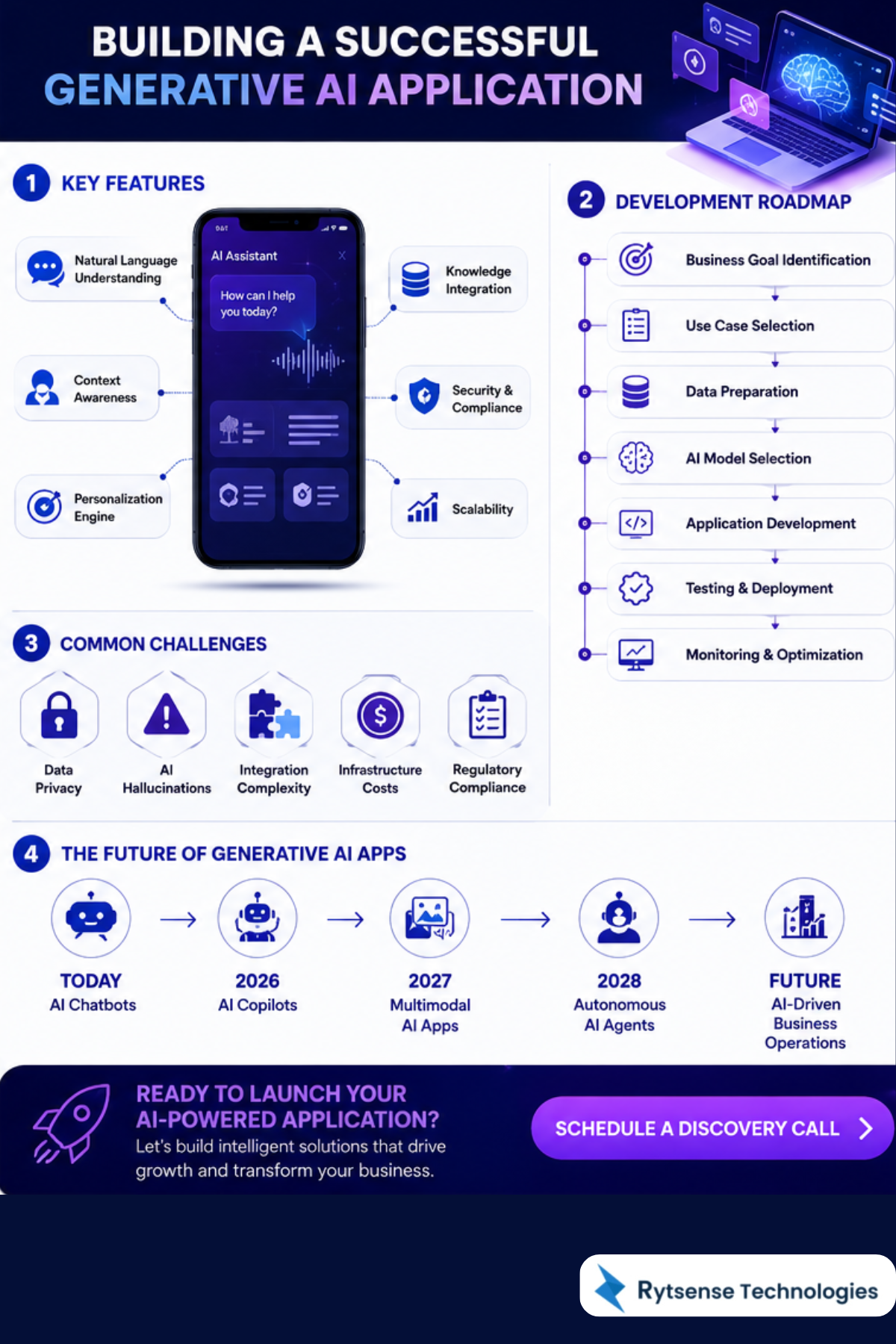
Essential Features of a Generative AI Application
Successful AI-powered applications often include:
Natural Language Understanding
Allows users to interact with the application using everyday language.
Context Awareness
Enables the application to understand previous interactions and maintain meaningful conversations.
Personalization Engine
Provides customized experiences based on user behavior and preferences.
Knowledge Integration
Connects AI models with business-specific data and knowledge bases.
Security and Compliance
Protects sensitive information and ensures regulatory compliance.
Scalability
Supports growing user demands without compromising performance.
Challenges in Generative AI Application Development
While the opportunities are significant, businesses should be aware of potential challenges.
Data Privacy and Security
AI systems often process sensitive information.
Organizations must implement robust security measures and comply with privacy regulations.
AI Hallucinations
Generative AI models may occasionally produce inaccurate information.
Proper validation mechanisms and human oversight are essential.
Integration Complexity
Connecting AI models with existing systems, databases, and workflows can be technically challenging.
Model Costs
Training, fine-tuning, and operating AI models may require significant computational resources.
Regulatory Compliance
Businesses must ensure compliance with industry-specific regulations and AI governance frameworks.
Key Considerations Before Building a Generative AI Application
Before starting development, businesses should define:
Business Objectives
Identify the specific problems the AI application will solve.
User Requirements
Understand user expectations and pain points.
Data Availability
Assess the quality and accessibility of business data.
AI Model Selection
Choose the most suitable AI models based on use cases and performance requirements.
Deployment Strategy
Determine whether the application will be deployed on-premises, in the cloud, or through a hybrid approach.
Long-Term Maintenance
Plan for continuous monitoring, optimization, and model updates.
The Future of Generative AI Applications
Generative AI is expected to become a standard component of modern software development.
Future applications will likely include:
- More advanced AI assistants
- Multimodal AI experiences
- Autonomous AI agents
- Hyper-personalized customer journeys
- Industry-specific AI solutions
- AI-powered business operations
As AI models continue to improve, applications will become more intelligent, efficient, and capable of handling increasingly complex tasks.
Businesses that embrace this transformation today will be better positioned to compete in a rapidly evolving digital landscape.
Why Partner with a Generative AI Application Development Company?
Building a successful AI-powered application requires expertise in AI models, data engineering, application architecture, security, and deployment.
An experienced Generative AI development partner can help businesses:
- Define AI strategies
- Identify high-impact use cases
- Build custom AI applications
- Integrate AI into existing systems
- Ensure security and compliance
- Scale AI solutions effectively
Whether you're developing an AI-powered SaaS platform, mobile application, virtual assistant, or enterprise solution, the right development partner can accelerate your journey from concept to deployment.
Conclusion
Generative AI application development is transforming modern apps by making them more intelligent, personalized, and efficient. From conversational assistants and content generation to workflow automation and advanced analytics, AI-powered applications are redefining how businesses engage with customers and operate internally.
As organizations continue investing in digital transformation, Generative AI will play an increasingly important role in shaping the next generation of software applications. Businesses that adopt AI strategically can improve customer experiences, boost productivity, and create innovative solutions that drive long-term growth.
Meet the Author

Co-Founder, Rytsense Technologies
Karthik is the Co-Founder of Rytsense Technologies, where he leads cutting-edge projects at the intersection of Data Science and Generative AI. With nearly a decade of hands-on experience in data-driven innovation, he has helped businesses unlock value from complex data through advanced analytics, machine learning, and AI-powered solutions. Currently, his focus is on building next-generation Generative AI applications that are reshaping the way enterprises operate and scale. When not architecting AI systems, Karthik explores the evolving future of technology, where creativity meets intelligence.