Key Takeaways
AI software development creates intelligent systems that can learn, automate decisions, and continuously improve without human intervention.
It uses advanced technologies like machine learning, deep learning, NLP, computer vision, and predictive analytics to solve complex problems.
AI-powered solutions deliver better decision-making, automation, personalization, cost reduction, and innovation for businesses of all sizes.
AI development requires a data-driven process including problem definition, data preparation, model training, integration, and ongoing optimization.
Companies across industries - retail, finance, healthcare, real estate, logistics, and manufacturing - are already seeing strong ROI from AI transformation.
AI adoption has challenges such as data quality and skill shortages, but these can be overcome by partnering with an experienced AI software development company.
The future of software is intelligent, autonomous, and adaptive, making AI essential for staying competitive in the digital era.
What Is Artificial Intelligence Software Development?
Artificial intelligence software development is the process of building intelligent applications that can analyze data, make decisions, learn from experience, understand text and speech, and automate tasks without constant human control. Unlike traditional software that follows fixed rules, AI-powered software evolves over time using AI models, machine learning, deep learning, and natural language processing to deliver smarter and more accurate outcomes.
Today, artificial intelligence is powering business transformation - from predictive analytics in finance to personalized shopping in retail, automated operations in logistics, and smart diagnosis in healthcare. Whether you're a startup exploring product innovation or an enterprise planning digital transformation, AI development services help turn data into decisions and automation into profit.
Why AI Software Development Matters Today
The volume of business data is doubling faster than ever — and humans alone cannot process it. Artificial intelligence software development enables:
- Real-time decision-making
- Automation of repetitive or complex work
- Higher customer satisfaction through personalization
- Reduced operational cost
- New revenue opportunities with predictive technologies
Simply put, AI is not optional anymore - it is becoming a core driver of business competitiveness.
Startups use AI to scale quickly with fewer resources. Enterprises rely on AI integration to modernize legacy systems and optimize workflows end-to-end.
What Makes AI Software Intelligent? (Core Components)
AI software is built with several cognitive capabilities:
| Intelligence Capability | What It Does | Business Example |
|---|---|---|
| Machine Learning | Learns from data patterns | Churn prediction, pricing automation |
| Neural Networks | Detects complex relationships | Voice assistants, facial ID |
| Deep Learning | Recognizes audio, image, video content | Self-driving vehicles, medical scans |
| Natural Language Processing (NLP) | Understands and generates language | Chatbots, translators |
| Predictive Analytics | Forecasts future outcomes | Demand forecasting |
| Reinforcement Learning | Learns through feedback | Robotics, autonomous systems |
These systems help build AI applications that continuously improve without rewriting code.
Essential Technologies Behind AI Development
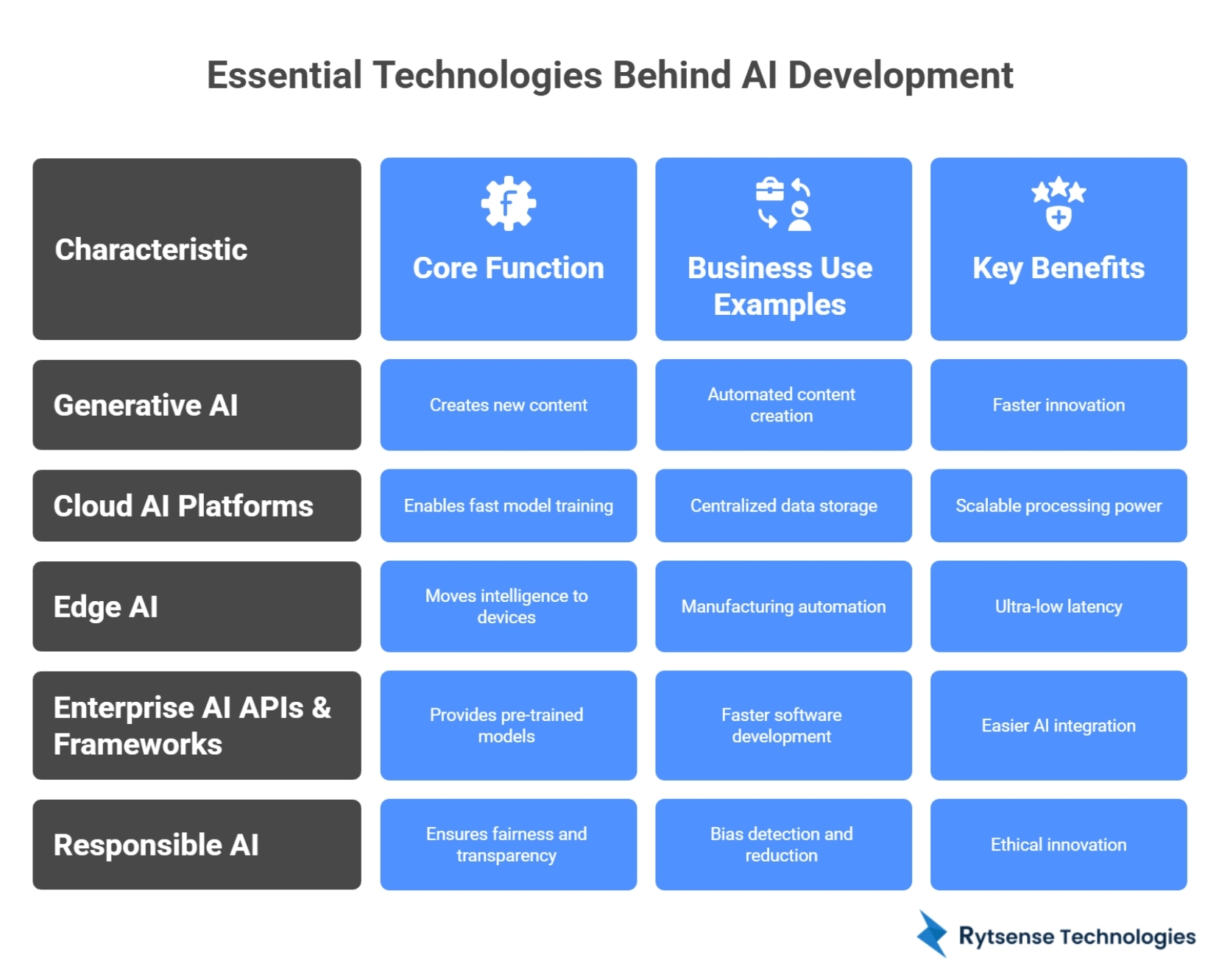
Modern artificial intelligence software development combines multiple advanced technologies to build intelligent, secure, and scalable AI applications. Each technology plays a unique role in how AI models learn, reason, and perform real-world tasks.
Let's break them down:
Generative AI
Generative AI refers to models that can create new content instead of just analyzing existing data. They understand patterns deeply and generate text, images, code, insights, recommendations and even business decisions.
Business Use Examples
- Automated content creation and marketing personalization
- Synthetic data generation for model training
- AI copilots for customer support and enterprise workflows
Generative AI helps companies innovate faster with less manual effort.
Cloud AI Platforms
Powerful AI systems require large computing resources. Cloud platforms like AWS, Google Cloud, and Azure enable fast model training, collaboration, data management, and deployment without upfront infrastructure cost.
Benefits
- Highly scalable processing power
- Centralized data storage and pipeline automation
- Faster time-to-deployment for AI solutions
Cloud-driven AI integration simplifies DevOps and long-term optimization.
Edge AI
Edge AI moves intelligence closer to the devices - like cameras, sensors, mobile phones, drones, and robots - for fast, real-time decisions without waiting for cloud communication.
Why It Matters
- Ultra-low latency decision-making
- Improved privacy (data stays on device)
- Works even with limited connectivity
Edge AI is widely used in manufacturing automation, smart vehicles, and IoT systems.
Enterprise AI APIs & Frameworks
Today, businesses don't have to build every AI capability from scratch. APIs from leading AI platforms provide pre-trained models for natural language processing, speech recognition, image analytics, and chatbot development.
Advantages
- Faster software development cycles
- Lower implementation cost
- Easier AI integration into existing systems
This democratizes AI - letting startups and enterprises innovate quickly.
Responsible AI (Ethical & Safe Systems)
As AI expands into critical decisions - healthcare, finance, hiring - trust and compliance are essential. Responsible AI ensures fairness, transparency, and security in every AI solution.
Responsible AI Includes:
- Bias detection and reduction in AI models
- Explainable AI (showing why a system made a decision)
- Data privacy and regulatory compliance
- Continuous monitoring to prevent misuse
Businesses benefit from ethical innovation that customers and regulators trust.
How Artificial Intelligence Software Is Developed
Building AI software is different from traditional development because the system learns from data, adapts over time, and requires continuous improvement. Here's how AI development companies typically execute the process:
1. Problem Definition - What Are We Solving?
Every successful AI project starts with a clear, measurable business goal.
This phase involves:
- Identifying the core business challenge
- Understanding user experience requirements
- Defining accuracy expectations and KPIs
- Estimating ROI and success metrics
Example: Retailer wants to reduce product returns → build a predictive recommendation model.
This step ensures the solution drives real business value, not just technology innovation.
2. Data Acquisition & Preparation - Fuel for AI Models
AI systems learn from data - the better the data quality, the smarter the system becomes.
Activities include:
- Collecting data from relevant sources (CRM, ERP, sensors, web apps, etc.)
- Cleaning and removing errors
- Structuring data for analysis
- Data labeling for supervised learning
- Splitting into training, validation, and test datasets
This is often the most time-consuming step - but it is critical for delivering accurate AI predictions.
3. AI Model Development
This is where the "intelligence" is created using:
- Machine learning for pattern recognition
- Deep learning and neural networks for high-complexity tasks
- Natural language processing for text and voice understanding
- Predictive analytics for forecasting
What happens here:
- Multiple algorithms are tested
- Best-performing model is selected
- Model is tuned for precision, speed & reliability
The result? An AI engine capable of decision-making similar to (or better than) humans.
4. Deployment & AI Integration
Once trained, AI models must be deployed into:
- Mobile apps
- Cloud platforms
- Business software (CRM, ERP, HRMS, POS, etc.)
- IoT devices (Edge AI)
- Web applications
Integration ensures that end-users interact with real-time intelligent features - whether it's fraud alerts, smart recommendations, or automated responses - while fitting seamlessly into existing workflows. Partnering with the best AI development company in USA ensures scalable deployment, robust security, and smooth AI integration across business systems without any operational disruption, making an experienced AI software development company essential for long-term success.
5. Monitoring & Continuous Optimization
AI is never "done."
After deployment, the system continuously tracks:
- Accuracy vs. real-world outcomes
- Data drift (changing patterns)
- Model performance under load
- Security and ethical compliance
As user behavior and business conditions evolve, AI models are retrained to maintain performance.
Why this matters: AI that adapts → provides increasing value over time → becomes a long-term business asset
AI Software vs. Traditional Software Development
| Factor | Traditional Software | AI-Driven Software |
|---|---|---|
| Behavior | Fixed rules | Autonomous decision-making |
| Learning | None | Improves over time |
| Output | Predictable | Adaptive |
| Data dependence | Low | Very high |
| ROI timeline | Gradual | Grows exponentially |
AI brings intelligence and creativity into software - not just automation.
Business Use Cases Across Industries
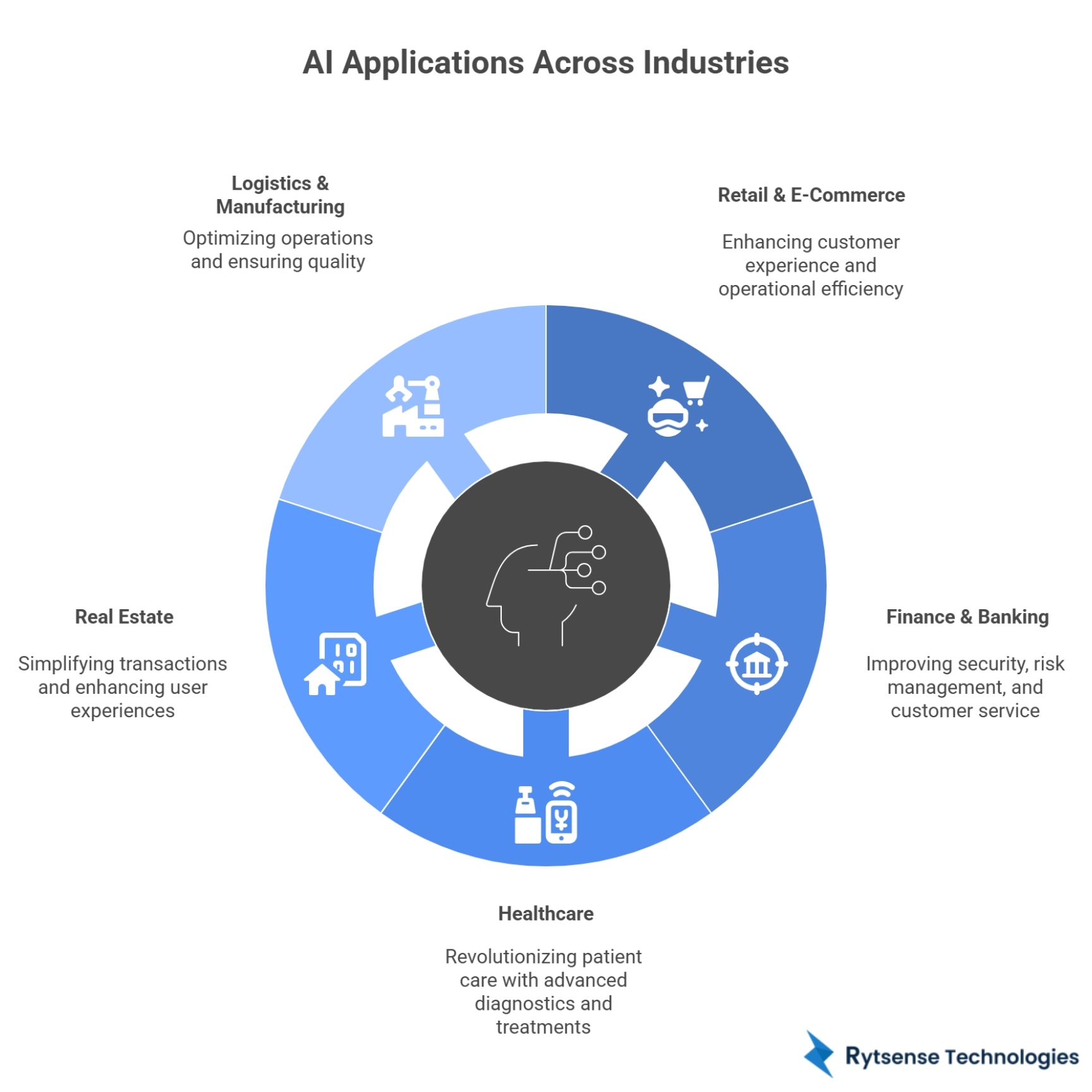
Artificial intelligence software development is transforming every major industry. Businesses are shifting from manual decision-making to data-driven automation, powered by AI models, neural networks, and predictive analytics.
Here's how startups and large enterprises are applying AI solutions for real impact:
Retail & E-Commerce
AI is reshaping how customers shop and how brands operate behind the scenes.
Key AI use cases:
- Personalized recommendations - Machine learning analyzes browsing and purchase behavior to suggest products tailored to each user - improving sales and user experience.
- Automated inventory planning - Predictive analytics forecasts demand to avoid overstocking or stockouts, reducing operational waste.
- Dynamic pricing systems - AI adjusts product prices in real time based on competitor pricing, demand patterns, and inventory.
This helps brands boost conversions, improve logistics, and deliver enjoyable shopping journeys.
Finance & Banking
Financial institutions rely on AI systems for security, risk control, and automation.
Key AI use cases:
- Fraud detection - AI models identify abnormal transaction behavior instantly - preventing fraud before it happens.
- Risk scoring - Deep learning evaluates creditworthiness more accurately than traditional rules-based scoring.
- Customer service automation - AI chatbots handle loan queries, KYC verifications, and support questions 24/7.
Banks achieve faster decision cycles with higher compliance and reduced losses.
Healthcare
AI development services are revolutionizing patient care with faster diagnosis and data-driven treatment.
Key AI use cases:
- AI-powered diagnosis and triage - NLP and predictive models help doctors assess patient symptoms and recommend care pathways.
- Medical imaging with deep learning - Neural networks detect diseases like cancer from X-rays, MRIs, and CT scans with high accuracy.
- Drug discovery and genomics - AI shortens research time and identifies life-saving therapies faster.
Healthcare becomes more accessible, accurate, and preventive.
Real Estate
AI is simplifying real estate transactions for buyers, sellers, and investors.
Key AI use cases:
- Smart pricing models - Machine learning predicts property value using location, market demand, amenities, and past sales data.
- Virtual property search with NLP - AI understands natural language search queries like "3BHK house near metro under 50 lakhs" and finds ideal matches.
- Lead scoring for agencies - Predictive analytics identifies serious buyers to improve sales productivity.
AI speeds decision-making and enhances user experiences in digital real estate marketplaces.
Logistics & Manufacturing
Industrial sectors benefit from automation and intelligent decisioning powered by AI.
Key AI use cases:
- Route optimization for delivery fleets - AI calculates the shortest and safest delivery paths, saving fuel and time.
- Predictive maintenance - IoT + AI detect machine faults early - avoiding costly shutdowns and increasing asset lifetime.
- Quality inspection using computer vision - Cameras and deep learning models identify defects faster than human inspectors.
AI improves efficiency, safety, and operational performance at scale.
Business Benefits of AI Development Services
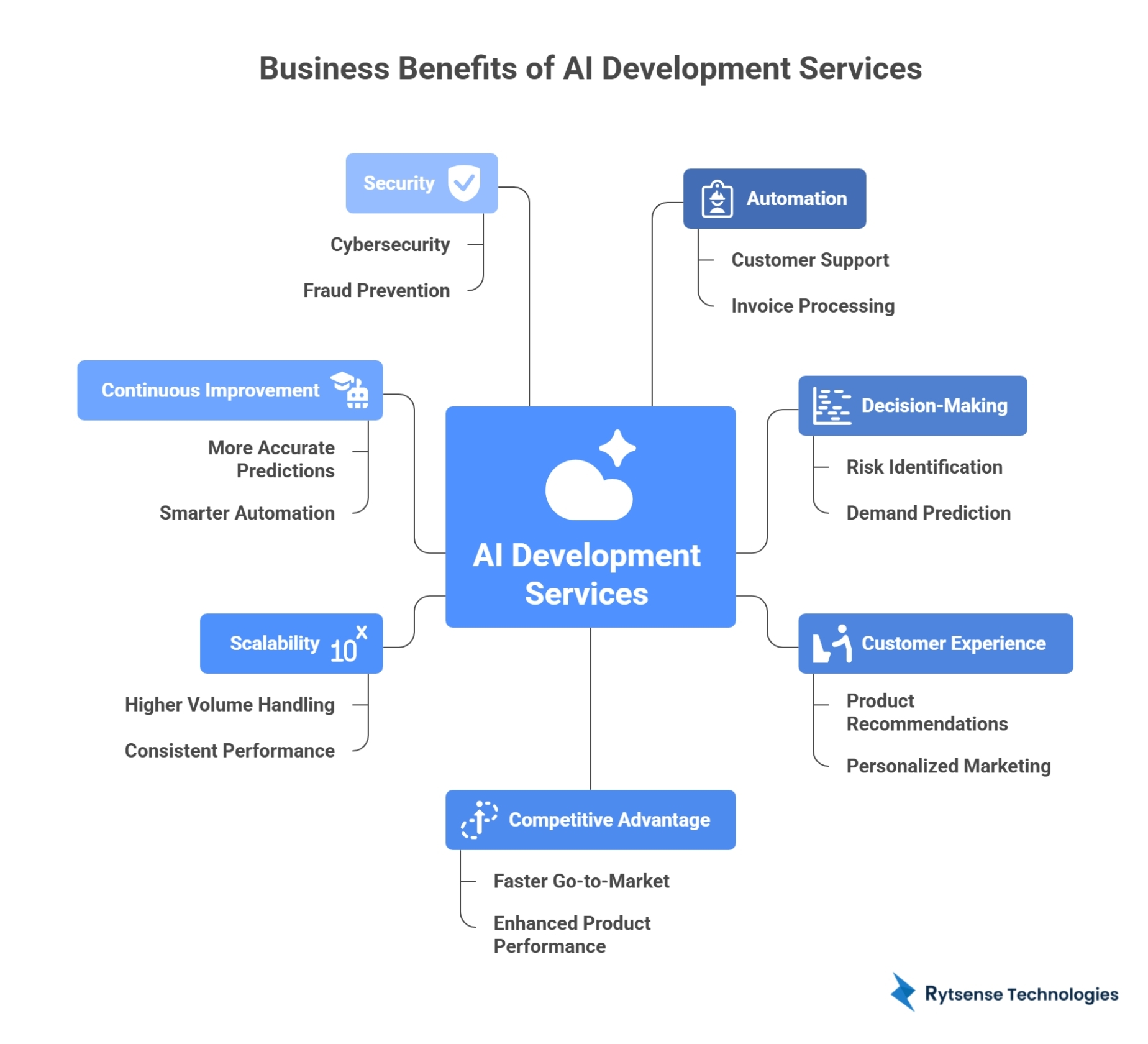
Artificial intelligence software development delivers measurable advantages across performance, productivity, customer experience, and profitability. Whether you're running a startup or scaling enterprise systems, AI development services can unlock new capabilities that traditional software simply cannot deliver.
Here are the most important business benefits:
1. Automation of Repetitive and Complex Processes
AI reduces human workload by taking over tasks that are time-consuming, error-prone, or require constant monitoring.
Examples include:
- Customer support ticket routing
- Invoice processing and financial reconciliation
- Inventory and supply chain automation
- HR screening and employee onboarding
Result: Lower operational cost + faster processes + improved accuracy
2. Better & Faster Decision-Making With Data
AI models analyze large datasets in seconds - detecting trends and predicting outcomes to support smarter business decisions.
How predictive intelligence helps:
- Identifies risks before they become costly issues
- Predicts demand, customer churn, and revenue growth
- Enables proactive planning rather than reactive action
Result: Confident, real-time decision-making powered by data
3. Personalized Customer Experiences
AI applications adapt to individual behavior - increasing satisfaction and conversions.
Examples:
- Product or content recommendations
- Personalized marketing campaigns
- Smart chatbots offering tailored responses
Result: Higher engagement + loyalty + sales
4. Competitive Advantage Through Innovation
AI solutions enable businesses to launch new features and products faster than competitors.
Advantages include:
- Faster go-to-market
- Enhanced product performance
- Ability to enter new markets and business models
Result: Business becomes a leader, not a follower
5. Scalable Systems That Grow With You
As your data and user base expand, custom AI development ensures systems continue to:
- Handle higher volumes
- Deliver consistent performance
- Maintain decision accuracy
Result: Operational efficiency at every growth stage
6. Continuous Improvement Over Time
Unlike manual workflows that stagnate, AI systems learn and improve every day with new data.
This means:
- More accurate predictions
- Smarter automation
- Enhanced long-term ROI
Result: AI becomes a strategic business asset that gains value year after year
7. Improved Security and Risk Management
AI detects threats faster than human monitoring could.
Use cases:
- Cybersecurity anomaly detection
- Banking fraud prevention
- Compliance & regulatory controls
Result: Better protection for customer data and financial assets
Summary of Benefits
| Benefit | Impact on Business |
|---|---|
| Automation | Significant cost & time savings |
| Accuracy | Better decisions, fewer errors |
| Personalization | Higher customer retention |
| Predictive power | Reduced losses and downtime |
| Innovation | Competitive advantage |
AI helps humans focus on strategy and creativity — machines handle the rest.
Challenges in AI Adoption & How to Overcome Them
| Challenge | Why It Matters | Solution |
|---|---|---|
| Lack of high-quality data | AI performance depends on data | Data engineering & governance |
| Shortage of skilled talent | Hard to hire ML experts | Partner with an AI software development company |
| Integration complexity | Hard to merge legacy systems | API-based and phased integration |
| Ethical + security concerns | Must avoid bias and risks | Responsible AI policies |
A smart approach turns challenges into innovation opportunities.
Hiring Options: In-House vs. Partnering With Experts
| Option | Best For | Pros |
|---|---|---|
| In-house AI team | Long-term R&D | Full control |
| Freelancers | Small experiments | Fast hiring |
| AI development company | Scalable projects | Expertise + speed + lower risk |
For most businesses, dedicated AI developers or a trusted AI development partner is the strongest ROI choice.
Future of AI Software Development (2025–2030)
Key growth trends shaping industries:
- Agentic AI (autonomous decision-making software)
- Domain-specific AI models (finance, healthcare, etc.)
- AI copilots for workplace productivity
- AI-enhanced cybersecurity
- Edge AI for real-time automation at the source
- Multimodal AI understanding visuals, text, speech together
The future of software is intelligent, continuously learning, and proactive.
Conclusion: AI Is the Next Default for Business Innovation
Artificial intelligence software development is helping companies move faster, operate smarter, and scale more efficiently. From building AI-driven applications to integrating automation into existing systems, AI enables:
- Better user experiences
- Higher performance and productivity
- Safer and more accurate decision-making
- New business models and revenue streams
The question is no longer "Should we adopt AI?"
It's "How fast can we leverage it to grow?"
Meet the Author

Karthikeyan
Connect on LinkedInCo-Founder, Rytsense Technologies
Karthik is the Co-Founder of Rytsense Technologies, where he leads cutting-edge projects at the intersection of Data Science and Generative AI. With nearly a decade of hands-on experience in data-driven innovation, he has helped businesses unlock value from complex data through advanced analytics, machine learning, and AI-powered solutions. Currently, his focus is on building next-generation Generative AI applications that are reshaping the way enterprises operate and scale. When not architecting AI systems, Karthik explores the evolving future of technology, where creativity meets intelligence.