Key Takeaways
Define specific, measurable business objectives before starting AI app development to ensure focused solutions that deliver ROI within 18-24 months. AI app development costs range from $40,000 for simple apps to $500,000+ for enterprise solutions, with complexity and data requirements being primary cost drivers. High-quality data is critical for AI success, requiring minimum 10,000 labeled examples and ongoing management to maintain model accuracy over time. Select AI technologies that match your use case; machine learning for predictions, NLP for language processing, computer vision for image analysis, and deep learning for complex tasks. Budget 15-20% of initial development costs annually for maintenance, model retraining, and updates to prevent performance degradation and keep pace with evolving data patterns.
How to Build an AI App for Your Business: Complete Guide
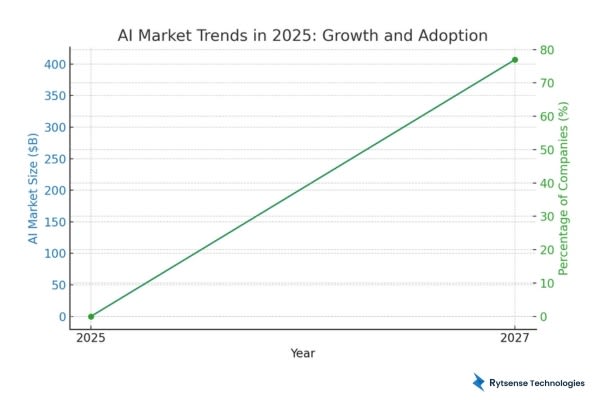
For businesses to remain competitive in 2026, it is becoming essential to understand how to build an AI application. Industry data suggests the global AI marketplace will reach $407 billion by 2027 and over 77% of companies are already using AI technology or exploring what AI technology could provide for their organization.
Enterprises that leverage an AI application for their operations report an average productivity improvement of 40% and a cost reduction of up to 30% in the first year of adoption. Knowing how to build an AI application allows organizations to automate processes and offer a more personalized experience with their customer. They may also quickly make data-driven decisions with proven confidence.
Know the Core Elements of AI Applications
Before knowing how to build an AI application, you need to understand the core technologies that form these intelligent systems. AI applications combine several technologies to solve real-world business problems.
Key Components in How to Build an AI App
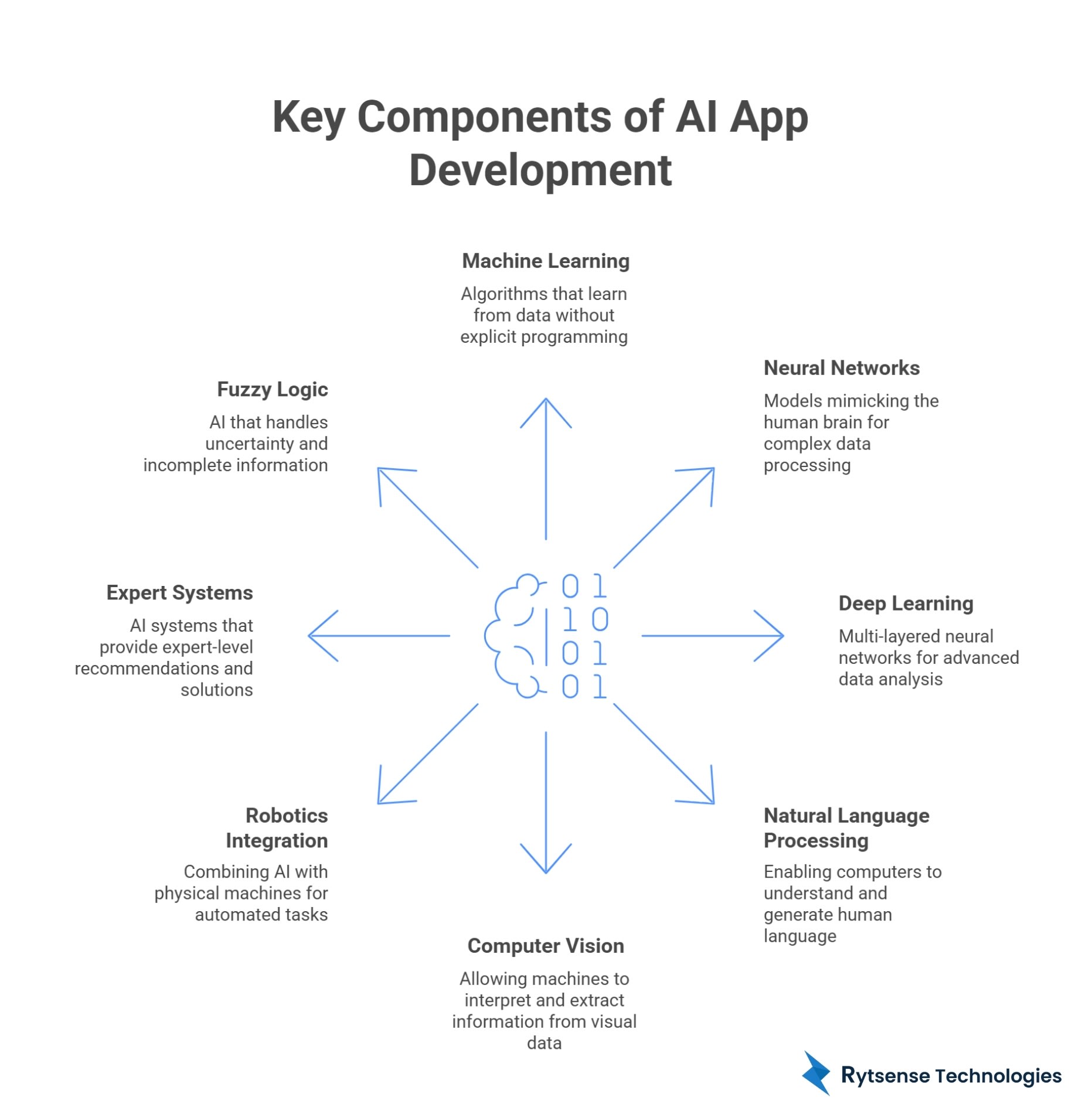
Understanding the key components in how to build an AI app is essential for successful development. These core technologies, including machine learning, neural networks, NLP, and
computer vision
, form the foundation of intelligent applications that solve real business problems.
Machine Learning (ML) for Smarter Apps
Machine Learning
apps
form the core of most AI solutions. ML algorithms learn from the patterns of data without programming the algorithm. When you build an AI application utilizing ML, the system will continually improve as it receives and processes new information. Common ML applications are spam filtering, product recommendation engines, and credit scoring systems.
Neural Networks for Complex Problem-Solving
Neural networks for apps
are a model designed to imitate the structure of the human brain in processing complex information. These interconnected nodes collaborate to identify patterns, classify data, and make predictions. They are critical for tasks involving the processing of complex information, often associated with image recognition.
Deep Learning in AI Applications
Deep learning
in AI apps uses a neural network model where multiple layers of the neural network are used to process data with layered levels of complexity. The technology that enables facial recognition, autonomous vehicles, and language translation is based on deep learning. Though deep learning is powerful, it does require vital computational ability to deliver highly accurate results for difficult tasks.
Natural Language Processing (NLP) Capabilities
NLP or
Natural language processing
applications allow computers to interpret, understand, and generate human language. When you build an AI app that leverages the capabilities of natural language processing, builds for chatbots,
sentiment analysis
, document summarization, and voice-activated interaction in a way that engages in natural human-to-human conversation.
Computer Vision for Intelligent Analysis
Computer vision applications
enable machines to understand and extract information from visual data from images and video files. This application supplies the technology behind quality control applications, medical imaging analysis, autonomous navigation, and security surveillance. Computer vision-based AI has become critical across many sectors, especially retail, healthcare, and manufacturing.
Robotics Integration in Apps
Robotics integration in apps
is where AI-based software interacts with physical machines to undertake an automated process. This combination of AI and robotics has transformed production floors, warehouse operations, and surgical procedures with intelligent decision-making and the ability to conduct tasks with precision and repeatability.
Expert Systems for Decision-Making
Expert systems
function like experts in a particular field or discipline, providing recommendations and solving problems. By following computer rule-based logic,
expert systems
are an example of an AI application for diagnostic, presenting solutions and decision processes, and intelligent sequential logic.
Expert systems
are remarkably useful in medical diagnosis and financial planning examples.
Fuzzy Logic AI for Handling Uncertainty
Fuzzy logic-based AI applies in scenarios where information is incomplete or vague.
Fuzzy logic AI
deals with degrees of truth or accepts levels of uncertainty, as opposed to traditional binary logic systems, which are either true or false. This makes it an ideal solution for applications in temperature control, image processing, and decision support systems handling ambiguity of knowledge and uncertainty in the real world.
Advantages of Building an AI App for Your Business
Before starting AI app development, it’s important to understand
how AI apps
benefit businesses, as this helps justify the overall development costs and investment.
Generating Intellectual Property Through AI
When you begin your AI app development journey or explore
how to build an AI application
, you’re not just creating software, you’re building valuable intellectual property. By developing proprietary algorithms and
custom AI models
, your business gains unique assets that strengthen innovation and market position. These advanced models can uncover patterns in your data, generate predictive insights, and deliver outcomes that are specific to your organization’s needs. Over time, these capabilities help establish competitive advantages and create natural entry barriers, allowing your company to stand out in the rapidly growing AI-driven marketplace.
Full Control Over Your Data
The
AI application development solution
you subsequently design offers full ownership and control over sensitive business-specific data. Unlike third-party AI applications, custom applications utilize your own infrastructure and keep your information locally, reducing the impact of data breaches and protecting undisclosed competitive intelligence.
Greater Business Flexibility and Agility
Custom AI app development
process
lets you modify features, alter algorithms, and change strategies immediately. You're not stuck to a vendor's roadmap or pricing plan. That flexibility will enable you to react quickly to changes in the marketplace or customer needs.
Long-Term Cost Savings
While the original cost of the AI app may be considerable, custom solutions will avoid continuing subscription fees paid to
AI service providers
. Over time, those charges will accumulate steadily, especially with heavier use case applications. Businesses typically receive ROI for their investment 18-24 months after deployment.
Strengthened Security Measures
Enterprise AI applications
built in-house will allow you to provide ID security protocols unique to your industry. You can implement advanced encryption, access controls, and compliance requirements from the beginning of the application architecture, ensuring your data is secure to your specifications.
Future-Ready Business Operations
AI-powered systems will help scale with business operations as your business progresses and changes with emerging technologies. When you build an AI app today, you are laying the foundation for future needs, upcoming innovations like quantum computing, advanced robotics, and new generation analytics in the future, without having to start over.
Also Read: Choosing the Right AI ML Development Company for Your Business Needs
Industry-Specific Applications When You Build an AI App
Each industry has more specific
AI app use cases
that play to the unique pain points being tackled.
Healthcare - Predictive Analytics for Better Patient Care
AI for healthcare
space can enhance patient outcomes by making patient treatment, resource allocation, and early detection of diseases and abnormalities more efficient.
Predictive analytics
can effectively identify at-risk patients to reduce the readmission of hospital patients by up to 35%. AI-based diagnostic tools can analyze medical images with 95% accuracy, allowing radiologists to detect cancers and abnormalities sooner than with manual techniques.
Transportation - Autonomous Vehicle Solutions
AI in transportation
can be used through self-driving technologies, better route optimization, and smart systems for predictive maintenance. By deploying AI, transportation companies can minimize fuel, reducing costs from 15%-20% through smart route planning. By analyzing real-time traffic data, adaptive navigation and route planning systems enable transportation companies to reduce delays and improve safety across fleet operations.
Real Estate - Market Analysis and Property Valuation
AI in real estate
provides the ability to automate property valuation, predict overall market trends & analyze potential matches for buyers searching for properties. Through machine learning algorithms, AI can analyze hundreds of property attributes, lifestyle attributes, and market conditions to justify price recommendations that typically fall within 3-5% of actual selling prices.
Retail - Personalized Shopping and Recommendations
AI in retail
develops tailored recommendation engines that lift conversion rates by 30-40%.
Computer vision applications
create cashier-less stores and virtual try-on experiences. AI for inventory management lowers stockouts by 65%, decreases excess inventory holding costs, and centralizes inventory management capabilities.
Finance - Intelligent Budget Management
AI in finance
redefines risk assessment, fraud detection, and automated trading. Financial institutions using AI-supported fraud detection systems cut losses by 50-70%. Robo-advisors provide uniquely tailored investment recommendations, democratizing wealth management services for retail clients.
Manufacturing - Predictive Maintenance Solutions
AI in manufacturing
limits operational downtime through predictive maintenance built on failure predictions 7-10 days in advance. AI equipped with quality control reviews product quality 3-4 times faster than human inspectors with 99.5% accuracy. Meanwhile, production optimization algorithms improve production output by 20-25% without capital investment.
Step-by-Step Guide on How to Build an AI App
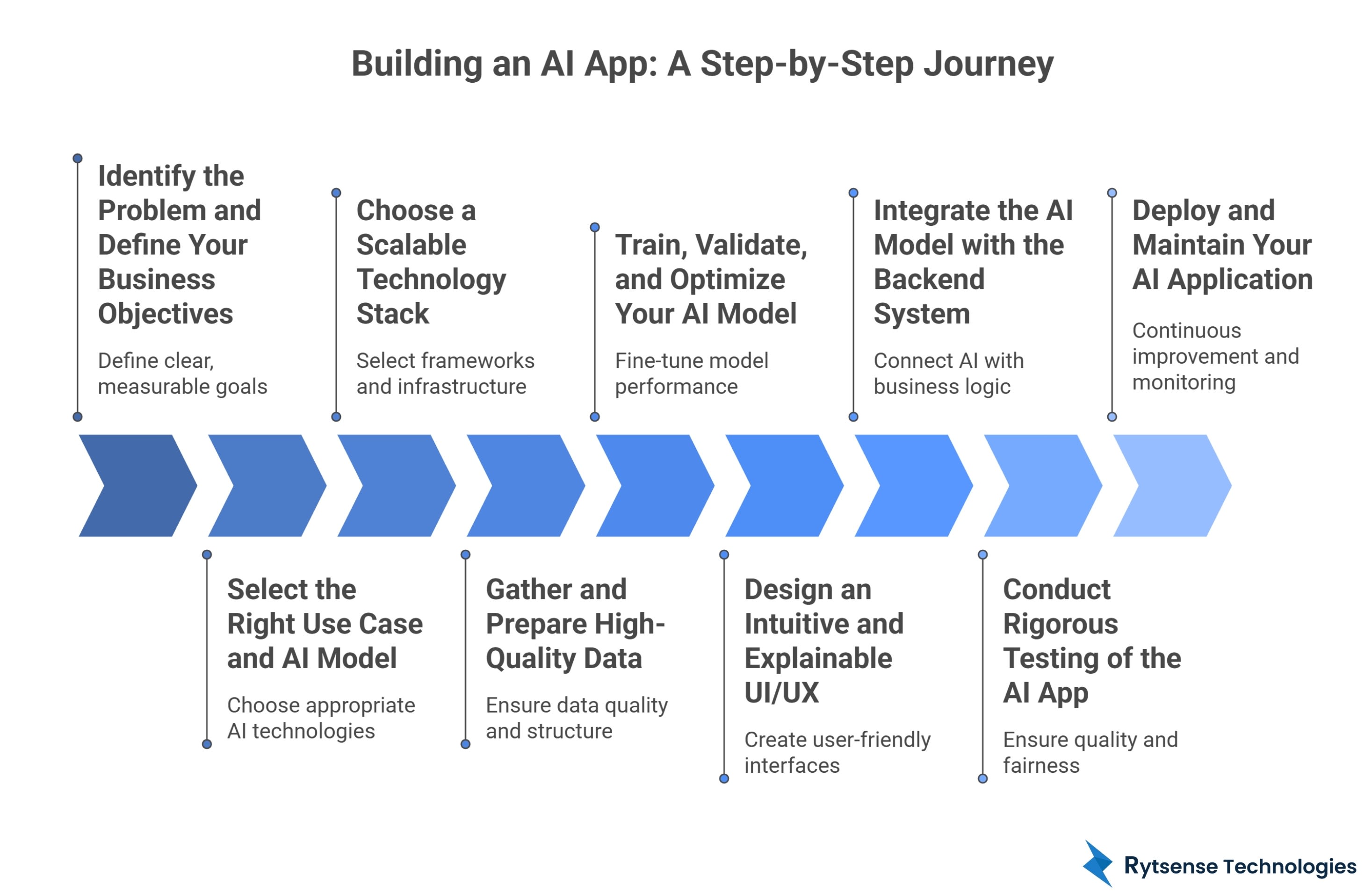
Use these AI app development steps to build a powerful, scalable solution- especially if you’re exploring how to build an AI app from scratch.
Identify the Problem and Define Your Business Objectives
First, identify the business problem that you will be solving with your AI application. Define the business objective in measurable terms, like reduce customer service response time by 60%, increase sales conversion by 25% or reduce operational effort/cost by 35%. Creating clear objectives will help guide your decisions for the remainder of the development process for the novel AI application.
What You Can Do:
- Define the current pain points with quantifiable measures
- Identify the stakeholders and the requirements
- Create your specific, measurable KPIs for achievement
- Plan the budget and timeframe
Select the Right Use Case and AI Model
Once you have identified the objective, you can determine which
AI app use cases
align with your availability of data and technical readiness. Align your question to appropriate AI technologies, supervised learning for predictive purposes, unsupervised learning for discovery of patterns, or reinforcement learning for optimization problems. Understand what solutions are already out in the marketplace to understand feasibility and distinguish the potential outcome.
Choose a Scalable Technology Stack
Select frameworks, programming languages, and cloud infrastructure that support your
AI app features
and growth plans. Popular choices include:
ComponentOptionsBest ForProgramming LanguagePython, R, JavaPython for versatilityML FrameworksTensorFlow, PyTorch, Scikit-learnTensorFlow for productionCloud PlatformAWS, Google Cloud, AzureAWS for mature AI servicesDatabasePostgreSQL, MongoDB, RedisPostgreSQL for structured dataAPI FrameworkFastAPI, Flask, DjangoFastAPI for ML model serving
Gather and Prepare High-Quality Data
The success of your AI application will depend on how you manage the data. Acquire data that aligns with your organization’s needs, from internal systems, third-party, or generated. Clean the data by eliminating duplicates, addressing missing values, and correcting inaccuracies. Transform the data into structures acceptable to
AI model training
through normalization, encoding, and feature engineering.
Data requirements:
- At least 10,000 labeled examples for supervised learning,
- Equitable representation in categories,
- Current data updated regularly,
- Clear documentation and versioning.
Train, Validate, and Optimize Your AI Model
Training an AI model involves feeding your data into your chosen algorithm and optimizing hyperparameters to achieve the best performance. Dividing your data into three sets: training, validation, and testing. The training data set is typically 70% of your data; validation and testing are generally 15% each. The validation data set is used to tune your hyperparameters and for monitoring to ensure that your model does not overfit. Your final trained model will be tested using the testing data set to measure performance in the real world.
Timeline for training:
- Basic models: 1-2 weeks,
- Moderate complexity models: 4-6 weeks,
- Complex deep learning models: 8-12 weeks.
Design an Intuitive and Explainable UI/UX
Develop interfaces that help users understand the AI predictions and facilitate actionable outcomes. To earn user trust in AI recommendations, it is important to give explanations for its decisions, provide levels of confidence in the recommendations, and provide the ability to override any decisions made by AI. The design should allow for differences in user experience for both technical and non-technical users through an approach of progressively disclosing complexity.
Integrate the AI Model with the Backend System
Integration of AI
with backend systems that already exist is really about linking your newly trained model up to the business logic, databases, and APIs. Models can be exposed by implementing REST APIs or using a microservices architecture. Correct logging mechanisms for monitoring, tracking model performance in production environments, and error handling should be in place.
Conduct Rigorous Testing of the AI App
AI app testing and maintenance
can take on a unique set of challenges that differ from traditional software testing approaches. As well as looking at traditional testing for AI, app testing needs to assess model quality, fairness, robustness, and model explainability.
Later, testing edge cases, adversarial inputs, and performance under load is essential. Finally, ensure that the AI works correctly when looking at various demographic factors and in different contexts.
Testing Checklist:
- Functional testing of the app features
- Model accuracy and bias testing
- Performance and load testing
- Security and vulnerabilities testing
- User acceptance testing
Deploy and Maintain Your AI Application
A strategy for deploying your app may include identifying your hosting infrastructure, establishing CI/CD pipelines, and creating monitoring systems. Make sure to plan for model retraining schedules, especially as data patterns change in the environment where the model has been deployed. Lastly, build feedback loops into your app to collect both user feedback and performance metrics to continuously improve your app.
Maintenance Requirements:
- Weekly performance
- Monthly data quality review
- Quarterly retraining of the model
- Annual architecture review
Essential Features to Include When You Build an AI App
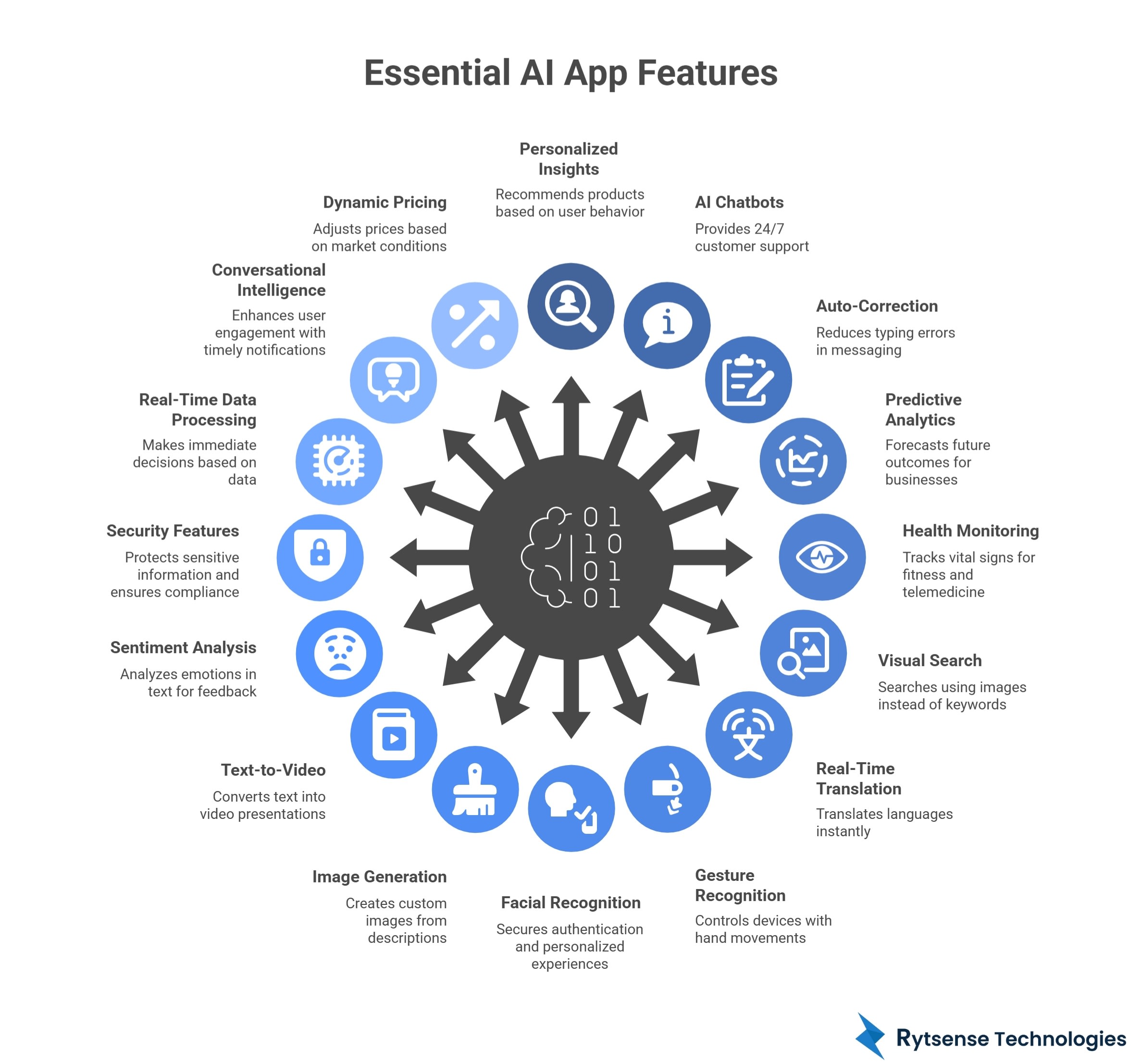
These AI app elements improve usability and functionality. When you wonder
how to build an AI app
, follow these features:
Personalized Insights
Personalized recommendation engines
analyze user behavior, preferences, and context in order to suggest useful products, content, or actions. These apps improve engagement rates by 45% and revenue per user by 30%.
AI-powered chatbots and Voice Assistants
Chatbots which use AI can answer users' questions 24/7 without human help.
AI-powered chatbots
respond to 70-80% of common questions without human assistance. Voice assistants offer a hands-free method of interacting with content, improving accessibility and ease of use.
Also Read: How Much Does Enterprise AI Chatbot Development Cost in 2026?
Auto-Correction and Predictive Text
Auto-correction and predictive text features reduce typing errors and input time by predicting users intended text. This functionality is a necessity in messaging apps, search interfaces, and the creation of document.
Predictive Analytics
Predictive analytics
examines historical and previous data for the purpose of predicting potential future outcomes. Businesses utilize
predictive analytics
in order to predict potential customer churn, optimize inventory, and know potential sales opportunities before competitors do.
Health Monitoring
AI health tracking measures vital signs, activity patterns, and symptoms to issue early warnings. These abilities are useful for fitness programs, wearables, and telemedicine applications.
Visual Search Capabilities
AI-based visual searching allows users to search for products or information by uploading a photo rather than a keyword. This capability improved e-commerce conversion rates by 25-30%.
Real-Time Language Translation
Natural language processing applications
are able to provide implicit translation for multiple countries that speak more than 100 languages, breaking down global business operations and travel applications.
Gesture Recognition
Computer vision applications
can recognize hand actions to control devices without touching them. This technology is becoming mainstream in gaming, smart homes, and automotive interfaces.
Facial Recognition
Facial recognition provides secure authentication, personalized customer experiences, and attendance tracking. Using face recognition and activating it in public spaces must be assessed carefully regarding privacy regulations and ethical implications.
Image & Sticker Generation
Generative AI applications
are able to produce custom images, graphics, and stickers by writing a description. These features are now being integrated into creativity tools, social media applications, and e-commerce and marketing platforms.
Text-to-Video
Text-to-video AI apps
can turn written content into video presentations automatically. This technology is able to save video-production costs by 80% and reduce time by 90%.
Sentiment Analysis AI apps
Sentiment analysis AI apps
examine emotions in a text to allow businesses to assess customer feedback, track brand reputation, and custom-tailor a response based on user mood.
Security and Compliance Features
AI app security and compliance
capabilities, such as anomaly detection, access control, data encryption, and automated compliance monitoring, provide protection for sensitive information and act to satisfy strict regulatory conditions.
Real-Time Data Processing
Real-time data processing allows decisions to be made immediately upon receipt of data, which is greatly beneficial in applications such as fraud detection systems, stock trading, or emergency response systems, where delays can cost companies money or even lives.
Conversational Intelligence
Artificial intelligence uses various variables, including prior user behavior, user location, and user preferences/behaviors, to achieve optimal user engagement via notifications delivered at appropriate times with contextual relevance that can increase engagement rates by up to 40% in comparison to delivering the same notifications generically.
Also Read: Top AI Development Companies in 2026: Reviewed and Ranked
Dynamic Pricing Strategies
Artificial intelligence algorithms apply real-time pricing models based on demand, competition, inventory levels, and customer segments to achieve peak revenue and market share.
Fraud Detection and Risk Scoring
Machine learning apps
examine patterns that a human may overlook to identify suspicious transactions, fraud accounts, and security threats in real-time to reduce fraud loss by up to 60-70%.
Intelligent Search
AI-powered visual search
understands and makes recommendations based on natural language queries, correcting typing errors, and prioritizing and ranking based on relevancy and user intent experiences to improve success rates on search outputs by up to 35%.
Behavior-Based Personalization
AI tracks user interactions to create personalization in interfaces, content, and features.
Offline AI Capabilities
Offline AI capabilities
enable apps to operate without any internet access through the use of lightweight models running on a device, ideal for remote work and travel situations.
Adaptive Learning Flows
The
Adaptive learning AI
will adjust the difficulty and pace of educational content in accordance with the learner’s progress, thus retaining 40% more knowledge than static learning paths.
Voice Biometrics
Voice authentication will verify someone’s identity based on their unique vocal characteristics, allowing individuals to authenticate without the use of passwords or physical tokens.
AI-Driven Content Moderation
AI-driven content moderation
will detect and eliminate inappropriate content, spam, and policy violations 100x quicker than a manual review team.
How Much Does It Cost to Build an AI App?
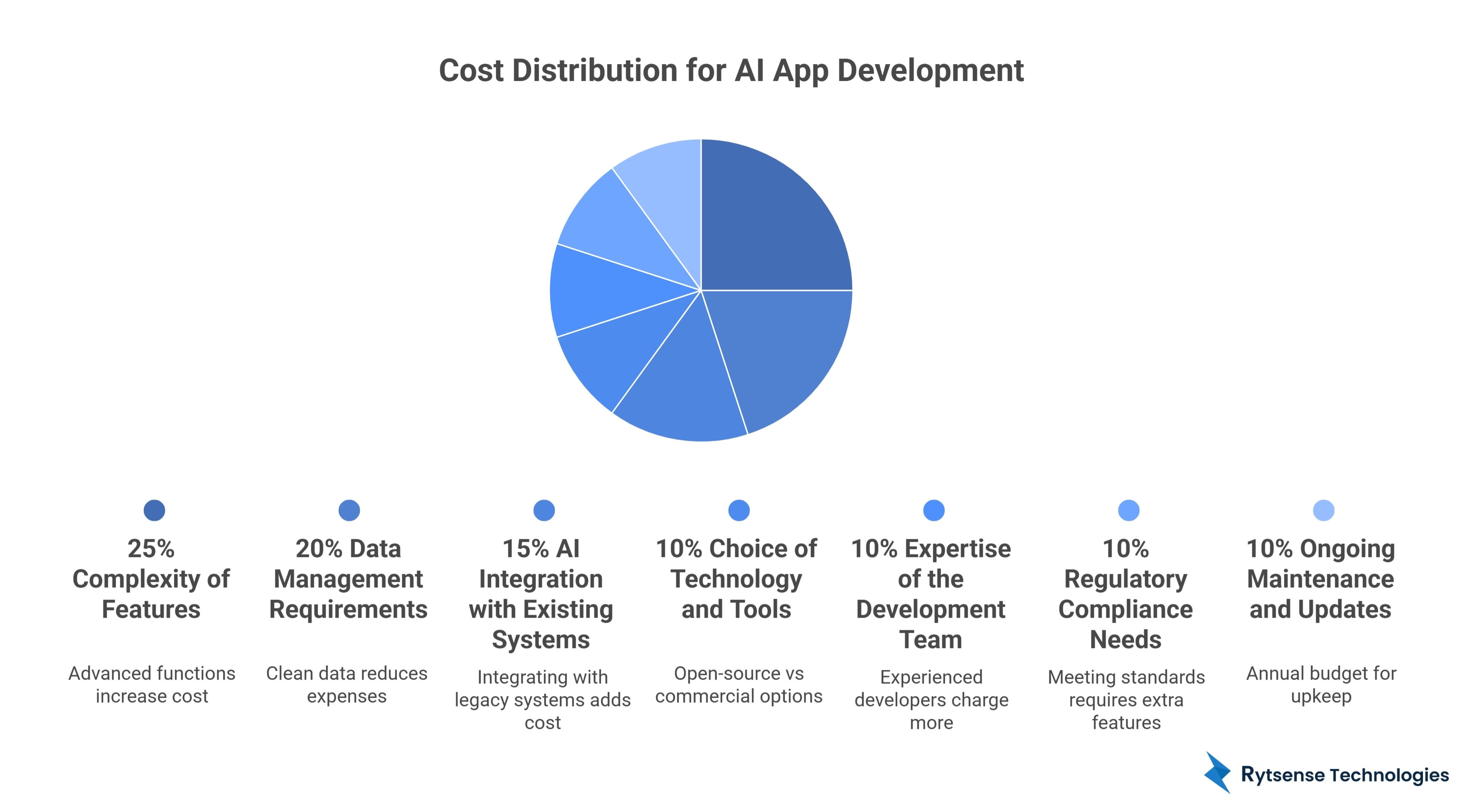
The
AI app cost
varies significantly based on complexity, features, and implementation approach.
ProjectScaleCost RangeTimelineTeam SizeSimple AI AppSmall$40,000 - $80,0003-4 months3-5 developersMedium ComplexityMedium$80,000 - $200,0005-8 months5-8 developersEnterprise SolutionLarge$200,000 - $500,000+9-18 months8-15 developers
Factors That Influence the Cost of Your AI App
Complexity of Features
The cost of apps for AI at the simpler level (e.g., chatbots, recommendation systems) will be less than that of tools with more advanced functions (e.g., computer vision or autonomous decision-making). Each feature will increase your overall cost by 15-30%.
Data Management Requirements
Data management for AI
applications includes data collection, cleaning, storage, and continuous updates. Organizations with clean, organized data spend an average of 40% less on AI projects than organizations that start with messy and non-organized data sources.
AI Integration with Existing Systems
In order to be effective,
AI integration
with existing systems
through the import of data from external systems, a custom API, development performance, and data synchronization. When integrating AI with legacy systems, you can expect integration to increase your cost from 20% to 50%, depending on your system's technical debt and the quality of documentation.
Choice of Technology and Tools
When using an open-source framework for your AI app, you may spend less on licensing costs but will incur more hours during development. Commercial AI platforms let you implement applications faster but charge flat subscription fees. Using cloud AI services will increase your operational cost and increase implementation time, with the benefit of scale once deployed.
Expertise of the Development Team
AI developers who have experience charge (on average) $100-250/hour, depending on location and area of specialization. While using the
best AI development company in USA
will allow for the best quality, it will be at a higher cost compared to lower-cost regions.
Regulatory Compliance Needs
Security and compliance of your AI application will require additional features, security audits, and documentation if your app will need to comply with regulatory requirements such as GDPR, HIPAA, or others. This can increase your overall development cost anywhere from 10% to 25%.
Ongoing Maintenance and Updates
Each year, part of your budget for maintenance should equal 15-20% of the initial development cost. This aspect of the spending allows for model retraining, security patches, feature enhancements, and scaling of the underlying infrastructure with increased usage.
Testing and Quality Assurance
AI app testing and maintenance
in a production context involves 20-30% of the original development budget. Areas to consider are testing for functional validity, checking for bias, evaluating performance, and conducting security testing.
Exploring Monetization Models for Your AI Application
AI app monetization models
are ways to monetize your application:
- Subscription model: Monthly or annual rates for access to AI features ($10-$500/month, depending on AI capabilities).
- Freemium model: Access to basic features for free, but paying for premium AI capabilities (2-5% of users convert).
- Pay-per-use: Charge for API calls, predictions, or data processed (ideal for B2B apps).
- Licensing: Sell your AI technology to businesses ($50,000-$500,000 a license).
- Data monetization: Sell aggregate anonymous insights to market research companies (need to take privacy advisory into consideration).
- Advertising: Free app, monetized with targeted ads with personalization via AI.
- Transaction fees: Take a percentage of the transactions your AI facilitated (common in fintech).
Emerging Trends in AI App Development
Stay ahead of the curve by adopting
emerging AI trends
in your development.
AI and IoT Convergence
Connected devices now create a multitude of data flows that allow AI to analyze the data in real-time on the edge. Smart home applications, industrial sensors, and wearables rely on AI and IoT integration and can process the data locally and return accurate results in less time and at a lower cost.
Deep Learning for Enhanced Personalization
AI apps that leverage deep learning create hyper-personalized experiences from analyzing complex behavior patterns. Neural networks can predict a user's preferences at an accuracy level above 90%, which leads to increased engagement, conversion, and loyalty.
Integrating Generative AI Into Workflows
Generative AI apps are capable of automating the content creation process, coding, and design work, among others. Businesses that integrate generative AI capabilities into their work will decrease their production time by 70% and produce consistent quality.
Explainable AI for Regulatory Compliance
Explainable AI, or xAI, simply means we can demonstrate how our model makes decisions. Transparency is critical for regulated industries such as healthcare, finance, and law. As AI use becomes more prevalent, regulations will mandate that systems justify their recommendations.
Edge AI for Low-Latency Enterprise Solutions
More businesses are implementing edge AI because they want to solve the issues that come with high latency in enterprise solutions. Edge LE processes the data locally on the device, and these apps slice the time it would typically take to process by even seconds, down to milliseconds. Businesses will rely on Edge AI because the latency is mission-critical for applications such as autonomous vehicles, industrial automation, and augmented or virtual reality.
Growth of Autonomous AI Agents
Autonomous
AI agents
function with self-direction to achieve identified goals, making decisions on their own, free of human monitoring. Examples of System Use: They can optimize supply chains, manage trading portfolios, and coordinate logistics operations.
No-Code and Low-Code AI Platforms
No-code AI development
and
low-code AI development
platforms broaden the ability to create AI, that allows non-technical users to create simple AI applications. These platforms can reduce the time traditionally spent on development by around 60-80% for standard use cases, making
AI development
more accessible.
Human-AI Collaboration for Better UX
Human-AI collaboration
designs focus on collaboration and extending human capabilities, not replacing the work with AI. This makes it more likely for adoption and creates better overall results compared to fully automated solutions.
Retrieval-Augmented Generation (RAG) for Accurate Real-Time Results
RAG (Retrieval-Augmented Generation) AI
combines a language model with the ability to retrieve real-time information in a combination of a data set and a real-time information set. The AI solution reduces the probability of hallucination and provides up-to-date answers. RAG will make chatbots more accurate by 40-50%.
Quantum AI Developments
Quantum AI applications
apply quantum computing to optimization problems faster and better than computers that can solve them classically. Early applications that are already being applied include drug discovery, financial modeling, and cryptography.
AI for ESG and Sustainability Initiatives
ESG and sustainability intelligence
apply AI to manage and monitor environmental impact, responsible consumption, and the implementation of ethical supply chains. AI users achieve reductions in carbon emissions of 15-25%.
Overcoming Common Challenges in AI App Development
When understanding the kinds of obstacles you will face, planning for effective solutions will be easier.
Integration With Legacy Systems
Legacy systems do not have APIs, consume outdated forms of data, and cannot read one another's infrastructure. Solutions to consider include building middleware layers to facilitate communication, migrating data piecemeal, and wrapping the legacy systems in APIs.
Addressing Talent Concerns
AI applications bring up a number of concerns about biases and discrimination that lead us to question the privacy of the data we are using. Notice these concerns by using training data from a variety of sources, testing for biases, ensuring transparency of algorithms, and implementing data governance policies.
Addressing Talent and Skill Gaps
AI expertise is scarce and expensive, so organizations look for ways to address the skill gaps already present within their teams. Solutions include teaming with
AI development services
partnered with agencies, upskilling your existing staff, putting together a no-code platform, or connecting with fractional specialists.
Managing Implementation Costs
AI apps can be expensive to develop, which frightens many organizations away from launching into AI. To reduce the costs of developing AI apps, develop narrow, focused use cases (journey into AI app deployment strategy in a gradual way), use open-source tools to keep costs down, buy and use services in the cloud, and follow phased developments.
Setting Realistic Expectations
Realistic expectations must be set in order to remove overhyped expectations of capabilities. Provide groups educating stakeholders on AI, establish realistic goals, and communicate incremental value for management rather than presenting success as transformational overnight.
Ensuring Algorithmic Fairness
AI models have the potential to reproduce or even exacerbate the biases that are already present in the data we are using for training. Institute fairness testing of models, apply a level of diversity in your published datasets, learn and report about how your models are performing in alignment with identified demographics, and develop corrective actions for biases found within your model and its outcomes.
Scaling AI Solutions Effectively
AI solutions that operate well in pilot projects can easily fail when they need to scale. We advocate that you design for scalability in your AI solutions by leveraging cloud infrastructure, designing efficient algorithms, and developing monitoring systems to identify and signal significant declines in performance.
Keeping Up With Technology Evolution
Technology, including AI, works in three-minute cycles and becomes obsolete quickly, which makes the planned solution you purchased, developed, and implemented last year obsolete. Invest in modular architectures and change components when necessary, upgrade budget dollars for new and continued learning, and work with vendors who will support you over the long haul.
Data Management, Privacy, and Model Training Challenges
Some technical challenges need solutions.Here Follows
Finding Data Dilemma in Enterprise AI Projects
Enterprise AI Applications
require large, high-quality datasets that most companies do not have access to. Possible solutions include generating synthetic data, transferring knowledge from pre-trained models, establishing data partnerships, and initiating smaller projects that utilize less data.
Solving the Cold Start Problem
New AI applications lack historical data to train effective models. To overcome the cold start problem: Use publicly available datasets to train models at the outset Utilize rule-based systems until sufficient data is available Utilize data from similar use cases Start with the simplest algorithms that require the least amount of training data.
Complexity and Cost of Model Training
Training complex models involves expensive GPUs, specialized expertise, and may take weeks of compute time. Solutions for lowering costs include using pre-trained models, cloud-based training solutions, or using efficient architectures that deliver similar results with less compute time.
Strategic Approaches for Enterprise AI Implementation
Successful implementation of AI appeals at the enterprise level will typically entail:
- Executive Sponsorship: Gaining a commitment of leadership time and dollars
- Center of Excellence: Creating an AI team to promote learning and identify best practices
- Phased Roll-Out: Initiating lower-risk pilots for successful implementation on an enterprise-wide basis
- Change Management: Transitioning users while managing fears and concerns about their jobs
- Governance Framework: Having policies in place for data consumption, model approval, and risk mitigation
How to Measure the ROI of Your AI App
Use the following metrics in measuring the
AI app ROI metrics
to establish value.
Reducing Manual Efforts
Calculate net labor hours saved by automation multiplied by your product cost of labor, like the following example: AI reduces manual effort for routine tasks by between 40% and 70%. If you implement five automated processes in a year, that could equate to saving $50,000.00 to $300,000.00 per year, per automation.
Improving Accuracy and Operational Efficiency
Revenue gained increases from personalization and recommendations to optimize products, and should be measured in addition to conversions. Gaining an expected 20-35% in conversion rates and a 15-25% increase in average order value in a web store is customary, as a human does not control it.
Enhancing Customer Satisfaction and Retention
Net Error and Quality Improvements gained in efficiencies need to be quantified. Overall, AI-based systems can reduce human error by between 85% and 95% in data, data entry, inspection, and analysis work to reduce errors and costly rework.
Accelerating Decision-Making
Customer satisfaction ratings, idea retention, and net promoter score can help evaluate AI implementations. Customer satisfaction scores, which will typically improve between 15 and 30 points, and reduce churn by 20-35%.
Reducing Operational Costs
Calculate the savings associated with reduced waste, optimized resource allocation, and increased efficiency. AI in manufacturing has been shown to achieve operational cost reductions in the range of 15-30%, while logistics AIs have achieved transportation savings of 20-35%.
Enabling Scalable Solutions
Consider the tremendous value of AI's capacity to simply grow without growing costs. A well-built AI system can process 10x (or sometimes 100x) more volume without additional staff and yet can still be a highly profitable venture.
Conclusion
Learning how to build an AI app is essential to ensure a sustained competitive advantage, especially as our economy continues to become increasingly digital. Achieving that advantage will take a knowledge of AI technologies, understanding what use cases to apply them to, finding skilled teams to implement them, and following development processes and methodologies.
Start small, with clear, defined problems to tackle, look closely at the results, and scale gradually. The organizations that adopt AI app development, whether it is through a best AI development company out of the USA or by their own AI development service capabilities, will lead their industries in the near future. Follow the complete guide to know how to build an AI app.
Meet the Author

Co-Founder, Rytsense Technologies
Karthik is the Co-Founder of Rytsense Technologies, where he leads cutting-edge projects at the intersection of Data Science and Generative AI. With nearly a decade of hands-on experience in data-driven innovation, he has helped businesses unlock value from complex data through advanced analytics, machine learning, and AI-powered solutions. Currently, his focus is on building next-generation Generative AI applications that are reshaping the way enterprises operate and scale. When not architecting AI systems, Karthik explores the evolving future of technology, where creativity meets intelligence.