Key Takeaways
E-commerce AI agents autonomously make decisions and learn continuously, unlike traditional chatbots that follow pre-programmed scripts.
Businesses implementing AI agents achieve 25-40% higher conversion rates and 30% operational cost reductions with measurable ROI.
Successful implementation follows a 5-6 month phased approach from pilot testing to full integration across existing systems.
AI agents automate promotions, generate product descriptions, extract insights, and deliver scalable one-to-one personalization for every customer.
Agentic commerce requires balancing autonomous intelligence with human oversight while addressing data privacy, security, and ethical AI considerations.
E-commerce AI Agents and Agentic Commerce: What Businesses Need to Know in 2026
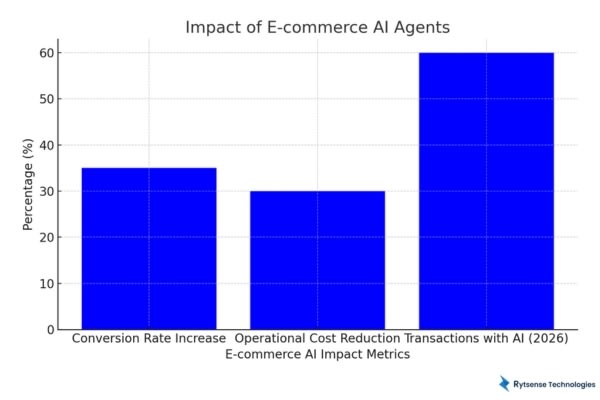
E-commerce AI agents are changing how online retail works at breakneck speed. Recent industry reports indicate businesses adopting AI agents in retail and ecommerce have experienced increases in conversion rates between 25% and 40% and reductions in operational costs of up to 30%. By 2026, it is estimated that 60% of e-commerce transactions will involve some level of agentic AI interactions. This creates a definitive shift in the way consumers shop and businesses conduct e-commerce, supported by AI development services and innovations led by top AI development company in USA providers.
What Is Agentic Commerce?
Agentic commerce is the next stage of online retail; autonomous e-commerce AI agents are able to act independently of human beings in order to achieve particular business objectives. These ecommerce AI agents are not pre-programmed automated systems that reliably run their scripts. They operate independently, while they learn from interactions and adjust their behavior in response to their environments. E-commerce AI agents are digital assistants or agents that are able to assess customer intent, negotiate agreements, manage inventory, and perform other complex tasks autonomously, with limited interaction with humans.This evolution is closely tied to the growing adoption of AI agent development services and solutions offered by modern AI agent development company partners.
How Agentic Commerce Differs from Traditional E-commerce
In traditional e-commerce, you set up product pages, and customers interact with those listings through browsing and adding items to their cart before proceeding to checkout. Traditional e-commerce stores rely on static rules and manual processes. In contrast, agentic commerce introduces intelligent automation where AI agents are autonomously involved in the online shopping experience at every stage. They anticipate user needs, suggest relevant solutions on a user’s behalf, and facilitate transactions on a user’s behalf. The significant difference is in their autonomy; agentic AI e-commerce systems think, decide, and take action within defined parameters, independent from the user. These shifts also highlight why many companies compare AI agent vs chatbot capabilities to choose the best path forward.
The Evolution of AI Agents in Online Retail
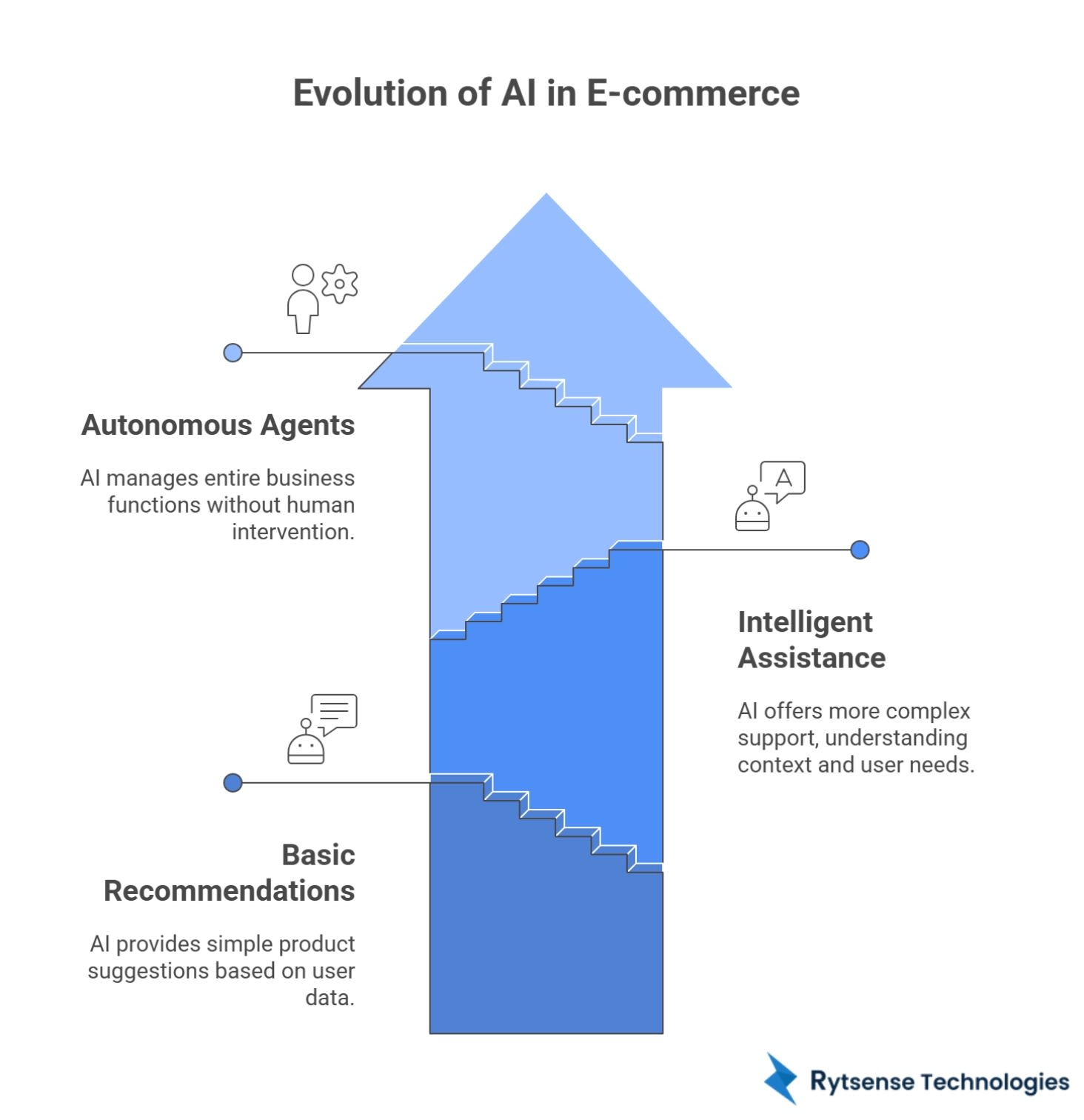
In e-commerce, AI started with basic recommendation engines and chatbots, only being able to respond to direct queries. Today's e-commerce AI agents are a quantum leap forward, combining natural language processing, machine learning, and multi-layer cognitive and decision-making capabilities to support complex scenarios. The goal has shifted from automation to intelligent assistance to fully autonomous agents that can manage entire functions of a business. Growing offerings such as Generative AI development services further accelerate this evolution.
What Does Agentic Commerce Look Like in Practice?
AI agents for e-commerce differ from chatbots and automation because they incorporate independent reasoning, continuous learning, and goal-oriented action in addition to their products providing scripted functions or the automation tool executing a function as instructed. Other than scripted functions or generating a single function, ecommerce AI agents can execute a multi-step workflow through contextual awareness and proactive problem-solving. Many organizations evaluate AI agent vs chatbot comparisons to better understand this distinction, and increasingly adopt capabilities such as an AI sales agent to support autonomous decision-making in real-world commerce scenarios.
The Role of Autonomous E-commerce AI Agents
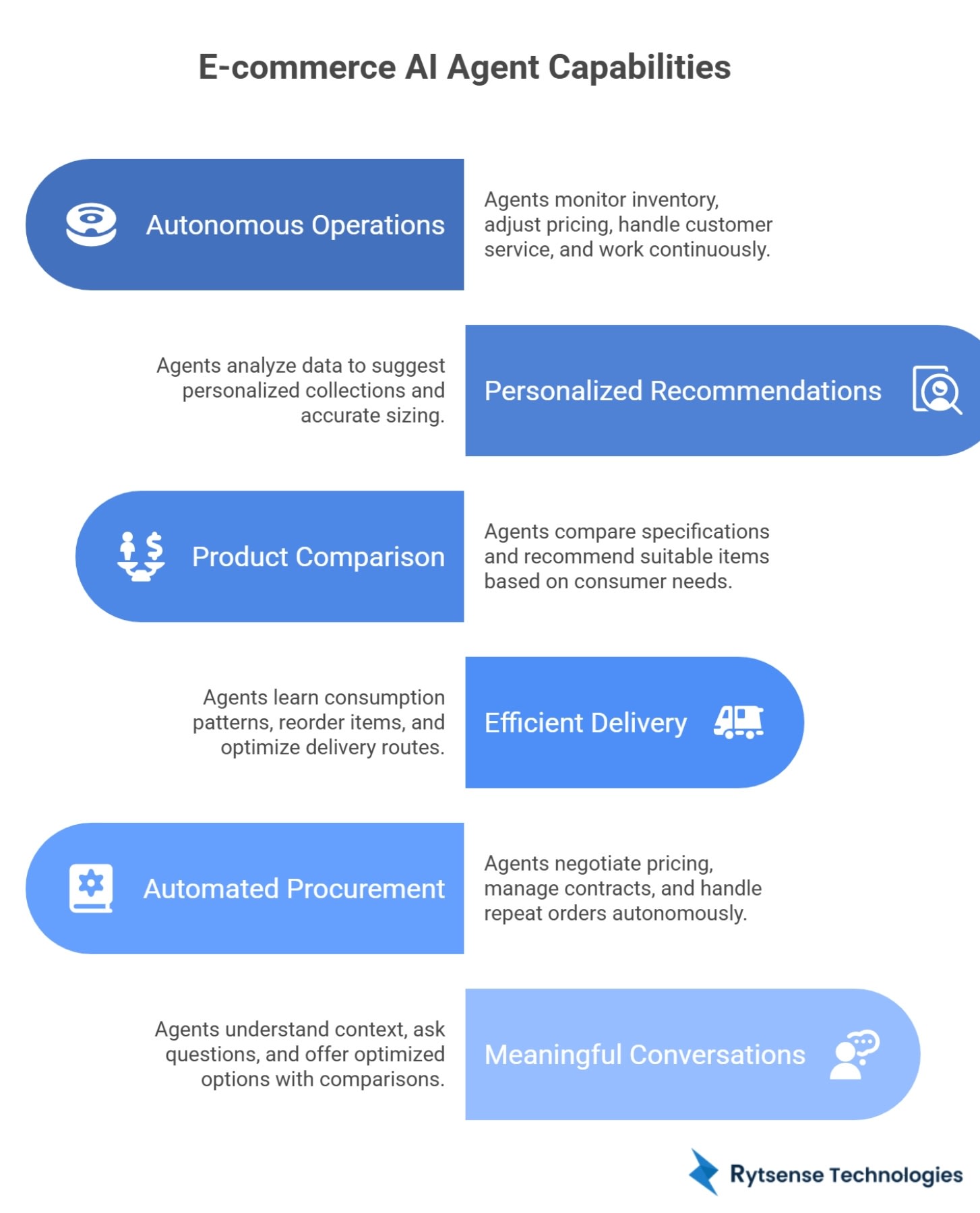
Autonomous agents perform multiple duties, which include monitoring inventory and automatically triggering reorders. They analyze customers' behavior to make instant pricing modifications. They also handle customer service requests and issues while only contacting human agents for complex tasks. They work constantly, addressing thousands of requests without needing breaks and making a few errors. These capabilities support use cases often delivered through AI agents for enterprise ecosystems.
Real-world E-commerce Use Cases
- Fashion retailers: AI agents analyze customer measurements, clothing styles, and preferences, and purchase history to choose personalized collections based on that information. The agents have been shown to provide accurate sizing recommendations with a 35% return rate reduction.
- Electronics platforms: Agents can compare specifications across thousands of items, explain to the consumer the difference in terms that make sense, and recommend the best-suited items for that consumer outside of price.
- Grocery delivery: AI agents learn consumption patterns for the household, reorder items before customers run out, and produce delivery routes that increase efficiency and lower costs (20-25% savings).
- Wholesale B2B: Agents negotiate pricing for bulk buys autonomously, can automatically manage renewal contracts, and can autonomously manage repeat orders, reducing the time of procurement from days to minutes.
These use cases increasingly rely on AI chatbot for ecommerce and conversational agents that enhance retail workflows.
Shopper Interaction and Experience with AI Agents
Shoppers engage in meaningful conversations with AI agents. One shopper might say, “I need running shoes for marathon training at a budget of $150.” The agent understands the context and asks relevant follow-up questions about running style or terrain, checks inventory across multiple warehouses, and then offers three optimized options along with a detailed comparison. The experience has the appearance of being human, helpful, and personal in nature, rather than scripted or robotic in form. These interactions reflect the growing adoption of Conversational AI in retail, AI chatbot development services, and even specialized AI chatbot development in USA offerings supporting retailers globally.
Upgrade your e-commerce with intelligent AI agents built for speed and scale.
AI Agents vs. Chatbots vs. Automation Tools
AI agents for e-commerce differ from chatbots and automation because they incorporate independent reasoning, continuous learning, and goal-oriented action in addition to their products providing scripted functions or the automation tool executing a function as instructed. Other than scripted functions or generating a single function, ecommerce AI agents can execute a multi-step workflow through contextual awareness and proactive problem-solving. Many organizations evaluate AI agent vs chatbot comparisons to better understand this distinction, especially when adopting advanced capabilities such as an AI sales agent for automated decision-making and customer-facing tasks.
Key Differences in Functionality
| Feature | Traditional Chatbots | Automation Tools | E-commerce AI Agents |
|---|---|---|---|
| Decision Making | Pre-scripted responses | Rule-based triggers | Autonomous reasoning |
| Learning Ability | Limited or none | None | Continuous adaptation |
| Task Complexity | Simple Q&A | Single-function tasks | Multi-step workflows |
| Context Understanding | Keyword matching | None | Deep contextual awareness |
| Goal Orientation | Reactive | Programmed actions | Proactive goal pursuit |
- Independence and Objective-driven Behavior: E-commerce AI agents work autonomously and within pre-defined parameters. Your assignment states that “maximize customer lifetime” or “decrease cart abandonment by 15%”, and the agent can ascertain the best course of action to accomplish the task without step-by-step instruction.
- Contextual Awareness: AI agents are aware of the complete context surrounding each interaction. They are cognizant of the customer’s purchase history compared to the customer’s browsing history, the hour of the day, the device type, and whether or not it is peak purchasing season. All of this enables them to respond with almost true overall personalization.
- Immediate Decision-making: Agent e commerce systems aggregate information and make decisions in real time. When a customer asks a question about product availability, the Agent checks supply on demand, considers package delivery times, offers alternatives, and completely answers your query in seconds—not hours or days.
- Learning and Adaptation: Each interaction improves agent performance. If customers constantly rebut a recommendation pattern, the agent recognizes the trend and recalibrates its recommendation strategy. This can be completed in real time, without any static retraining of the model.
- Collaboration with Other Systems: E-commerce artificial intelligence agents are not likely to operate in isolation. They will run in conjunction with inventory management, customer relationship management platforms, payment processors, and shipping services that work together to manage complex operations across your entire connected technology stack.
Why Agentic E-commerce AI Agents are the Next Generation of Online Shopping
Chatbots sit and wait for customers to ask questions. Automated tools perform pre-programmed tasks. AI agents for e-commerce operate automatically toward business-specific objectives. AI agents see opportunity, make strategic decisions, and independently optimize outcomes. The ability to operate autonomously and proactively transforms agentic commerce into the most powerful form of e-commerce technology to date.
Core Attributes of an E-commerce AI Agent
Autonomy and Goal-Driven Behavior
E-commerce AI agents operate independently, executing tasks such as product recommendations, inventory checks, or customer support without requiring constant human input. They are designed to pursue specific business goals like boosting conversions or enhancing customer experience.
Context Awareness
These agents understand context—such as user intent, browsing history, cart activity, and real-time store conditions—to deliver highly relevant responses and actions.
Real-time Decision-making
E-commerce AI agents analyze data instantly and make decisions on the spot, helping with dynamic pricing, personalized promotions, fraud detection, and customer engagement.
Learning and Adaptation
They continuously learn from customer behavior, new data, and outcomes of previous actions. This enables them to improve accuracy, refine strategies, and adapt to changing market trends.
Collaboration with Other Systems
AI agents integrate seamlessly with CRMs, ERPs, inventory management tools, payment systems, and marketing automation platforms—creating an interconnected, intelligent e-commerce ecosystem.
How E-commerce Teams Can Use AI Agents
E-commerce teams take advantage of AI agents to manage promotion campaigns, generate dynamic product descriptions, extract actionable business insights, and customize customer interactions at scale. These applications save time associated with manual workloads, enhance marketing ROI by 40%, and allow data-driven decision-making across all business areas.
Automate Promotions and Campaigns with E-commerce AI Agents
As marketing teams spend countless hours planning, creating, and managing promotional campaigns, AI Agents will help significantly streamline this process. AI agents analyze customer segments and orders, assess the optimal discount levels needed to drive profitably, and automatically generate an offer for customers in the automation. For example, the agent can analyze a customer segment of customers who have abandoned a cart, and identify that customers who have carts over $200 are more likely to respond to a free shipping offer, compared to a percentage discount, or vice versa for each offer type.
Rytsense Technologies provides use cases that provide a marketing team with AI agents that will assess campaign performance in real time, halt advertising placement on underperforming campaigns, and then direct all the budgets to the campaigns with the highest conversion rate. This type of technology has produced results for clients with a 40% improvement in ROI on marketing spend within the first quarter of implementation.
Generate Dynamic Product Descriptions
Composing effective product descriptions for a catalog of thousands of SKUs is labor-intensive and costly. AI agents evaluate product characteristics, customer reviews, competing listings, and search trends to automatically develop optimized descriptions. Agents will modify tone and detail reset according to the product category (i.e., technical specifications for electronics or emotional narrative for a piece of clothing).
Extract Actionable Business Insights
E-Commerce AI agents will constantly evaluate transaction data, customer experience data, website activity, and trends to provide on-demand, actionable insights. Instead of waiting for a monthly report, business leaders receive alerts in real-time when an opportunity or a problem is known or is occurring. An agent may disclose that customers from a certain location have been searching for a product variant that you do not have, so the opportunity is clear.
Personalize Customer Interactions
At scale, each customer will have personalization. AI agents will remember previous interactions, anticipate the needs of a customer based on behavior patterns, and customize communications. The returning customer will see product recommendations based on their previous preferences, rather than rankings of bestsellers. The email communications will include customizations regarding content, timing, and offers based on the individual’s engagement pattern.
Automate workflows and enhance customer experiences with custom AI solutions.
How Shoppers Benefit from AI Agents
Consumers enjoy considerable benefits by receiving improved product recommendations, which generate 3-4 times greater conversion rates, conversational shopping that simplifies the process and compresses the time to purchase by 45-50%. They also receive faster personalized support, where 70-80% of customer inquiries are answered instantly and brand questions are resolved without a person or lengthy response times.
Smarter Product Recommendations via AI Agents
Customers receive recommendations that truly match their needs and preferences. The best AI agents for ecommerce evaluate not just purchase history, but also browsing behavior, time on pages, items placed in and out of shopping carts, and the profiles of shoppers who make similar selections. This multi-faceted analysis provides recommendations with 3-4 times better conversion compared to non-AI recommendations.
Seamless Conversational Shopping
Customers shop through natural conversation and do not have to work their way through a complex category structure. Customers simply describe their needed items in natural language, and the agent does the searching, filtering, sorting, and comparing. On average, this can reduce the time from browsing to purchase by 45-50%, and it is a frictionless experience.
Faster, Personalized Support Experiences
Support inquiries are answered quickly and accurately. An AI agent can access the complete customer history, order history, and product knowledge on demand. An AI agent is able to address 70-80% of standard inquiries without anyone else assisting. And personal support leads to a solid lead hand-off by guaranteeing complex inquiries go to the right specialist immediately, with context already presented to the specialist.
The Benefits of Agentic Commerce
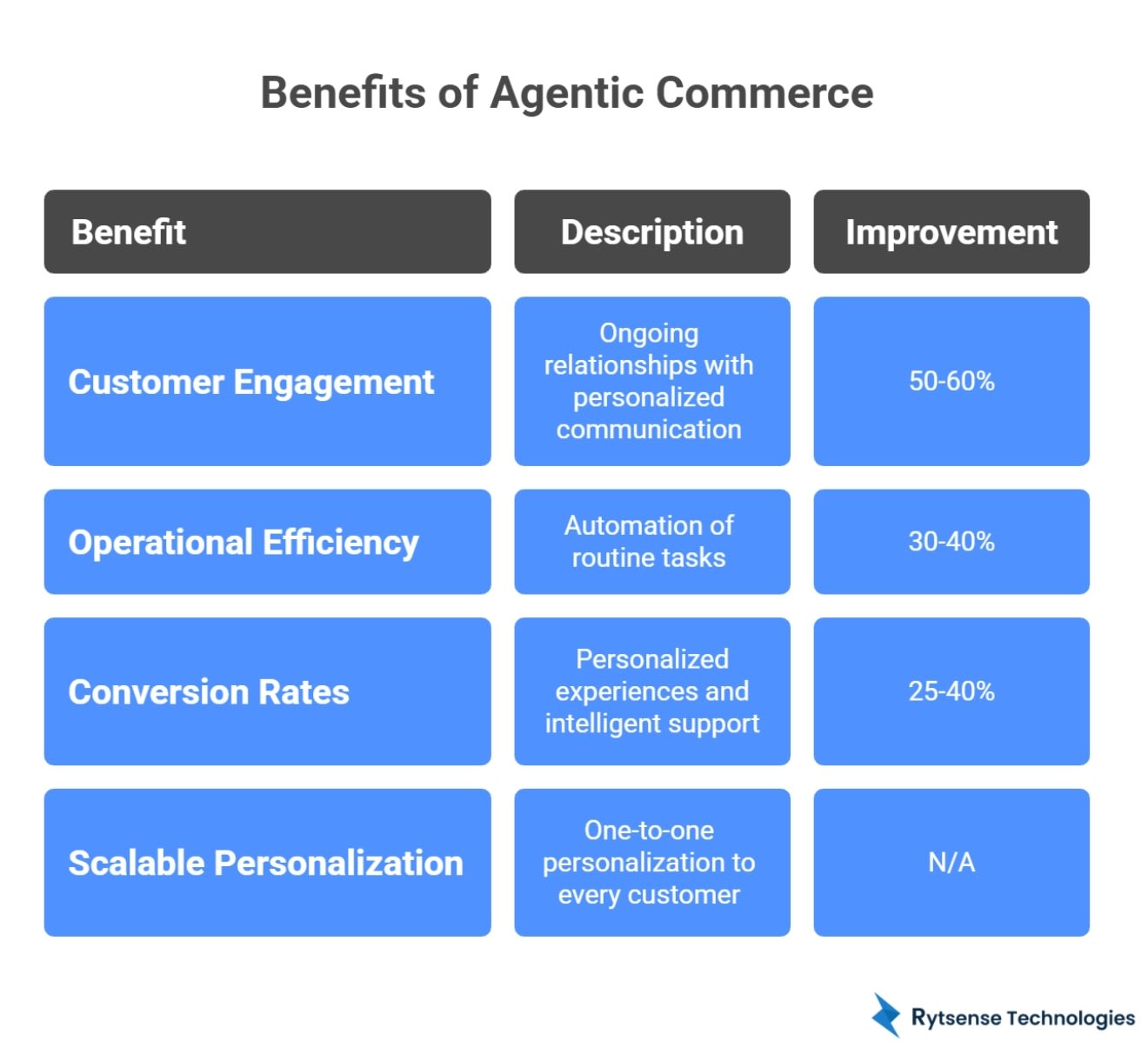
Agentic commerce provides significant customer engagement improvements of up to 50-60%, operational efficiency improvements of 30-40%, increases in conversion rates of 25-40%, and effective scalability for personalization. All of these benefits provide measurable ROI in lower costs, increased revenues, and sustainable competitive advantages in digital retail.
Enhanced Customer Engagement
Agentic commerce is about creating ongoing relationships rather than one-off transactions. AI agents facilitate ongoing engagement with personalized communications, timely recommendations, and proactive issue resolution. Customer engagement metrics typically improve by 50-60% within 6 months of implementation.
Improved Operational Efficiency
A business reduces operational costs significantly by automating routine tasks. AI agents manage inventory, process orders, deal with basic customer service, and undertake routine admin work. Teams can use this time on strategic initiatives and complex problem-solving. Companies realize operational efficiency improvements in the range of 30-40% after full implementation.
Increased Conversion Rates and ROI
Personalized experiences and intelligent support lead to measurable revenue gain. Businesses that use agentic AI e-commerce report average conversion rate increases from 25-40%. Cart abandonment is reduced by 20-30%. Average order values improved by 15-25%, accomplished through improved product matching and intelligent upsell.
Scalable Personalization
Traditional personalization requires a significant amount of manual effort, and it becomes impractical to scale personalized experiences beyond basic segmentation. E-commerce AI agents can provide actual one-to-one personalization to every customer, all at the same time. It does not matter if you see 100 or 100,000 daily visitors – every single visitor receives an individualized experience without the need for additional resources.
How to Implement Agentic Commerce in Your Business
Implementing an agent involves evaluation of data infrastructure readiness, selecting suitable AI frameworks based on use cases and business requirements, integrating the agents into existing systems through a phased approach over 5 to 6 months, and determining how to continuously measure performance and make adjustments to improve performance and return on investment.
Assess Readiness and Data Infrastructure
Audit Your Data Quality: Review your current methods for collecting and storing data. AI agents function best with "clean," organized data in relation to products, customers, and transactions. Conduct a comprehensive audit of your data, identifying gaps and inconsistencies.
Review Your Technology Stack: Document all of your current systems e-commerce platform, CRM, inventory management, marketing tools, and determine which of these systems have API ability that would allow agent integration.
Consider Capabilities of Your Staff: Review your internal capabilities in AI, data science, and systems integration. Determine whether you need additional partners or whether you can implement the AI agents internally.
Plan Your Internal Budget: The cost to implement AI agents will vary significantly based on the size and complexity of your business. A small business may start the implementation for a cost of $25,000-50,000 for the implementation of a basic agent. For enterprises, the cost of implementation will cost anywhere from $200,000 to $500,000 upfront, with some 20-30% of manual ongoing costs after the agent is implemented.
Choose the Right AI Framework
| Business Need | Recommended Framework Type | Best For |
|---|---|---|
| Customer Service | Conversational AI Agents | Support ticket reduction |
| Marketing Automation | Predictive Analytics Agents | Campaign optimization |
| Inventory Management | Decision-making Agents | Stock optimization |
| Personalization | Recommendation Agents | Conversion improvement |
Select frameworks based on specific business requirements:
Consider both custom-built and off-the-shelf build options. There is great flexibility with custom development, but significant technical resources are needed for development and monitoring. Pre-built solutions offered by established vendors are typically faster to implement and will require less customization.
Integrate with Existing Systems
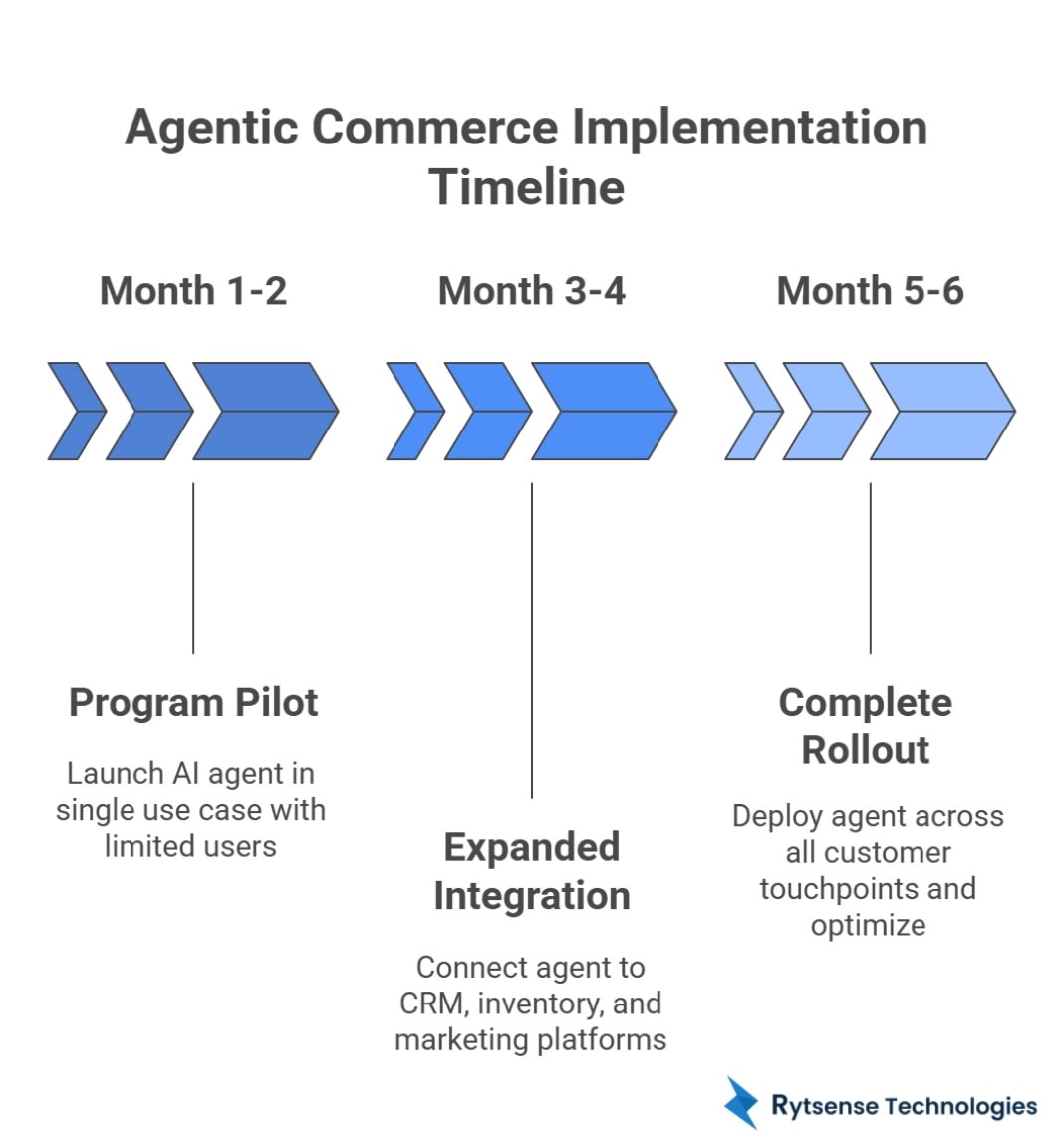
Phase 1: Program Pilot (Month 1-2)
Begin with a single use case (typically customer service or product recommendations). Connect the AI agent to just one or two core systems. Pilot the AI agent with a limited participant/user group and collect baseline metrics prior to launching.
Phase 2: Expanded Integration (Months 3-4)
Based on pilot learnings, expand the capability, system connectivity, and integrations of the agent. Connect to both CRM, inventory management, and marketing platforms. A vendor like Rytsense Technologies provides seamless integrations and will ensure the AI agents are communicating across your entire technology ecosystem without conflicting with any existing systems.
Phase 3: Complete Rollout (Months 5-6)
Launch the AI agent at all customer touchpoints. Allow agent configuration across functions. Implement in-depth monitoring and optimization processes.
Measure Success and Optimize
Identify clear KPIs in advance of deployment:
Customer Experience KPIs
Customer satisfaction score (target: 15-20% improvement)
Average resolution time (target: 40-50% reduction)
Net Promoter Score (target: 10-15 points higher)
Business Performance KPIs
Conversion rate (target: 25-40% improvement)
Average order value (target: 15-25% increase)
Cart abandonment rate (target: 20-30% lower)
Customer lifetime value (target: 30-50% higher)
Operational Efficiency KPIs
Cost per transaction (target: 25-35% lower)
Support ticket volume (target: 60-70% lower)
Time to resolution (target: 50-60% improvement)
Set up a continuous optimization cycle. Review performance monthly and change underperforming agent parameters.
Read Also:
Top 10 Agentic AI Use Cases in BankingChallenges and Ethical Considerations
Companies have to tackle significant challenges such as data privacy and security compliance with legislation such as GDPR and CCPA, transparency and bias in AI decisions by performing regular audits, and ensuring proper human control and oversight for ethical operations and accountability, while balancing automation and autonomy.
Data Privacy and Security
AI agents in retail and ecommerce analyze massive amounts of sensitive data about customers. Implement strong security protocols, including encryption, access controls, and regular security audits. Abide by GDPR, CCPA, and other applicable regulations. Communicate when data is collected and simplify in clear terms how that information is used to enhance the customer's experience. Customers need to know what data the agent accesses, or aggregates, and how it improves their experience.
Transparency and Bias in AI Decisions
Although Agent e commerce may make decisions based on patterns, such behavior may lead to unintentional discrimination against certain customers. Regular audits of bias are beneficial. Assess agent behavior across customer segments. Establish fairness constraints to guarantee that all customers are treated equally, regardless of demographic variables. Additionally, maintain transparency related to whether customers are interacting with a customer service agent or AI when they inquire about support or services.
Maintaining Human Oversight
While agents work in an autonomous fashion, human oversight is still critical in customer service. Provide clear directions for agent escalation when complexity arises. Agents should be reviewed regularly as it pertains to their decisions or outcomes. Keep human teams in place and able to assume responsibility in the organization when agent interventions occur that are unusual, less than satisfactory, or unexplained. The concept is one of augmented intelligence (the human and the agent) rather than complete human automation.
The Future of Agentic Commerce
The future includes advanced technologies like multimodal AI, quantum computing, and edge processing, enabling next-gen agents. By 2026, personalized autonomous shopping will take over, and the competitive advantage will soon shift from prior factors to agent intelligence, changing the e-commerce strategy and consumer type dramatically.

Emerging Technologies Powering E-commerce AI Agents
Multimodal AI: Future agents will return results based on inputs from text, images, video, and audio at the same time. For example, a customer will photograph an item they like, and the agent will instantly find similar products across your entire catalog and provide results.
Quantum Computing: As quantum systems become more available, AI agents will leverage their quantum processing power to solve problems required for optimization that are impossible or unattainable from classical computing, leading to even greater personalization and logistics feats.
Edge Computing: Processing will be performed closer to the user, decreasing latency and increasing the agents' ability to process and return real-time responses, even when connectivity is subpar. This will benefit mobile commerce and markets with emerging economies as well.
Companies like Rytsense Technologies are developing capabilities to capitalize on these emerging technologies to enable and lead the development of next-generation agentic commerce platforms.
The Rise of Personalized Autonomous Shopping
Autonomous shopping services will be AI agents that will serve as individualized shopping agents with a more nuanced understanding of individual preferences and limitations. They will have the ability to facilitate a complete shopping experience by performing tasks autonomously, including product research, comparing alternatives from different suppliers, negotiating prices, and completing the transaction. Consumers will simply communicate tasks like "please furnish my new apartment for no more than $5,000" and receive a complete, customized solution.
Long-term Impact on E-commerce Strategy
Agentic commerce changes the competitive interactions of e-commerce. Rather than competing solely on products and pricing, businesses will be competing on the intelligence of their agents and consumer experiences. Companies that are able to provide superior AI agents for e-commerce will take market share from businesses using more traditional approaches. Strategic focuses will shift from customer acquisition to agent performance and ongoing learning systems.
As stated at the outset of this book, the researcher views (agentic) commerce and AI customer service agents as a paradigm shift, the biggest change since mobile shopping and its ubiquity in the retail sector. Companies that deploy (agentic) commerce solutions will quickly realize competitive advantages that stem from productivity,' better customer experiences,' and higher profitability than their competitors. Success with emerging retail technology will require planning, appropriate supporting infrastructure, and a commitment to ongoing improvement.
The future of commerce is for those who find and implement intelligent automated solutions, whilst maintaining strong ethical frameworks, and a level of human oversight. Start implementing agentic solutions by assessing readiness, determining the right AI agents in retail and ecommerce use cases, and working with the appropriate vendor who has a good grasp of the strategic and tactical aspects.
Start your journey toward fully autonomous, agentic commerce.
Meet the Author

Karthikeyan
Connect on LinkedInCo-Founder, Rytsense Technologies
Karthik is the Co-Founder of Rytsense Technologies, where he leads cutting-edge projects at the intersection of Data Science and Generative AI. With nearly a decade of hands-on experience in data-driven innovation, he has helped businesses unlock value from complex data through advanced analytics, machine learning, and AI-powered solutions. Currently, his focus is on building next-generation Generative AI applications that are reshaping the way enterprises operate and scale. When not architecting AI systems, Karthik explores the evolving future of technology, where creativity meets intelligence.