Key Takeaways
Agentic AI for marketing autonomously makes decisions, optimizes campaigns in real time, and executes strategies without constant human oversight, transforming personalization and customer engagement. Marketing skills are shifting from manual tasks to strategic capabilities such as AI orchestration, creative direction, ethical judgment, and human-AI collaboration. Successful implementation a requires strong data foundations, focused pilot projects with cross-functional teams, and clear ethical guidelines before deployment. Organizations can achieve 40-60% efficiency gains and 20-50% performance improvements but must manage risks such as over-automation, privacy concerns, and algorithmic bias. Future marketing leaders will develop complementary strategic skills, partner with experienced AI development companies, and prioritize responsible AI use.
Agentic AI for Marketing: The Complete Guide You Need to Know
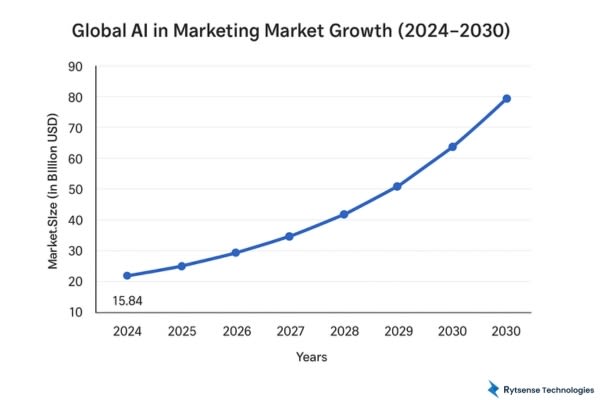
Agentic AI for marketing is reshaping how businesses engage customers and, notably, Gartner found that 72% of marketing executives expect to invest more in AI in 2026. Through independent decision-making, real-time data analysis, and push-button implementation of marketing strategies, agentic AI is a distinct class of autonomous technology.
Agentic AI differs from basic automated processes and traditional automation because agents do not just follow established rules. They also learn, adapt, and categorize campaign performance over time.
The global AI in marketing market officially surpassed $15.84 billion in 2024, and the segment was projected to grow at a CAGR of 29.79% through 2030. Suffice it to say, it is time to learn about and engage with agentic AI systems, which will be a powerful tool for marketers.
About Agentic AI for Marketing
To appreciate agentic AI for marketing, one must recognize the independent-thinking capacity of these systems: they make decisions, act from input data and algorithmic processing of customer behavioral analysis. It helps to optimize campaigns across multiple marketing channels while leveraging customer behavior data, but without continuous supervision. This fundamentally changes how marketers approach personalization, customer segmentation and engagement, and marketing in real time.
What Agentic AI Means in Marketing
Agentic AI for marketing refers to artificial intelligence systems that can operate independently to meet marketing objectives. These autonomous AI agents can act on and analyze consumer behavior, determine audience segments, develop content permutations, optimize campaigns, and make decisions that contribute to strategy independently.
An AI agent for marketing is like having a competent team resource that works 24/7 to process huge data sets, recognize patterns, and highlight opportunities that humans may not recognize.
The primary feature of AI agents for marketing is choice; they set goals, plan actions, curate tasks to achieve those goals, and learn from results without the need for humans to issue step-by-step instructions. This sets them apart from chatbots or basic automation.
How It Differs from Traditional Automation
Traditional marketing automation follows predefined workflows. If a customer abandons a cart, the system sends a pre-written email after a set period, and that’s the extent of its capabilities. It's the limit.
Traditional AutomationAgentic AI for MarketingFollows fixed rulesMakes dynamic decisionsExecutes pre-programmed sequencesAdapts strategies in real-timeRequires manual updatesLearns and improves automaticallyLimited to simple triggersHandles complex scenariosStatic personalizationDeep, contextual personalization
Classic marketing automation operates based on predetermined processes. For eg, if a customer abandons a cart, the system sends a pre-written email after a set period, and that’s the extent of its capabilities.
A marketing AI agent is capable of performing functions such as diagnosing the reasons why customers abandon carts, deciding the best tone for each customer message, determining the best time to send each customer message, experimenting with different approaches, and iterating on results, all without human assistance.
Why It Matters for Modern Marketers
Consumers now expect personalized experiences across multiple channels simultaneously. This is not feasible manually. Marketing AI agents within small businesses in the USA can level the playing field and enable small companies to access advanced capabilities that once required large teams.
The best marketing AI agents will produce three valuable benefits: speed, scale, and accuracy. These systems can instantly process customer signals, strategize in thousands of customer journeys at the same time, and optimize each interaction based on the data, not the gut.
The Evolution of Marketing Skills
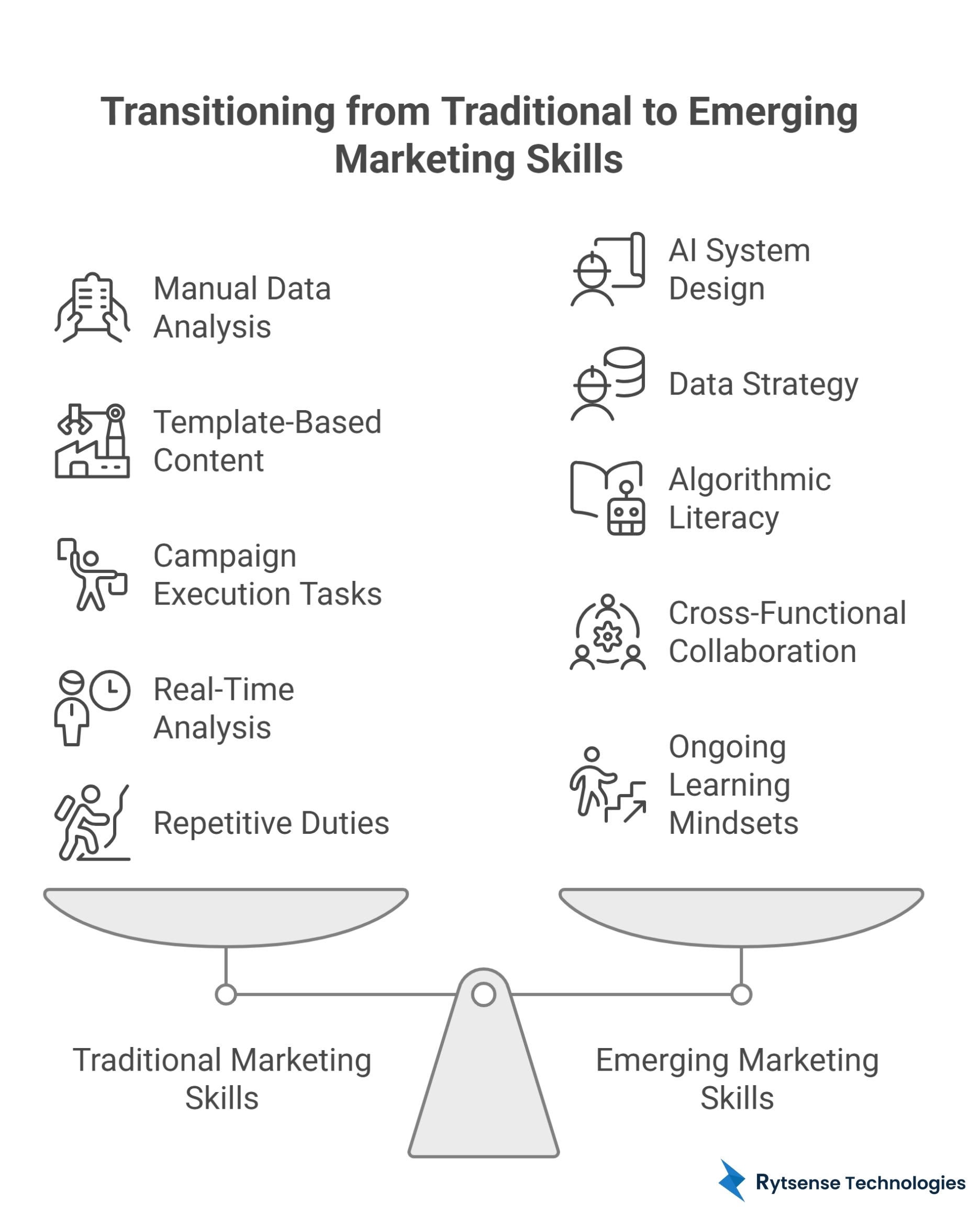
Marketer's skills are changing as agentic AI for marketing continues to automate mundane and routine tasks: the traditional skill of manual data analysis deserves diminishing value. The content created in a template has raised points for having value; the new marketer must learn about, define parameters for, and orchestrate AI. While also framing must-have ethical frameworks and collaborating horizontally across functions, disparate departments or levels of authority.
What’s Going Away: Marketing Skills on the Decline
As agentic AI for marketing becomes a regular tool, there are some traditional skills that will not hold their value:
- Manual analysis still matters for interpretation and validation.
- Template-based content production becomes more poorly timed when AI generates personalized approaches.
- Campaign execution tasks (scheduling posts, list segmentation, etc.) are automatically planned.
- Real time analysis and basic reporting are provided by AI-enabled systems that help companies analyze in real time.
- Marketers who spend their time on repetitive duties are facing automation as transition is quick.
The AI agent for marketing is creating a demand for higher-level skills:
- AI system design helps marketers organize effective and efficient AI workflow.
- Data strategy ensures that your AI agents have good data inputs.
- Algorithmic literacy permits marketers to know how AI reaches decisions.
- Cross-functional collaboration is needed since AI will affect every department.
- Ongoing learning mindsets permit marketers to stay updated with the rapid evolution of technology.
- Shifting the focus away from operational tasks to designing systems and providing strategic guidance.
Also Read: Agentic AI vs Generative AI: Understanding the Differences
5 Agentic AI Marketing Skills You Need
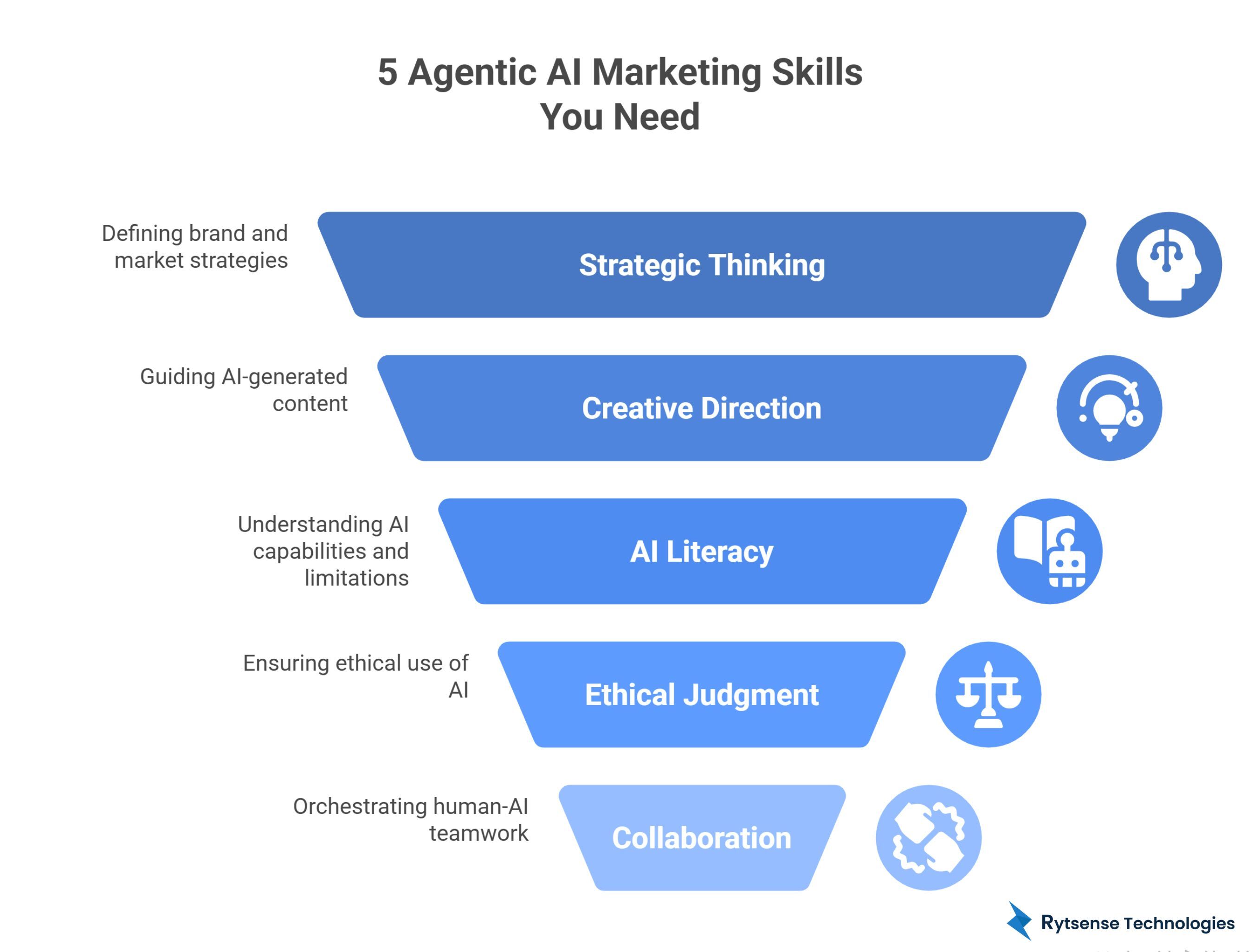
Strategic Thinking in an AI-Driven Landscape
AI agents for marketing carry out tactics very well, but they still need humans to make decisions about strategies. Marketers must define the brand's positioning, define target markets, create business goals, and know how to be competitive.
Strategic thinking is asking questions such as:
- What do we need to accomplish?
- Who are we serving?
- What makes us different?
- What is success?
These questions call upon humans to use decision-making skills, market intuition, and business expertise that AI cannot replicate.
Guiding Creative Direction with AI Support
The leading AI agent for marketing can create thousands of iterations of content, though humans must drive the creative vision. Marketers need to develop a brand voice, establish visual aesthetics, convey emotional tenor and dimension, and demonstrate cultural relevance.
Creative direction centers around giving AI good briefs, assessing the options created by the AI, exploring different directions that reflect brand values, and curating an authentic representation. AI enhances creativity; it doesn’t replace it.
Building AI Literacy for Marketing Teams
Every marketer should be able to operate with a level of basic AI literacy. This implies understanding how to use AI agentsfor market research, articulating the capabilities and challenges of AI, and reading AI recommendations. Along with this to know, identifying bias or errors, and assessing when to arrive at override of the AI's decisions is vital.
AI knowledge is not just about learning how to code, but about understanding the logic of AI, asking the right questions, and making informed choices about how to use AI agents in marketing.
Exercising Ethical Judgment in AI Use
Agentic AI in marketing requires ethical judgement surrounding many topics:
- Is this personalization helpful or intrusive?
- Does the use of this data value privacy?
- Is there transparency about the role of AI?
- Will this approach disadvantage a portion of the population?
Marketers need to take the time to develop ethical parameters, hold AI accountable by assessing its decisions in action, maintain a balance between business objectives and even respecting the consumer, and practice to adhere with new regulations as they emerge. Ethical judgment cannot be offloaded to an algorithm.
Orchestrating Collaboration Between Humans and AI
The best thing is a mix of both. Marketers need to create workflows that take advantage of both human and AI capabilities, decide what decisions must involve human judgment, create feedback loops for continuous improvement, and lead through the change. Because teams learn to work collaboratively with AI systems in the same way they do with their peers.
Success in orchestrating means treating AI agents for marketing as another member of the team. It has specific capabilities to augment and enhance not as a tool to replace another member of the team.
Also Read: Top 10 agentic ai companies 2026
How Agentic AI Transforms Marketing Journeys
Agentic AI for marketing transforms the customer journey in ways most don't typically expect. Consider an unsupervised intelligent personalization capability that can start to respond to hundreds of individual signals, optimize in real time through multiple channels responding to changing input data, as well as faster multivariate testing, optimizing for each consumer with the right content at the right time; as well as at web or app speed (speed of consumer action).
Smarter Personalization and Real-Time Optimization
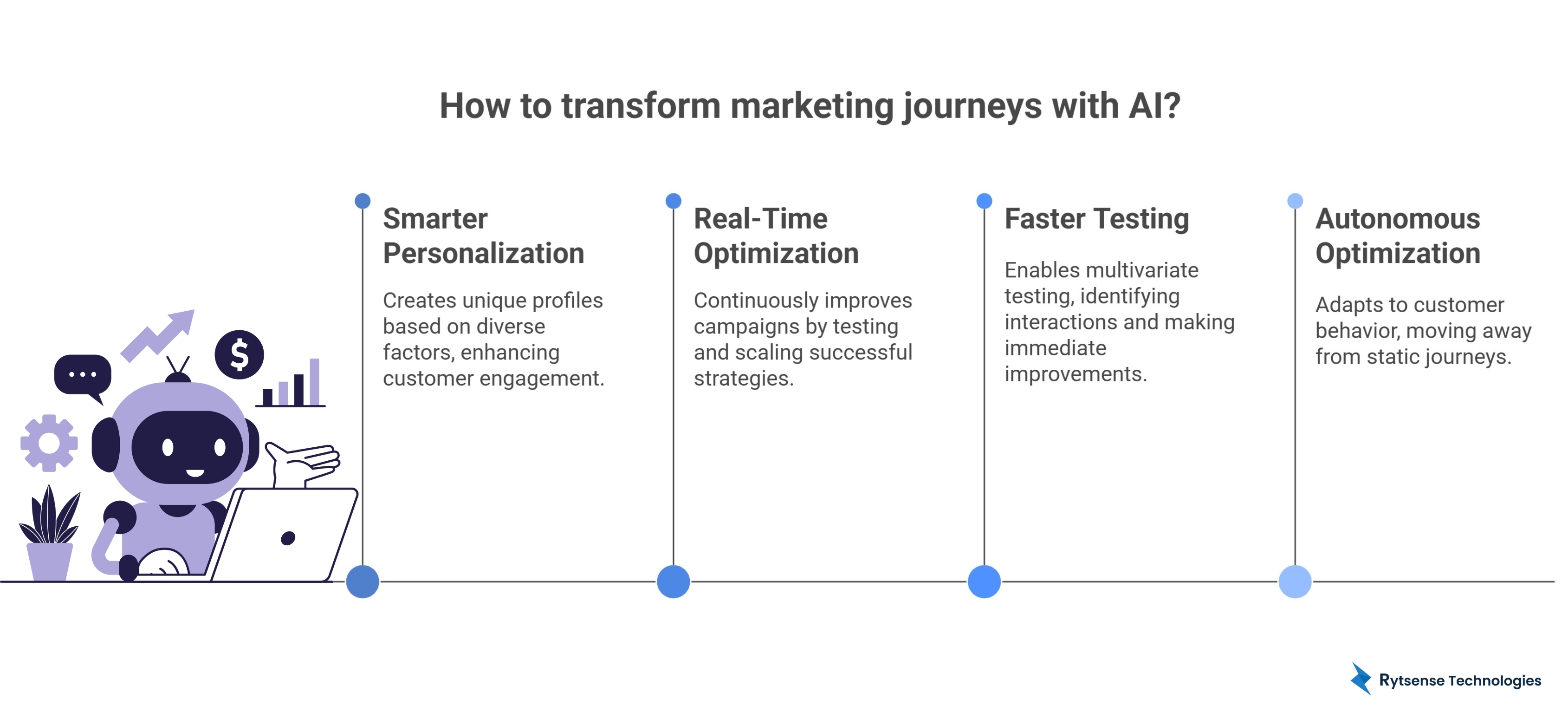
Older forms of personalization often rely on basic segments or buckets to define, "customers who bought product X." Agentic AI for marketing creates unique individual profiles for consumers based on many factors such as purchase history, browsing behavior, engagement patterns, predicted lifetime value and context at the time of engagement coupled with hundreds of additional signals or contextual data.
An AI agent for marketing would change messaging, timing, channel, offers, content formats for each person engaging with their brand differently on a continual and automated basis. If a consumer prefers video content and typically engages in the evening they receive video content.
If another consumer responds better to text and engages in the morning then they receive relevant text based content. The AI continually learns and adapts to engage millions of individual customers with minimal human input.
Real-time optimization allows campaigns to be continuously improved. The AI-agent for marketing literally tests variations, analyzes responses, identifies winners, and scales successful strategies, all of which can happen without waiting for a quarterly review.
Faster Testing and Improved Timing
A/B testing is very slow. You build two versions, you split the traffic, wait for statistical validity, send the better version and then repeat. Weeks or months later, you may have found an answer.
AI agents for marketing enable multivariate continuous testing, meaning even dozens of variables can be tested at one time, they can identify subtle interactions or interdependencies among multiple elements, use advanced statistics to reach conclusions more rapidly, and make the improvements immediately.
The timing optimization based on individual patterns can be very precise. Rather than saying "send at 10 AM," the best AI agent for marketing will determine the optimal time for each specific recipient based on their unique engagement patterns.
Change from Static Journeys to Autonomous Optimization
The traditional customer journey is a linear flowchart: "If they click, you can send this. If they don't click, you need to wait for three days, then send that."
Linear journeys quickly become stale, and worse, they cannot respond dynamically or adapt to a customer's unexpected behavior.
Preparing Your Brand for Agentic AI in Marketing
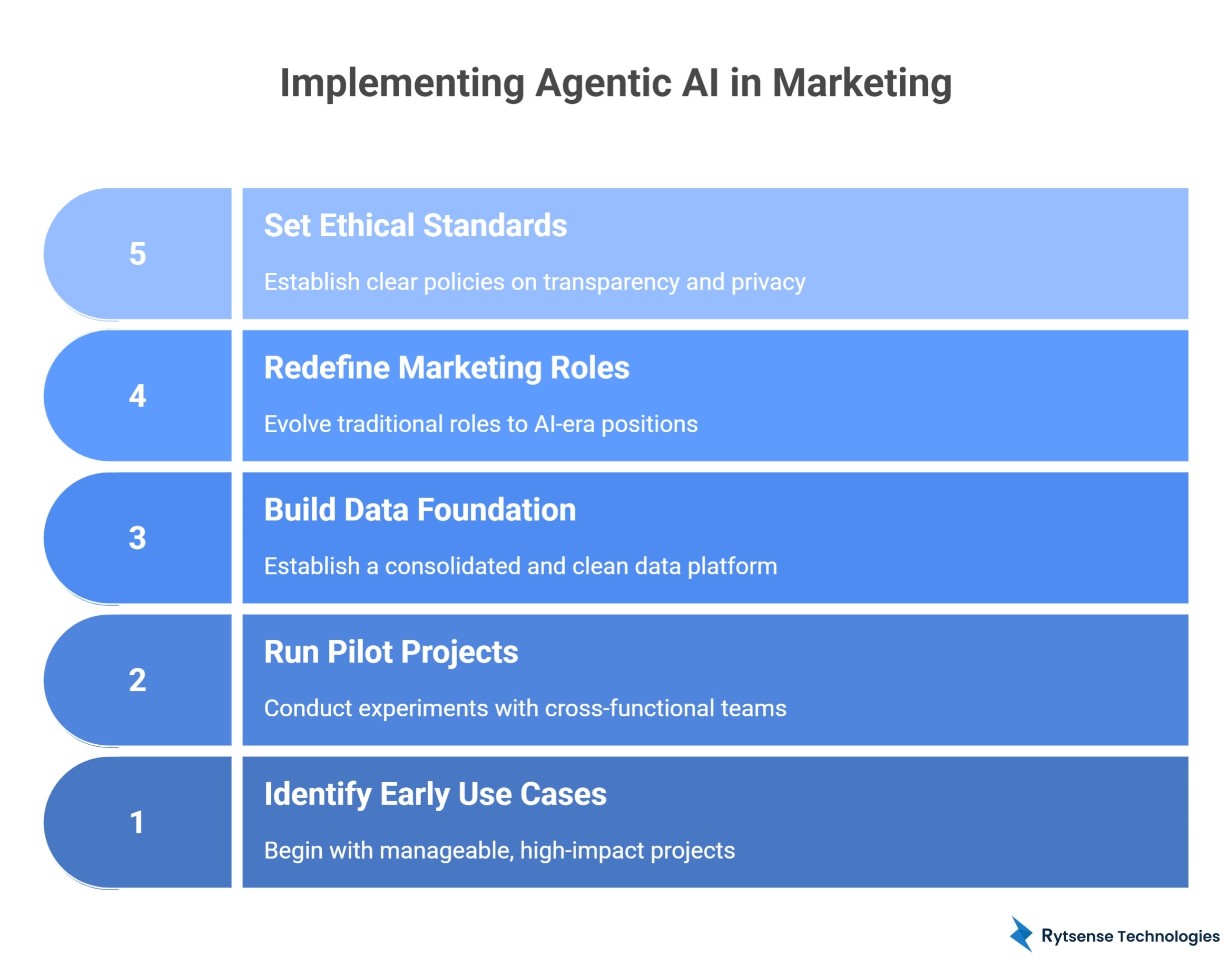
To successfully implement agentic AI for marketing, one needs to put in place some strategies, starting with high-impact use cases, and selective pilot projects with cross-functional teams, building a solid data foundation, restructuring marketing roles as an AI marketing organization, and setting clear ethical standards to protect customers while innovating.
Identifying Early Use Cases and Opportunities
Begin by starting with manageable, high-impact projects. AI agents for marketing small businesses USA should target areas where the apparent value of autonomous optimization is clear:
Use CaseAI Agent CapabilityExpected ImpactEmail optimizationSubject line testing, send time optimization15-30% engagement liftCustomer segmentationReal-time behavioral clustering20-40% conversion improvementContent personalizationDynamic webpage adaptation25-50% relevance increaseAd biddingAutonomous budget allocation10-35% efficiency gainLead scoringPredictive qualification30-60% sales team efficiency
Running Pilot Projects with Cross-Functional Teams
Effective implementation extends beyond marketing into collaboration. Your pilot should have marketing strategists, data scientists, IT professionals, legal/compliance experts, and customer service personnels.
Conduct contained experiments (with a clearly defined scope) with success metrics, timelines (8-12 weeks is typical), and documented learning. Don't attempt to change everything at once.
Building a Strong Data and Analytics Foundation
Your AI agents, whether for market research or executing marketing, need quality data. It requires a consolidated customer data platform, clean and consistent data structure, real-time data pipelines, adequate consent and privacy, and a solid analytics stack.
Many organizations face various issues with their data when you implement agentic AI for marketing. Fix these foundational aspects first, as AI will not fix poor data quality.
Redefining Marketing Roles in the AI Era
As an AI agent development company implements agentic systems, marketing roles evolve:
Traditional RoleAI-Era EvolutionCampaign ManagerAI Strategy DesignerContent CreatorCreative Director + AI OrchestratorData AnalystAI Performance ManagerMarketing ManagerHuman-AI Team Leader
Clearly articulate these changes. Also, provide training and support. Expect people from your team to require vital reskilling; if not all, will embrace the new responsibilities collaboratively and enthusiastically.
Setting Ethical Rules and Safeguards
If you are preparing to employ AI agents for marketing, get ready to establish clear policies on the following before you go ahead:
- Transparency policies: When do we have to disclose the use of AI?
- Privacy boundaries: What data can I use, and how?
- Override protocols: When do we have human intervention?
- Identify and prevent bias: How can we identify and prevent algorithmic bias?
- Consumer rights: How can consumers opt out or request human interaction?
Write down these guidelines and revisit every quarter as technology and regulations change.
Tools and Applications of Agentic AI for Marketing
Companies leading the development of AI agents, such as Rytsense Technologies, develop customized agentic AI for marketing solutions. These solutions seamlessly fit into existing marketing stacks, process proprietary data securely, and provide measurable results with real use cases. These use cases include personalization engines, autonomous campaign optimization, and intelligent market research systems.
How Rytsense Technologies Brings Agentic AI to Life
Rytsense Technologies creates custom AI agents for marketing that are tailored specifically to an organization or campaign for a given task. As an agent development company, we create an AI agent that connects with an already-existing marketing technology stack that uses secure proprietary data and operates within brand guidelines.
AI CapabilityMarketing ApplicationNatural language processingContent generation and optimizationPredictive analyticsCustomer behavior forecastingComputer visionVisual content analysis and creationReinforcement learningCampaign optimization and testingMulti-agent orchestrationComplex journey management
Their methodology centers on establishing Marketing AI systems that are understandable, user friendly, and trustworthy, not black boxes that produce inscrutable decisions.
Real-World Examples of AI-Driven Campaigns
- E-commerce customization: An AI marketing agent looks for browsing behavior, purchases, and current context, which makes suggestions, adjusts pricing and even presents promotional messages for the customer. Results indicated 40% higher conversion rates than rule-based personalization.
- B2B lead advancing: Certain AI agents helped small business owners with multi-touch campaigns and adapted content topics, formats and timing in the campaign based on engagement signals. AI-driven lead conversion rates improved 35%.
- Content optimization: Top marketing AI agents test headlines, images, bodies of copy and calls to action continuously across thousands of webpage visitors. There was a 28% improvement in engagement metrics within three months.
- Market research automated: Marketing AI agents monitored customer feedback, social conversations, competitive activities and market trends and created and shared real time insights with changes to strategies.
Must Read: AI in Oil and Gas Industry: Real-World Applications, Benefits, and Key Challenges
Benefits and Challenges of Agentic AI for Marketing
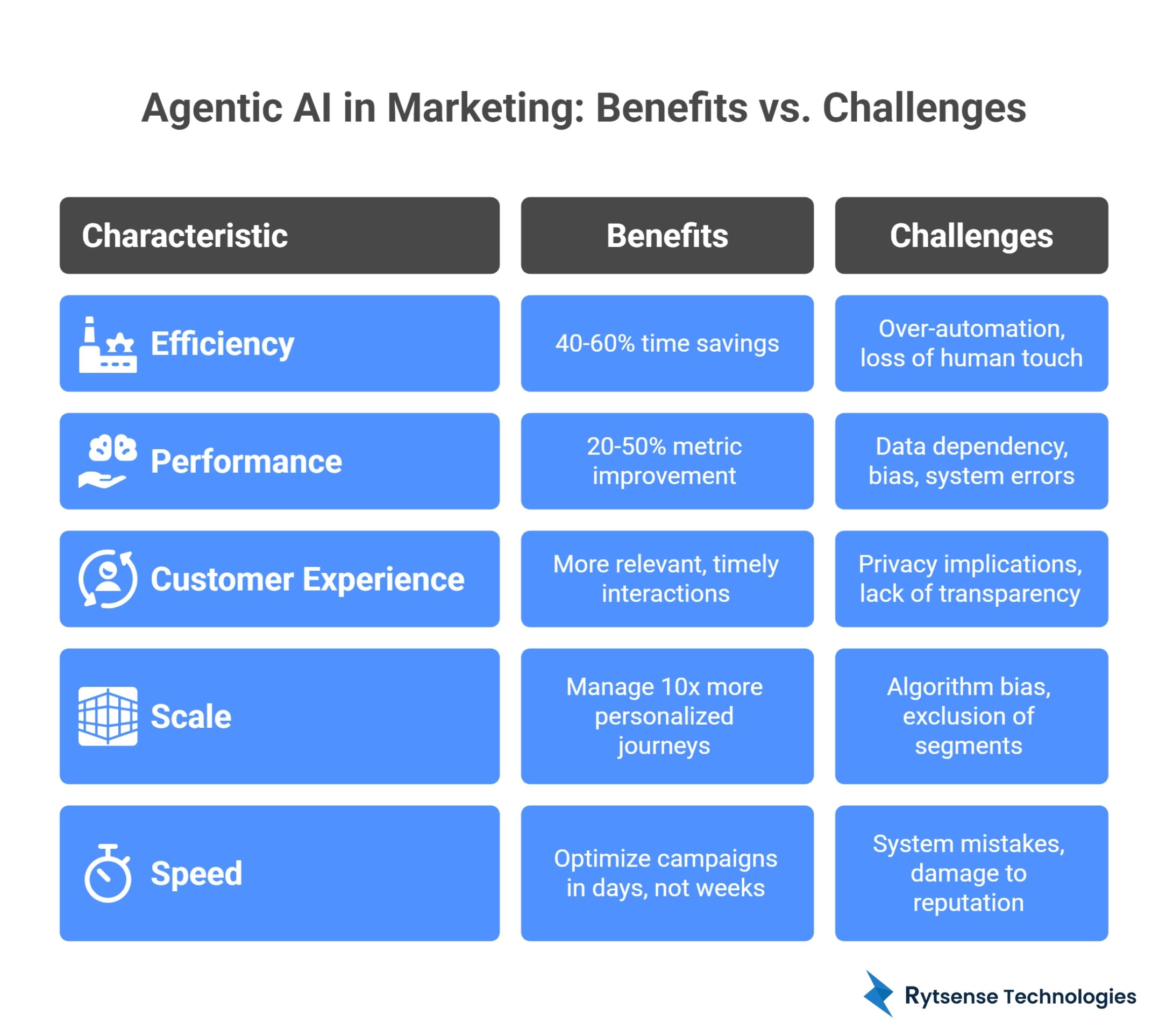
Agentic AI for marketing offers significant competitive advantages, with 40-60% efficiency gains, 20-50% performance gains, and also better experiences for the customer, but organizations need to manage issues including the risk of over-automation, data dependency, transparency, privacy consequences, algorithm bias, and system errors.
Competitive Advantages for Forward-Thinking Brands
Organizations that use agentic AI for marketing benefit in measurable ways:
- Efficiency achievements: Marketing people or teams can spend 40-60% less time on curation processes.
- Performance achievements: Campaign metrics improve 20-50% with ongoing optimization.
- Scale possibilities: Same resources manage 10x more personalized customer journeys.
- Speed to market: Launch a campaign and then optimize it in days, not weeks.
- Customer experience: Give more relevant and timely interactions that foster loyalty.
Organizations leveraging the capabilities of Agentic AI will establish advantages that may become difficult to close for competitors.
Risks, Ethical Considerations and Limitations
Agentic AI for marketing also introduces risks:
- Issues of over-automation: Human touch and brand authenticity may be lost.
- Data limits: AI doesn't work well with little, too much or biased data.
- Transparency Issues: Clearing and explaining AI decisions to stakeholders may become difficult.
- Privacy implications: Lack of Customer comfort and lack of personalization.
- Algorithm bias: Unintentional exclusion and misperceptions of customer segments.
- System mistakes: AI making a decision that damages brand reputation.
These issues must be mitigated through clear policies and protocols and monitored by a trusted AI development partner.
The Future of Agentic AI in Marketing
The next decade of agentic AI for marketing will deliver predictive customer intent recognition, seamless cross-channel orchestration, advanced voice and conversational channels, autonomous creative generation, and differentiation through ethical AI. Also, marketers who focus on to know, learn, build strategic partnerships, and stay focused on utilizing human skills will continue to lead.
Trends That Will Shape Next Decade
- Predictive customer vision: AI agents for marketing will face customer needs even before customers can express or understand them, enabling better decisions and proactive engagement rather than reactive engagement measures.
- Conversational marketing: The AI Agents for marketing systems will manage highly advanced voice-based interactions where conversations with brands and marketers will feel natural.
- Autonomous creation: AI will autonomously spin up entire campaigns that include strategy, creative concepts, execution, and optimization with minimal human intervention.
- AI identifier: Brands which utilize AI responsibly and transparently will differentiate themselves in the marketplace as consumer awareness of AI within marketing systems increases.
How Marketers Can Stay Ahead
Continue to learn. Pay attention to artificial intelligence developments, experiment with tools that roll out regularly, attend industry conferences, and connect with professional communities focused on artificial intelligence in marketing.
Establish strategic relationships with an AI Agent development company that understands the business of your marketing discipline. Forming partnerships in this space will aid in effectively deploying the technology to execute AI-driven components while still using in-house resources to solve problem.
Pursue knowledge and practice in areas AI cannot realistically perform at high-scale: strategic thinking, creative direction, ethical reasoning, and connections. These will, secondarily, increase your relative value as marketers build efficiencies which will inevitably be covered by AI.
Be a champion for the responsible use of AI in your organization. Marketers that advocate for their organizations to venture into the use of artificial intelligence, responsibly, will lead the next wave of marketing teams.
The Future of Agentic AI in Marketing
The next decade of agentic AI for marketing will deliver predictive customer intent recognition, seamless cross-channel orchestration, advanced voice and conversational channels, autonomous creative generation, and differentiation through ethical AI. Also, marketers who focus on to know, learn, build strategic partnerships, and stay focused on utilizing human skills will continue to lead.
Trends That Will Shape Next Decade
- Predictive customer vision: AI agents for marketing will face customer needs even before customers can express or understand them, enabling better decisions and proactive engagement rather than reactive engagement measures.
- Conversational marketing: The AI Agents for marketing systems will manage highly advanced voice-based interactions where conversations with brands and marketers will feel natural.
- Autonomous creation: AI will autonomously spin up entire campaigns that include strategy, creative concepts, execution, and optimization with minimal human intervention.
- AI identifier: Brands which utilize AI responsibly and transparently will differentiate themselves in the marketplace as consumer awareness of AI within marketing systems increases.
How Marketers Can Stay Ahead
Continue to learn. Pay attention to artificial intelligence developments, experiment with tools that roll out regularly, attend industry conferences, and connect with professional communities focused on artificial intelligence in marketing.
Establish strategic relationships with an AI Agent development company that understands the business of your marketing discipline. Forming partnerships in this space will aid in effectively deploying the technology to execute AI-driven components while still using in-house resources to solve problem.
Pursue knowledge and practice in areas AI cannot realistically perform at high-scale: strategic thinking, creative direction, ethical reasoning, and connections. These will, secondarily, increase your relative value as marketers build efficiencies which will inevitably be covered by AI.
Be a champion for the responsible use of AI in your organization. Marketers that advocate for their organizations to venture into the use of artificial intelligence, responsibly, will lead the next wave of marketing teams.
Conclusion
Agentic artificial intelligence for marketing represents a transformational progression away from manual execution towards strategic orchestration. The best AI agent for marketing enhances human capability instead of replacing it; the AI can conduct optimization and execution while the human provides a vision, creativity, and judgment that has an ethical dimension.
Connect with suppliers who have demonstrated the expertise to guide you through the possibilities versus actualities and emerging parameters, like Rytsense Technologies, while remaining focused on your marketing aspirations.
The issue is no longer whether to adopt Agentic AI for marketing, but how quickly you can effectively integrate it in your particular marketing practices. Your competitors have already begun experimenting. Your customers increasingly expect a personalized experience infused with AI. The next era of marketing is intelligent, autonomous, and already on its way.
Meet the Author

Co-Founder, Rytsense Technologies
Karthik is the Co-Founder of Rytsense Technologies, where he leads cutting-edge projects at the intersection of Data Science and Generative AI. With nearly a decade of hands-on experience in data-driven innovation, he has helped businesses unlock value from complex data through advanced analytics, machine learning, and AI-powered solutions. Currently, his focus is on building next-generation Generative AI applications that are reshaping the way enterprises operate and scale. When not architecting AI systems, Karthik explores the evolving future of technology, where creativity meets intelligence.