45% Faster Claims Processing and
30% Fewer Claim Denials with Generative AI
A leading medical billing and revenue cycle management company serving healthcare providers, physician groups, specialty practices, and healthcare organizations across the United States.
Industry
Healthcare Revenue Cycle Management
Service
Generative AI Development Services
Solution
AI-Powered Medical Billing, Claims Processing, and Revenue Cycle Automation Platform
Engagement Model
Dedicated Development Team
Client Overview
A leading healthcare revenue cycle management company provides end-to-end medical billing services for physician groups, specialty practices, clinics, and healthcare organizations across the United States.
The organization manages thousands of insurance claims every month across multiple specialties, including cardiology, orthopedics, internal medicine, behavioral health, and outpatient care.
As claim volumes increased, billing specialists spent significant time reviewing physician documentation, assigning diagnosis and procedure codes, validating claims, handling denials, and preparing prior authorization requests. These manual processes created operational bottlenecks, delayed reimbursements, increased administrative costs, and limited the company's ability to scale efficiently.
The client wanted to leverage Generative AI to streamline revenue cycle operations, improve coding accuracy, reduce claim denials, accelerate reimbursements, and gain better visibility into financial performance while maintaining healthcare compliance standards.
Rytsense Technologies partnered with the client to build an intelligent Revenue Cycle Management platform powered by Generative AI, Large Language Models, AI agents, Retrieval-Augmented Generation (RAG), and workflow automation.
See Also: Generative AI Development Services
Rytsense Technologies helps healthcare and medical billing organizations leverage Generative AI to automate coding, claims processing, denial management, prior authorizations, and revenue cycle operations. Our Generative AI development services combine LLMs, AI agents, and workflow automation to improve efficiency, accuracy, and financial performance.
Project Journey
As the client expanded its customer base, monthly claim volumes continued to rise across multiple healthcare specialties.
Billing specialists found themselves spending hours each day reviewing clinical documentation, assigning medical codes, validating claims, managing denials, and coordinating with insurance providers.
A single denied claim could require multiple rounds of investigation, documentation review, and payer communication before reimbursement could be secured. Prior authorization requests often delayed treatment because teams needed to manually collect supporting documentation and navigate varying payer requirements.
The client initially explored traditional automation tools and rule-based systems. However, these solutions struggled to understand complex clinical documentation, specialty-specific coding requirements, and constantly changing payer regulations.
The organization needed a more intelligent system capable of understanding medical context, analyzing documentation, generating recommendations, and supporting billing teams throughout the entire revenue cycle.
Rytsense Technologies was selected to design and develop a Generative AI-powered platform that could automate repetitive tasks while allowing healthcare professionals to maintain control over critical coding and reimbursement decisions.
Business Challenges
The medical billing company faced several operational and financial challenges.
Manual Claims Processing
Large volumes of claims required extensive manual review before submission. Billing teams spent hours validating patient information, reviewing documentation, and checking coding accuracy.
Impact
- •Slower claim submission cycles
- •Increased operational costs
- •Growing administrative workload
High Claim Denial Rates
Claims were frequently denied because of incomplete documentation, coding inconsistencies, missing modifiers, and payer-specific requirements.
Impact
- •Delayed reimbursements
- •Revenue leakage
- •Increased administrative effort
Time-Consuming Medical Coding
Certified coders manually reviewed physician notes and medical records to identify appropriate ICD-10, CPT, and HCPCS codes.
Impact
- •Coding bottlenecks
- •Reduced productivity
- •Higher staffing costs
Prior Authorization Delays
Preparing prior authorization requests required substantial manual effort and coordination between providers, billing teams, and insurance companies.
Impact
- •Treatment delays
- •Administrative burden
- •Reduced operational efficiency
Limited Revenue Visibility
Leadership lacked real-time visibility into denial trends, payer performance, reimbursement timelines, and revenue leakage opportunities.
Impact
- •Reactive decision making
- •Missed optimization opportunities
Solution
Rytsense Technologies developed a GenAI-powered Revenue Cycle Management platform that automates critical billing operations using advanced AI models, intelligent agents, and healthcare workflow automation.
The solution integrates with Electronic Health Records (EHRs), practice management systems, clearinghouses, and payer portals to streamline the entire revenue cycle.
The platform acts as an AI-powered billing assistant capable of analyzing clinical documentation, generating claims, validating coding accuracy, managing denials, and providing actionable revenue insights.
How the Platform Works
The platform was designed to support the complete lifecycle of a medical claim from patient encounter to reimbursement.
When a patient visit is completed, clinical documentation is automatically synchronized from the Electronic Health Record system.
The Medical Coding Agent analyzes physician notes and recommends diagnosis and procedure codes.
The Claims Processing Agent generates claims using approved coding information and supporting documentation.
Before submission, the Claim Scrubbing Agent validates coding accuracy, documentation completeness, insurance eligibility, and payer-specific requirements.
If a claim is denied, the Denial Management Agent automatically investigates the rejection, identifies corrective actions, and prepares appeal recommendations.
Meanwhile, the Revenue Intelligence Agent continuously analyzes operational and financial data to identify opportunities for revenue optimization.
This multi-agent architecture allows healthcare organizations to automate complex workflows while maintaining compliance and human oversight.
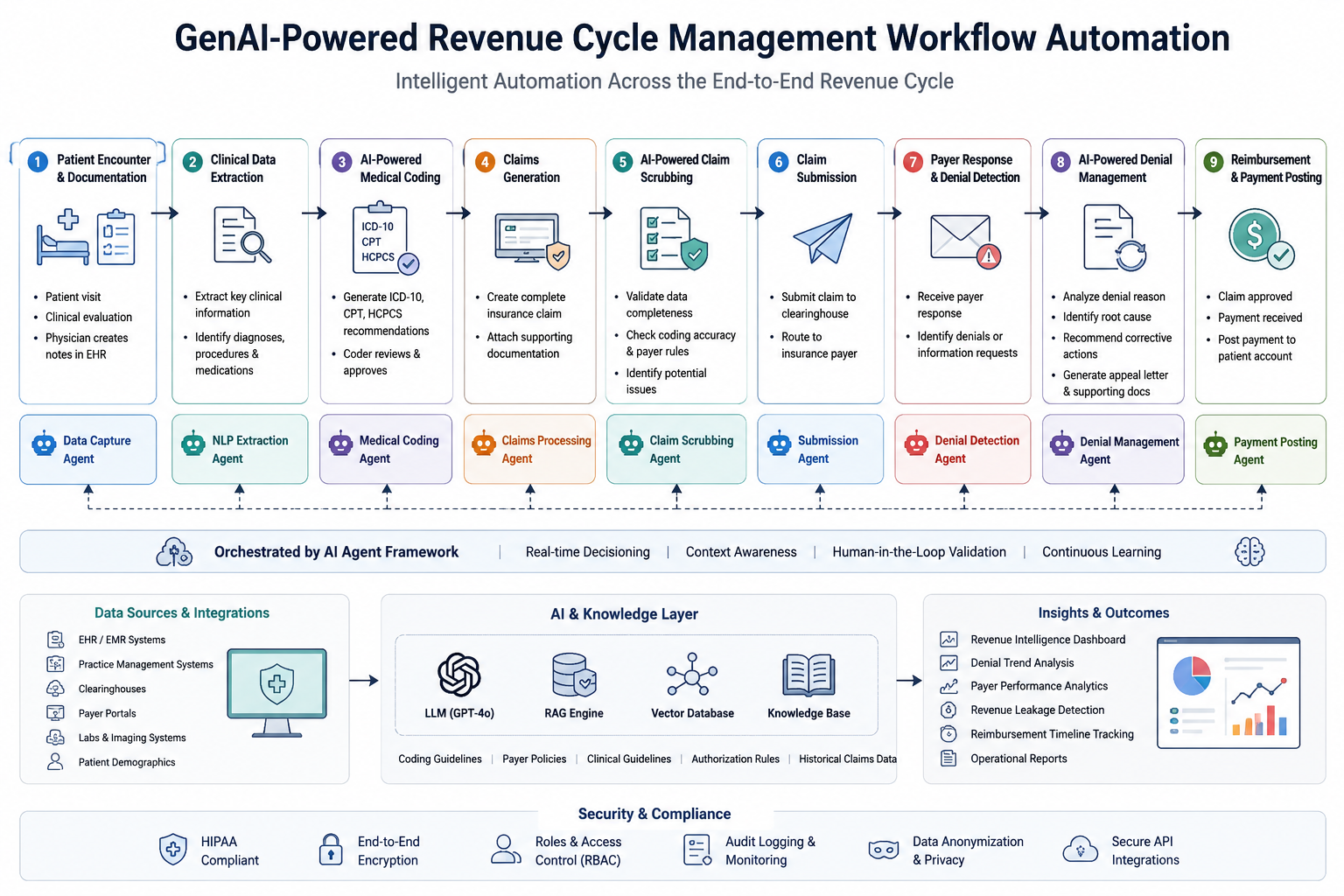
End-to-End Revenue Cycle Workflow
Scenario: Cardiology Patient Visit
Clinical Documentation Creation
A patient visits a cardiology clinic for an evaluation and echocardiogram procedure. Following the appointment, the physician completes encounter notes within the EHR system.
- • Symptoms
- • Diagnoses
- • Procedures Performed
- • Treatment Recommendations
AI-Powered Coding Analysis
The Medical Coding Agent analyzes the physician's documentation and identifies key clinical entities.
- • ICD-10 Diagnosis Codes
- • CPT Procedure Codes
- • HCPCS Billing Codes
Automated Claim Generation
After coding approval, the Claims Processing Agent generates an insurance claim and validates critical billing information.
- • Patient Demographics
- • Insurance Information
- • Procedure Details
- • Diagnosis Codes
- • Required Modifiers
Claim Validation
The Claim Scrubbing Agent performs extensive validation checks before submission.
- • Missing Documentation
- • Coding Conflicts
- • Modifier Issues
- • Eligibility Problems
- • Payer-Specific Rule Violations
Claim Submission
The validated claim is electronically submitted through the clearinghouse to the insurance payer.
Denial Detection
The platform monitors payer responses and identifies requests for additional documentation or claim denials requiring intervention.
AI-Powered Appeal Generation
The Denial Management Agent analyzes denial reasons and generates appeal recommendations.
- • Reviews Denial Reasons
- • Analyzes Payer Feedback
- • Retrieves Supporting Records
- • Drafts Appeal Letters
- • Generates Corrective Recommendations
Reimbursement
Corrected claims are approved and reimbursement is processed, improving revenue recovery while reducing administrative effort.
Key Features
AI-Powered Medical Coding Assistant
Automatically analyzes clinical documentation and recommends:
- ● ICD-10 codes
- ● CPT codes
- ● HCPCS codes
Benefits
- ● Faster coding workflows
- ● Reduced errors
- ● Improved coding consistency
- ● Higher reimbursement accuracy
Intelligent Claims Generation
Automatically generates complete insurance claims using clinical and billing information.
Benefits
- ● Faster claim preparation
- ● Reduced manual data entry
- ● Improved first-pass acceptance rates
Automated Claim Scrubbing
Performs validation checks before submission.
Benefits
- ● Reduced claim denials
- ● Improved claim quality
- ● Faster reimbursement cycles
AI-Powered Denial Management
Analyzes denied claims and generates corrective recommendations.
Benefits
- ● Faster denial resolution
- ● Increased revenue recovery
- ● Reduced administrative workload
Prior Authorization Automation
Automates prior authorization preparation and tracking.
Benefits
- ● Faster approvals
- ● Improved efficiency
- ● Reduced administrative effort
Revenue Intelligence Dashboard
Provides real-time visibility into:
- ● Claim approval rates
- ● Denial trends
- ● Revenue leakage
- ● Payer performance
- ● Collection metrics
Building a Healthcare-Aware AI System
Developing AI for healthcare billing presents unique challenges.
Unlike general business workflows, medical billing requires compliance with healthcare regulations, payer-specific requirements, coding standards, and constantly evolving reimbursement policies.
To address these challenges, Rytsense implemented a Retrieval-Augmented Generation architecture that enables AI agents to access current coding guidelines, payer policies, and authorization requirements in real time.
The platform also incorporates a human-in-the-loop review process to ensure healthcare professionals remain in control of critical decisions.
This combination of AI automation and human expertise ensures both efficiency and compliance.
Implementation Challenges and Solutions
Overcoming healthcare-specific complexities required a combination of advanced AI capabilities, domain expertise, and compliance-focused workflows.
Inconsistent Clinical Documentation
Documentation quality varied across providers and specialties.
Solution
Healthcare-specific NLP models normalize clinical information before coding recommendations are generated.
Frequent Payer Rule Changes
Insurance requirements changed frequently and varied across payers.
Solution
The RAG framework continuously references current payer guidelines and authorization requirements.
Maintaining Coding Accuracy
Fully autonomous coding introduces compliance risks.
Solution
Certified coders validate AI recommendations before claims are finalized.
Security and Compliance
To ensure healthcare compliance and patient data protection, the platform includes:
- ● HIPAA-compliant architecture
- ● End-to-end encryption
- ● Secure API integrations
- ● Role-based access control (RBAC)
- ● Audit logging and monitoring
- ● Patient data anonymization
Results
The implementation delivered measurable operational, financial, and productivity improvements across the healthcare revenue cycle.
Operational Improvements
45% Reduction in Claim Processing Time
Automated workflows accelerated claim preparation and submission.
60% Faster Medical Coding
AI-assisted coding significantly reduced manual review effort.
40% Improvement in Prior Authorization Efficiency
Automated authorization workflows reduced delays.
Financial Improvements
30% Reduction in Claim Denials
Claim scrubbing and AI validation improved claim quality.
25% Increase in Revenue Recovery
Automated denial analysis improved reimbursement outcomes.
Higher First-Pass Acceptance Rates
Claims were submitted with greater accuracy and completeness.
Productivity Improvements
- ✓ Significant reduction in administrative workload
- ✓ Faster denial resolution
- ✓ Improved billing team efficiency
- ✓ Ability to manage larger claim volumes without proportional staffing increases
Tech Stack
Artificial Intelligence
- GPT-4o
- Azure OpenAI
- LangChain
- RAG Architecture
- AI Agents
- Vector Databases
Backend
- .NET 8
- Node.js
- Python
- REST APIs
Cloud Infrastructure
- Microsoft Azure
- Azure Kubernetes Service
- Azure Functions
- Azure Event Hubs
Database & Storage
- Azure Cosmos DB
- Azure Blob Storage
- PostgreSQL
Security
- OAuth 2.0
- JWT Authentication
- RBAC
- HIPAA Compliance
DevOps
- Docker
- Kubernetes
- CI/CD Pipelines
Business Impact
The GenAI-powered Revenue Cycle Management platform transformed the client's billing operations by automating repetitive workflows, improving coding accuracy, accelerating reimbursements, and reducing claim denials.
By combining Generative AI, AI agents, workflow automation, and healthcare intelligence, the solution enabled the client to scale operations efficiently while improving financial performance.
The project demonstrates how Generative AI development services can modernize healthcare revenue cycle operations, enhance compliance, and drive measurable business outcomes.
Ready to Transform Revenue Cycle Operations with Generative AI?
Build intelligent medical billing, coding, claims processing, and revenue cycle automation solutions with Rytsense Technologies.
Talk to Our Generative AI Experts Today