Key Takeaways
- Start every AI initiative with a clearly defined business problem—not the latest AI technology.
- High-quality, well-governed data is the foundation of successful AI projects.
- Treat AI as a business transformation initiative involving cross-functional stakeholders.
- Prioritize seamless integration with existing business systems and workflows.
- Define measurable KPIs before development begins to evaluate business impact.
- Establish AI governance, security, and compliance from day one.
- View deployment as the start of continuous optimization, monitoring, and improvement.
- Following a structured AI implementation framework significantly increases project success and ROI.
Why 80% of Custom AI Projects Fail
Artificial intelligence has moved from experimentation to business transformation. Organizations across healthcare, finance, manufacturing, retail, logistics, and professional services are investing heavily in custom AI solutions to automate workflows, improve decision-making, and create competitive advantages.
Yet despite billions of dollars invested every year, a large percentage of AI initiatives never achieve their intended business outcomes. Some projects never move beyond a proof of concept, while others are deployed but fail to deliver measurable value. In many cases, the issue isn't the AI model itself, it's the strategy, execution, and organizational readiness behind the project.
Business leaders often assume that selecting the latest large language model (LLM) or hiring an experienced AI development company guarantees success. In reality, successful AI implementation depends on much more than technology. Data quality, integration, stakeholder alignment, governance, and continuous optimization often have a greater impact on outcomes than the choice of AI model.
This article explores the most common reasons custom AI projects fail, the warning signs to watch for, and practical strategies that can help organizations maximize the return on their AI investment.
The AI Opportunity Is Bigger Than Ever
Organizations are adopting AI to solve increasingly complex business problems.
Common objectives include:
- Automating repetitive business processes
- Improving customer service through AI agents
- Accelerating document processing
- Enhancing decision-making with predictive analytics
- Reducing operational costs
- Increasing employee productivity
- Supporting healthcare workflows
- Optimizing supply chains
- Detecting fraud and managing risk
While these objectives are achievable, success depends on how AI is implemented, not simply on which technology is chosen.
Many companies begin with ambitious goals but underestimate the effort required to transform AI into a reliable production system.
Why Do So Many AI Projects Fail?
There is no single reason why AI initiatives struggle.
Instead, failures typically result from several small decisions made early in the project that compound over time.
Successful AI projects combine five essential elements:
- A clearly defined business objective
- High-quality and accessible data
- Strong technical architecture
- Executive and stakeholder support
- Continuous monitoring and optimization
When one or more of these elements is missing, the project becomes increasingly difficult to scale.
Let's examine the most common causes.
1. Solving the Wrong Business Problem
This is the most common, and expensive mistake.
Many organizations start with a question like:
"How can we use AI?"
Instead, they should ask:
"Which business problem is costing us the most time, money, or customer satisfaction?"
AI should never be the objective.
It should be the solution.
For example:
Poor approach
"We want an AI chatbot because our competitors have one."
Better approach
"Our customer support team spends 40% of its time answering repetitive questions. Can AI automate these interactions while maintaining service quality?"
The second approach defines a measurable business outcome.
Projects built around clear business goals are significantly easier to evaluate and improve.
What Successful Companies Do Instead
Successful organizations begin by identifying high-impact workflows rather than exciting technologies.
They typically prioritize problems such as:
- Manual document processing
- Prior authorization delays in healthcare
- Claims processing
- Customer onboarding
- Sales qualification
- Invoice automation
- Internal knowledge search
- Quality inspection
- Predictive maintenance
Each project begins with a measurable business metric rather than a preferred AI model.
2. Poor Data Quality
AI systems are only as reliable as the data they learn from.
Many organizations assume that purchasing a powerful model will compensate for inconsistent, incomplete, or outdated data.
Unfortunately, it doesn't.
Common data problems include:
- Duplicate records
- Missing information
- Inconsistent formats
- Outdated datasets
- Poor labeling
- Isolated systems
- Limited historical data
Imagine training an AI model to predict insurance claim approvals using inaccurate historical records.
The result won't simply be inaccurate predictions—it may lead to poor operational decisions and reduced trust in the entire AI initiative.
Questions Every Organization Should Ask
Before beginning AI development, consider:
- Is our data centralized?
- Is it accurate?
- Is it regularly updated?
- Are there sufficient historical examples?
- Can we legally use this data for AI training?
- Does the data represent real business scenarios?
Organizations that invest time in data preparation often reduce implementation risks significantly.
3. Treating AI as an IT Project Instead of a Business Initiative
One of the biggest misconceptions is that AI belongs solely to the technology team.
In reality, successful AI adoption requires collaboration across the organization.
An AI project typically involves:
- Business stakeholders
- Product managers
- Operations teams
- Compliance specialists
- Security teams
- IT teams
- Data engineers
- AI engineers
- End users
Without cross-functional alignment, projects often lose momentum after the prototype stage.
A Typical Failure Scenario
The IT department develops an impressive AI solution.
However:
- Operations teams were never consulted.
- Business workflows weren't considered.
- Employees weren't trained.
- Success metrics weren't defined.
The result?
A technically successful system that nobody actually uses.
What High-Performing Organizations Do
Instead of assigning AI exclusively to technical teams, they establish governance from the beginning.
Business leaders define objectives.
Technical teams design the solution.
Operations teams validate workflows.
Compliance teams review risks.
End users provide continuous feedback.
This collaborative approach improves adoption while reducing resistance to change.
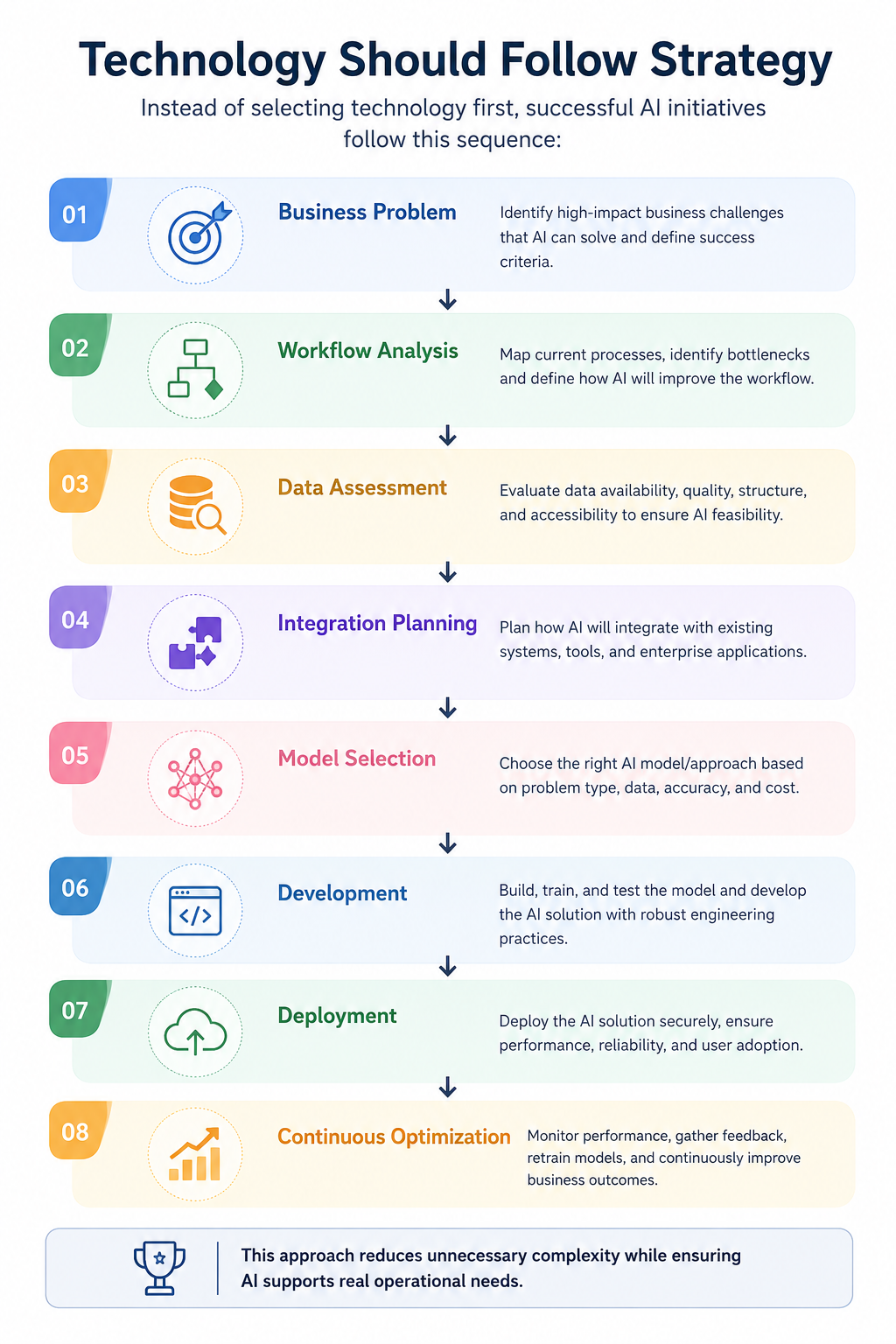
4. Choosing Technology Before Defining Requirements
Many AI discussions begin with questions like:
- Should we use GPT-5?
- Should we fine-tune an open-source model?
- Should we build an AI agent?
These are important technical decisions, but they should come later.
The first questions should be:
- What process are we improving?
- What outcome are we measuring?
- What systems must AI integrate with?
- What level of accuracy is acceptable?
- What security requirements exist?
Only after answering these questions should organizations evaluate technologies.
5. Ignoring System Integration Until the End
Many AI demonstrations look impressive in isolation. They answer questions, summarize documents, generate content, or analyze data. However, business value is created only when AI becomes part of everyday workflows.
Imagine an AI assistant that identifies high-priority customer support tickets but cannot update your CRM automatically. Employees still have to copy information manually, assign tickets, and trigger follow-up actions. The AI may be accurate, but the workflow remains inefficient.
This is one of the biggest reasons AI projects fail after deployment.
Custom AI rarely operates as a standalone application. It typically needs to integrate with:
- Customer Relationship Management (CRM) platforms
- Enterprise Resource Planning (ERP) systems
- Electronic Health Records (EHR)
- HR Management Systems
- Document Management Systems
- Payment gateways
- APIs and internal databases
If integration planning happens at the end of the project, development costs increase, deployment is delayed, and user adoption suffers.
Best Practice
Before development begins, create an integration roadmap.
Ask questions such as:
- Which systems will AI access?
- What data needs to flow between systems?
- Are APIs available?
- What security controls are required?
- How will AI fit into existing workflows?
The most successful AI implementations automate entire business processes—not just isolated tasks.
6. Unrealistic Expectations About AI
AI is often presented as a technology that can solve every business problem.
In reality, it cannot.
Many organizations expect AI to:
- Replace entire departments
- Make perfect decisions
- Eliminate all manual work
- Deliver ROI within weeks
These expectations usually lead to disappointment.
AI is not a replacement for business strategy or human expertise. It is a decision-support and automation tool that performs best within clearly defined boundaries.
For example:
Poor expectation
"We want AI to automate our complete customer support operation."
Better expectation
"We want AI to resolve repetitive Tier-1 support requests while escalating complex cases to human agents."
The second goal is realistic, measurable, and easier to implement successfully.
Organizations that treat AI as a productivity accelerator rather than a complete replacement generally achieve better long-term outcomes.
7. No Clear Definition of Success
One of the most overlooked questions in AI implementation is:
"How will we know this project has succeeded?"
Surprisingly, many organizations cannot answer this before development begins.
Without measurable KPIs, every stakeholder has a different definition of success.
Technical teams may focus on model accuracy.
Business leaders may focus on cost reduction.
Operations teams may care about faster turnaround times.
These objectives need to be aligned from the start
Examples of Business KPIs
| Business Goal | KPI |
|---|---|
| Reduce manual work | Hours saved per week |
| Improve customer support | Average response time |
| Increase efficiency | Process completion time |
| Improve accuracy | Error reduction percentage |
| Reduce operational costs | Cost per transaction |
| Increase revenue | Conversion rate |
AI projects should always be measured against business outcomes rather than technical metrics alone.
8. Neglecting AI Governance and Security
As AI adoption grows, governance is becoming just as important as model performance.
Organizations handling sensitive customer information must consider:
- Data privacy
- Access controls
- Audit trails
- Compliance requirements
- Model transparency
- Human oversight
This is particularly important in industries such as:
- Healthcare
- Banking
- Insurance
- Government
- Legal services
Without governance, even technically successful AI solutions can create compliance and security risks.
Organizations should establish policies covering:
- Data usage
- Model monitoring
- Human review
- Bias detection
- Security testing
- Responsible AI practices
Governance should be built into the project, no added after deployment.
9. Treating Deployment as the Finish Line
One of the biggest misconceptions is that an AI project ends when it goes live.
In reality, deployment marks the beginning of continuous improvement.
Unlike traditional software, AI systems learn from changing business conditions, new data, and evolving user behavior.
Without ongoing monitoring, performance gradually declines.
Successful organizations continuously measure:
- Model accuracy
- User feedback
- Response quality
- Business KPIs
- Infrastructure performance
- Cost optimization
AI systems require regular updates, retraining, prompt optimization, and security reviews.
The organizations seeing the highest ROI treat AI as an evolving business capability rather than a one-time implementation.
What Successful AI Projects Have in Common
Although every AI initiative is different, successful organizations consistently follow similar principles.
They start with a business problem.
Instead of asking, "How can we use AI?" they ask, "Which process creates the biggest operational challenge?"
They prepare their data.
Reliable AI depends on reliable information.
They involve business stakeholders.
AI decisions are made collaboratively—not solely by IT teams.
They prioritize integration.
AI becomes part of existing workflows rather than operating separately.
They define measurable success.
Business outcomes are identified before development begins.
They continuously improve.
Deployment is treated as the first milestone, not the last.
AI Success Framework
The following framework summarizes the characteristics of successful AI projects.
| Stage | Focus |
|---|---|
| Discovery | Define business objectives |
| Assessment | Evaluate data quality and readiness |
| Strategy | Select the right AI approach |
| Development | Build and integrate AI |
| Validation | Test business outcomes |
| Deployment | Launch into production |
| Optimization | Monitor, improve, and scale |
Organizations that follow this structured approach significantly reduce implementation risks while improving long-term value.
AI Project Readiness Checklist
Before investing in a custom AI solution, evaluate whether your organization is ready. Many AI initiatives fail because businesses rush into development without assessing their operational and technical readiness.
Use this checklist before selecting an AI development partner.
| Question | Yes | No |
|---|---|---|
| Have we identified a clear business problem? | ☐ | ☐ |
| Can the expected ROI be measured? | ☐ | ☐ |
| Do we have sufficient historical data? | ☐ | ☐ |
| Is our data accurate and accessible? | ☐ | ☐ |
| Have we identified users who will adopt the solution? | ☐ | ☐ |
| Do we know which business systems AI must integrate with? | ☐ | ☐ |
| Is executive leadership aligned on the project? | ☐ | ☐ |
| Have we allocated a realistic implementation budget? | ☐ | ☐ |
| Have we considered security and compliance requirements? | ☐ | ☐ |
| Do we have a long-term AI adoption strategy? | ☐ | ☐ |
If most answers are Yes, your organization is well-positioned to begin a custom AI initiative. If several answers are No, it's often more beneficial to address those gaps before development begins.
How to Choose the Right AI Development Partner
Selecting the right AI development company is just as important as selecting the right technology.
Many organizations compare vendors based only on pricing or the AI models they use. While those factors matter, they rarely determine long-term project success.
Instead, evaluate potential partners using these criteria:
Business Understanding
The best AI partners focus on solving business problems rather than simply building AI applications. They should understand your industry, workflows, and operational challenges before recommending a solution.
Industry Experience
Every industry has unique processes, regulations, and compliance requirements. A partner with relevant domain expertise can reduce implementation risks and accelerate deployment.
Integration Capabilities
AI should work seamlessly with your existing CRM, ERP, EHR, HRMS, payment systems, and internal databases. Integration expertise is often more valuable than model selection alone.
Scalability
Your AI solution should support future business growth without requiring major architectural changes.
Security and Compliance
Ensure the provider follows secure development practices and understands industry regulations such as HIPAA, GDPR, SOC 2, or ISO standards where applicable.
Post-Deployment Support
AI systems require continuous monitoring, optimization, and updates. Choose a partner that offers long-term support rather than ending the engagement after deployment.
Common Myths About AI Projects
Many organizations delay or misdirect AI investments because of common misconceptions.
| Myth | Reality |
|---|---|
| AI replaces all employees. | AI automates repetitive tasks while enabling employees to focus on higher-value work. |
| The latest LLM guarantees success. | Business strategy, data quality, and integration are more important than the model itself. |
| AI projects finish after deployment. | |
| Every business needs custom AI. | Some organizations achieve better results using existing AI platforms before investing in custom development. |
| AI automatically produces ROI. | ROI depends on selecting the right use case, measuring outcomes, and driving user adoption. |
Final Thoughts
Custom AI has the potential to transform business operations, improve customer experiences, and unlock new revenue opportunities. However, technology alone does not guarantee success.
The organizations achieving the highest return on AI investment share several common characteristics. They begin with clearly defined business objectives, invest in high-quality data, involve cross-functional stakeholders, plan integrations early, establish measurable success metrics, and continuously optimize their AI systems after deployment.
Rather than asking, "Which AI model should we use?", successful organizations ask:
- Which business challenge should we solve first?
- What measurable outcome are we trying to achieve?
- Is our organization prepared for AI adoption?
- Which implementation approach aligns with our long-term strategy?
The answers to these questions often determine whether an AI initiative becomes a competitive advantage or an expensive experiment.
Custom AI is not simply about adopting new technology, it's about creating measurable business value through thoughtful planning, disciplined execution, and continuous improvement.
Meet the Author

Co-Founder, Rytsense Technologies
Karthik is the Co-Founder of Rytsense Technologies, where he leads cutting-edge projects at the intersection of Data Science and Generative AI. With nearly a decade of hands-on experience in data-driven innovation, he has helped businesses unlock value from complex data through advanced analytics, machine learning, and AI-powered solutions. Currently, his focus is on building next-generation Generative AI applications that are reshaping the way enterprises operate and scale. When not architecting AI systems, Karthik explores the evolving future of technology, where creativity meets intelligence.