Key Takeaways
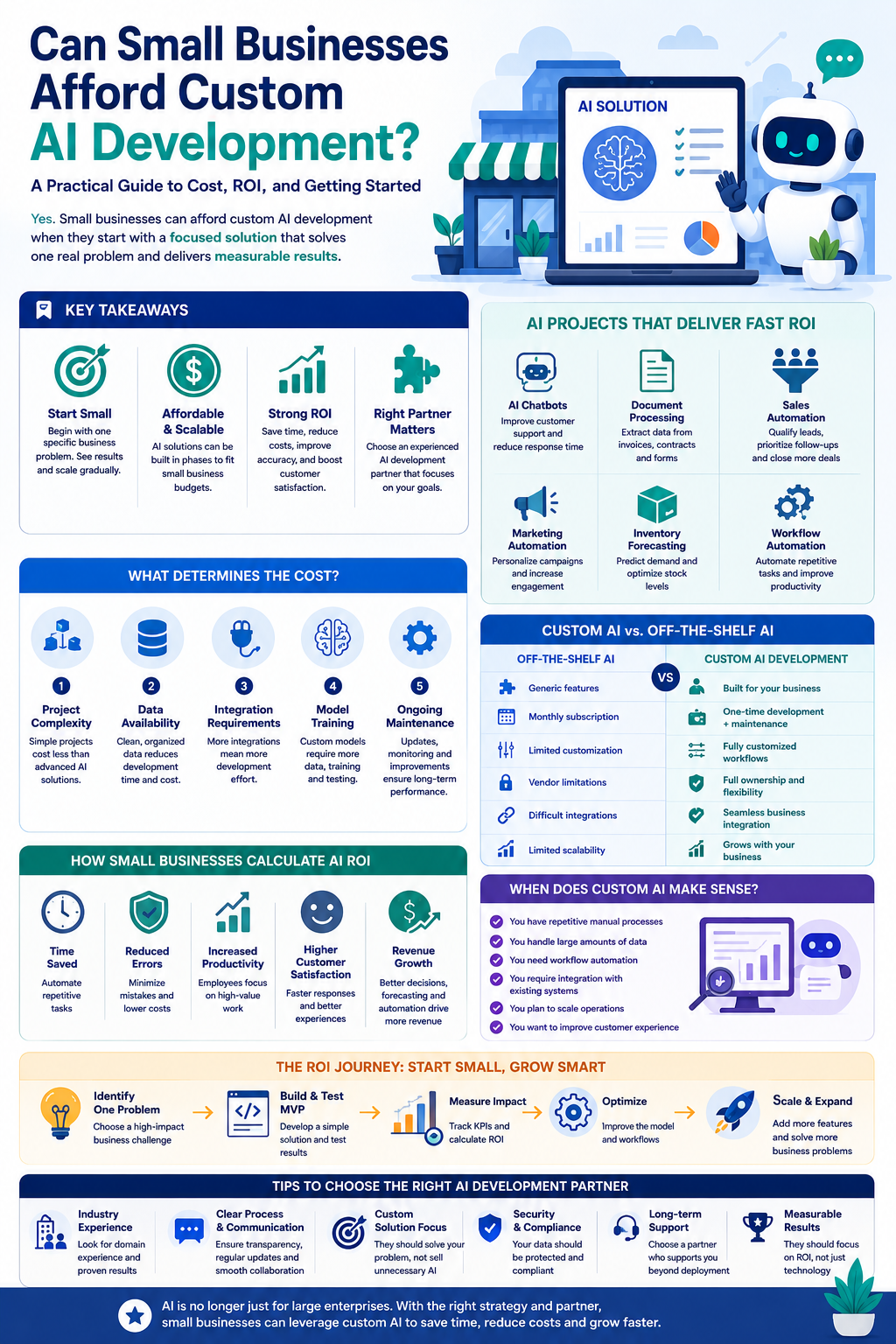
- Small businesses can afford custom AI development by starting with a focused project rather than a large-scale implementation.
- The cost of AI development depends on project complexity, data readiness, integrations, and long-term maintenance.
- AI delivers measurable ROI by reducing manual work, improving productivity, minimizing errors, and enhancing customer experience.
- High-impact use cases such as AI chatbots, document processing, workflow automation, and sales forecasting often provide faster returns.
- Working with an experienced custom AI development company helps ensure the solution aligns with your business goals and can scale as your company grows.
- The most successful AI projects begin with a clear business challenge and expand based on measurable results.
Artificial intelligence is no longer reserved for large enterprises with million-dollar budgets. Today, small businesses are using AI to automate repetitive work, improve customer service, reduce operational costs, and make faster business decisions.
Yet one question remains common:
Can small businesses actually afford custom AI development?
The short answer is yes, but only when it's built around clear business goals rather than unnecessary complexity.
Modern AI solutions can be developed in phases, allowing businesses to start small, measure results, and expand over time. This approach makes AI far more accessible than many business owners expect.
In this guide, you'll learn:
- What custom AI development really costs
- What factors influence pricing
- How small businesses calculate ROI
- Which AI projects provide the fastest return
- How to choose the right AI development partner
Quick Answer
Yes. Small businesses can afford custom AI development when they focus on solving one specific business problem first.
Instead of investing in a large-scale AI platform, many businesses begin with a single automation, such as:
- Customer support chatbots
- Document processing
- Lead qualification
- Invoice automation
- Appointment scheduling
- Inventory forecasting
These focused projects typically cost less, deliver measurable results faster, and create a strong foundation for future AI adoption.
What Is Custom AI Development?
Custom AI development involves building artificial intelligence solutions specifically designed around your company's workflows, goals, and data.
Unlike off-the-shelf AI tools that serve general use cases, custom solutions are tailored to your business processes.
A custom AI development company creates AI systems that integrate with your existing software while addressing challenges unique to your organization.
Examples include:
- AI-powered customer support
- Intelligent document processing
- Sales prediction models
- Recommendation engines
- Workflow automation
- Predictive maintenance
- AI assistants for employees
The goal is not simply adding AI, it is improving business outcomes.
Why More Small Businesses Are Investing in AI
Several factors have made AI more accessible than ever.
Lower Development Costs
Cloud infrastructure, open-source AI models, and reusable frameworks have significantly reduced development expenses.
Businesses no longer need to build every AI model from scratch.
Faster Implementation
Many AI applications can now be launched in weeks rather than several months.
Businesses can validate results quickly before expanding.
Better Integration
Modern AI systems connect easily with:
- CRM platforms
- ERP software
- Accounting tools
- Customer support platforms
- ECommerce systems
This reduces implementation complexity.
Scalable Investment
Instead of building everything at once, businesses can:
- Launch one AI feature
- Measure results
- Improve workflows
- Expand gradually
This lowers financial risk.
What Determines the Cost of Custom AI Development?
Every AI project is different. Several factors influence the final investment.
1. Project Complexity
Simple automation projects cost significantly less than enterprise-grade predictive analytics platforms.
Examples of lower-cost projects include:
- FAQ chatbots
- Email classification
- Data extraction
- Appointment scheduling
More advanced AI solutions require additional development and testing.
2. Data Availability
AI performs best with clean, organized data.
If historical business data requires cleaning or preparation, development costs may increase.
3. Integration Requirements
Connecting AI with existing systems often requires:
- API development
- Database integration
- Security implementation
- Workflow customization
The more integrations required, the larger the project.
4. Model Training
Some businesses can use existing AI models.
Others require industry-specific models trained using proprietary data.
Custom model training increases development effort but often improves accuracy.
5. Maintenance
AI systems continue learning and improving over time.
Businesses should budget for:
- Model updates
- Performance monitoring
- Security improvements
- Feature enhancements
Is Custom AI More Expensive Than Off-the-Shelf AI?
Initially, yes.
However, total cost of ownership often tells a different story.
| Off-the-Shelf AI | Custom AI Development |
|---|---|
| Generic features | Built for your business |
| Monthly subscription | One-time development plus maintenance |
| Limited customization | Fully customized workflows |
| Vendor limitations | Full ownership and flexibility |
| Difficult integrations | Seamless business integration |
| Limited scalability | Grows with your business |
For companies with unique workflows, custom AI development services often deliver greater long-term value.
How Small Businesses Calculate AI ROI
Instead of focusing only on development costs, successful companies evaluate business impact.
Key metrics include:
Time Saved
If employees spend hours on repetitive administrative work, AI can automate many routine tasks.
Even saving a few hours each week can generate significant annual savings.
Reduced Errors
AI minimizes:
- Manual data entry
- Invoice mistakes
- Documentation errors
- Processing delays
Fewer mistakes reduce operational costs.
Increased Productivity
- Employees spend less time on repetitive work and more time on strategic activities.
- This improves overall business efficiency.
Higher Customer Satisfaction
AI enables:
- Faster responses
- 24/7 support
- Personalized recommendations
- Improved service quality
Better customer experiences often lead to higher retention.
Revenue Growth
AI can support revenue through:
- Better lead qualification
- Personalized marketing
- Improved forecasting
- Smarter pricing decisions
AI Projects That Deliver Fast ROI
Small businesses usually benefit most from practical AI applications.
AI Chatbots
Reduce customer support workload while providing instant responses.
Document Processing
Automatically extract information from:
- Invoices
- Contracts
- Medical documents
- Purchase orders
Sales Automation
AI can:
- Score leads
- Recommend follow-ups
- Predict customer behavior
Marketing Automation
AI helps businesses create:
- Personalized campaigns
- Audience segmentation
- Content recommendations
Forecasting
Predict:
- Sales
- Inventory demand
- Customer churn
- Seasonal trends
Common Mistakes Small Businesses Should Avoid
Many businesses delay AI adoption because they assume it requires a massive investment.
Others move too quickly without clear goals.
Avoid these common mistakes.
Trying to automate everything at once
Start with one business problem.
Ignoring data quality
Poor data produces poor AI results.
Choosing the cheapest provider
- Low-cost development often leads to higher long-term expenses.
- Look for experience, scalability, and ongoing support.
Not measuring ROI
Establish KPIs before development begins.
Examples include:
- Hours saved
- Cost reduction
- Revenue growth
- Customer satisfaction
- Employee productivity
How to Choose the Right AI Development Partner
Selecting the right partner can have a major impact on project success.
Look for an AI development company that offers:
- Industry experience
- End-to-end AI consulting
- Custom solution design
- Cloud deployment expertise
- Security best practices
- Ongoing support and optimization
- Transparent pricing
- Proven implementation methodology
If your business serves customers internationally, choosing the right AI partner depends on more than location. Some companies prefer working with a local team for easier collaboration and market expertise, while others choose offshore development to reduce costs without compromising quality. The best partner is one that understands your business goals, communicates effectively, and provides long-term support.
Similarly, a reliable custom AI software development company should focus on solving measurable business problems rather than simply implementing AI for its own sake.
When Does Custom AI Make Sense?
Custom AI is often the right investment when your business:
- Has repetitive manual processes
- Handles large amounts of data
- Needs workflow automation
- Wants to improve customer experience
- Requires integration with existing software
- Plans to scale operations over time
If these challenges sound familiar, partnering with a custom AI development service company can help you design solutions aligned with your business objectives instead of adapting your processes to generic software.
Final Thoughts
Custom AI is no longer out of reach for small businesses. With today's technology, companies can begin with a focused project, validate results, and expand their AI capabilities over time.
Rather than asking whether AI is affordable, the better question is whether your business can afford to keep spending valuable time and resources on manual processes that could be automated.
The key is to start with a clear objective, measure business outcomes, and work with an experienced custom AI development company that understands your industry, budget, and long-term growth goals.
Meet the Author

Co-Founder, Rytsense Technologies
Karthik is the Co-Founder of Rytsense Technologies, where he leads cutting-edge projects at the intersection of Data Science and Generative AI. With nearly a decade of hands-on experience in data-driven innovation, he has helped businesses unlock value from complex data through advanced analytics, machine learning, and AI-powered solutions. Currently, his focus is on building next-generation Generative AI applications that are reshaping the way enterprises operate and scale. When not architecting AI systems, Karthik explores the evolving future of technology, where creativity meets intelligence.