Key Takeaways
- Trusted machine learning solutions combine accuracy, scalability, security, and business value.
- Predictive analytics, recommendation engines, computer vision, and NLP solutions are among the most widely adopted ML technologies.
- Businesses should evaluate machine learning solutions based on performance, transparency, and integration capabilities.
- Cloud-based machine learning platforms continue to dominate enterprise adoption.
- The right implementation partner is often as important as the technology itself.
- Choosing an experienced Machine Learning Development Company can help organizations reduce implementation risks and accelerate AI adoption.
Why Trust Matters in Machine Learning
Machine learning systems influence critical business decisions. From approving loans to forecasting demand and detecting fraud, organizations rely on these systems to provide accurate insights.
A trusted machine learning solution should offer:
- High prediction accuracy
- Consistent performance
- Data security and compliance
- Scalability
- Explainability
- Continuous monitoring
- Integration flexibility
Without these capabilities, businesses risk poor decision-making, operational inefficiencies, and compliance challenges.
The Most Trusted Machine Learning Solutions in 2026
1. Predictive Analytics Solutions
Predictive analytics remains one of the most trusted machine learning applications because of its measurable business impact.
Organizations use predictive models to:
- Forecast sales
- Predict customer behavior
- Reduce churn
- Manage inventory
- Optimize operations
Industries such as retail, healthcare, and finance depend heavily on predictive analytics to make proactive decisions.
Why Businesses Trust It
- Proven ROI
- High adoption rates
- Easy integration with business intelligence systems
- Continuous performance improvements through new data
2. Recommendation Engines
Recommendation systems power many of the digital experiences consumers use every day.
These solutions analyze user behavior and preferences to suggest relevant products, services, or content.
Common use cases include:
- E-commerce recommendations
- Streaming platforms
- Personalized marketing campaigns
- Content delivery systems
Why Businesses Trust It
- Improves customer engagement
- Increases conversion rates
- Drives higher customer retention
- Enhances user experience
3. Fraud Detection Systems
Fraud detection is one of the earliest and most successful machine learning use cases.
Financial institutions and online businesses use machine learning models to identify suspicious activities in real time.
Applications include:
- Credit card fraud detection
- Banking security
- Insurance claim verification
- Transaction monitoring
Why Businesses Trust It
- Real-time decision-making
- Reduced financial losses
- Continuous learning from new fraud patterns
- Improved risk management
4. Natural Language Processing (NLP) Solutions
Natural Language Processing enables machines to understand and interpret human language.
Trusted NLP applications include:
- Customer support automation
- Sentiment analysis
- Document classification
- Chatbots and virtual assistants
- Knowledge management systems
As businesses generate massive amounts of unstructured data, NLP continues to play a crucial role in extracting meaningful insights.
Why Businesses Trust It
- Automates repetitive tasks
- Improves customer support
- Processes large volumes of text efficiently
- Supports multilingual communication
5. Computer Vision Solutions
Computer vision allows machines to analyze images and videos with remarkable accuracy.
Popular applications include:
- Quality inspection
- Facial recognition
- Medical imaging
- Security surveillance
- Manufacturing automation
Advancements in deep learning have significantly improved the reliability of computer vision systems.
Why Businesses Trust It
- High accuracy rates
- Real-time image processing
- Reduced human error
- Scalable automation capabilities
6. Demand Forecasting Solutions
Demand forecasting uses historical and real-time data to predict future market demand.
Businesses use these solutions to:
- Optimize inventory
- Improve supply chain planning
- Reduce waste
- Increase operational efficiency
Retailers, manufacturers, and logistics providers rely heavily on machine learning-based forecasting.
Why Businesses Trust It
- Better planning accuracy
- Lower inventory costs
- Improved customer satisfaction
- Reduced stock shortages
7. Predictive Maintenance Systems
Predictive maintenance helps organizations identify equipment failures before they occur.
Industries using predictive maintenance include:
- Manufacturing
- Energy
- Transportation
- Aviation
- Logistics
Machine learning algorithms analyze equipment performance data and detect anomalies that indicate future failures.
Why Businesses Trust It
- Reduced downtime
- Lower maintenance costs
- Increased equipment lifespan
- Improved operational efficiency
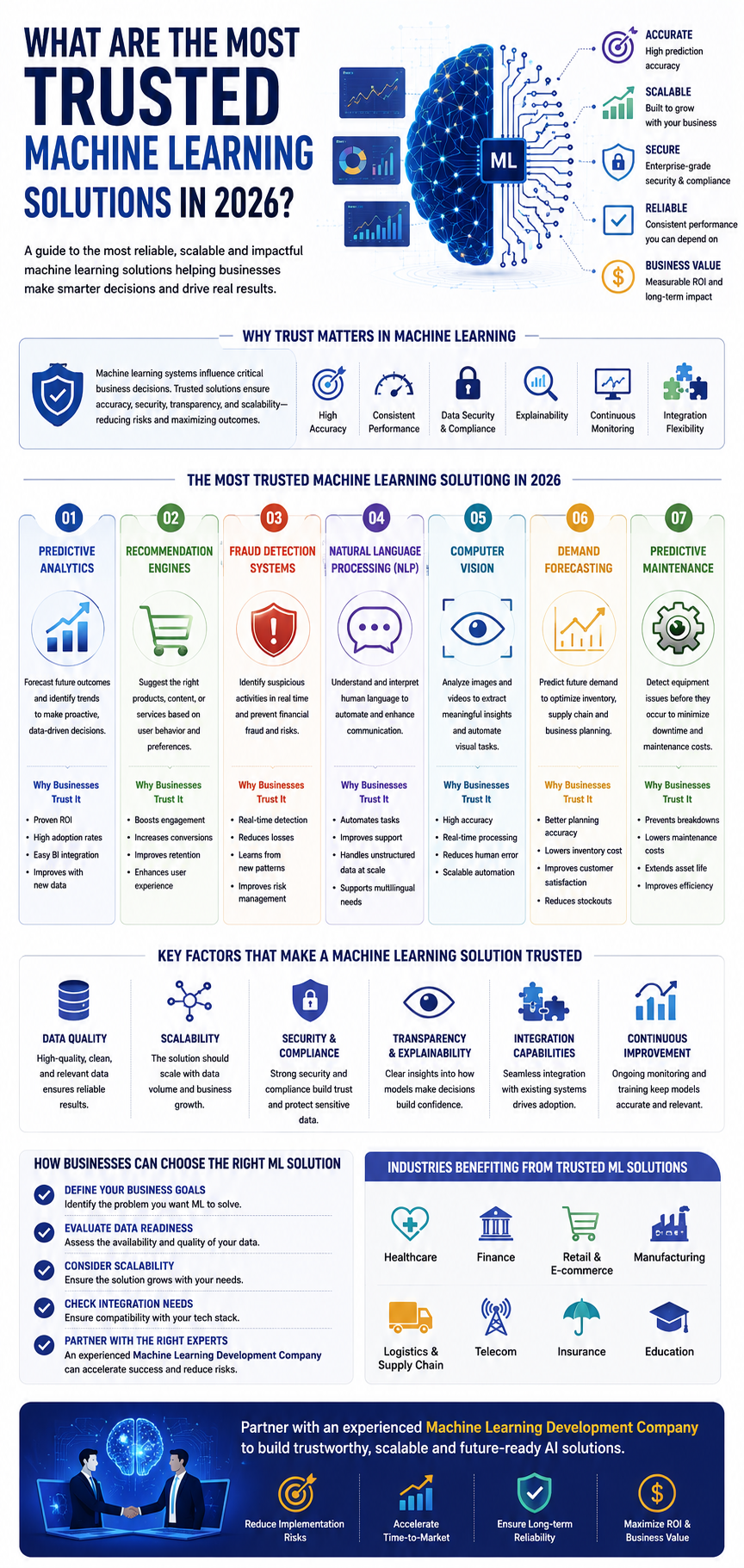
What Makes a Machine Learning Solution Trustworthy?
Businesses should evaluate machine learning solutions using the following criteria.
Accuracy
The solution should consistently deliver reliable predictions across different scenarios.
Scalability
The platform must handle growing data volumes and increasing user demands.
Security
Strong security controls are essential for protecting sensitive business and customer data.
Transparency
Organizations should understand how the model generates predictions and recommendations.
Compliance
Trusted solutions support industry regulations such as GDPR, HIPAA, and other data protection standards.
Integration Capabilities
The system should integrate easily with existing software, databases, and business workflows
Cloud-Based Machine Learning Platforms Businesses Trust
Many organizations prefer cloud-based machine learning platforms because they reduce infrastructure complexity.
Leading cloud ML platforms offer:
- Managed machine learning services
- Automated model training
- Scalable infrastructure
- Built-in security features
- MLOps capabilities
Cloud-based deployments enable businesses to launch machine learning initiatives faster while reducing operational overhead.
How to Choose the Right Machine Learning Solution
Before selecting a machine learning solution, organizations should answer several questions:
What Business Problem Are You Solving?
The technology should align with specific business objectives rather than following market trends.
Is Your Data Ready?
High-quality data remains one of the most important success factors in machine learning projects.
Can the Solution Scale?
Businesses should evaluate future growth requirements before implementation.
Does It Support Existing Systems?
Integration challenges often increase project complexity and costs.
Do You Have the Right Expertise?
Many organizations partner with a Machine Learning Development Company to access specialized skills, accelerate deployment, and ensure successful implementation.
Common Mistakes When Evaluating Machine Learning Solutions
Many businesses focus solely on technology features while overlooking practical requirements.
Common mistakes include:
- Choosing tools without clear business goals
- Ignoring data quality issues
- Underestimating implementation complexity
- Failing to plan for maintenance and monitoring
- Prioritizing cost over long-term value
Avoiding these mistakes can significantly improve project outcomes.
Future Trends Shaping Trusted Machine Learning Solutions
Several trends are influencing machine learning adoption in 2026:
Explainable AI (XAI)
Organizations increasingly demand transparency in machine learning decisions.
MLOps Adoption
Automated deployment, monitoring, and governance improve model reliability.
Industry-Specific AI Solutions
Businesses are moving toward specialized machine learning solutions designed for specific industries.
Generative AI Integration
Organizations are combining predictive machine learning with generative AI capabilities to create more intelligent business systems.
Conclusion
The most trusted machine learning solutions in 2026 are those that consistently deliver measurable business outcomes while maintaining accuracy, security, and scalability. Predictive analytics, recommendation engines, fraud detection, NLP, computer vision, demand forecasting, and predictive maintenance remain among the most reliable and widely adopted machine learning applications.
However, technology alone does not guarantee success. Businesses must align machine learning initiatives with clear objectives, high-quality data, and long-term operational goals. Working with an experienced Machine Learning Development Company can help organizations identify the right solution, reduce implementation risks, and maximize the value of their AI investments.
Meet the Author

Co-Founder, Rytsense Technologies
Karthik is the Co-Founder of Rytsense Technologies, where he leads cutting-edge projects at the intersection of Data Science and Generative AI. With nearly a decade of hands-on experience in data-driven innovation, he has helped businesses unlock value from complex data through advanced analytics, machine learning, and AI-powered solutions. Currently, his focus is on building next-generation Generative AI applications that are reshaping the way enterprises operate and scale. When not architecting AI systems, Karthik explores the evolving future of technology, where creativity meets intelligence.