Key Takeaways
Automates HR document processing and reduces manual workImproves accuracy in hiring, onboarding, and data managementUses AI technologies like OCR, NLP, and NERSpeeds up candidate screening and HR workflowsEnsures better compliance and data consistencyReduces errors and operational costsEnhances scalability and overall HR efficiency
Machine Learning Document Processing Services for HR Automation: How AI Is Rebuilding HR Document Workflows
Machine learning document processing services for HR automation are transforming how organizations manage document-heavy HR workflows. Today, HR teams are overwhelmed with resumes, onboarding forms, policy documents, contracts, and compliance records that require constant manual effort. With AI-powered document processing and intelligent document processing systems, businesses can automatically read, classify, extract, and process HR documents with high accuracy and speed. This shift toward HR automation reduces manual workload, minimizes errors, and improves decision-making. Whether it's resume parsing, contract analysis, or employee records management, machine learning is redefining HR operations at scale.
Key HR Document Processing Challenges & Impact73% of HR professionals cite document overload as their #1 bottleneck6.2× faster candidate screening with ML-based data extraction compared to manual review$11K average cost per mis-hire linked to missed or overlooked document insights
Why HR Document Chaos Costs More Than You Think
Every HR team, regardless of company size, operates in a document-heavy environment. Resumes arrive in PDFs with inconsistent formatting. Employment contracts require multi-party review and version tracking. Onboarding packets include forms, compliance declarations, tax submissions, and benefits enrollment, all collected and processed manually, one at a time.
The hidden cost is not just time, it is decision quality. When an HR coordinator manually reviews 200 applications, fatigue often sets in around the 40th resume. Cognitive shortcuts begin to replace careful reading. High-potential candidates with non-standard formats get overlooked. Critical compliance clauses in contracts can be missed. Errors in manually entered employee data compound over time.
This is where machine learning document processing changes the game — not by replacing HR judgment, but by providing HR professionals with cleaner, faster, and more consistent information to make better decisions.
Key insight: The goal of AI in HR document processing is not to remove humans from the loop, but to remove them from repetitive, error-prone tasks such as data extraction, formatting, classification, and routing.
How Machine Learning Document Processing Services for HR Automation Actually Work
The phrase “AI reads documents” is often used loosely, but understanding the underlying technologies helps in making smarter decisions when adopting intelligent document processing solutions. Modern AI-powered HR document processing systems combine multiple layers of machine learning and automation technologies:
1. Optical Character Recognition (OCR)Converts scanned PDFs, images, and handwritten forms into machine-readable text. Modern OCR powered by deep learning can handle messy layouts, stamps, and handwritten inputs far better than traditional systems.2. Named Entity Recognition (NER)Extracts structured data from unstructured text, such as candidate names, job titles, employment dates, education, skills, and locations. This enables accurate resume parsing and structured data creation.3. Document ClassificationAutomatically categorizes documents into types such as resumes, offer letters, contracts, policy documents, or performance reviews. This eliminates manual sorting and improves workflow efficiency.4. Natural Language Processing (NLP) & Semantic UnderstandingGoes beyond keyword matching to understand context and intent. For example, it can identify whether a contract clause aligns with company policies or summarize lengthy HR documents into actionable insights.5. Workflow Automation & System IntegrationExtracted and structured data is automatically pushed into HR systems such as HRIS, ATS, and payroll platforms, triggering actions like employee record creation, onboarding workflows, or compliance alerts.
Together, these technologies form an AI-driven intelligent document processing pipeline, which is the backbone of scalable HR automation.
Six Real Use Cases in HR Document Processing Today
1. Intelligent Resume Screening
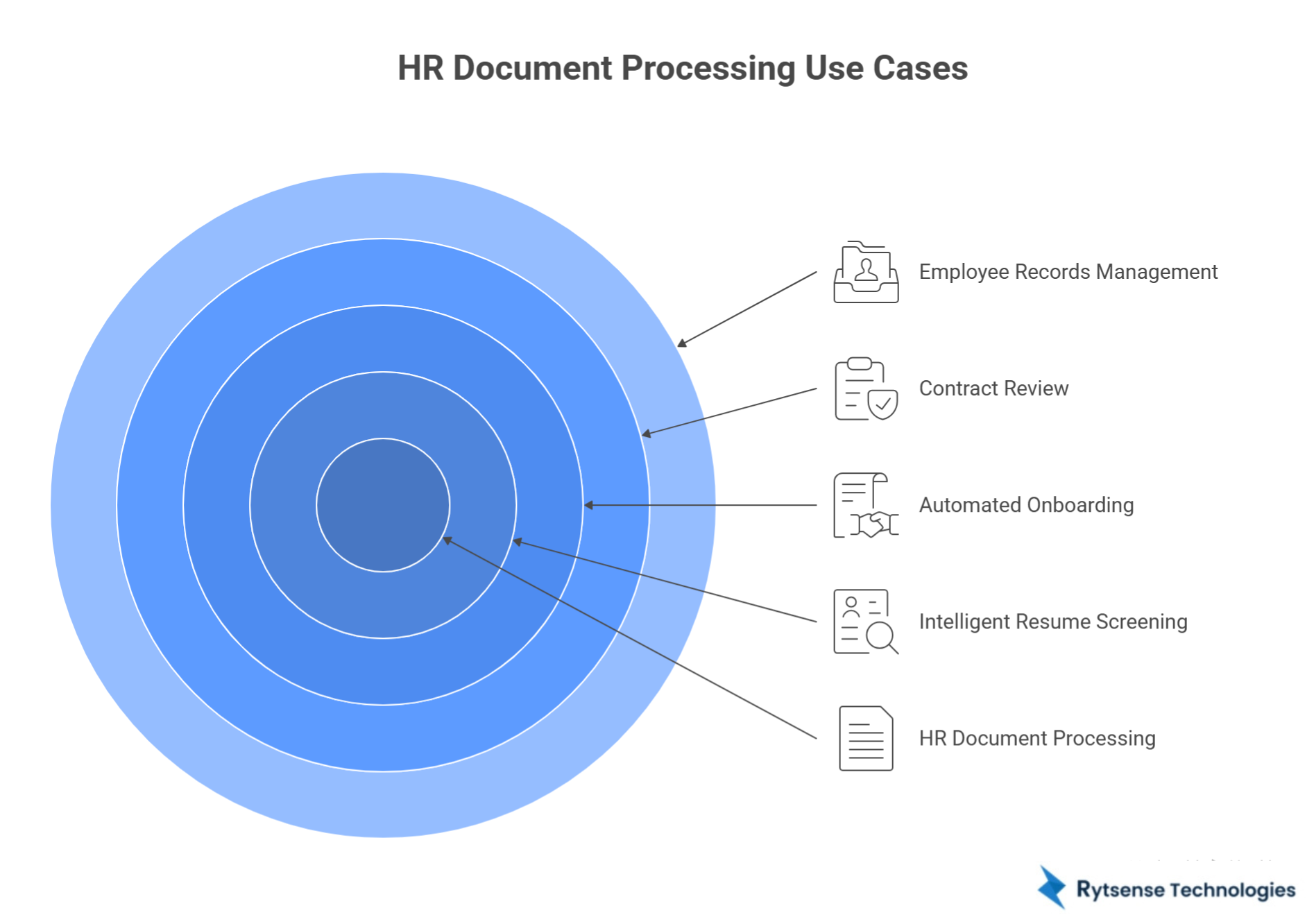
Machine learning models trained on historical hiring data can parse resumes of any format, extract structured information, and rank candidates based on semantic relevance rather than simple keyword matching.
2. Automated Onboarding Document Collection
New hire onboarding often involves 15–30 documents. AI systems validate completeness, cross-check information, flag missing fields, and automatically route documents to appropriate systems without manual follow-ups.
3. Contract Review and Clause Extraction
ML models extract and categorize clauses from employment contracts, NDAs, and vendor agreements. They also flag non-standard clauses and compare them against templates, reducing review time significantly.
4. Employee Records Management and Audit Readiness
Automated classification and metadata tagging ensure employee records are organized, searchable, and compliant with retention policies, making audits faster and more efficient.
5. Policy Document Summarization and Q&A
AI systems can process large volumes of policy documents and enable internal chatbots that answer employee queries instantly by referencing relevant sections.
6. Exit Documentation and Offboarding
AI ensures all exit processes, document collection, payroll processing, access revocation, and record updates are completed accurately and consistently.
Manual vs. AI-Assisted Document Processing: The Real Comparison
ProcessManual ApproachAI-Powered ApproachOutcomeResume ScreeningHR reads each resume (6–10 mins each)ML ranks candidates instantly90%+ time savedOnboardingManual document checksAutomated validationNear-zero missing documentsContract Review45–90 mins per contractClause extraction in minutes80% fasterData EntryManual input into HR systemsAutomated extraction and sync~99% accuracyPolicy QueriesEmail-based responsesAI chatbot answers instantlyReduced HR workload
If your HR team is spending hours extracting data and checking documents, AI can automate this in minutes with fewer errors. See How It Works →
How to Implement Without Disrupting Your HR Operations
One of the most common fears around AI adoption in HR is disruption either to daily workflows or to people's sense of security in their roles. The organizations that successfully deploy ML document processing follow a phased, collaborative approach:
Phase 1: Document Audit

Catalog all document types your HR team processes monthly. Volume, format variety, and error frequency reveal where automation delivers the fastest return.
Phase 2: Integration Mapping
Identify which downstream systems (HRIS, ATS, payroll) need to receive processed data. Integration clarity prevents the classic data-island failure mode.
Phase 3: Pilot Deployment
Start with one document type resumes or onboarding forms are ideal. Measure accuracy, speed, and HR team satisfaction before expanding scope.
Phase 4: Continuous Training
ML models improve with feedback loops. HR professionals flag errors; the model learns. Within 60–90 days, accuracy typically surpasses the initial baseline.
Phase 5: Scale Intelligently
Expand across document types and geographies only once the pilot model demonstrates stable, measurable performance and HR team trust is established.
Phase 6: Governance & Review
Establish quarterly model performance reviews. Track drift, update training data for new document formats, and align with evolving compliance requirements.
"The AI didn't replace our HR team it gave them back 40% of their week. Now they spend that time on things that actually require human judgment: candidate experience, team culture, and conflict resolution."— Head of People Operations, Series B SaaS Company (150 employees)
Data Privacy, Compliance, and the Trust Question
HR documents contain the most sensitive personal data your organization holds. Any ML deployment in this space must address privacy and compliance as a first-order concern, not an afterthought. Here is what a responsible implementation looks like:
Data minimizationThe ML system processes only what it needs extracted structured fields and does not store raw document images beyond defined retention windows.Role-based access controlsProcessed data and document access is gated by role. A recruiter sees candidate profiles; only HR leadership sees compensation data or disciplinary records.Audit trailsEvery automated action extraction, classification, routing is logged with timestamps, creating a complete chain of custody.Bias monitoringResume screening models must be tested regularly for demographic bias. If a model trained on historical hiring data disadvantages certain groups, this requires immediate intervention.Regulatory alignmentDepending on your geography, relevant regulations may include GDPR, CCPA, DPDP Act, or sector-specific requirements. Any ML system must be configured to honor data subject rights including access and deletion requests.
For regulated industries: Healthcare, finance, and government contractors should ensure their AI document processing vendor can provide model explainability the ability to show why a particular classification decision was made. This is increasingly required for compliance audits.
Choosing the Right AI Partner for HR Document Automation
The market for AI-powered HR document tools ranges from point solutions (resume parsers, contract analyzers) to full-stack intelligent document processing platforms. Here is a clear-eyed framework for evaluating what your organization actually needs:
Point Solution vs. Platform vs. Custom BuildFor early-stage startups with a single, urgent problem such as resume screening at volume a well-integrated point solution may be the fastest path to ROI. For mid-size companies with complex, multi-document workflows and proprietary document formats, a platform that supports custom models will serve better in the long run.For enterprises with unique document types, unusual data architectures, or strict on-premise requirements, investing in custom machine learning development services ensures the solution is trained on your actual documents — not generic industry datasets which consistently delivers higher accuracy and better integration with existing systems.
Questions Worth Asking Any VendorHow was the model trained, and on what document corpus?What accuracy benchmarks can you demonstrate on documents similar to ours?How does the system handle document formats it has not seen before?What does your bias testing and fairness monitoring protocol look like?What happens to our documents and extracted data post-processing?Can you integrate with our existing HRIS and ATS without a full rip-and-replace?
Vendors who struggle to answer these clearly, or who deflect with marketing language, are usually selling a tool that is not production-ready for serious HR workloads.
What Is Coming Next in AI-Powered HR Document Processing
The pace of development in this space is unusually fast. Here is where the technology is heading over the next 12 to 24 months, and why it matters for decisions you are making right now:
Multimodal Document Understanding
Beyond reading text, next-generation models understand the visual layout of documents recognizing tables, form fields, signatures, stamps, and logos as meaningful elements. This dramatically improves accuracy on government IDs, structured forms, and scanned legacy documents.
Agentic HR Workflows
Rather than passive extraction, AI agents will take end-to-end actions: receive a signed offer letter, create an employee record in the HRIS, send calendar invites for orientation sessions, trigger background check workflows, and notify the hiring manager all without human intervention. Several enterprise platforms are in advanced beta with this capability today.
Continuous Compliance Monitoring
Instead of periodic audits, ML systems will continuously scan employee records and contracts against current regulatory requirements, alerting HR teams to documents approaching expiration, containing newly non-compliant clauses, or missing required updates.
Explainable AI for Hiring Decisions
Regulatory pressure around algorithmic hiring decisions is increasing globally. The next generation of resume screening tools will need to generate human-readable explanations for every recommendation creating both legal defensibility and trust within hiring teams.
Conclusion
Machine learning document processing services for HR automation are no longer a future concept, they are a critical component of modern HR operations. By leveraging AI technologies such as OCR, NLP, and intelligent document processing, organizations can streamline document workflows, reduce manual errors, and improve decision-making at scale. From resume screening to compliance management, the benefits are immediate and measurable. Companies that invest in these solutions today will achieve faster processes, better accuracy, improved compliance, and enhanced employee experiences, positioning themselves for long-term success in an increasingly data-driven world.
Still dealing with document overload during hiring, onboarding, or audits? It's time to simplify and scale your HR workflows. Get Started →
Meet the Author

Co-Founder, Rytsense Technologies
Karthik is the Co-Founder of Rytsense Technologies, where he leads cutting-edge projects at the intersection of Data Science and Generative AI. With nearly a decade of hands-on experience in data-driven innovation, he has helped businesses unlock value from complex data through advanced analytics, machine learning, and AI-powered solutions. Currently, his focus is on building next-generation Generative AI applications that are reshaping the way enterprises operate and scale. When not architecting AI systems, Karthik explores the evolving future of technology, where creativity meets intelligence.