Pros and Cons of In-House AI UX Teams in Retail
Building an in-house AI UX team in retail gives you greater control, faster iteration, and deeper alignment with your customers, but it also comes with high costs, talent challenges, and scalability limitations.
For retail leaders evaluating this approach, the decision ultimately comes down to whether long-term strategic ownership outweighs short-term complexity and investment.
If your business relies heavily on AI-driven customer experiences like personalization engines, recommendation systems, or AI-powered interfaces an in-house team can become a powerful competitive advantage. However, for many startups and growing businesses, the operational burden can slow innovation rather than accelerate it.
Key Takeaways
In-house AI UX teams offer deep brand alignment and faster iteration cyclesBuilding internally requires significant investment in talent, tools, and infrastructureExternal partners bring specialized expertise and faster time to valueMost successful retailers use a hybrid model — core in-house capability with specialist partnersThe AI talent market is highly competitive, making recruitment and retention a key riskStrategic alignment between AI UX and business goals is the most critical success factor
1. What Is an In-House AI UX Team in Retail?
An in-house AI UX team is a dedicated internal group responsible for designing, optimizing, and managing AI-driven user experiences across retail touchpoints.
This includes:
- AI-powered product recommendations
- Smart search and voice interfaces
- Chatbots and virtual shopping assistants
- Predictive personalization
- AI-driven checkout and conversion flows
Unlike traditional UX teams, these teams work closely with machine learning models, data pipelines, and AI systems to create experiences that evolve dynamically.
2. Why Retailers Are Investing in AI UX
Retail is no longer just about selling products; it’s about delivering hyper-personalized experiences at scale.
AI UX plays a key role in:
- Increasing conversion rates
- Reducing cart abandonment
- Enhancing customer engagement
- Driving repeat purchases
- Improving customer lifetime value
Modern consumers expect platforms to “know” them. AI bridges this gap by combining data analysis, behavioral insights, and intelligent interfaces.
3. Core Responsibilities of AI UX Teams
An effective AI UX team in retail operates at the intersection of design, data, and intelligence. Their role goes beyond traditional UX; they design experiences that learn, adapt, and improve continuously. Here’s a clearer breakdown of their key responsibilities:
Conversational AI & Interaction DesignAI UX teams design conversational flows for chatbots and virtual assistants, voice-based shopping experiences, and smart search interfaces with predictive suggestions.4. Seamless Integration with Existing SystemsInternal teams work closely with Product, Engineering, and Data teams. This ensures smooth AI integration across eCommerce platforms, mobile apps, and CRM systems.5. Ethical & Trust DesignTrust is critical in AI-driven retail experiences. Teams must ensure transparency, reduce bias, and build interfaces that users can rely on.
Building these capabilities requires deep expertise in machine learning development services to ensure the AI behaves as expected while maintaining a user-centric focus.
Pros of Building an In-House AI UX Team
Deep Brand and Customer Knowledge
No external partner can match the depth of institutional knowledge that an in-house team accumulates over time. In-house AI UX designers and engineers understand your customer base, brand voice, product catalog nuances, and competitive context at a level that typically takes outside teams months to approach.
For retailers with complex, differentiated brand identities or highly specific customer segments, this depth of context translates directly into better AI experience quality.
Faster Iteration and Experimentation
In-house teams eliminate the coordination overhead of working with external partners. Changes to AI recommendation models, conversation flows, or personalization logic can be tested, measured, and refined on a daily cycle without the latency of external communication, contracts, or project handoffs.
For retailers running continuous A/B testing across AI-powered experiences, in-house teams are significantly faster at turning insights into improvements.
Data Security and Intellectual Property Control
Customer behavioral data, purchase history, and personalization models are among the most valuable assets in retail AI. Keeping the team that builds and works with this data in-house reduces the risk of exposure, provides direct control over data handling practices, and ensures proprietary AI models remain competitive advantages — not shared knowledge.
Long-Term Capability Building
Each project an in-house team completes builds organizational knowledge, reusable components, and improved processes. Over time, this compounds into a genuine capability that is difficult for competitors to replicate and becomes increasingly efficient as the team deepens its understanding of your systems and customers.
Cons of Building an In-House AI UX Team
Talent Acquisition and Retention Challenges
AI UX is an extremely competitive talent market. Professionals who combine strong UX design skills with AI/ML fluency are rare and expensive. Tech companies, AI startups, and consultancies compete aggressively for the same pool of candidates — often with compensation packages, culture, and career trajectory that traditional retailers struggle to match.
Turnover in this space is high, and each departure represents significant knowledge loss and replacement cost.
High Initial Investment
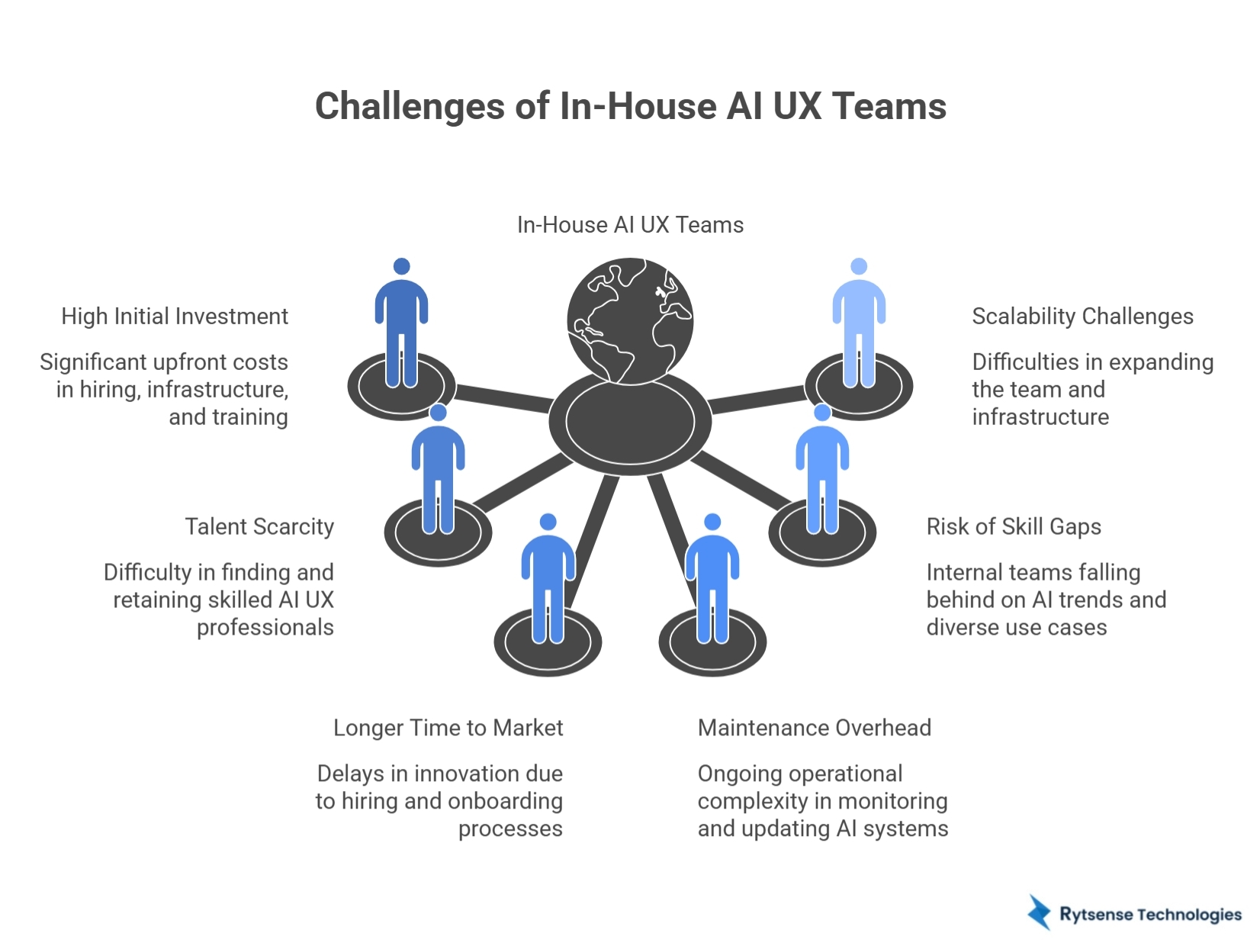
Building a capable in-house AI UX team requires sustained investment in salaries, tools, compute infrastructure, training, and management overhead — regardless of whether you have a full project pipeline. This fixed cost structure creates financial pressure in slower business periods and limits flexibility to scale resources based on demand.
Slower Speed to First Value
Hiring, onboarding, tool procurement, infrastructure setup, and initial capability development take time — often 6–12 months before an in-house AI UX team is operating at meaningful productivity. For retailers facing competitive pressure to deploy AI capabilities quickly, this timeline can be a significant disadvantage.
Skill Gaps and Limited Specialization
AI UX spans multiple disciplines — conversational design, ML systems understanding, behavioral research, data visualization, accessibility. Small in-house teams typically cannot maintain deep expertise across all of these simultaneously. Teams often develop strong capability in some areas while remaining thin in others.
When In-House Makes Sense
Building an in-house AI UX team is most justified when:
- AI-powered customer experience is a primary competitive differentiator for your brand
- You have sufficient scale to sustain a team of 5+ specialists at full productivity
- You have access to competitive compensation to attract and retain strong talent
- Your AI development roadmap spans multiple years with sustained project volume
- Data sensitivity requirements make external collaboration impractical
- You are building proprietary AI models that require continuous in-house iteration
Large enterprise retailers — those with significant e-commerce operations, loyalty programs, and multi-channel AI touchpoints — typically have sufficient scale to justify in-house investment. The ROI compounds over time as the team's institutional knowledge deepens.
When to Partner with External AI UX Specialists
External partnerships deliver the most value when:
- You need AI UX capabilities quickly and can't wait for in-house team development
- Your AI project volume doesn't justify full-time specialist headcount
- You need specialized expertise (e.g., conversational AI design) for a specific initiative
- You want to de-risk a major AI investment by leveraging proven frameworks and experience
- Your core business model doesn't depend on proprietary AI UX as a differentiator
Mid-market retailers and those early in their AI journey often get faster, higher-quality outcomes from specialized partners than from building in-house teams that take time to become productive.
Start with a Hybrid Model
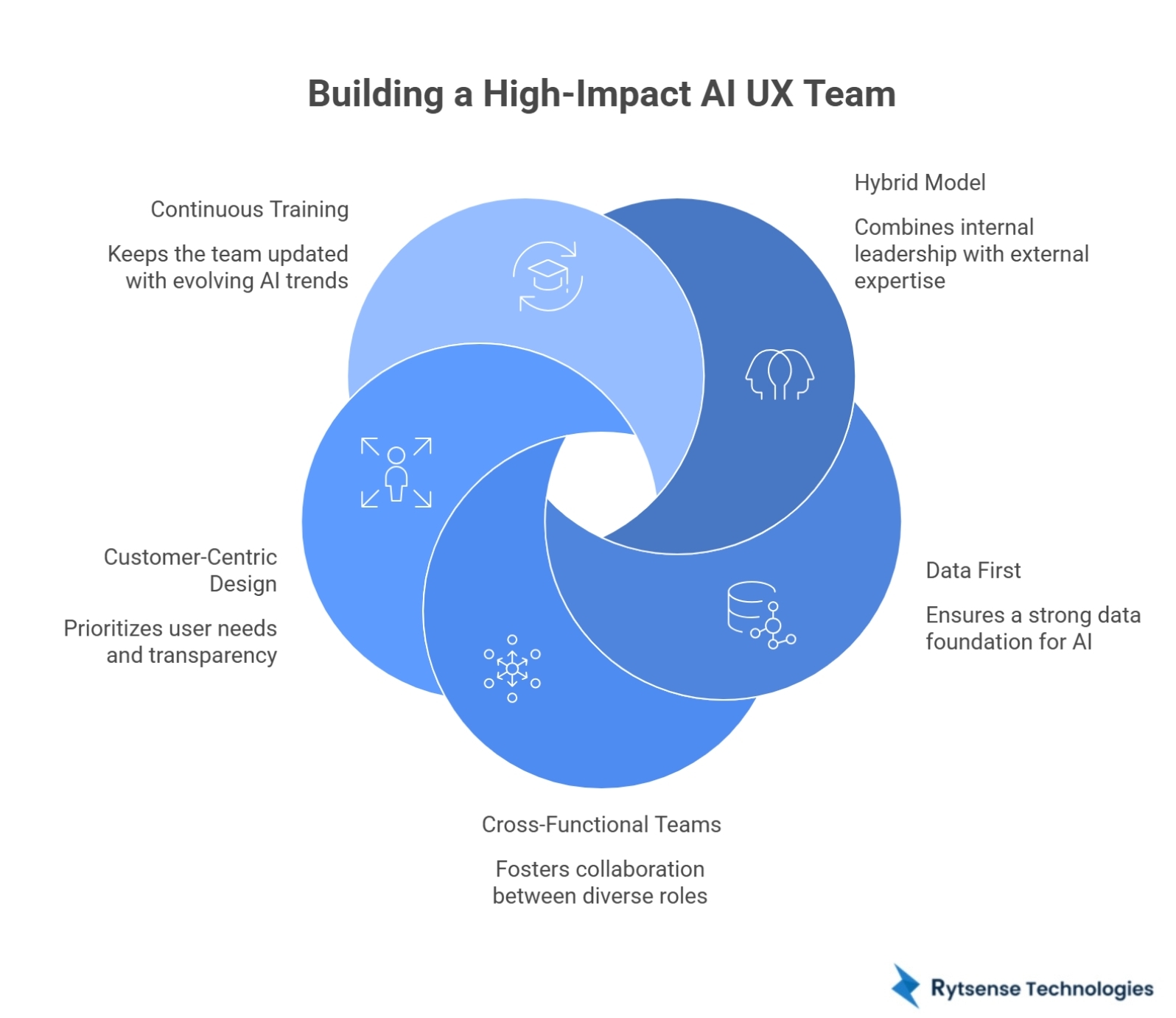
The most pragmatic and widely adopted approach is a hybrid model that combines a small, senior in-house AI UX capability with specialized external partners for specific initiatives or surge capacity.
In-House CoreA small team (2–5 people) owns AI UX strategy, brand standards, vendor relationships, and quality review. They provide continuity, institutional knowledge, and decision authority.External SpecialistsSpecialized partners deliver execution capacity for major projects, bring domain expertise for specific AI capabilities, and provide access to cutting-edge tools and methodologies that would be prohibitively expensive to develop internally.
This model balances speed and specialization from partners with the continuity and brand alignment of in-house ownership — delivering better outcomes than either approach alone for most retail organizations.
Conclusion
There is no single right answer to whether retailers should build in-house AI UX teams or partner externally. The decision depends on scale, competitive positioning, talent access, budget, and how central AI experience is to your core value proposition.
What is clear is that the quality of AI-powered customer experience is rapidly becoming a primary competitive differentiator in retail. Retailers who invest early — through whatever model fits their context — will build advantages that are difficult and expensive for competitors to close.
Whether you build, partner, or do both — invest in AI UX with intention. Your customers will notice the difference.
Meet the Author

Co-Founder, Rytsense Technologies
Karthik is the Co-Founder of Rytsense Technologies, where he leads cutting-edge projects at the intersection of Data Science and Generative AI. With nearly a decade of hands-on experience in data-driven innovation, he has helped businesses unlock value from complex data through advanced analytics, machine learning, and AI-powered solutions. Currently, his focus is on building next-generation Generative AI applications that are reshaping the way enterprises operate and scale. When not architecting AI systems, Karthik explores the evolving future of technology, where creativity meets intelligence.