Key Takeaways
- Plan your AI budget around the entire project lifecycle, not just development costs.
- Define clear business goals before estimating your investment.
- Assess your data quality and integration requirements early.
- Choose a pricing model that matches your project scope and flexibility.
- Include ongoing costs such as maintenance, cloud infrastructure, and updates.
- Measure ROI using clear business and performance metrics.
Artificial intelligence has become a strategic investment for businesses looking to automate operations, improve customer experiences, and make data-driven decisions. However, before choosing an AI development partner, one important question needs to be answered:
How much budget should you allocate for a custom AI solution?
The answer goes beyond a simple price estimate. A successful AI budget should include planning for development, data preparation, infrastructure, integrations, deployment, and long-term maintenance. Understanding these costs early helps businesses avoid unexpected expenses and choose a solution that aligns with their goals.
In this guide, we'll explain how to plan your AI budget, understand different pricing models, identify hidden costs, and evaluate the return on your investment.
Quick Answer
The budget for a custom AI solution depends on factors such as project complexity, available data, integrations, compliance requirements, and long-term maintenance. While smaller AI projects may require a modest investment, enterprise-grade AI platforms often involve a larger budget due to advanced functionality, scalability, and ongoing optimization.
Rather than focusing solely on development costs, businesses should budget for the complete AI lifecycle to achieve sustainable results.
Why AI Budget Planning Matters
Many organizations underestimate the total investment required for AI projects by focusing only on development costs. In reality, AI initiatives involve multiple stages, each contributing to the overall budget.
Proper planning helps businesses:
- Allocate resources more effectively.
- Reduce the risk of budget overruns.
- Prioritize high-value AI use cases.
- Compare vendor proposals with confidence.
- Measure business outcomes more accurately.
- Plan for future expansion and maintenance.
A realistic budget allows organizations to make informed investment decisions while minimizing financial and operational risks.
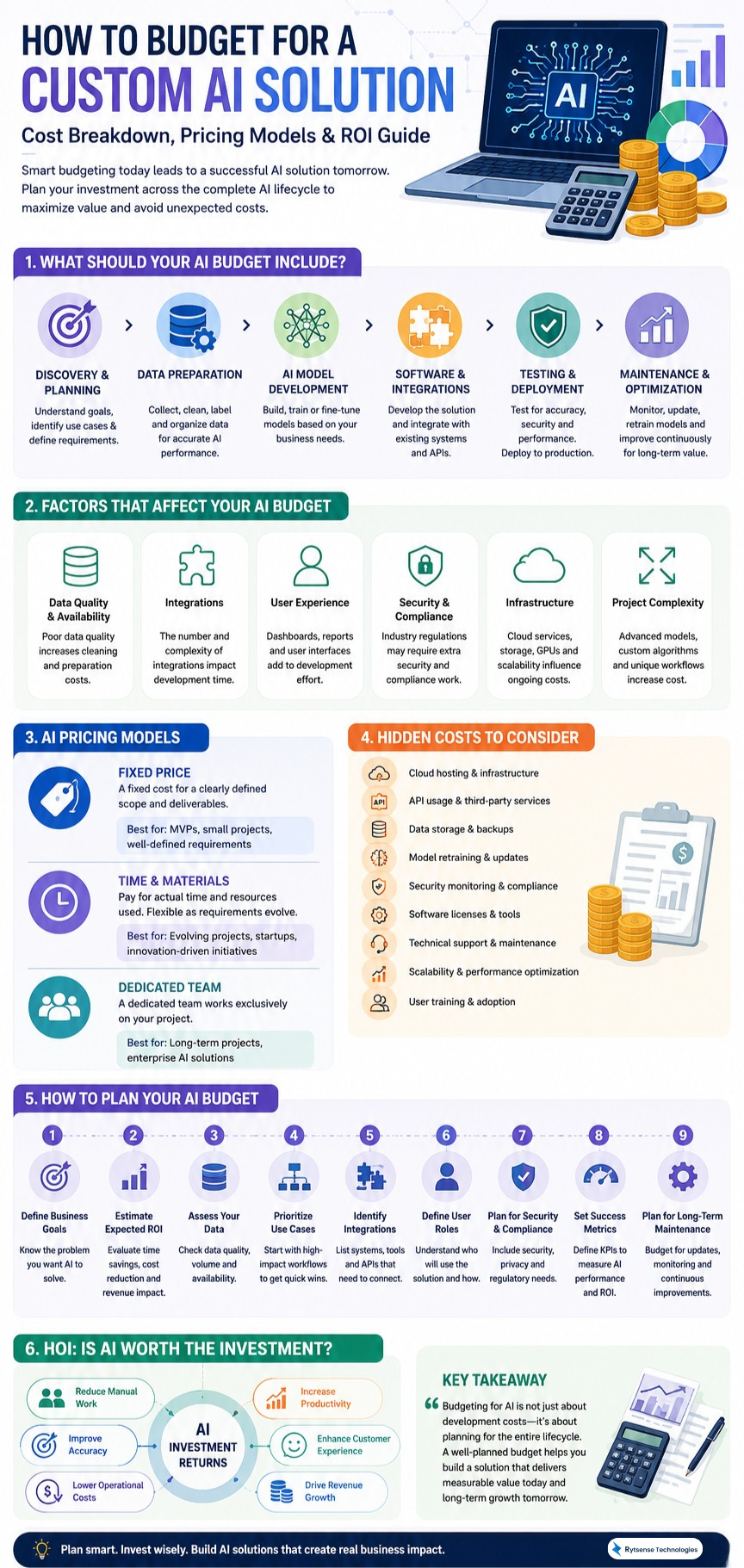
What Should Your AI Budget Include?
A comprehensive AI budget should account for every stage of implementation, not just software development.
Discovery and Business Planning
Every successful AI project begins with understanding business objectives, identifying challenges, and defining project requirements. This discovery phase helps establish priorities, estimate resources, and reduce unnecessary development work later.
Data Preparation
AI models rely on high-quality data. Preparing datasets often involves collecting information, removing duplicates, correcting inconsistencies, and organizing data into a format suitable for machine learning.
Businesses with clean, well-structured data typically experience faster implementation and lower project costs.
AI Model Development
Depending on your use case, developers may use pre-trained models, fine-tune existing models, or build custom machine learning solutions.
The complexity of the chosen approach directly affects the overall budget.
Software Development and Integrations
Most AI solutions need to integrate with existing business systems such as CRM platforms, ERP software, payment gateways, internal databases, or cloud applications.
The number and complexity of these integrations influence both development time and project costs.
Testing and Deployment
Before launch, AI solutions undergo functional testing, performance validation, security reviews, and user acceptance testing.
Deployment may involve cloud infrastructure, on-premises environments, or hybrid architectures depending on business requirements.
Ongoing Maintenance
AI solutions continue to evolve after deployment. Businesses should budget for:
- Model updates
- Performance monitoring
- Infrastructure upgrades
- Security patches
- Technical support
- Feature enhancements
- Model retraining
Considering these ongoing expenses helps prevent unexpected costs in the future.
How to Plan Your AI Budget
A structured budget begins with understanding your business priorities and technical requirements.
Define Business Objectives
Identify the specific problems your AI solution should solve. Whether your goal is improving customer support, automating repetitive processes, reducing operational costs, or increasing productivity, clear objectives help determine the appropriate project scope and investment.
Assess Your Data
Evaluate whether your organization has enough accurate and organized data to support AI implementation. If additional data preparation or labeling is required, include those activities in your budget.
Prioritize High-Impact Use Cases
Instead of automating every business process at once, begin with workflows that deliver measurable value. Starting with a focused implementation reduces risk while providing valuable insights for future expansion.
Identify Integration Requirements
Consider how your AI solution will connect with existing business applications. Integrations often represent a significant portion of project effort, so planning them early improves budgeting accuracy.
Include Security and Compliance
If your organization handles sensitive customer information, budget for encryption, user authentication, regulatory compliance, and security monitoring from the beginning.
Plan for Long-Term Growth
Your AI solution should be scalable. Reserve part of your budget for future improvements, additional features, cloud infrastructure, and continuous optimization as business needs evolve.
Understanding AI Pricing Models
Different pricing models suit different business requirements.
Fixed Price
A fixed-price model works well when project requirements are clearly defined. Businesses know the total investment before development begins, making budgeting more predictable.
Best suited for:
- Proof of concepts
- Minimum viable products (MVPs)
- Small AI automation projects
Time and Materials
For projects with evolving requirements, a time-and-materials model provides greater flexibility. Businesses pay based on the actual development effort, making it suitable for iterative AI projects.
Best suited for:
- Growing startups
- Research-driven initiatives
- AI product innovation
Dedicated Development Team
Organizations with long-term AI initiatives often choose a dedicated team model. This approach provides continuous access to AI engineers, data scientists, designers, and project managers who work as an extension of the internal team.
Best suited for:
- Enterprise AI transformation
- Multi-phase AI programs
- Continuous product development
How to Evaluate AI ROI Before Investing
Budget planning should include a clear understanding of the expected return on investment.
Evaluate potential benefits such as:
- Reduced manual work
- Faster business processes
- Lower operational costs
- Improved customer satisfaction
- Increased employee productivity
- Better forecasting and decision-making
- Higher revenue opportunities
Defining measurable success metrics before implementation makes it easier to track business outcomes and justify future AI investments.
Tips to Optimize Your AI Budget
You don't always need the largest budget to achieve meaningful results. Consider these practical strategies:
- Start with a pilot project or MVP.
- Prioritize business-critical features.
- Improve data quality before development begins.
- Reuse existing cloud services and APIs where appropriate.
- Choose a scalable architecture that supports future growth.
- Work with an experienced AI development partner to avoid costly rework.
A phased implementation approach allows businesses to validate results before making larger investments.
Conclusion
Budgeting for a custom AI solution involves much more than estimating development costs. A successful investment requires careful planning across every stage of the AI lifecycle, from discovery and data preparation to deployment, maintenance, and future optimization.
By defining clear business goals, understanding pricing models, preparing for hidden expenses, and measuring expected ROI, organizations can make informed investment decisions and maximize the long-term value of artificial intelligence.
A structured budget not only keeps projects on track but also ensures your AI solution delivers sustainable business growth and measurable results.
Meet the Author

Co-Founder, Rytsense Technologies
Karthik is the Co-Founder of Rytsense Technologies, where he leads cutting-edge projects at the intersection of Data Science and Generative AI. With nearly a decade of hands-on experience in data-driven innovation, he has helped businesses unlock value from complex data through advanced analytics, machine learning, and AI-powered solutions. Currently, his focus is on building next-generation Generative AI applications that are reshaping the way enterprises operate and scale. When not architecting AI systems, Karthik explores the evolving future of technology, where creativity meets intelligence.