Key Takeaways
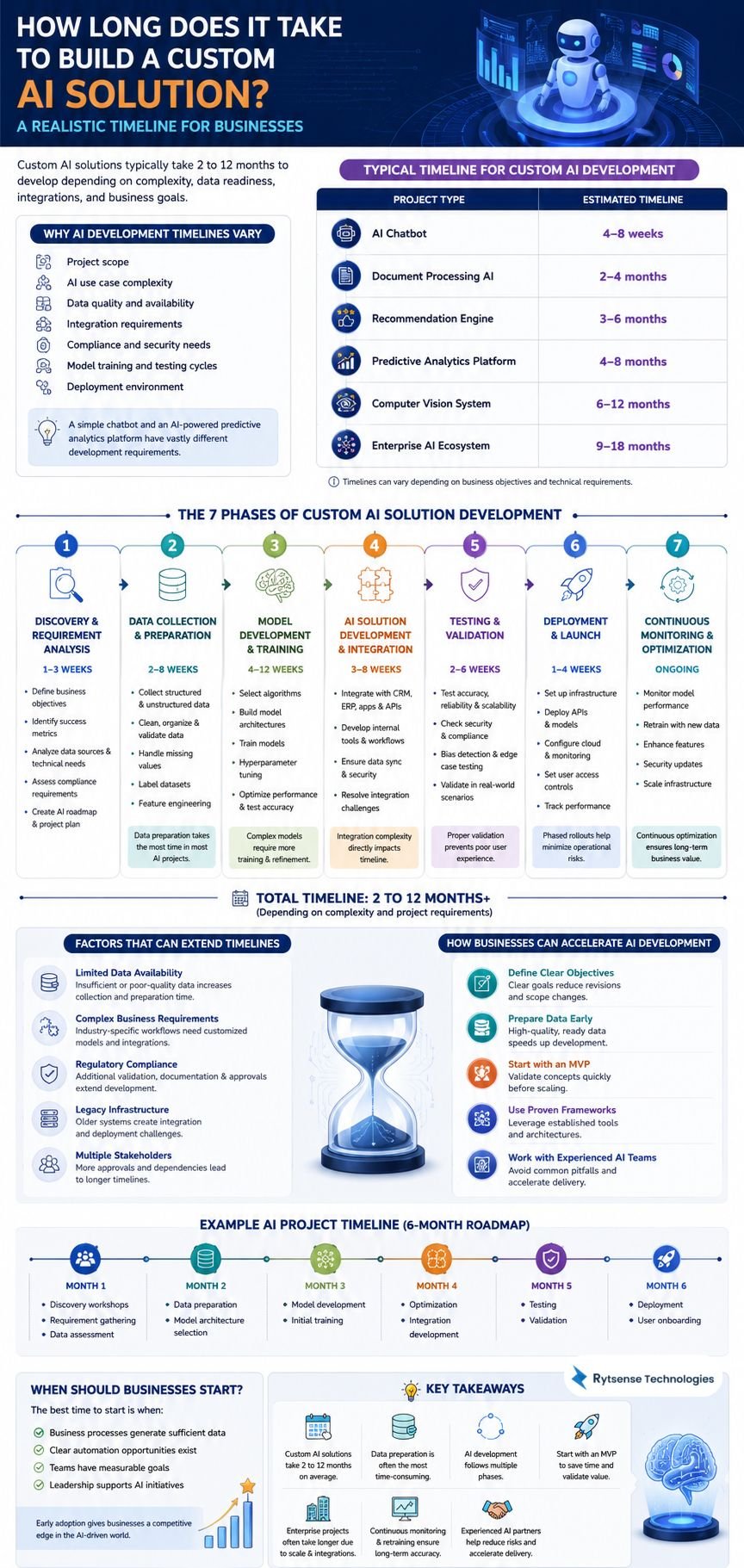
- Custom AI solutions typically take 2 to 12 months to develop depending on complexity and business requirements.
- Data preparation is often the most time-consuming stage of AI development.
- Project timelines vary based on data quality, integrations, compliance requirements, and deployment goals.
- AI development follows multiple phases, including discovery, data preparation, model training, testing, deployment, and optimization.
- Starting with an MVP can reduce development time and validate business value faster.
- Enterprise AI projects generally require longer timelines due to scalability and integration needs.
- Continuous monitoring and retraining are essential after deployment to maintain model accuracy.
- Partnering with experienced AI teams can accelerate development and reduce implementation risks.
How Long Does It Take to Build a Custom AI Solution?
Artificial Intelligence has moved beyond experimentation. Businesses across healthcare, finance, retail, manufacturing, and logistics are investing in AI-powered systems to automate processes, improve decision-making, and create better customer experiences.
One of the most common questions business leaders ask before starting an AI project is:
"How long will it take to build a custom AI solution?"
The answer depends on several factors, including project complexity, data availability, integration requirements, and deployment goals. While some AI projects can be completed in a few months, enterprise-grade solutions often require longer development cycles.
This guide explains the typical AI development timeline, the stages involved, and what businesses can do to accelerate implementation.
Why AI Development Timelines Vary
Unlike traditional software applications, AI solutions require more than coding and deployment. Teams must collect data, train models, test performance, validate outputs, and continuously optimize results.
The timeline depends on:
- Project scope
- AI use case complexity
- Data quality and availability
- Integration requirements
- Compliance and security needs
- Model training and testing cycles
- Deployment environment
A simple chatbot and an AI-powered predictive analytics platform have vastly different development requirements.
Typical Timeline for Custom AI Development
| Project Type | Estimated Timeline |
|---|---|
| AI Chatbot | 4–8 weeks |
| Document Processing AI | 2–4 months |
| Recommendation Engine | 3–6 months |
| Predictive Analytics Platform | 4–8 months |
| Computer Vision System | 6–12 months |
| Enterprise AI Ecosystem | 9–18 months |
These timelines can vary depending on business objectives and technical requirements.
Phase 1: Discovery and Requirement Analysis
Estimated Time: 1–3 Weeks
Every successful AI project begins with a discovery phase.
During this stage, teams define:
- Business objectives
- Success metrics
- Expected outcomes
- Data sources
- Technical requirements
- Compliance considerations
The goal is to determine whether AI is the right solution and identify the most effective implementation strategy.
Deliverables
- AI roadmap
- Project scope document
- Technology recommendations
- Development timeline estimation
Without a proper discovery phase, projects often face delays later in development.
Phase 2: Data Collection and Preparation
Estimated Time: 2–8 Weeks
Data is the foundation of every AI system.
Before model development begins, data must be collected, cleaned, organized, and validated.
Common tasks include:
- Gathering structured and unstructured data
- Removing duplicates
- Handling missing values
- Labeling datasets
- Data normalization
- Feature engineering
Many AI projects spend more time preparing data than building models.
Why This Phase Takes Time
Organizations often discover:
- Incomplete datasets
- Inconsistent formats
- Data silos
- Poor-quality records
Addressing these issues is essential for model accuracy.
Phase 3: Model Development and Training
Estimated Time: 4–12 Weeks
This stage involves creating and training machine learning or generative AI models.
Activities include:
- Selecting algorithms
- Building model architectures
- Training models
- Hyperparameter tuning
- Performance optimization
- Accuracy testing
The timeline depends heavily on project complexity.
For example:
- A customer support chatbot may require only a few weeks.
- A fraud detection system may require months of experimentation and refinement.
Businesses seeking advanced language capabilities often invest in custom generative AI development services to build models tailored to their specific industry and workflows.
Phase 4: AI Solution Development and Integration
Estimated Time: 3–8 Weeks
After the model achieves acceptable performance, developers integrate it into business systems.
This may include:
- CRM integration
- ERP integration
- Mobile applications
- Web platforms
- APIs
- Internal business tools
Integration complexity significantly impacts overall project timelines.
Common Challenges
- Legacy systems
- Security requirements
- Data synchronization
- Infrastructure limitations
The smoother the integration environment, the faster deployment can occur.
Phase 5: Testing and Validation
Estimated Time: 2–6 Weeks
Testing ensures the AI system performs reliably in real-world conditions.
Teams evaluate:
- Accuracy
- Reliability
- Scalability
- Security
- Bias detection
- Edge case performance
This phase often reveals opportunities for further model improvements.
Skipping proper validation can result in poor user experiences and inaccurate predictions.
Phase 6: Deployment and Launch
Estimated Time: 1–4 Weeks
Once testing is complete, the solution moves into production.
Deployment tasks include:
- Infrastructure setup
- API deployment
- Cloud configuration
- Monitoring setup
- User access controls
- Performance tracking
Organizations may choose phased rollouts to minimize operational risks.
Phase 7: Continuous Monitoring and Optimization
Ongoing Process
AI development does not end after deployment.
Models require continuous monitoring because:
- Business conditions change
- User behavior evolves
- Data patterns shift
- Accuracy may decline over time
Key post-launch activities include:
- Model retraining
- Performance monitoring
- Feature enhancements
- Security updates
- Infrastructure scaling
Long-term optimization ensures sustained business value.
Factors That Can Extend AI Development Timelines
Several factors can increase project duration.
Limited Data Availability
If organizations lack sufficient training data, teams may need additional time to collect and prepare datasets.
Complex Business Requirements
Industry-specific workflows often require customized AI architectures and integrations.
Regulatory Compliance
Healthcare, finance, and insurance projects may require additional validation and documentation.
Legacy Infrastructure
Older systems can make integration more challenging and time-consuming.
Multiple Stakeholders
Large enterprises often require approvals from various departments, increasing project timelines.
How Businesses Can Accelerate AI Development
Organizations can shorten development cycles by:
Defining Clear Objectives
Well-defined goals reduce unnecessary revisions and scope changes.
Preparing Data Early
Data readiness significantly impacts project speed.
Starting with an MVP
Building a Minimum Viable Product helps validate concepts quickly before expanding functionality.
Using Proven Frameworks
Leveraging established AI frameworks reduces development overhead.
Working with Experienced AI Teams
An experienced development partner can avoid common implementation mistakes and accelerate delivery.
Businesses looking for specialized AI solutions often collaborate with providers offering custom generative AI development services to streamline development and deployment processes.
Example AI Project Timeline
Month 1
- Discovery workshops
- Requirement gathering
- Data assessment
Month 2
- Data preparation
- Model architecture selection
Month 3
- Model development
- Initial training
Month 4
- Optimization
- Integration development
Month 5
- Testing
- Validation
Month 6
- Deployment
- User onboarding
This timeline represents a medium-complexity business AI project.
When Should Businesses Start AI Development?
The best time to start is when:
- Business processes generate sufficient data
- Clear automation opportunities exist
- Teams have measurable goals
- Leadership supports AI initiatives
Organizations that delay adoption may find themselves competing against businesses already benefiting from AI-driven efficiencies.
Conclusion
Building a custom AI solution typically takes anywhere from 2 to 12 months, depending on complexity, data readiness, integration requirements, and business goals.
The development process involves much more than training a model. Successful projects require careful planning, data preparation, testing, deployment, and continuous optimization.
By understanding the development timeline and preparing the right resources, businesses can reduce risks and accelerate AI adoption while achieving measurable outcomes.
Meet the Author

Co-Founder, Rytsense Technologies
Karthik is the Co-Founder of Rytsense Technologies, where he leads cutting-edge projects at the intersection of Data Science and Generative AI. With nearly a decade of hands-on experience in data-driven innovation, he has helped businesses unlock value from complex data through advanced analytics, machine learning, and AI-powered solutions. Currently, his focus is on building next-generation Generative AI applications that are reshaping the way enterprises operate and scale. When not architecting AI systems, Karthik explores the evolving future of technology, where creativity meets intelligence.