Key Takeaways
- Most custom AI applications take between 2 and 7 months to develop, depending on complexity.
- Data quality has a greater impact on timelines than coding effort alone.
- Discovery, planning, and validation are essential for predictable delivery.
- Starting with an MVP helps businesses achieve value sooner while reducing project risk.
- Partnering with an experienced AI development company can accelerate implementation through proven processes and reusable components.
Introduction
One of the first questions every business asks before investing in AI is:
"How long will it take to build a custom AI application?"
The answer depends on much more than coding.
Unlike traditional software, a custom AI application must be trained using business data, integrated with existing systems, validated for accuracy, tested continuously, and optimized after deployment. A simple AI assistant can be launched in a few weeks, while an enterprise AI platform may require several months of development.
At Rytsense Technologies, we've found that the fastest AI projects aren't necessarily the smallest—they're the ones with clear business objectives, high-quality data, and well-defined workflows.
This guide explains the complete custom AI development timeline, what influences project duration, and how businesses can accelerate delivery without compromising quality.
Quick Answer
If you're planning to build a custom AI application, here's a realistic timeline:
| Project Type | Estimated Duration |
|---|---|
| AI Proof of Concept | 2–4 Weeks |
| AI MVP | 6–10 Weeks |
| Internal Business AI Tool | 2–4 Months |
| Customer-Facing AI Platform | 4–7 Months |
| Enterprise AI Ecosystem | 6–12 Months |
The timeline depends on data readiness, integration complexity, compliance requirements, AI model selection, and testing, not simply the number of developers.
Why AI Projects Take Longer Than Traditional Software
A website or mobile app mainly follows predefined business rules.
An AI application learns from data.
That difference introduces additional stages such as:
- Data collection
- Data cleaning
- Model training
- Prompt engineering
- Machine learning optimization
- Human validation
- AI safety testing
- Continuous learning
Skipping any of these steps usually results in inaccurate outputs, poor adoption, or expensive rework later.
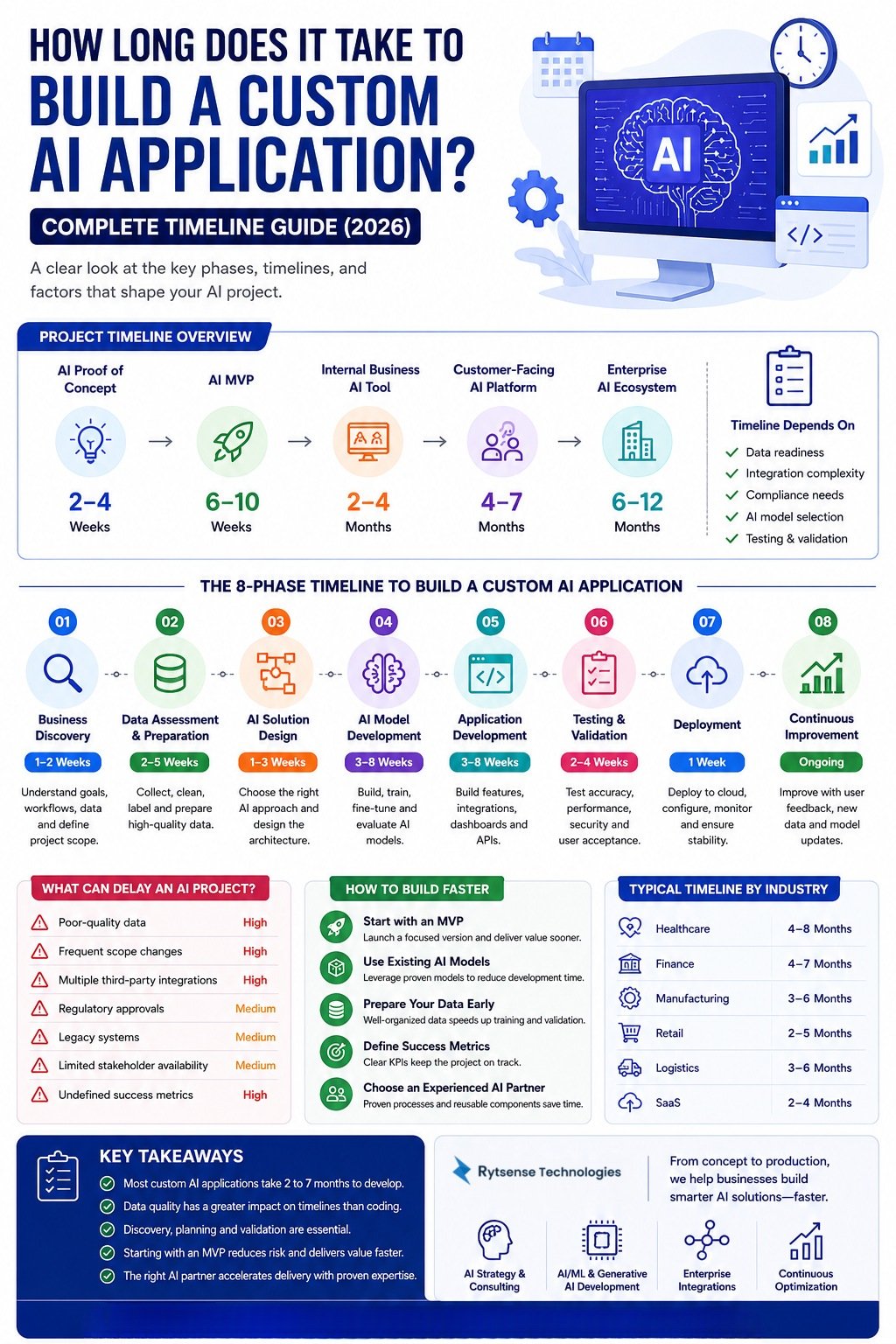
Complete Timeline to Build a Custom AI Application
Phase 1 - Business Discovery (1–2 Weeks)
Every successful AI project begins with understanding the business problem, not choosing an AI model.
During discovery, the team identifies:
- Business goals
- Existing workflows
- Manual bottlenecks
- Expected ROI
- Available datasets
- Success metrics
- Compliance requirements
Typical Deliverables
- AI roadmap
- Feature prioritization
- Technical architecture
- Project scope
- Timeline estimation
Projects with a detailed discovery phase often experience fewer change requests during development.
Phase 2 - Data Assessment and Preparation (2–5 Weeks)
This is frequently the longest stage.
AI systems are only as effective as the quality of the data they receive.
Tasks include:
- Data collection
- Data cleaning
- Duplicate removal
- Missing value handling
- Labeling
- Data transformation
- Data governance
- Security validation
Organizations with well-structured CRM, ERP, or operational data can reduce this phase significantly.
Phase 3 - AI Solution Design (1–3 Weeks)
Before writing code, engineers determine the best technical approach.
Questions include:
Should the project use:
- Large Language Models?
- Machine Learning?
- Computer Vision?
- Predictive Analytics?
- Agentic AI?
- RAG Architecture?
- Hybrid AI?
Architecture planning prevents costly redesigns later.
Phase 4 - AI Model Development (3–8 Weeks)
This stage varies based on project complexity.
Activities include:
- Model selection
- Fine-tuning
- Prompt engineering
- Feature engineering
- Machine learning development
- Evaluation
- Hyperparameter optimization
- Benchmark testing
Many modern AI projects use existing foundation models instead of building models from scratch, reducing development time while maintaining strong performance.
Phase 5 - Application Development (3–8 Weeks)
The AI model now becomes a usable business application.
Developers build:
- Admin dashboard
- APIs
- Authentication
- Workflow automation
- Chat interface
- Mobile app integration
- CRM integration
- ERP connectivity
- Analytics dashboard
This phase transforms AI into a practical business solution.
Phase 6 - Testing and Validation (2–4 Weeks)
Unlike traditional software testing, AI validation focuses on both functionality and output quality.
Testing typically covers:
- Accuracy
- Hallucination checks
- Performance
- Scalability
- Security
- Bias detection
- User acceptance testing
- Edge cases
Businesses in healthcare, finance, and insurance often require additional validation before deployment.
Phase 7 - Deployment (1 Week)
Deployment includes:
- Cloud infrastructure
- Production release
- Security configuration
- Monitoring
- Logging
- Backup
- API configuration
A structured deployment minimizes downtime and ensures a smoother transition to production.
Phase 8 - Continuous Improvement (Ongoing)
AI applications improve after launch through:
- User feedback
- Model retraining
- Prompt refinement
- New data
- Performance optimization
- Feature enhancements
The first production release marks the beginning of optimization rather than the end of development.
What Can Delay an AI Project?
Businesses often focus on coding time, but delays usually arise from other areas.
| Factor | Impact |
|---|---|
| Poor-quality data | High |
| Frequent scope changes | High |
| Multiple third-party integrations | High |
| Regulatory approvals | Medium |
| Legacy software | Medium |
| Limited stakeholder availability | Medium |
| Undefined success metrics | High |
The earlier these risks are addressed, the more predictable the project timeline becomes.
How to Build a Custom AI Application Faster
Organizations can reduce delivery time by following a structured approach.
Start with an MVP
Instead of building every feature, launch a focused version that solves one high-value business problem.
Use Existing AI Models
Leveraging proven models often shortens development compared to creating a model from scratch.
Prepare Your Data Early
Well-organized datasets reduce delays during model training and validation.
Define Success Metrics
Clear KPIs help teams avoid unnecessary revisions and maintain project focus.
Choose an Experienced AI Development Partner
A team with established AI workflows, reusable components, and deployment experience can streamline the overall process.
Typical Timeline by Industry
| Industry | Average Timeline |
|---|---|
| Healthcare | 4–8 Months |
| Finance | 4–7 Months |
| Manufacturing | 3–6 Months |
| Retail | 2–5 Months |
| Logistics | 3–6 Months |
| SaaS | 2–4 Months |
Industries with strict compliance or complex integrations generally require additional planning and testing.
How Rytsense Accelerates AI Development
At Rytsense Technologies, we focus on reducing delivery time without sacrificing scalability or quality.
Our approach includes:
- AI discovery workshops
- Reusable AI architecture
- Rapid MVP development
- Enterprise-grade integrations
- Machine learning development expertise
- Generative AI implementation
- AI agent development
- Continuous optimization
This structured methodology enables businesses to move from concept to production more efficiently while maintaining long-term flexibility.
Meet the Author

Co-Founder, Rytsense Technologies
Karthik is the Co-Founder of Rytsense Technologies, where he leads cutting-edge projects at the intersection of Data Science and Generative AI. With nearly a decade of hands-on experience in data-driven innovation, he has helped businesses unlock value from complex data through advanced analytics, machine learning, and AI-powered solutions. Currently, his focus is on building next-generation Generative AI applications that are reshaping the way enterprises operate and scale. When not architecting AI systems, Karthik explores the evolving future of technology, where creativity meets intelligence.