What Is Revenue Cycle Management?
Revenue Cycle Management, commonly known as RCM, is the complete financial process healthcare organizations use to manage revenue from the moment a patient schedules an appointment until the final payment is collected.
In simple terms, revenue cycle management helps healthcare providers make sure they are paid accurately and on time for the care they deliver.
RCM includes every administrative, clinical, and financial step involved in healthcare billing, such as patient registration, insurance verification, prior authorization, medical coding, claim submission, payment posting, denial management, and patient collections.
According to the Healthcare Financial Management Association, revenue cycle management covers the activities that lead to payment for healthcare services, starting from patient registration and benefit verification to care delivery, claim submission, and reimbursement.
For hospitals, clinics, specialty practices, and healthcare systems, RCM is not just a billing function. It is a critical part of financial stability, operational efficiency, and patient experience.
Why Revenue Cycle Management Matters in Healthcare
Healthcare providers work in a complex environment where payer rules, coding requirements, patient expectations, and compliance standards constantly change. Even a small error in patient information, insurance eligibility, documentation, or coding can lead to claim denials, delayed payments, and revenue leakage.
A strong revenue cycle management process helps healthcare organizations:
- Reduce claim denials
- Improve clean claim rates
- Accelerate reimbursements
- Minimize accounts receivable delays
- Improve cash flow
- Increase billing accuracy
- Reduce administrative workload
- Improve patient financial experience
- Maintain compliance with payer and regulatory requirements
For healthcare leaders, RCM directly affects profitability. For billing teams, it reduces repetitive manual work. For patients, it creates a smoother and more transparent billing experience.
That is why modern healthcare organizations are moving from reactive billing processes to proactive, automated, and data-driven revenue cycle management systems.
How Does Revenue Cycle Management Work?
Revenue cycle management works by connecting every step of the patient financial journey into one continuous process.
The cycle begins before the patient receives care and continues until the provider receives full payment from the payer and/or patient.
Here is the basic flow:
- The patient schedules an appointment.
- The provider collects patient and insurance details.
- Insurance eligibility and benefits are verified.
- Prior authorization is obtained if required.
- The patient receives care.
- Services are documented by the provider.
- Medical codes are assigned.
- Charges are captured.
- Claims are created and submitted to payers.
- Payers review and process the claims.
- Payments are posted.
- Denials or underpayments are reviewed.
- Patient balances are billed and collected.
- Reports are analyzed to improve future performance.
Each stage depends on the accuracy of the previous stage. For example, if insurance eligibility is not verified correctly at the beginning, the claim may be denied later. If clinical documentation is incomplete, coders may not assign the correct codes. If claims are submitted with errors, reimbursement may be delayed.
This is why revenue cycle management is often divided into three major parts:
HFMA describes the revenue cycle as a process that includes communication with patients, insurance companies, and government payers such as Medicare and Medicaid.
Key Stages of the Revenue Cycle Management Process
1. Patient Scheduling
The revenue cycle starts when a patient books an appointment. At this stage, the healthcare organization collects basic details such as the patient’s name, contact information, reason for visit, insurance provider, and appointment type.
Accurate scheduling helps the provider prepare for the visit, identify payer requirements, and reduce delays later in the billing process.
A well-managed scheduling process can also improve patient satisfaction because patients receive clear information about appointment availability, required documents, and payment expectations.
2. Patient Registration
Patient registration involves collecting and verifying demographic and insurance information. This includes:
- Full name
- Date of birth
- Address
- Contact details
- Insurance policy number
- Group number
- Guarantor information
- Referring provider details, if applicable
Incorrect patient data is one of the most common reasons for claim rejections and billing delays. Even a small spelling mistake, outdated insurance detail, or missing policy number can create problems later.
This stage is important because clean data creates the foundation for clean claims.
3. Insurance Eligibility Verification
Insurance eligibility verification confirms whether the patient’s insurance coverage is active and whether the planned service is covered.
This step helps providers understand:
- Active coverage status
- Copay amount
- Deductible
- Coinsurance
- Coverage limitations
- Referral requirements
- Payer-specific rules
Eligibility verification is one of the most important steps in revenue cycle management because it helps prevent avoidable denials. If a patient’s coverage is inactive or the wrong payer is billed, the claim may be rejected or denied.
4. Prior Authorization
Some procedures, medications, imaging services, surgeries, and specialty treatments require prior authorization from the insurance payer before care is delivered.
Prior authorization confirms that the payer agrees the service is medically necessary and eligible for reimbursement.
If prior authorization is missed, delayed, or submitted with incomplete information, the provider may not get paid even if the service was clinically necessary.
This is why many healthcare organizations are now using automation to track authorization requirements, submit requests, monitor status, and reduce manual follow-ups.
5. Patient Financial Counseling and Cost Estimation
Modern patients expect more transparency around healthcare costs. Before care is delivered, providers may offer cost estimates based on insurance benefits, deductibles, copays, and expected patient responsibility.
This step improves the patient financial experience and reduces surprise billing concerns.
Financial counseling also helps patients understand:
- Estimated out-of-pocket costs
- Payment options
- Insurance responsibility
- Patient responsibility
- Available financial assistance programs
When patients understand their financial responsibility early, providers can improve collections and reduce unpaid balances.
6. Care Delivery and Clinical Documentation
Once the patient receives care, the provider documents the services, diagnosis, treatment plan, procedures, medications, and clinical notes.
Accurate clinical documentation is essential because medical coders rely on this information to assign the correct billing codes.
Incomplete documentation can lead to:
- Coding errors
- Claim denials
- Underbilling
- Overbilling
- Compliance risks
- Delayed reimbursement
Strong documentation helps ensure that the services provided are supported, coded correctly, and reimbursed appropriately.
7. Medical Coding
Medical coding translates clinical documentation into standardized codes used for billing and reimbursement.
Common code sets include:
- ICD-10 codes for diagnoses
- CPT codes for procedures and services
- HCPCS codes for supplies, equipment, and certain services
Medical coding must be accurate because payers use these codes to determine whether a claim should be paid, denied, or reviewed.
Coding errors can result in denied claims, compliance issues, or lost revenue. For example, if a service is coded incorrectly, the payer may reject the claim or reimburse less than expected.
8. Charge Capture
Charge capture ensures that every billable service, procedure, supply, medication, or test is recorded and added to the claim.
If charge capture is incomplete, the provider may deliver care but fail to bill for all eligible services. This creates revenue leakage.
Common charge capture issues include:
- Missed charges
- Duplicate charges
- Incorrect charge amounts
- Delayed charge entry
- Mismatched documentation and billing codes
An effective charge capture process helps healthcare organizations maximize legitimate reimbursement while maintaining billing accuracy.
9. Claim Creation and Claim Scrubbing
After coding and charge capture, the billing team creates a claim. Before submission, the claim should be reviewed for errors.
Claim scrubbing checks for issues such as:
- Missing patient information
- Invalid codes
- Incorrect modifiers
- Payer rule violations
- Duplicate claims
- Missing authorization
- Medical necessity issues
The goal is to submit a clean claim the first time.
A clean claim is more likely to be accepted and paid quickly, while an error-filled claim may be rejected, denied, or delayed.
10. Claim Submission
Once the claim is reviewed, it is submitted to the insurance payer electronically, often through a clearinghouse.
The payer then reviews the claim based on:
- Patient eligibility
- Coverage rules
- Medical necessity
- Coding accuracy
- Contracted rates
- Authorization status
- Payer policies
If the claim meets payer requirements, it moves toward payment. If not, it may be rejected or denied.
Timely claim submission is important because payers have filing deadlines. Missing those deadlines can result in permanent revenue loss.
11. Payment Posting
Payment posting records payments received from insurance companies and patients.
This stage involves matching payments to claims and reviewing:
- Paid amount
- Allowed amount
- Contractual adjustments
- Patient responsibility
- Denials
- Underpayments
- Overpayments
Accurate payment posting helps healthcare organizations understand whether they were paid correctly.
It also helps identify payer trends, underpayment issues, and recurring denial patterns.
12. Denial Management
Denial management is the process of identifying, analyzing, correcting, appealing, and preventing denied claims.
A denied claim means the payer has reviewed the claim and decided not to pay it, either fully or partially.
Common reasons for claim denials include:
- Inaccurate patient information
- Inactive insurance coverage
- Missing prior authorization
- Coding errors
- Lack of medical necessity
- Duplicate claims
- Late filing
- Missing documentation
- Incorrect payer submission
HFMA notes that denials can cause payment delays, lost revenue, and lower patient satisfaction, making denial prevention and process improvement essential for revenue cycle performance.
Effective denial management should not only fix denied claims. It should also identify the root causes and prevent the same errors from happening again.
13. Accounts Receivable Follow-Up
Accounts receivable, or AR, refers to money owed to the healthcare provider by payers or patients.
AR follow-up involves tracking unpaid claims, delayed payments, underpayments, and unresolved denials.
The goal is to reduce the number of days claims remain unpaid.
Important AR metrics include:
- Days in AR
- AR aging
- Clean claim rate
- Denial rate
- Net collection rate
- First-pass resolution rate
If AR is not managed properly, healthcare organizations may experience cash flow problems even when they are delivering a high volume of services.
14. Patient Billing and Collections
After insurance payments are posted, any remaining patient responsibility is billed to the patient.
This may include:
- Copays
- Deductibles
- Coinsurance
- Non-covered services
- Self-pay balances
Patient billing should be clear, accurate, and easy to understand. Confusing bills can lead to delayed payments, patient frustration, and higher call volumes.
Healthcare providers can improve patient collections by offering:
- Digital payment options
- Clear statements
- Payment plans
- Online portals
- SMS/email reminders
- Financial assistance guidance
A patient-friendly billing process improves both collections and trust.
15. Reporting and Performance Analytics
The final stage of revenue cycle management is performance analysis.
Healthcare leaders use RCM reports to understand what is working, where revenue is leaking, and which processes need improvement.
Important RCM reports include:
- Denial trend reports
- AR aging reports
- Payer performance reports
- Coding accuracy reports
- Collection performance reports
- Authorization delay reports
- Clean claim rate reports
Analytics helps healthcare organizations move from reactive problem-solving to proactive revenue optimization.
Common Revenue Cycle Management Challenges
Even experienced healthcare organizations face RCM challenges because the process involves many people, systems, payers, and rules.
Some of the most common challenges include:
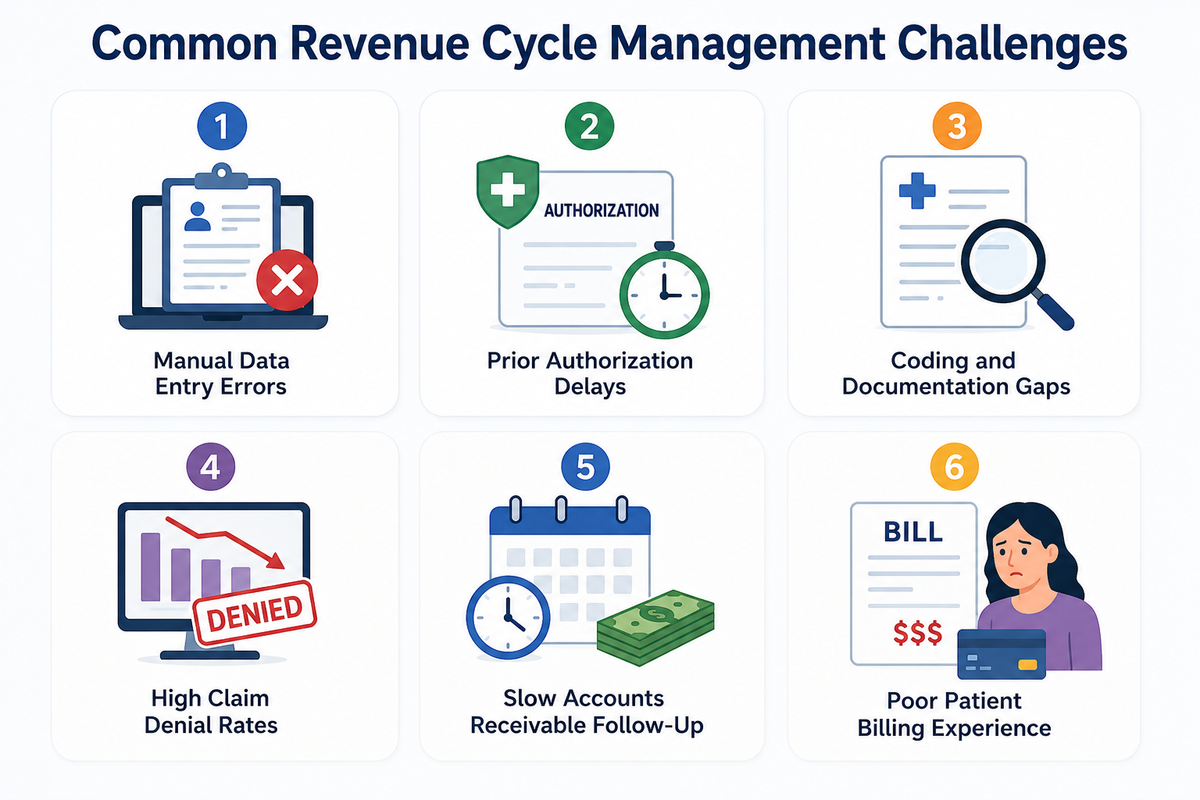
1. Manual Data Entry Errors
Manual entry increases the risk of incorrect patient details, insurance information, coding data, and claim information.
These errors can create downstream denials and payment delays.
2. Prior Authorization Delays
Prior authorization often requires payer-specific forms, clinical documents, follow-ups, and status checks.
Manual authorization workflows can delay care and reimbursement.
3. Coding and Documentation Gaps
If provider documentation is incomplete or unclear, coders may not have enough information to assign accurate codes.
This can lead to undercoding, overcoding, denials, or compliance concerns.
4. High Claim Denial Rates
Denials are one of the biggest revenue cycle problems. They increase administrative workload and delay cash flow.
Many denials are preventable when front-end verification, authorization, coding, and claim checks are handled correctly.
5. Slow Accounts Receivable Follow-Up
When billing teams do not follow up quickly on unpaid claims, revenue can remain stuck for weeks or months.
Delayed AR follow-up can increase bad debt and reduce cash flow.
6. Poor Patient Billing Experience
Patients are now responsible for a larger share of healthcare costs in many markets. If bills are confusing or payment options are limited, collections become harder.
A better patient billing experience can improve payment rates and patient satisfaction.
How Automation Improves Revenue Cycle Management
Automation is changing how healthcare organizations manage revenue cycle operations.
Instead of relying only on manual work, healthcare providers can use AI-powered RCM automation to identify errors, predict denials, speed up claim processing, and reduce repetitive administrative tasks.
RCM automation can help with:
- Eligibility verification
- Prior authorization tracking
- Claim scrubbing
- Coding support
- Denial prediction
- Denial management
- Payment posting
- AR follow-up
- Patient payment reminders
- Reporting and analytics
For example, an automated denial management system can detect why claims are being denied, categorize denial reasons, suggest corrections, and support faster resubmission.
This helps billing teams spend less time on repetitive claim follow-ups and more time on high-value revenue recovery.
Automation does not replace revenue cycle teams. It helps them work faster, reduce errors, and focus on the claims that need human attention.
Benefits of Revenue Cycle Management Automation
Healthcare organizations that adopt automation in revenue cycle management can achieve several benefits:
Faster Reimbursements
Automated workflows reduce delays in eligibility checks, claim creation, denial correction, and payment follow-up.
Fewer Claim Denials
Automation can identify missing information, coding issues, and authorization gaps before claims are submitted.
Improved Staff Productivity
Billing teams can reduce repetitive manual tasks and focus on complex exceptions.
Better Cash Flow
Faster claim submission, cleaner claims, and quicker denial resolution help improve cash flow.
Reduced Revenue Leakage
Automation helps capture missed charges, identify underpayments, and prevent avoidable write-offs.
Stronger Compliance
Automated checks can help ensure claims follow payer rules, coding standards, and documentation requirements.
Better Patient Experience
Clear estimates, digital payment options, and transparent billing improve patient trust and satisfaction.
Revenue Cycle Management Best Practices
To build a stronger RCM process, healthcare organizations should focus on accuracy, speed, visibility, and prevention.
1. Verify Patient Information Early
Collect and verify patient demographics and insurance details before the visit.
2. Check Eligibility Before Every Encounter
Insurance coverage can change frequently. Eligibility should be verified before each appointment or service.
3. Track Prior Authorization Requirements
Create a structured process to identify which services need authorization and monitor approval status.
4. Improve Clinical Documentation
Train providers to document clearly and completely so coders can assign accurate codes.
5. Use Claim Scrubbing Before Submission
Check claims for errors before they reach the payer.
6. Monitor Denial Trends
Do not only work denials one by one. Analyze denial patterns by payer, department, provider, code, and root cause.
7. Prioritize High-Value AR
Focus follow-up efforts on claims with the highest financial impact and oldest aging buckets.
8. Make Patient Billing Simple
Use clear statements, digital payments, payment plans, and proactive communication.
9. Measure the Right KPIs
Track clean claim rate, denial rate, days in AR, net collection rate, first-pass resolution rate, and patient collection rate.
10. Use Automation Where Manual Work Slows the Cycle
Automate repetitive, rule-based, and data-heavy tasks to improve speed and accuracy.
When Should Healthcare Providers Consider RCM Automation?
Healthcare organizations should consider RCM automation if they are experiencing:
- Increasing claim denials
- Delayed reimbursements
- High AR days
- Manual billing workload
- Frequent prior authorization delays
- Poor claim visibility
- High cost to collect
- Missed charges
- Underpayments
- Staffing shortages
- Patient billing complaints
If your billing team spends more time correcting claims than preventing errors, it may be time to modernize your revenue cycle process.
Automation can help healthcare providers move from reactive revenue recovery to proactive revenue protection.
How Rytsense Technologies Can Help with Revenue Cycle Management Automation
Revenue cycle management is no longer just about submitting claims and waiting for payments. Healthcare providers need intelligent systems that can detect issues early, reduce denials, improve claim accuracy, and accelerate reimbursements.
Rytsense Technologies helps healthcare organizations build AI-powered revenue cycle management solutions that automate complex billing workflows and improve financial performance.
Our AI-driven RCM solutions can support:
- Automated eligibility verification
- Prior authorization workflow automation
- AI-powered denial detection
- Claim error identification
- Denial root cause analysis
- Automated claim correction suggestions
- AR follow-up automation
- Payment analytics dashboards
- Patient billing automation
- Custom healthcare workflow integrations
Whether you are a hospital, clinic, specialty practice, billing company, or healthcare technology provider, Rytsense Technologies can help you design a scalable RCM automation solution tailored to your workflows.
CTA
Conclusion
Revenue cycle management is the financial engine of every healthcare organization. It connects patient access, clinical documentation, coding, billing, payer communication, denial management, payment posting, and patient collections into one complete process.
When RCM works well, healthcare providers get paid faster, denials decrease, staff productivity improves, and patients experience clearer billing communication.
But when the process is manual, disconnected, or error-prone, providers face delayed payments, revenue leakage, high administrative costs, and frustrated patients.
The future of revenue cycle management is proactive, automated, and data-driven. Healthcare organizations that invest in modern RCM automation can reduce preventable denials, improve cash flow, and focus more on patient care instead of paperwork.
Meet the Author

Co-Founder, Rytsense Technologies
Karthik is the Co-Founder of Rytsense Technologies, where he leads cutting-edge projects at the intersection of Data Science and Generative AI. With nearly a decade of hands-on experience in data-driven innovation, he has helped businesses unlock value from complex data through advanced analytics, machine learning, and AI-powered solutions. Currently, his focus is on building next-generation Generative AI applications that are reshaping the way enterprises operate and scale. When not architecting AI systems, Karthik explores the evolving future of technology, where creativity meets intelligence.