Key Takeaways
- Generative AI consulting helps businesses plan AI initiatives before investing in development.
- AI readiness assessments evaluate business, data, technology, workforce, and governance preparedness.
- Consultants identify high-ROI AI opportunities based on business impact, feasibility, and strategic value.
- A well-defined AI strategy aligns AI investments with organizational goals and measurable outcomes.
- Governance frameworks help address data privacy, security, compliance, and ethical AI concerns.
- A phased AI adoption roadmap reduces implementation risks and improves success rates.
- AI consulting focuses on strategy and planning, while AI development focuses on building and deploying solutions.
- Organizations that start with AI consulting often achieve faster adoption, better ROI visibility, and stronger governance.
- Choosing an experienced AI consulting partner helps businesses avoid costly mistakes and maximize AI value.
- Successful AI adoption begins with a clear roadmap, prioritized use cases, and executive alignment.
Artificial intelligence is no longer a future initiative. Businesses across industries are actively exploring how generative AI can improve productivity, reduce operational costs, enhance customer experiences, and create new revenue opportunities.
However, many organizations rush into AI implementation without a clear strategy. The result is often wasted budgets, failed pilots, compliance risks, and limited business impact.
This is where Generative AI Consulting Services in the USA play a critical role.
AI consulting helps businesses identify the right opportunities, assess readiness, build a roadmap, and establish governance before investing in development or deployment. Rather than focusing on building solutions immediately, consulting focuses on ensuring AI investments align with business goals and deliver measurable returns.
In this guide, we'll explore how AI consulting works, when businesses need it, and how organizations can successfully move from AI strategy to deployment.
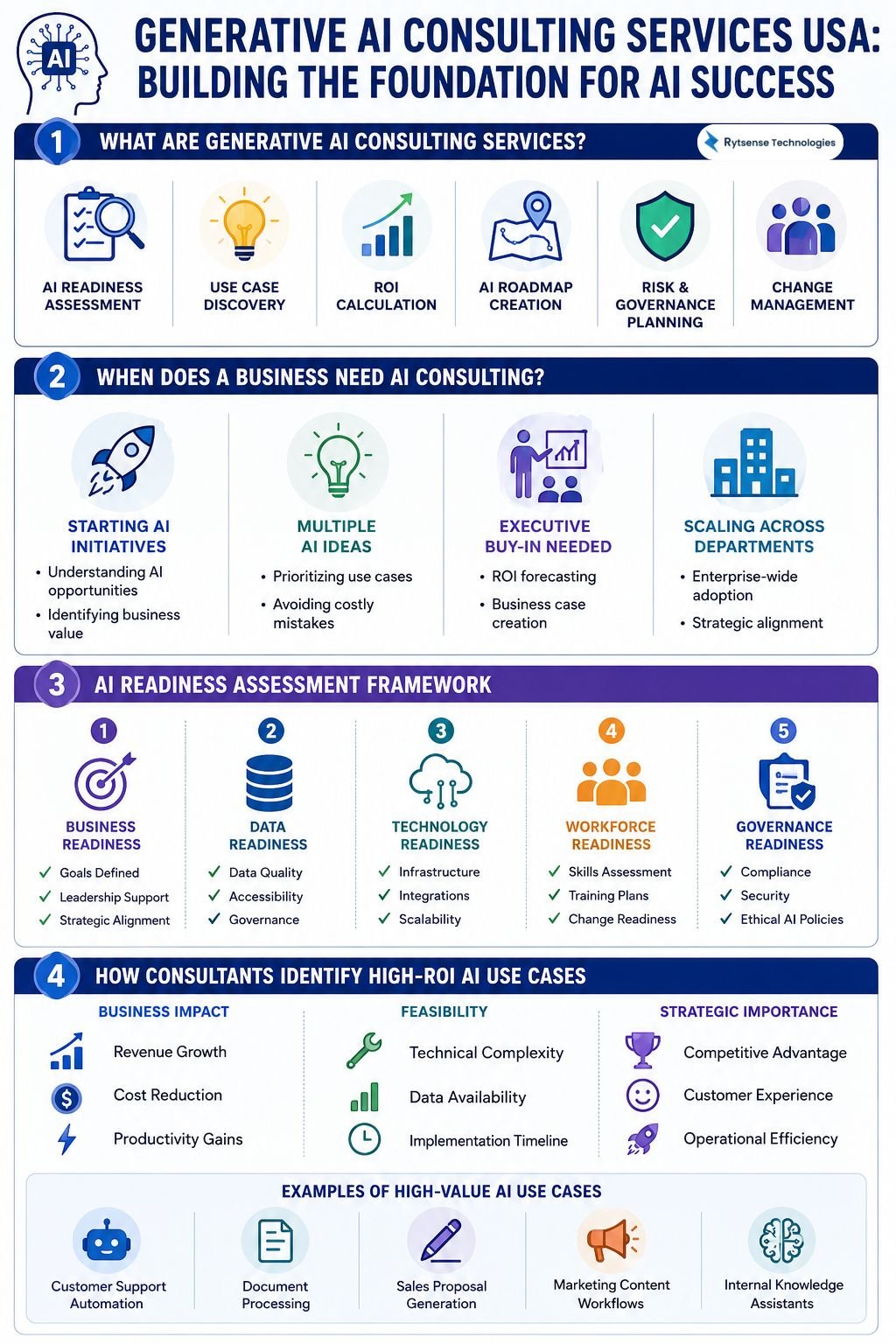
What Are Generative AI Consulting Services?
Generative AI consulting services help organizations understand, evaluate, and plan AI initiatives before implementation.
Consultants work with leadership teams, stakeholders, and operational departments to identify where AI can create business value and how it can be adopted safely and effectively.
Common consulting services include:
- AI readiness assessment
- AI opportunity identification
- Business process evaluation
- Use case discovery workshops
- AI strategy consulting
- AI adoption planning
- ROI forecasting
- Governance framework design
- Risk assessment and compliance planning
- Enterprise AI roadmap creation
The primary objective is to create a practical and measurable AI strategy that supports long-term business growth.
When Does a Business Need AI Consulting?
Many organizations know they should invest in AI but are unsure where to begin.
AI consulting becomes valuable when businesses face questions such as:
- Which AI opportunities offer the highest ROI?
- Is our data ready for AI adoption?
- What business processes should be automated first?
- How much investment is required?
- What risks should we anticipate?
- How do we ensure compliance and security?
Organizations typically seek enterprise AI consulting when:
They Are Exploring AI for the First Time
Consultants help leadership teams understand opportunities, risks, and implementation requirements.
They Have Multiple Potential Use Cases
AI experts prioritize projects based on business impact, complexity, and expected returns.
They Need Executive Buy-In
Consultants create business cases and ROI projections that support leadership decision-making.
They Want to Scale AI Across Departments
Consulting ensures AI initiatives align with broader digital transformation goals.
AI Readiness Assessment Framework
Before implementing AI, organizations must evaluate whether they are prepared for successful adoption.
A comprehensive AI readiness assessment examines five key areas.
1. Business Readiness
Questions include:
- Are AI goals clearly defined?
- Do projects align with business objectives?
- Is leadership committed to adoption?
2. Data Readiness
Organizations assess:
- Data quality
- Data availability
- Data governance policies
- Security controls
3. Technology Readiness
Evaluation includes:
- Existing infrastructure
- Cloud capabilities
- Integration requirements
- Scalability considerations
4. Workforce Readiness
Businesses assess:
- Employee skills
- Training needs
- Change management requirements
5. Governance Readiness
Organizations evaluate:
- Compliance requirements
- Security frameworks
- Ethical AI guidelines
- Risk management policies
The results provide a clear understanding of strengths, gaps, and next steps.
How Consultants Identify High-ROI AI Use Cases
One of the biggest mistakes businesses make is pursuing AI projects based on hype rather than value.
Experienced AI consultants use structured frameworks to identify opportunities with measurable business outcomes.
Typical evaluation criteria include:
Business Impact
- Revenue growth potential
- Cost reduction opportunities
- Productivity improvements
Feasibility
- Data availability
- Technical complexity
- Implementation timeline
Strategic Importance
- Competitive advantage
- Customer experience improvement
- Operational efficiency gains
Examples of high-value AI use cases include:
- Customer support automation
- Internal knowledge assistants
- Sales proposal generation
- Document processing
- Marketing content workflows
- Employee productivity tools
- Business intelligence enhancement
Organizations that prioritize use cases effectively often achieve faster adoption and higher ROI.
Building an Enterprise AI Strategy
An effective AI strategy connects business objectives with technology investments.
Successful strategies generally include the following components.
Vision and Objectives
Define what success looks like.
Examples:
- Improve customer service efficiency by 30%
- Reduce operational costs by 20%
- Accelerate product innovation
Prioritized Use Cases
Identify projects based on value and implementation feasibility.
Technology Planning
Determine:
- Infrastructure requirements
- Platform selection
- Integration needs
Resource Planning
Assess:
- Internal teams
- External partners
- Budget allocation
Success Metrics
Establish KPIs such as:
- Cost savings
- Revenue impact
- Adoption rates
- Productivity improvements
A well-defined strategy prevents fragmented AI initiatives and improves long-term outcomes.
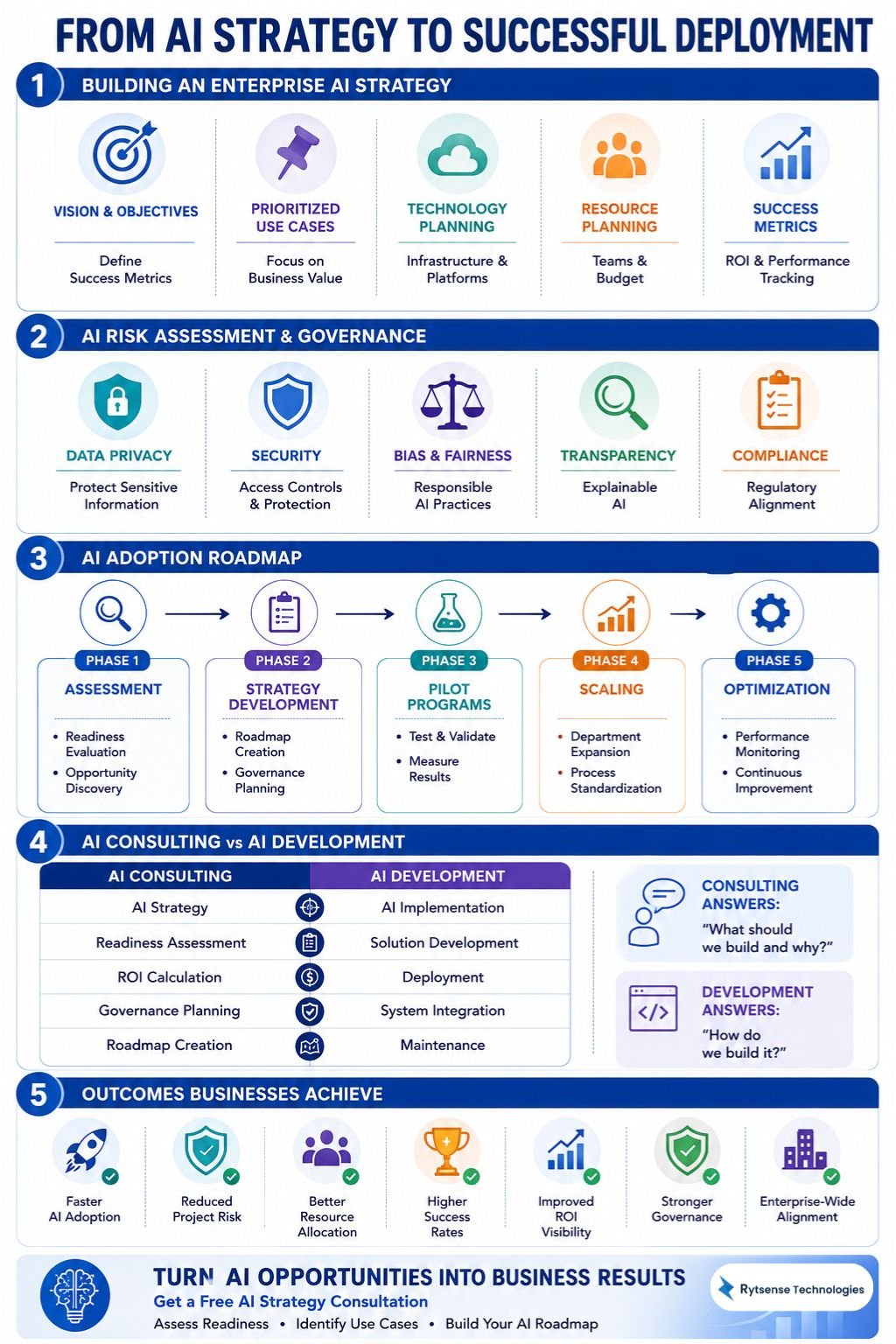
AI Risk Assessment and Governance
As AI adoption grows, governance becomes increasingly important.
Organizations must address risks related to:
Data Privacy
Ensure compliance with regulations and internal policies.
Security
Protect sensitive information and prevent unauthorized access.
Bias and Fairness
Identify and mitigate potential biases in AI outputs.
Transparency
Maintain visibility into how AI systems generate results.
Regulatory Compliance
Meet industry-specific and regional compliance requirements.
Strong governance frameworks help organizations scale AI responsibly while minimizing operational and legal risks.
AI Adoption Roadmap
AI transformation should happen in phases rather than through large-scale deployments.
Phase 1: Assessment
- Evaluate readiness
- Identify opportunities
- Define goals
Phase 2: Strategy Development
- Create roadmap
- Prioritize initiatives
- Establish governance
Phase 3: Pilot Programs
- Launch limited-scope projects
- Measure outcomes
- Gather feedback
Phase 4: Scaling
- Expand successful implementations
- Integrate across departments
- Standardize processes
Phase 5: Optimization
- Monitor performance
- Improve models
- Refine workflows
Following a structured roadmap reduces risk and improves adoption success.
AI Consulting vs AI Development
Businesses often confuse consulting and development services. While both are important, they serve different purposes.
| AI Consulting | AI Development |
|---|---|
| Focuses on strategy | Focuses on implementation |
| Identifies opportunities | Builds AI solutions |
| Evaluates readiness | Develops applications |
| Calculates ROI | Deploys technology |
| Establishes governance | Integrates systems |
| Creates roadmap | Maintains and optimizes solutions |
Consulting answers the question:
"What should we build and why?"
Development answers:
"How do we build it?"
Most successful AI initiatives begin with consulting before moving into development.
How to Choose an AI Consulting Partner
Selecting the right consulting partner significantly impacts project success.
Consider the following factors:
Industry Experience
Look for consultants who understand your business challenges and market dynamics.
Strategic Expertise
The partner should focus on measurable business outcomes rather than technology alone.
Governance Knowledge
Ensure expertise in compliance, security, and risk management.
Framework-Driven Approach
A structured methodology helps organizations move from assessment to adoption efficiently.
Long-Term Support
Choose a partner capable of supporting future AI initiatives as your strategy evolves.
Common Outcomes Businesses Achieve Through AI Consulting
Organizations that invest in AI strategy consulting often experience:
- Faster AI adoption
- Reduced implementation risks
- Improved resource allocation
- Higher project success rates
- Stronger executive alignment
- Better ROI visibility
- Enhanced governance and compliance
Most importantly, they gain clarity on where AI can create the greatest business value.
Conclusion
Generative AI has the potential to transform how organizations operate, innovate, and compete. However, successful adoption requires more than selecting the latest technology.
Businesses need a clear strategy, readiness assessment, governance framework, and adoption roadmap before implementation begins.
Generative AI consulting services help organizations make informed decisions, prioritize high-value opportunities, and reduce the risks associated with AI investments.
Whether you're evaluating your first AI initiative or planning enterprise-wide transformation, consulting provides the foundation needed for successful deployment and long-term growth.
Meet the Author

Co-Founder, Rytsense Technologies
Karthik is the Co-Founder of Rytsense Technologies, where he leads cutting-edge projects at the intersection of Data Science and Generative AI. With nearly a decade of hands-on experience in data-driven innovation, he has helped businesses unlock value from complex data through advanced analytics, machine learning, and AI-powered solutions. Currently, his focus is on building next-generation Generative AI applications that are reshaping the way enterprises operate and scale. When not architecting AI systems, Karthik explores the evolving future of technology, where creativity meets intelligence.