Key Takeaways
- Enterprise AI projects require strong governance, security, and compliance frameworks.
- Enterprise AI architecture must integrate with existing business systems and workflows.
- AI governance helps manage risk, transparency, accountability, and regulatory requirements.
- Multi-agent systems can automate complex enterprise processes and improve efficiency.
- Successful enterprise AI implementation depends on scalable infrastructure and data management.
- Security measures such as access controls, encryption, and compliance standards are critical.
- Enterprises should evaluate AI partners based on architecture, integration expertise, and long-term support.
- A phased adoption roadmap helps reduce risk and improve AI implementation success.
- Measuring ROI through productivity, cost savings, and business outcomes is essential.
- Choosing the right enterprise generative AI development company in the USA can accelerate AI transformation and deliver sustainable business value.
Generative AI is rapidly moving beyond experimentation. Across industries, enterprises are deploying AI to improve productivity, automate workflows, enhance decision-making, and create new business opportunities.
However, enterprise AI projects require far more than model deployment. Organizations must address governance, security, compliance, integration, scalability, and long-term operational management.
This is why selecting the right Enterprise Generative AI Development Company in the USA has become a strategic business decision.
The ideal partner should understand enterprise architecture, risk management frameworks, regulatory requirements, and complex system integrations, not just AI technologies.
This guide explains how enterprises can evaluate AI partners and build a successful AI transformation strategy.
What Defines an Enterprise Generative AI Development Company?
An enterprise-focused AI company specializes in designing, implementing, and managing AI systems that operate across large organizations.
Unlike traditional AI vendors, enterprise-focused partners address:
- Enterprise-wide deployment strategies
- AI governance structures
- Data security and privacy controls
- Regulatory compliance requirements
- Cross-department integrations
- Scalable infrastructure
- Long-term AI operations
An enterprise AI partner helps organizations move from isolated pilots to business-wide AI adoption.
Key characteristics include:
Enterprise Architecture Expertise
AI systems must align with existing enterprise technology ecosystems.
This includes:
- ERP platforms
- CRM systems
- Data warehouses
- Cloud infrastructure
- Identity management systems
Governance-First Approach
Successful enterprise AI initiatives prioritize governance before deployment.
Organizations require:
- Policy controls
- Audit trails
- Risk monitoring
- Human oversight mechanisms
Scalability
Enterprise AI environments often serve thousands of users simultaneously.
Solutions must support:
- High availability
- Large-scale processing
- Multi-region deployment
- Performance monitoring
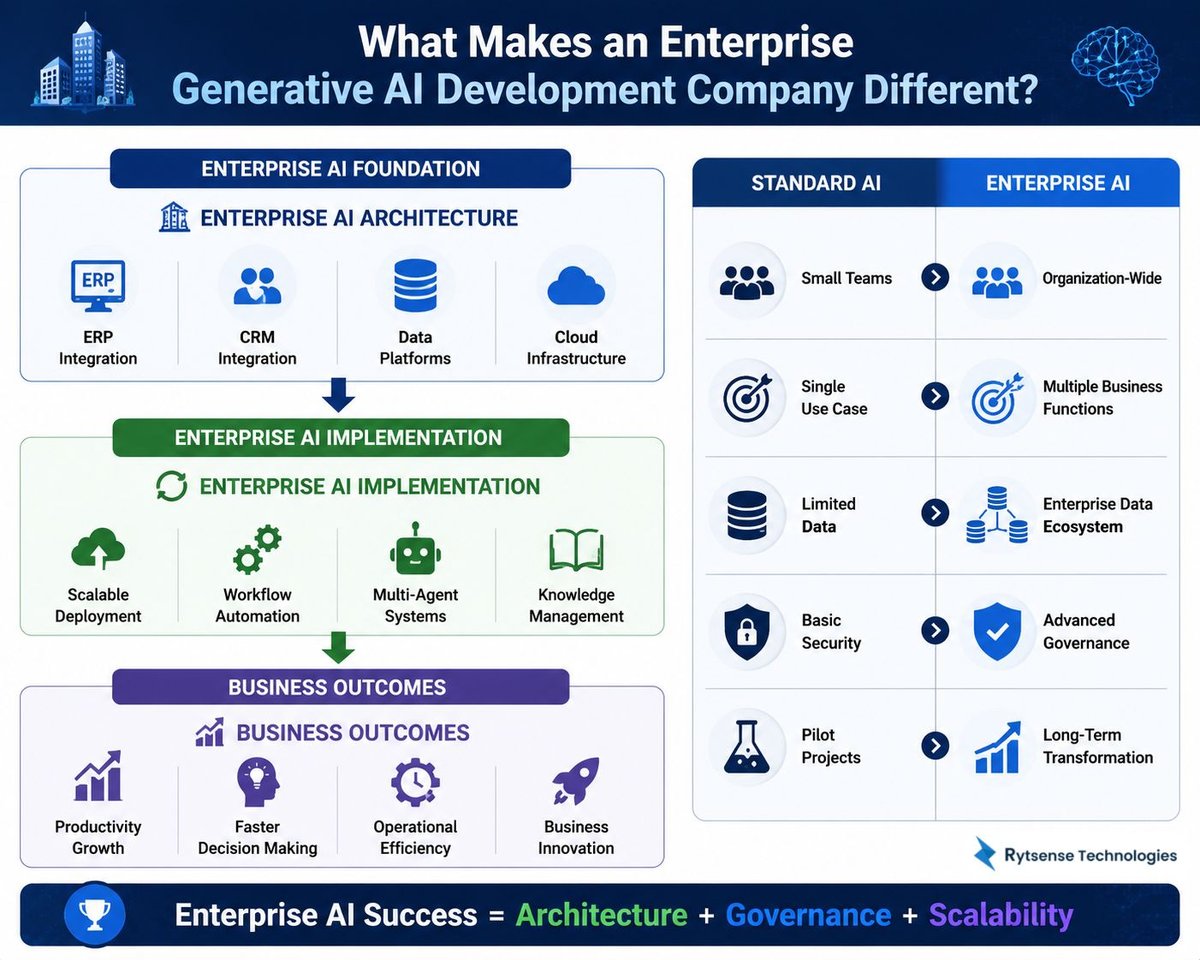
Enterprise AI vs Standard AI Development
Many organizations mistakenly assume all AI implementations follow the same approach.
In reality, enterprise AI involves significantly greater complexity.
| Standard AI Projects | Enterprise AI Projects |
|---|---|
| Department-level use cases | Organization-wide deployment |
| Limited data sources | Multiple enterprise systems |
| Basic governance | Comprehensive governance framework |
| Small user groups | Thousands of users |
| Minimal compliance requirements | Industry-specific regulations |
| Short-term implementation | Long-term transformation initiatives |
Enterprise AI focuses on operational resilience, security, governance, and measurable business outcomes.
This is why enterprise AI implementation requires specialized expertise.
Essential Capabilities Enterprises Should Look For
When evaluating an Enterprise Generative AI Development Company USA, enterprises should assess the following capabilities.
Enterprise AI Architecture
A strong partner should design AI systems that integrate seamlessly with enterprise environments.
This includes:
- Data architecture
- AI orchestration layers
- Knowledge management systems
- Multi-cloud deployments
- API ecosystems
Multi-Agent Systems
Modern enterprises increasingly use AI agents to automate complex workflows.
Examples include:
- Customer support automation
- IT operations assistance
- Knowledge retrieval systems
- Internal process automation
- Decision-support systems
A qualified AI partner should understand how multiple agents collaborate across enterprise environments while maintaining governance controls.
Enterprise Data Management
Enterprise AI success depends on data quality.
Look for expertise in:
- Data governance
- Data lineage
- Data security
- Metadata management
- Enterprise knowledge repositories
AI Operations (AIOps)
Enterprise AI initiatives require ongoing monitoring.
Capabilities should include:
- Performance tracking
- Model monitoring
- Usage analytics
- Incident management
- Continuous optimization
Security and Compliance Requirements
Security remains one of the biggest concerns for enterprise AI adoption.
Organizations must protect sensitive business data while maintaining regulatory compliance.
Important security considerations include:
Data Protection
Enterprises should ensure:
- Encryption at rest
- Encryption in transit
- Secure data storage
- Access control policies
Identity and Access Management
Strong authentication frameworks are essential.
Features may include:
- Single Sign-On (SSO)
- Multi-Factor Authentication (MFA)
- Role-Based Access Control (RBAC)
- Privileged access management
Regulatory Compliance
Depending on industry requirements, organizations may need support for:
- GDPR
- HIPAA
- SOC 2
- ISO 27001
- PCI DSS
Compliance should be integrated into the architecture rather than added later.
AI Governance and Risk Management
As AI adoption increases, governance becomes critical.
An effective AI governance framework helps organizations manage risks while maintaining innovation.
Core governance areas include:
Model Transparency
Organizations should understand:
- How decisions are made
- Data sources used
- Model limitations
- Risk factors
Human Oversight
AI should augment, not replace, critical decision-making processes.
Enterprises should establish:
- Review workflows
- Escalation mechanisms
- Approval systems
- Accountability structures
Risk Monitoring
Continuous monitoring helps identify:
- Model drift
- Hallucinations
- Bias
- Security threats
- Compliance violations
A mature governance strategy protects both the organization and its stakeholders.
Enterprise Integration Challenges
One of the most difficult aspects of enterprise AI transformation is integration.
Most organizations operate dozens of interconnected systems.
Common integration challenges include:
Legacy Infrastructure
Many enterprises still rely on legacy applications that were not designed for AI.
Data Silos
Data often exists across multiple departments and platforms.
Inconsistent Data Standards
Different systems may store information in incompatible formats.
Complex Workflows
Enterprise processes often span multiple business units.
Successful AI implementation requires a comprehensive integration strategy that aligns AI with existing operational systems.
Industries Using Enterprise Generative AI
Enterprise AI adoption is accelerating across sectors.
Healthcare
Applications include:
- Clinical documentation
- Knowledge management
- Patient engagement
- Administrative automation
Financial Services
Organizations use AI for:
- Risk assessment
- Fraud detection
- Customer support
- Regulatory reporting
Manufacturing
Common use cases include:
- Predictive maintenance
- Process optimization
- Knowledge retention
- Supply chain intelligence
Retail
AI helps improve:
- Customer experiences
- Inventory planning
- Demand forecasting
- Product recommendations
Technology
Technology companies leverage AI for:
- Software development assistance
- Internal knowledge systems
- IT support automation
- Operational efficiency
Questions to Ask Before Selecting an AI Partner
Before signing an engagement, enterprise leaders should ask:
Governance Questions
- How do you implement AI governance frameworks?
- What risk management processes do you recommend?
- How is model oversight handled?
Security Questions
- What security controls are included?
- How is sensitive data protected?
- Which compliance standards do you support?
Architecture Questions
- How will AI integrate with existing enterprise systems?
- Can the solution scale globally?
- What deployment models are available?
Operational Questions
- How do you monitor AI performance?
- What support structure is provided?
- How do you manage continuous improvement?
These questions help identify whether a vendor can support enterprise-scale requirements.
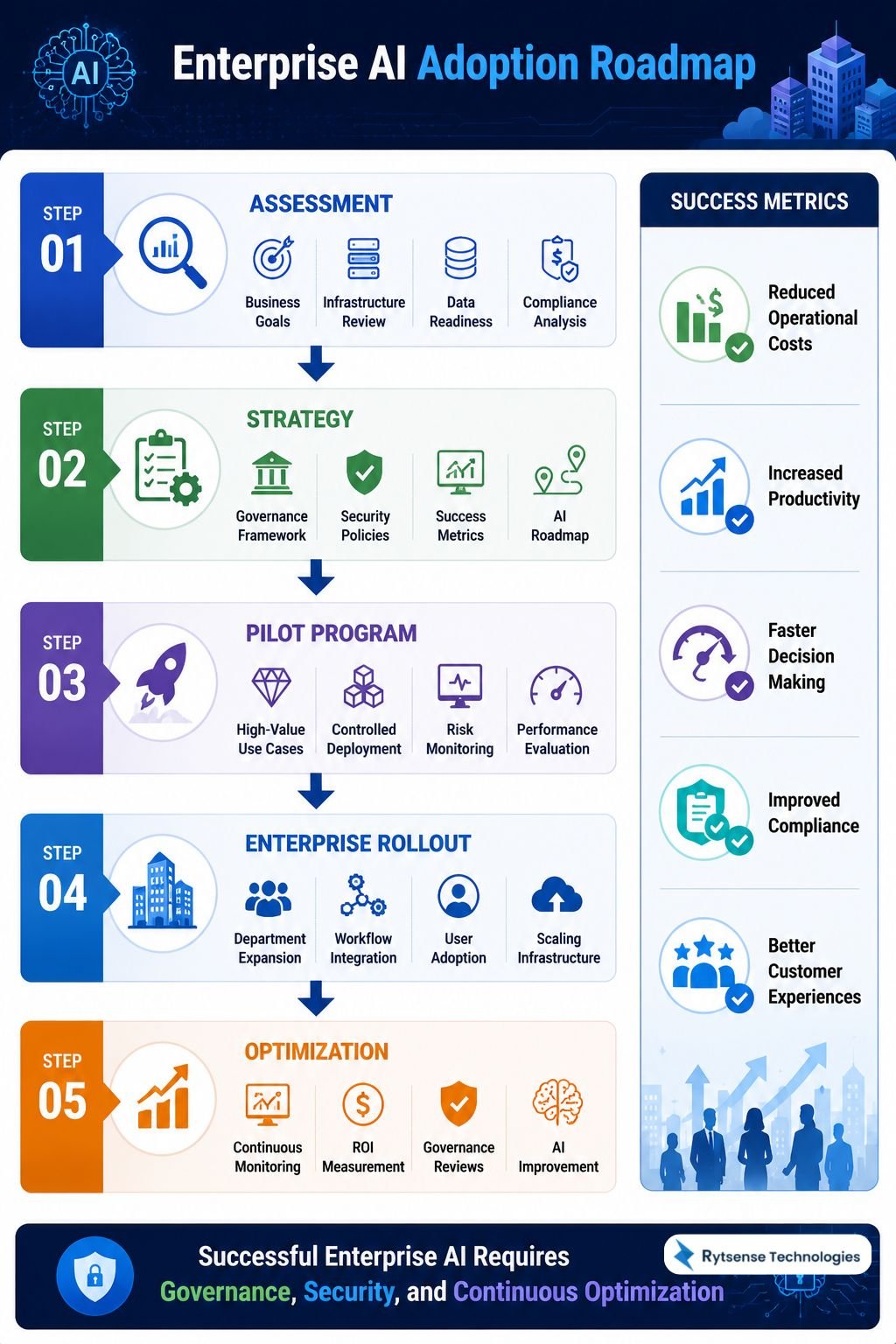
Enterprise AI Adoption Roadmap
Successful enterprise AI transformation typically follows a structured roadmap.
Phase 1: Assessment
Evaluate:
- Business objectives
- Existing infrastructure
- Data readiness
- Compliance requirements
Phase 2: Strategy Development
Define:
- Governance frameworks
- Security policies
- Success metrics
- Adoption plans
Phase 3: Pilot Implementation
Launch controlled initiatives focused on high-value use cases.
Phase 4: Enterprise Expansion
Scale successful pilots across departments and business units.
Phase 5: Optimization
Continuously monitor, improve, and expand AI capabilities.
Organizations that follow a phased approach typically experience lower risk and higher adoption rates.
Measuring ROI from Enterprise AI Initiatives
Enterprise leaders increasingly require measurable outcomes from AI investments.
Key ROI indicators include:
Operational Efficiency
Measure:
- Time savings
- Process automation gains
- Productivity improvements
Cost Reduction
Track:
- Reduced manual work
- Lower operational expenses
- Resource optimization
Revenue Growth
Evaluate:
- New service opportunities
- Faster innovation cycles
- Improved customer retention
Risk Reduction
Monitor:
- Compliance improvements
- Security enhancements
- Reduced operational disruptions
A structured ROI framework helps justify long-term enterprise AI investments.
Conclusion
Selecting the right Enterprise Generative AI Development Company in the USA requires more than evaluating technical expertise.
Organizations should prioritize partners that understand enterprise AI architecture, governance, security, compliance, integrations, and long-term transformation strategies.
The most successful enterprise AI initiatives are built on strong governance frameworks, scalable architectures, and measurable business outcomes.
As enterprises continue their AI transformation journey, choosing a partner with proven experience in enterprise AI implementation can significantly improve adoption success and accelerate ROI.
Meet the Author

Co-Founder, Rytsense Technologies
Karthik is the Co-Founder of Rytsense Technologies, where he leads cutting-edge projects at the intersection of Data Science and Generative AI. With nearly a decade of hands-on experience in data-driven innovation, he has helped businesses unlock value from complex data through advanced analytics, machine learning, and AI-powered solutions. Currently, his focus is on building next-generation Generative AI applications that are reshaping the way enterprises operate and scale. When not architecting AI systems, Karthik explores the evolving future of technology, where creativity meets intelligence.