Key Takeaways
- Machine learning helps businesses automate processes, improve decision-making, and uncover valuable insights from data.
- The easiest way to start is by solving a single business problem with measurable outcomes.
- Common beginner-friendly use cases include customer churn prediction, sales forecasting, lead scoring, and support automation.
- High-quality data is essential for successful machine learning implementation.
- Starting with a small pilot project reduces risk and helps demonstrate ROI quickly.
- Cloud-based AI and ML platforms make adoption more accessible for businesses of all sizes.
- Success should be measured using business metrics such as revenue growth, customer retention, cost savings, and operational efficiency.
- Working with experts offering machine learning development services can accelerate implementation and improve project outcomes.
- Continuous monitoring and model improvement help maintain long-term business value.
- Businesses that adopt machine learning early can gain a competitive advantage through smarter, data-driven decisions.
Machine learning is no longer limited to large technology companies with dedicated data science teams. Today, businesses of all sizes are using machine learning to automate tasks, improve decision-making, reduce costs, and deliver better customer experiences.
The challenge is that many business leaders know machine learning is important but are unsure where to begin. Questions like "Do we need a large budget?", "Do we need data scientists?", and "What problem should we solve first?" often delay adoption.
The good news is that getting started with machine learning is much easier than most organizations think. Instead of attempting a large-scale transformation, businesses can begin with a single use case that delivers measurable value.
In this guide, we'll explore the easiest way to start using machine learning in your business, common use cases, implementation steps, and best practices for long-term success.
What Is Machine Learning?
Machine learning (ML) is a branch of artificial intelligence that enables computer systems to learn from data and improve their performance without being explicitly programmed for every scenario.
Rather than following fixed rules, machine learning models analyze patterns in historical data and use those patterns to make predictions, recommendations, or decisions.
Businesses use machine learning to:
- Forecast future demand
- Predict customer behavior
- Detect fraud and anomalies
- Automate repetitive processes
- Personalize user experiences
- Optimize operations and resource allocation
The goal is simple: turn business data into actionable insights.
Why Businesses Are Adopting Machine Learning
Organizations generate enormous amounts of data every day through websites, mobile apps, CRM systems, customer interactions, and operational processes.
Without machine learning, much of this data remains underutilized.
Machine learning helps businesses:
Improve Decision-Making
ML models identify trends and patterns that may be difficult for humans to detect manually.
Reduce Operational Costs
Automation eliminates repetitive work and reduces the need for manual analysis.
Increase Revenue Opportunities
Predictive insights help businesses target the right customers with the right offers at the right time.
Enhance Customer Experience
Machine learning enables personalized recommendations, faster support, and improved engagement.
Gain Competitive Advantage
Companies that leverage data effectively can respond faster to market changes and customer demands.
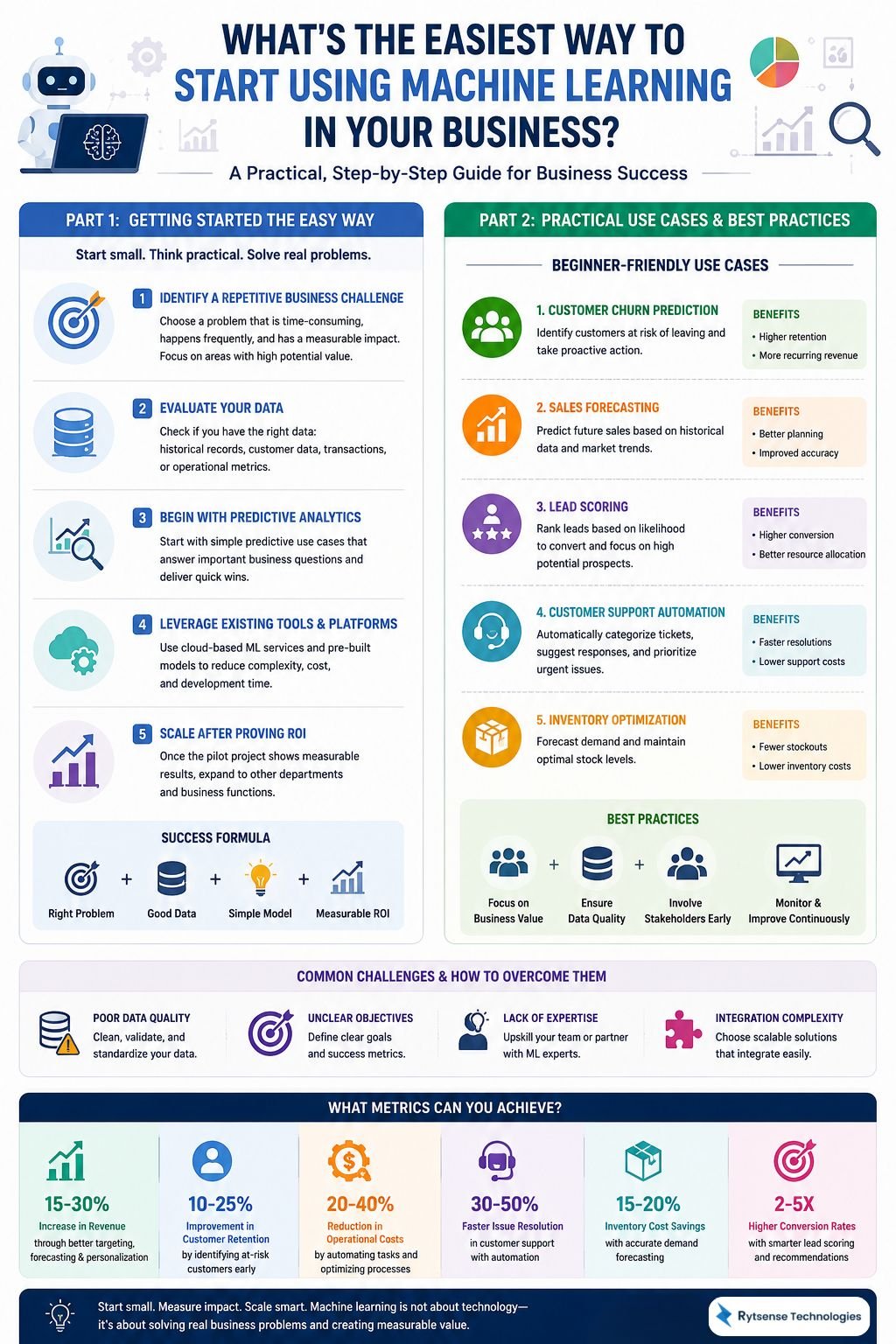
The Easiest Way to Start with Machine Learning
One of the biggest mistakes businesses make is trying to implement machine learning across the entire organization from day one.
A better approach is to start with a small, high-impact problem.
Step 1: Identify a Repetitive Business Challenge
Look for areas where your team spends significant time performing manual tasks.
Examples include:
- Lead qualification
- Customer support ticket routing
- Sales forecasting
- Inventory management
- Fraud detection
- Demand prediction
- Customer churn analysis
Choose a problem that:
- Has measurable outcomes
- Uses existing business data
- Can demonstrate ROI quickly
Step 2: Evaluate Available Data
Machine learning depends on data.
Before starting a project, assess whether you have:
- Historical records
- Customer information
- Transaction data
- Website analytics
- Operational metrics
The quality of your data often has a greater impact on project success than the complexity of the model itself.
Step 3: Begin with Predictive Analytics
Predictive analytics is often the easiest entry point into machine learning.
Instead of automating an entire process, predictive models help businesses answer questions such as:
- Which customers are likely to leave?
- What products will sell next month?
- Which leads are most likely to convert?
- When will equipment require maintenance?
These projects typically provide quick wins while minimizing implementation complexity.
Step 4: Use Existing Tools and Platforms
Businesses do not always need to build machine learning systems from scratch.
Modern cloud platforms provide pre-built machine learning capabilities for:
- Customer insights
- Forecasting
- Image recognition
- Natural language processing
- Recommendation engines
This reduces development time and lowers the barrier to adoption.
Step 5: Scale After Proving ROI
Once the first project demonstrates measurable value, businesses can expand machine learning initiatives to additional departments.
A successful pilot often leads to applications in:
- Marketing
- Sales
- Operations
- Finance
- Human resources
- Supply chain management
Starting small reduces risk while building internal confidence.
Beginner-Friendly Machine Learning Use Cases
Customer Churn Prediction
Businesses can identify customers who may stop using their products or services and take proactive retention measures.
Benefits:
- Improved customer retention
- Increased recurring revenue
- Better customer engagement
Sales Forecasting
Machine learning analyzes historical sales data and market trends to predict future revenue.
Benefits:
- Better inventory planning
- Improved budgeting
- Reduced operational uncertainty
Lead Scoring
ML models evaluate incoming leads and rank them based on conversion probability.
Benefits:
- Higher sales productivity
- Improved conversion rates
- Better resource allocation
Customer Support Automation
Machine learning can categorize support tickets, prioritize requests, and recommend responses.
Benefits:
- Faster resolution times
- Lower support costs
- Improved customer satisfaction
Inventory Optimization
Businesses can forecast demand and maintain optimal stock levels.
Benefits:
- Reduced stock shortages
- Lower inventory costs
- Improved operational efficiency
Common Challenges Businesses Face
While machine learning adoption is becoming easier, organizations should prepare for several challenges.
Poor Data Quality
Incomplete or inaccurate data can significantly impact model performance.
Unclear Business Objectives
Many projects fail because teams focus on technology rather than solving a business problem.
Lack of Internal Expertise
Building and managing machine learning solutions often requires specialized skills.
Integration Complexity
Machine learning systems must work seamlessly with existing business applications and workflows.
Partnering with experienced providers offering machine learning development services can help organizations overcome these challenges while accelerating implementation.
How to Measure Machine Learning Success
Success should be evaluated using business metrics rather than technical metrics alone.
Consider measuring:
| Business Goal | Example Metric |
|---|---|
| Customer Retention | Churn reduction rate |
| Sales Growth | Revenue increase |
| Marketing Efficiency | Conversion improvement |
| Operations | Cost reduction |
| Customer Support | Resolution time improvement |
| Inventory Management | Forecast accuracy |
Tracking measurable outcomes helps justify future investments in machine learning initiatives.
Best Practices for First-Time Machine Learning Adoption
Focus on Business Value
Choose projects that solve real operational problems.
Start Small
Avoid large-scale implementations initially.
Ensure Data Readiness
Clean, organized, and accessible data improves outcomes.
Involve Stakeholders Early
Business teams and technical teams should collaborate throughout the project.
Continuously Improve Models
Machine learning systems require ongoing monitoring and refinement as business conditions change.
The Future of Machine Learning for Businesses
Machine learning is becoming more accessible through cloud platforms, automation tools, and AI-powered development frameworks.
Businesses that start today gain several advantages:
- Better use of existing data
- Faster decision-making
- Increased efficiency
- Enhanced customer experiences
- Stronger competitive positioning
Organizations that delay adoption may find it increasingly difficult to compete in data-driven markets.
Conclusion
The easiest way to start using machine learning in your business is to focus on a single problem that offers measurable value. Begin with available data, launch a small pilot project, evaluate results, and expand gradually.
Whether your goal is improving customer retention, forecasting sales, automating support processes, or optimizing operations, machine learning can deliver meaningful business outcomes without requiring a massive upfront investment.
By taking a practical, step-by-step approach and leveraging the right expertise, businesses can successfully adopt machine learning and create long-term competitive advantages.
Meet the Author

Co-Founder, Rytsense Technologies
Karthik is the Co-Founder of Rytsense Technologies, where he leads cutting-edge projects at the intersection of Data Science and Generative AI. With nearly a decade of hands-on experience in data-driven innovation, he has helped businesses unlock value from complex data through advanced analytics, machine learning, and AI-powered solutions. Currently, his focus is on building next-generation Generative AI applications that are reshaping the way enterprises operate and scale. When not architecting AI systems, Karthik explores the evolving future of technology, where creativity meets intelligence.