Key Takeaways
- General-purpose AI is a strong starting point, but enterprise use cases often require deeper customization.
- Custom generative AI solutions combine business knowledge, workflows, integrations, and governance to deliver more relevant outcomes.
- The most successful AI initiatives focus on solving measurable business problems rather than adopting technology for its own sake.
- Organizations should evaluate whether to build, buy, or customize AI based on their data, operational complexity, and long-term objectives.
- As AI becomes part of everyday business operations, context and integration will matter more than model size alone.
Most AI Projects Don't Fail Because of the Model - They Fail Because They Don't Understand the Business.
When ChatGPT launched, businesses rushed to experiment with generative AI. Marketing teams used it to create content. Developers relied on it to write code. Customer support teams drafted responses in seconds. Almost overnight, AI became part of everyday work.
Yet, as organizations moved from experimentation to implementation, many encountered the same challenge.
The AI could answer questions, but it couldn't answer their questions.
It didn't understand internal policies, customer contracts, product documentation, approval workflows, or years of organizational knowledge. It couldn't retrieve information from ERP systems, CRM platforms, or private databases without additional engineering. And for industries with strict compliance requirements, relying on a public AI model wasn't always an option.
This is where many AI initiatives reach a turning point.
Instead of asking, "Which AI model should we use?" business leaders begin asking a different question:
"How do we build an AI solution that understands our business?"
That's the purpose of custom generative AI solutions. They don't replace powerful foundation models like GPT, Claude, Gemini, or Llama. Instead, they transform those models into enterprise-ready systems by connecting them with business knowledge, workflows, and governance.
The result isn't just a smarter chatbot. It's an AI solution designed to support the way your organization actually operates.
Why Businesses Eventually Outgrow Off-the-Shelf AI
Off-the-shelf AI platforms are an excellent starting point. They reduce the barrier to adoption and help teams understand where AI can improve productivity.
For many organizations, they're enough for tasks such as:
- Drafting emails and reports
- Brainstorming ideas
- Summarizing documents
- Writing code snippets
- Translating content
- Creating marketing copy
However, these tools are designed for general-purpose use. Enterprise environments demand something far more specific.
Imagine asking an AI assistant to explain why a customer's insurance claim was denied. A public AI model has no access to your claims history, policy rules, or internal documentation. Even if it generates a convincing answer, there's no guarantee it's based on your organization's data.
Now consider a manufacturing company troubleshooting equipment failures. The AI needs access to maintenance manuals, sensor readings, service records, and historical repair logs before it can provide meaningful recommendations.
In both scenarios, the limitation isn't the language model itself. The limitation is context.
Enterprise AI succeeds when it combines language intelligence with business intelligence.
That's why organizations are investing in custom generative AI solutions instead of relying solely on general-purpose assistants.
What Makes an AI Solution Truly "Custom"?
One of the biggest misconceptions about enterprise AI is that customization begins with training a new language model.
In reality, most successful AI projects don't start there.
Customization is about creating an AI system that understands your organization's data, follows your business processes, and delivers responses aligned with your operational goals.
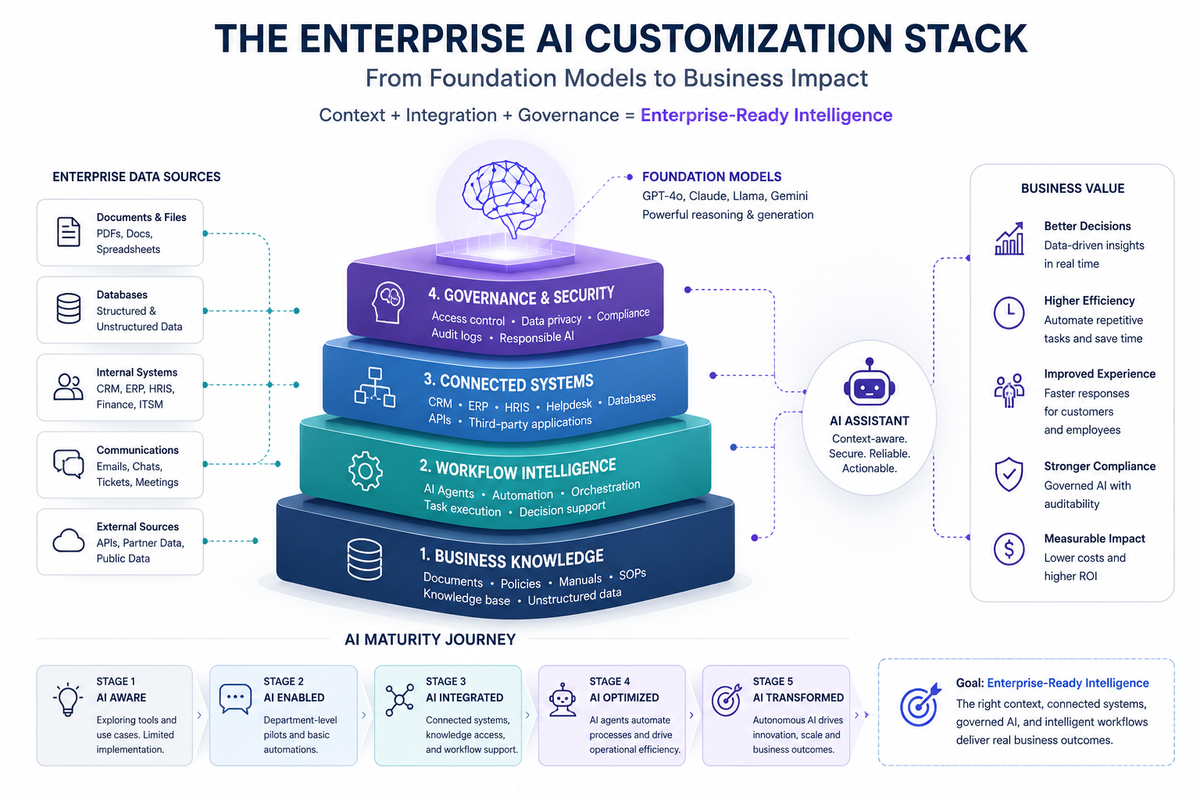
Think of it as building four connected layers rather than one intelligent model.
Layer 1: Business Knowledge
An AI assistant is only as valuable as the information it can access.
Instead of relying solely on publicly available knowledge, custom AI connects to trusted internal sources such as:
- Company documentation
- Standard operating procedures
- Product manuals
- Knowledge bases
- Customer records
- Internal policies
This allows the AI to provide answers that reflect your business rather than generic internet content.
Layer 2: Workflow Intelligence
Answering questions is useful.
Completing work is far more valuable.
Modern enterprise AI doesn't stop after generating text. It can trigger workflows, automate repetitive tasks, assign tickets, summarize meetings, generate reports, or initiate approval processes.
Rather than acting as a passive assistant, it becomes an active participant in business operations.
Layer 3: Connected Enterprise Systems
Organizations rarely rely on a single platform.
Sales teams use CRMs. Finance teams work with ERP systems. HR departments manage employee platforms. Customer service teams depend on help desk software.
A custom AI solution brings these systems together, allowing employees to interact with business data through natural language instead of navigating multiple applications.
For example, instead of manually checking three different systems, a sales manager could simply ask:
"Which enterprise customers have open support tickets, overdue invoices, and renewal opportunities this quarter?"
The AI gathers information across systems and delivers a unified response in seconds.
Layer 4: Governance, Security, and Compliance
Enterprise AI isn't only about performance.
It's about trust.
Organizations need clear visibility into how AI accesses data, what information it can retrieve, and how responses are generated. Role-based permissions, audit trails, data encryption, and compliance with industry regulations become just as important as the intelligence of the model itself.
Without these safeguards, even the most capable AI solution may never move beyond a pilot project.
The Shift Isn't Bigger Models, It's Better Context
A common assumption is that better AI comes from using a larger or newer language model.
In practice, context often matters more than model size.
An AI system connected to verified company knowledge, integrated with business applications, and guided by well-designed workflows can consistently outperform a more powerful standalone model.
This is why technologies such as Retrieval-Augmented Generation (RAG), enterprise knowledge graphs, AI agents, and workflow orchestration have become central to modern AI implementations. They provide the model with the information it needs at the moment a request is made, reducing hallucinations and improving the relevance of every response.
Businesses are no longer asking, "Which model is the smartest?" Instead, they're asking, "Which solution understands our business best?"
Build, Buy, or Customize? Choosing the Right AI Strategy
Not every business needs a fully custom AI solution on day one. The right approach depends on your goals, data, and the complexity of your operations.
| Approach | Best For | Advantages | Limitations |
|---|---|---|---|
| Off-the-Shelf AI | Individuals, startups, and small teams | Fast setup, lower upfront cost, easy to use | Limited business context, fewer integrations, generic responses |
| AI Platforms | Businesses with common workflows | Industry-specific features and faster deployment | Less flexibility and vendor dependency |
| Custom Generative AI Solutions | Organizations automating core business processes | Tailored workflows, enterprise integrations, stronger governance, long-term scalability | Higher initial investment and implementation effort |
The decision isn't about replacing ChatGPT or another AI platform. It's about determining when a general-purpose tool is no longer enough.
A practical rule is this:
- If AI helps individuals work faster, an off-the-shelf solution may be sufficient.
- If AI needs to make business decisions, access enterprise knowledge, or automate critical workflows, customization becomes increasingly valuable.
Three Enterprise Scenarios That Show the Difference
The impact of custom generative AI is easier to understand through real business scenarios than through feature lists.
Scenario 1: A Healthcare Provider Reduces Administrative Work
A hospital network wanted clinicians to spend less time searching for policies, reviewing patient documentation, and preparing discharge summaries.
Instead of training a new language model, the organization connected an AI assistant to approved clinical guidelines, internal documentation, and electronic health record systems.
When clinicians asked questions or requested summaries, the assistant retrieved verified information from trusted sources before generating a response.
The result wasn't just faster documentation. It also improved consistency, reduced time spent on administrative tasks, and gave clinicians greater confidence in the information they received.
The AI became a trusted assistant rather than another search tool.
Scenario 2: An Insurance Company Speeds Up Claims Processing
Claims teams often work across multiple systems while reviewing policy documents, customer history, and supporting evidence.
A custom generative AI solution can bring these sources together.
When a new claim is submitted, the AI:
- Extracts key information from documents.
- Matches the claim against policy rules.
- Identifies missing information.
- Flags potential inconsistencies.
- Generates a structured summary for the claims adjuster.
Instead of replacing human expertise, the AI reduces manual effort and helps adjusters focus on complex decisions.
Scenario 3: A Manufacturer Preserves Operational Knowledge
Manufacturing organizations often rely on experienced technicians who understand equipment better than anyone else.
The challenge comes when that knowledge isn't documented or is spread across manuals, maintenance logs, and service reports.
A custom AI assistant can combine these resources into a searchable knowledge system.
When a maintenance engineer asks,
"Why is Line 3 repeatedly failing after calibration?"
the AI retrieves relevant maintenance history, equipment documentation, and previous service records before suggesting possible causes.
Instead of searching multiple documents, engineers receive contextual answers that accelerate troubleshooting and reduce downtime.
Before Investing in Custom AI, Ask These Five Questions
Technology alone doesn't determine the success of an AI initiative. The quality of planning matters just as much.
Before moving forward, organizations should consider:
1. What business problem are we solving?
Avoid implementing AI because it's trending. Start with a measurable challenge such as reducing manual work, improving customer response times, or accelerating decision-making.
2. Do we have reliable business data?
AI can only work with the information available to it. Well-organized documentation, knowledge bases, and structured business data are essential for producing accurate results.
3. Which systems need to work together?
The greatest value often comes from connecting AI with existing platforms such as CRM, ERP, HR, or customer support systems.
4. How will success be measured?
Define success early. Metrics might include faster processing times, reduced operational costs, improved customer satisfaction, or increased employee productivity.
5. Can the solution evolve with the business?
Business processes change over time. A successful AI solution should be flexible enough to incorporate new knowledge, support additional workflows, and adapt as organizational needs evolve.
Enterprise AI Is Becoming Business Infrastructure
A few years ago, organizations viewed generative AI as an experimental productivity tool. Today, it's increasingly becoming part of core business operations.
The conversation has shifted from "Can AI write content?" to "Can AI help us deliver better customer experiences, improve operational efficiency, and support more informed decisions?"
That shift is significant.
Competitive advantage no longer comes from having access to the latest language model. Many organizations use the same underlying models. The difference lies in how those models are connected to business knowledge, integrated into workflows, and governed within the enterprise.
This is where custom generative AI solutions create lasting value. They bridge the gap between general-purpose AI capabilities and the specific needs of an organization, enabling systems that understand context, support employees, and adapt as the business grows.
The future of enterprise AI isn't about building the biggest model. It's about building the most relevant one for your business.
Final thoughts
Building a successful AI solution isn't about choosing the latest language model, it's about creating a system that understands your business. When AI has access to the right knowledge, integrates with existing workflows, and operates within the right governance framework, it becomes more than a productivity tool. It becomes a practical business capability.
Custom generative AI solutions help organizations move beyond generic responses and disconnected workflows by delivering intelligence that's relevant, reliable, and aligned with business objectives. As enterprise adoption continues to grow, organizations that invest in tailored AI solutions will be better equipped to improve operational efficiency, support informed decision-making, and create long-term business value.
The real advantage isn't having access to AI, it's having AI that's built for the way your business works.
Meet the Author

Co-Founder, Rytsense Technologies
Karthik is the Co-Founder of Rytsense Technologies, where he leads cutting-edge projects at the intersection of Data Science and Generative AI. With nearly a decade of hands-on experience in data-driven innovation, he has helped businesses unlock value from complex data through advanced analytics, machine learning, and AI-powered solutions. Currently, his focus is on building next-generation Generative AI applications that are reshaping the way enterprises operate and scale. When not architecting AI systems, Karthik explores the evolving future of technology, where creativity meets intelligence.