Custom AI vs Off-the-Shelf AI: Which One Delivers Better Business Value?
Artificial intelligence has become a practical business investment rather than an experimental technology. Organizations across healthcare, finance, manufacturing, logistics, retail, SaaS, and professional services are using AI to automate operations, improve customer experiences, and make faster business decisions.
Yet one question consistently comes up before implementation:
Should your business invest in a custom AI solution or buy an off-the-shelf AI product?
The answer depends less on company size and more on how AI fits into your business processes.
Many organizations initially choose ready-made AI software because it is quick to deploy. However, as AI adoption expands across departments, limitations begin to appear. Generic workflows, limited integrations, restricted customization, recurring licensing costs, and ownership concerns often prevent businesses from achieving their long-term objectives.
Custom AI, on the other hand, is designed around your business data, workflows, compliance requirements, and operational goals. Although it requires a higher upfront investment, it often delivers greater efficiency, competitive differentiation, and long-term return on investment.
This guide compares Custom AI vs Off-the-Shelf AI across every important decision factor, helping business leaders determine which approach aligns with their growth strategy.
Understanding Off-the-Shelf AI
Off-the-shelf AI refers to commercially available AI software built to serve a wide range of industries and use cases.
Examples include:
- AI writing assistants
- Customer support chatbots
- AI meeting assistants
- Marketing automation platforms
- AI analytics software
- Image generation tools
- Generic AI workflow automation platforms
These solutions are designed for rapid deployment with minimal setup.
They usually operate using standardized models that work well for common business scenarios but offer limited flexibility when organizations require specialized workflows.
Best suited for
- Small businesses
- Startups validating AI adoption
- Teams with standard workflows
- Companies needing immediate implementation
- Organizations without internal technical resources
What Is Custom AI?
Custom AI is developed specifically for an organization's business model, operational processes, data sources, compliance requirements, and customer journey.
Instead of adapting your business to software, custom AI adapts to your business.
A custom AI development company typically builds solutions such as:
- AI Agents
- Enterprise chatbots
- Document intelligence systems
- Predictive analytics platforms
- Recommendation engines
- Computer vision applications
- Industry-specific AI assistants
- Voice AI solutions
- Workflow automation systems
- Decision-support platforms
Every component is optimized around the organization's objectives rather than generic industry assumptions.
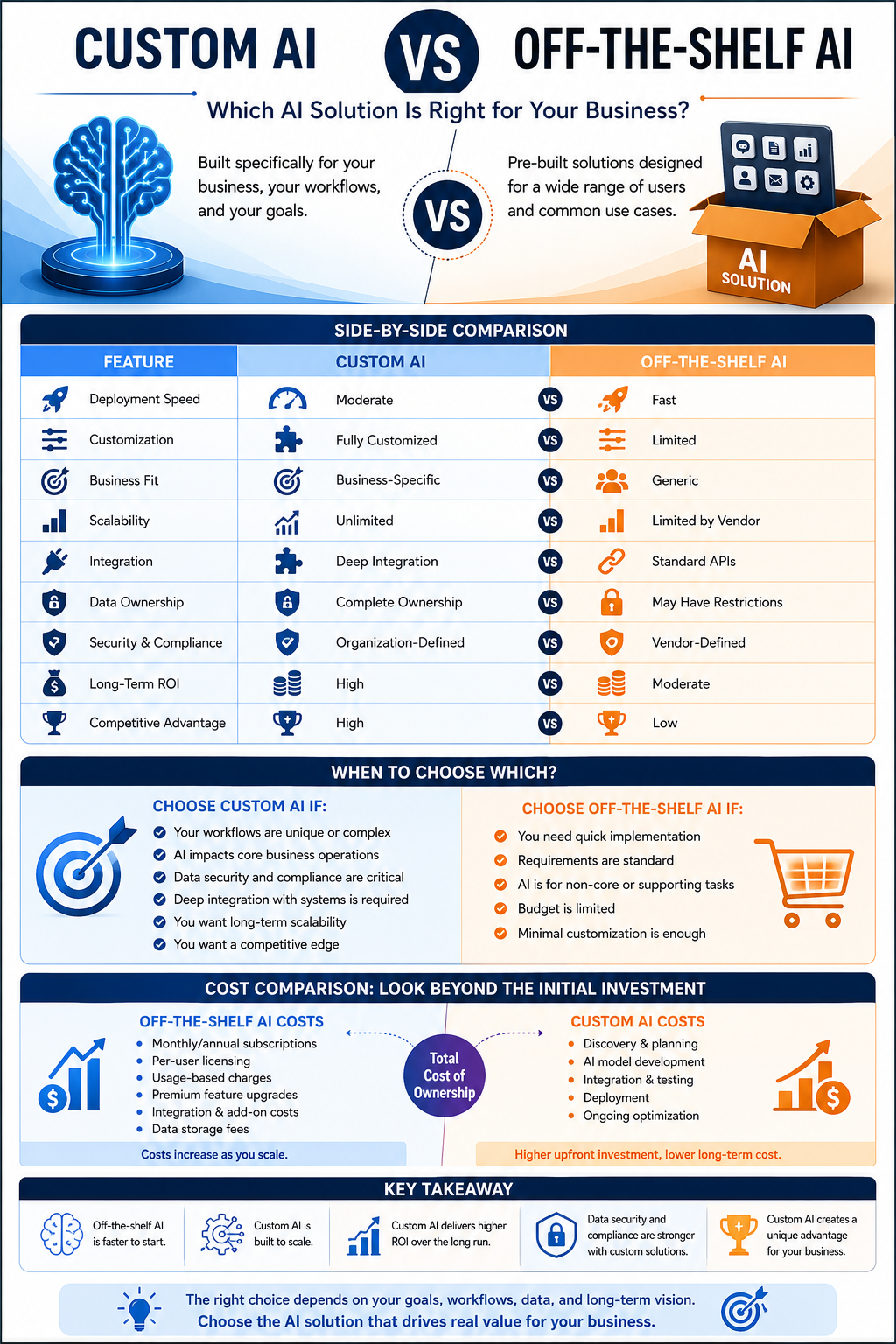
Custom AI vs Off-the-Shelf AI: Side-by-Side Comparison
| Feature | Off-the-Shelf AI | Custom AI Development |
|---|---|---|
| Deployment Speed | Fast | Moderate |
| Customization | Limited | Fully customized |
| Business Fit | Generic | Business-specific |
| Scalability | Limited by vendor | Unlimited |
| Integration | Standard APIs | Deep enterprise integration |
| Data Ownership | May have restrictions | Complete ownership |
| Security Controls | Vendor-defined | Organization-defined |
| Compliance | General | Industry-specific |
| Long-Term ROI | Moderate | High |
| Competitive Advantage | Low | High |
Although off-the-shelf software offers convenience, custom AI creates technology that becomes part of your competitive advantage.
The Biggest Difference: AI Built Around Your Workflow
Every business develops unique operational processes over time.
For example:
A logistics company may optimize delivery scheduling differently from competitors.
A healthcare provider may follow specialized patient intake procedures.
A financial institution may have proprietary fraud detection rules.
Generic AI platforms cannot understand these differences because they are designed for the average customer.
Custom AI learns your business rules and supports them directly.
Instead of forcing employees to change their workflow, the AI enhances existing operations.
This often leads to higher adoption rates and measurable productivity improvements.
Many businesses compare only the initial implementation cost.
That comparison is incomplete.
Off-the-Shelf AI Costs
Typical expenses include:
- Monthly subscriptions
- Per-user licensing
- Usage-based pricing
- API charges
- Premium feature upgrades
- Integration costs
- Data storage fees
As organizations scale, these recurring expenses can increase significantly.
Large enterprises often discover that subscription costs exceed the investment required for a custom AI solution within a few years.
Custom AI Costs
Custom AI generally includes:
- Discovery
- Solution architecture
- AI model development
- Integration
- Testing
- Deployment
- Ongoing optimization
Although the upfront investment is higher, organizations avoid paying perpetual licensing fees for core functionality they own.
The total cost of ownership frequently becomes more favorable over the long term.
Data Quality Determines AI Performance
Artificial intelligence performs only as well as the data it learns from.
Off-the-shelf AI is trained on broad datasets intended to work across multiple industries.
While versatile, these models may lack the context needed for specialized business operations.
Custom AI uses organizational data, enabling:
- More accurate predictions
- Better recommendations
- Higher automation rates
- Improved decision-making
- Industry-specific intelligence
For businesses with proprietary knowledge, historical records, or specialized documentation, this difference can significantly impact outcomes
Security and Compliance Considerations
Organizations operating in regulated industries cannot rely solely on generic security features.
Healthcare providers must protect patient records.
Financial institutions manage sensitive transaction data.
Legal firms handle confidential client information.
Manufacturers protect proprietary designs.
Custom AI enables businesses to implement:
- Private deployments
- Custom authentication
- Role-based permissions
- Data encryption policies
- Audit logging
- Regulatory compliance requirements
- Internal governance controls
This level of control is often essential for organizations handling sensitive information.
Scalability for Future Growth
AI adoption rarely remains limited to one department.
Many companies begin with:
- Customer support automation
Then expand into:
- Sales
- HR
- Operations
- Finance
- Procurement
- Product development
- Executive reporting
Off-the-shelf AI platforms may become restrictive as business requirements evolve.
Custom AI is designed with future expansion in mind.
New capabilities can be added without replacing the underlying system, allowing organizations to grow their AI ecosystem over time.
Competitive Advantage: Where Custom AI Wins
If every company uses the same AI software, every company receives similar capabilities.
Competitive differentiation becomes difficult.
Custom AI creates unique business assets.
Examples include:
- Proprietary recommendation engines
- AI-powered pricing models
- Industry-specific AI assistants
- Internal knowledge systems
- Custom AI agents
- Intelligent workflow orchestration
When Off-the-Shelf AI Makes Sense
Ready-made AI is often the right choice when:
- You need rapid implementation.
- AI adoption is still being evaluated.
- Budgets are limited.
- Workflows are relatively standard.
- Custom integrations are unnecessary.
- AI supports non-core business functions.
For example, using AI for meeting summaries or content drafting may not require custom development.
These capabilities cannot be easily replicated by competitors using standard AI platforms.
For businesses seeking market differentiation, this is often the strongest argument for custom AI development.
Decision Framework: Which Option Fits Your Business?
Ask these questions before choosing an AI approach:
Choose Off-the-Shelf AI if:
- You need immediate deployment.
- Your requirements are standard.
- AI is a supporting tool rather than a strategic capability.
- Budget is the primary consideration.
- Minimal customization is acceptable.
Choose Custom AI if:
- Your business processes are unique.
- AI directly impacts revenue or operations.
- Data privacy is a priority.
- Integration with existing software is essential.
- Long-term ROI outweighs short-term implementation speed.
- You want an AI solution that evolves with your organization.
Final Thoughts
The decision between custom AI and off-the-shelf AI is not simply about software—it is about how artificial intelligence supports your business strategy.
Off-the-shelf AI provides speed, convenience, and lower initial costs, making it suitable for organizations addressing common use cases or beginning their AI journey.
Custom AI development, however, is designed to solve business-specific challenges. It aligns with your workflows, integrates with existing systems, protects sensitive data, and scales as your organization grows. More importantly, it creates capabilities that competitors cannot easily replicate.
For businesses where AI will influence operational efficiency, customer experience, or long-term growth, custom AI is often the more strategic investment. Rather than adapting your business to fit a generic platform, a tailored solution enables AI to become a core driver of innovation, productivity, and competitive advantage.
As AI continues to evolve, organizations that invest in solutions built around their own processes and data will be better positioned to generate sustainable business value.
Meet the Author

Co-Founder, Rytsense Technologies
Karthik is the Co-Founder of Rytsense Technologies, where he leads cutting-edge projects at the intersection of Data Science and Generative AI. With nearly a decade of hands-on experience in data-driven innovation, he has helped businesses unlock value from complex data through advanced analytics, machine learning, and AI-powered solutions. Currently, his focus is on building next-generation Generative AI applications that are reshaping the way enterprises operate and scale. When not architecting AI systems, Karthik explores the evolving future of technology, where creativity meets intelligence.