Key Takeaways
- Evaluate custom AI as a long-term business investment, not just a development expense.
- Measure both cost savings and revenue growth when calculating ROI.
- Include hidden costs such as data preparation, integration, infrastructure, and user adoption.
- Compare ROI over multiple years instead of focusing only on first-year results.
- Use payback period, ROI projections, and business KPIs to support investment decisions.
- Start with high-impact use cases where AI can deliver measurable operational improvements.
Before You Invest in Custom AI, Calculate the Return
Building a custom AI solution can cost anywhere from $50,000 to over $500,000, depending on the complexity of the project. For business leaders, the biggest question isn't whether AI is powerful, it's whether the investment will generate measurable business value.
Can AI reduce operational costs enough to justify the budget? Will it improve productivity, increase revenue, or shorten manual processes? More importantly, how long will it take to recover the investment?
These are the questions that drive AI investment decisions. That's why calculating ROI before development begins is just as important as choosing the right technology partner.
In this guide, you'll learn how to estimate the return on a custom AI solution, calculate the payback period, identify hidden implementation costs, and determine whether custom AI is the right investment for your business.
Why ROI Is the First Metric Decision-Makers Evaluate
For technical teams, AI is about capabilities.
For executives, AI is about business outcomes.
A Chief Financial Officer isn't interested in the number of machine learning models or the latest large language model. They want to know:
- How much money will this save?
- How quickly will the investment pay for itself?
- Will it reduce operational costs?
- Can it improve revenue?
- What happens if adoption is slower than expected?
The same applies to founders, operations leaders, and CIOs. AI projects are increasingly approved based on measurable financial impact rather than technical innovation.
A well-planned custom AI development initiative should be tied to business metrics such as:
- Reduced processing time
- Lower labor costs
- Higher employee productivity
- Increased customer retention
- Faster sales cycles
- Fewer manual errors
- Improved compliance
- Better resource utilization
These metrics provide the foundation for calculating ROI and justifying AI investments.
What Does ROI Mean in Custom AI Development?
Return on Investment (ROI) measures the financial value your AI solution creates compared to the total amount invested in building, deploying, and maintaining it.
Unlike generic software purchases, custom AI often delivers value across multiple areas of the business. It may reduce operational costs, improve productivity, increase revenue, or create competitive advantages that continue to grow over time.
For example, an AI-powered document processing system may:
- Reduce manual processing by 80%
- Eliminate repetitive administrative tasks
- Lower error rates
- Process documents around the clock
- Improve customer turnaround times
The combined financial impact of these improvements determines the overall ROI of the project.
Why Businesses Choose Custom AI Instead of Off-the-Shelf AI
Many organizations begin their AI journey with tools like ChatGPT, Microsoft Copilot, or industry-specific AI platforms. These tools provide quick access to AI capabilities but are designed for general-purpose use.
As businesses grow, they often encounter limitations such as:
- Inability to automate complex workflows
- Limited integration with internal systems
- Restricted customization
- Lack of proprietary business logic
- Data privacy concerns
- Subscription costs that increase with usage
Custom AI addresses these challenges by building solutions around your business processes rather than forcing your operations to fit a predefined tool.
Comparison: Custom AI vs. Off-the-Shelf AI
| Factor | Off-the-Shelf AI | Custom AI Development |
|---|---|---|
| Initial Investment | Lower | Higher |
| Long-Term ROI | Moderate | Higher |
| Business Process Fit | Generic | Tailored |
| Integration with ERP, CRM, and Internal Systems | Limited | Extensive |
| Ownership of Models | No | Yes |
| Scalability | Vendor-dependent | Built for growth |
| Competitive Advantage | Shared with competitors | Unique to your business |
| Data Control | Limited | Full ownership |
While subscription tools may reduce short-term costs, custom AI often provides greater long-term value because it aligns with your workflows, data, and strategic objectives.
The Biggest Mistake Companies Make When Calculating AI ROI
Many businesses evaluate AI using only one number:
Development Cost
This approach overlooks the broader financial impact.
Consider two companies investing $200,000 in custom AI.
Company A
- Saves 200 employee hours per month
- Reduces manual errors by 15%
- Generates no additional revenue
Company B
- Saves 1,500 employee hours per month
- Automates customer support
- Improves lead conversion rates
- Reduces operational expenses
- Increases annual revenue by $500,000
Both companies invested the same amount, but their returns are dramatically different.
The value of AI depends less on development cost and more on how effectively it improves business performance.
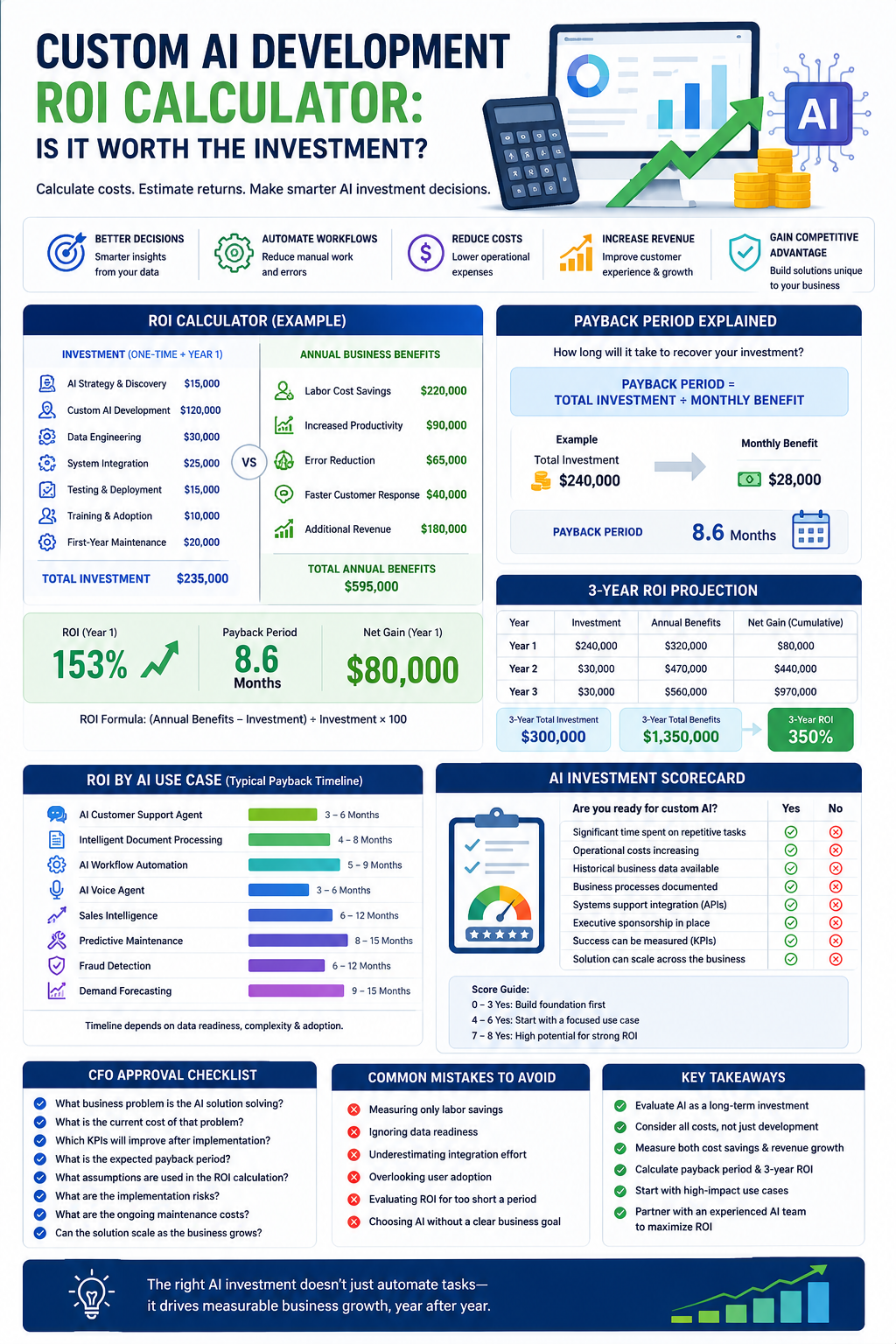
Custom AI Development ROI Calculator
Before approving an AI project, estimate its financial impact using the following framework.
Step 1: Calculate Total AI Investment
Include every cost associated with implementation, not just software development.
| Cost Category | Estimated Cost |
|---|---|
| AI Strategy and Discovery | $15,000 |
| Custom AI Development | $120,000 |
| Data Engineering | $30,000 |
| System Integration | $25,000 |
| Testing and Deployment | $15,000 |
| Employee Training | $10,000 |
| First-Year Maintenance | $20,000 |
Total Investment
$235,000
Many ROI calculations underestimate costs because they exclude integration, data preparation, or user adoption activities
Step 2: Estimate Annual Business Benefits
Identify measurable improvements that AI is expected to deliver.
| Business Benefit | Annual Value |
|---|---|
| Labor Cost Savings | $220,000 |
| Increased Productivity | $90,000 |
| Error Reduction | $65,000 |
| Faster Customer Response | $40,000 |
| Additional Revenue | $180,000 |
Total Annual Benefits
$595,000
These values should be based on operational data whenever possible rather than assumptions
Step 3: Calculate ROI
Use the following formula:
ROI (%) = ((Total Annual Benefits − Total Investment) ÷ Total Investment) × 100
Using the example above:
- Total Investment = $235,000
- Annual Benefits = $595,000
ROI = ((595,000 − 235,000) ÷ 235,000) × 100
ROI = 153%
This means the project generates significantly more value than its initial investment within the first year.
ROI Isn't Just About Cost Savings
One of the biggest misconceptions is that AI only reduces labor costs.
In reality, custom AI creates value in multiple ways.
Revenue Growth
AI-powered recommendation engines, intelligent pricing, and predictive sales tools help businesses increase revenue by improving customer engagement and conversion rates.
Productivity Gains
Employees spend less time on repetitive tasks and more time on high-value work, allowing organizations to accomplish more without increasing headcount.
Operational Efficiency
AI streamlines workflows by reducing delays, minimizing bottlenecks, and improving collaboration across teams.
Risk Reduction
Custom AI can identify anomalies, detect fraud, monitor compliance, and reduce costly operational errors before they escalate.
Better Customer Experience
Faster responses, personalized interactions, and consistent service improve customer satisfaction and retention, contributing to long-term business growth.
Which Businesses Typically Achieve the Highest AI ROI?
Not every company will experience the same level of return. Organizations with the following characteristics generally see faster and higher ROI from custom AI development:
- High volumes of repetitive manual work
- Large customer support teams
- Data-intensive operations
- Multiple disconnected software systems
- High error rates in business processes
- Growing operational costs
- Frequent document processing
- Predictable workflows suitable for automation
Examples include insurance claims processing, healthcare documentation, financial approvals, inventory management, customer service automation, and enterprise knowledge management.
Calculate the AI Payback Period
For many business leaders, the most important question isn't the ROI percentage.
It's:
"How long until the investment pays for itself?"
The payback period measures how quickly your savings and revenue gains recover the initial investment.
Formula
Payback Period = Total Investment ÷ Monthly Financial Benefit
Example
| Total AI Investment | $240,000 |
|---|---|
| Monthly Savings | $28,000 |
Payback Period = 8.6 Months
Projects with a payback period under 18 months are generally considered attractive for many organizations, although acceptable timelines vary by industry and project complexity.
Three-Year ROI Projection
Custom AI often delivers increasing value after deployment because development is a one-time investment, while operational benefits continue over time.
| Year | Investment | Annual Benefits | Net Gain |
|---|---|---|---|
| Year 1 | $240,000 | $320,000 | $80,000 |
| Year 2 | $30,000 | $470,000 | $440,000 |
| Year 3 | $30,000 | $560,000 | $530,000 |
In many cases, maintenance costs decrease as teams become familiar with the solution, while productivity gains continue to grow through optimization and broader adoption.
This is why businesses should evaluate AI investments over multiple years rather than focusing only on first-year returns.
ROI by AI Use Case
Different AI initiatives produce returns at different speeds.
The table below provides a practical benchmark for common enterprise AI implementations.
| AI Use Case | Primary Value | Typical Payback Timeline |
|---|---|---|
| AI Customer Support Agent | Lower support costs | 3–6 months |
| Intelligent Document Processing | Faster document handling | 4–8 months |
| AI Workflow Automation | Reduced manual effort | 5–9 months |
| AI Voice Agent | Increased call handling capacity | 3–6 months |
| Predictive Maintenance | Reduced equipment downtime | 8–15 months |
| Sales Intelligence | Improved conversion rates | 6–12 months |
| Fraud Detection | Lower financial losses | 6–12 months |
| Demand Forecasting | Better inventory planning | 9–15 months |
The timeline depends on factors such as data quality, implementation complexity, and the maturity of existing business processes.
AI Investment Scorecard
Before investing in custom AI development, assess whether your business is ready to achieve measurable ROI.
| Assessment Question | Yes | No |
|---|---|---|
| Do employees spend significant time on repetitive tasks? | ☐ | ☐ |
| Are operational costs increasing year over year? | ☐ | ☐ |
| Do you have historical business data available? | ☐ | ☐ |
| Are business processes documented and standardized? | ☐ | ☐ |
| Do existing systems support API integration? | ☐ | ☐ |
| Is there executive sponsorship for the project? | ☐ | ☐ |
| Can success be measured using defined KPIs? | ☐ | ☐ |
| Is the solution expected to scale across departments? | ☐ | ☐ |
How to Interpret Your Score
0–3 Yes Answers: Your organization may need to improve data quality, process maturity, or operational readiness before investing in custom AI.
4–6 Yes Answers: You have a solid foundation. Start with a focused AI use case, validate ROI, and expand based on measurable results.
7–8 Yes Answers: Your business is well-positioned to benefit from custom AI development with a strong potential for long-term ROI.
CFO Checklist Before Approving a Custom AI Project
Financial decision-makers evaluate AI investments differently from technical teams.
Before approving a project, they typically want answers to the following questions:
- What business problem is the AI solution solving?
- What is the current cost of that problem?
- Which KPIs will improve after implementation?
- How will success be measured?
- What assumptions are used in the ROI calculation?
- What are the implementation risks?
- How long is the expected payback period?
- What ongoing maintenance costs should be expected?
- Can the solution scale as the business grows?
Preparing clear answers to these questions strengthens the business case and helps align stakeholders before development begins.
Common Mistakes When Estimating AI ROI
Organizations often overestimate AI returns because they rely on assumptions rather than measurable operational data.
Avoid these common mistakes:
Measuring Only Labor Savings
AI also creates value through revenue growth, improved customer retention, reduced risk, and faster decision-making. Focusing only on labor savings understates the total business impact.
Ignoring Data Readiness
Poor-quality or fragmented data increases implementation time and reduces model performance. Data preparation should be part of every ROI estimate.
Overlooking User Adoption
AI delivers value only when employees integrate it into their daily workflows. Training and change management are essential for realizing projected benefits.
Using Short Evaluation Periods
Custom AI solutions often provide greater returns in the second and third years after deployment. Measuring ROI only over the first few months can lead to misleading conclusions.
Choosing AI Without a Defined Business Goal
Technology should never drive the project. A clearly defined operational challenge should determine whether AI is the right solution.
How a Custom AI Development Company Helps Maximize ROI
Building an AI model is only one part of a successful implementation.
An experienced custom AI development company begins by identifying business opportunities where AI can create measurable financial value.
A structured approach typically includes:
- Business process assessment
- AI feasibility and ROI analysis
- Data readiness evaluation
- Solution architecture and technology selection
- Custom AI model development
- Integration with existing enterprise systems
- Deployment, monitoring, and optimization
- Continuous improvement based on business outcomes
This approach helps organizations prioritize high-impact use cases, reduce implementation risk, and ensure that AI investments are aligned with measurable business objectives
Is Custom AI Development Worth the Investment?
The answer depends on the problem you're trying to solve—not on the technology itself.
If your organization relies on repetitive manual processes, handles large volumes of operational data, or faces rising labor costs, custom AI can generate measurable returns through automation, improved efficiency, and better decision-making.
The key is to evaluate AI as a business investment rather than a software expense.
A realistic ROI assessment should include implementation costs, operational savings, revenue opportunities, payback period, and long-term scalability. When these factors are measured together, decision-makers gain a clearer understanding of whether custom AI aligns with their financial and operational goals.
For organizations planning enterprise AI initiatives, partnering with a provider that combines technical expertise with ROI-driven planning can significantly improve project outcomes. A well-designed custom AI solution should not only solve today's operational challenges but also deliver sustainable business value as your organization grows.
Meet the Author

Co-Founder, Rytsense Technologies
Karthik is the Co-Founder of Rytsense Technologies, where he leads cutting-edge projects at the intersection of Data Science and Generative AI. With nearly a decade of hands-on experience in data-driven innovation, he has helped businesses unlock value from complex data through advanced analytics, machine learning, and AI-powered solutions. Currently, his focus is on building next-generation Generative AI applications that are reshaping the way enterprises operate and scale. When not architecting AI systems, Karthik explores the evolving future of technology, where creativity meets intelligence.