Key Takeaways
- AI readiness is a business strategy exercise, not just a technical evaluation.
- High-quality data and clearly defined objectives are the strongest indicators of AI readiness.
- Assessing processes, infrastructure, governance, and organizational adoption reduces project risk.
- Start with a high-impact pilot before scaling AI across the enterprise.
- A structured readiness assessment helps maximize ROI from custom AI development.
Artificial Intelligence has moved beyond experimentation. Today, organizations are investing in custom AI development to automate operations, improve customer experiences, reduce costs, and create new revenue opportunities. Yet, one of the biggest reasons AI projects fail isn't poor technology, it is poor preparation.
Many companies start building AI without evaluating whether their business processes, data, infrastructure, and teams are actually ready. The result is delayed projects, rising costs, low user adoption, and limited return on investment.
A Custom AI Development Readiness Assessment helps businesses identify strengths, uncover gaps, and build a practical roadmap before investing in AI.
At Rytsense Technologies, we believe successful AI implementation begins with understanding business readiness, not choosing algorithms. This guide explains how to assess your organization's AI readiness and determine whether it is the right time to invest in custom AI solutions.
Why AI Readiness Matters Before Development
Many organizations believe AI starts with selecting a model or choosing an AI platform.
In reality, successful AI projects begin much earlier.
Businesses should first answer questions like:
- Do we have enough quality business data?
- Which workflows actually need AI?
- Can our systems integrate with AI?
- Are stakeholders aligned?
- Can employees adopt AI successfully?
- Do we have measurable business goals?
An AI readiness assessment answers these questions before development starts.
Instead of asking,
"Can we build AI?"
the better question becomes,
"Will AI solve the right business problem?"
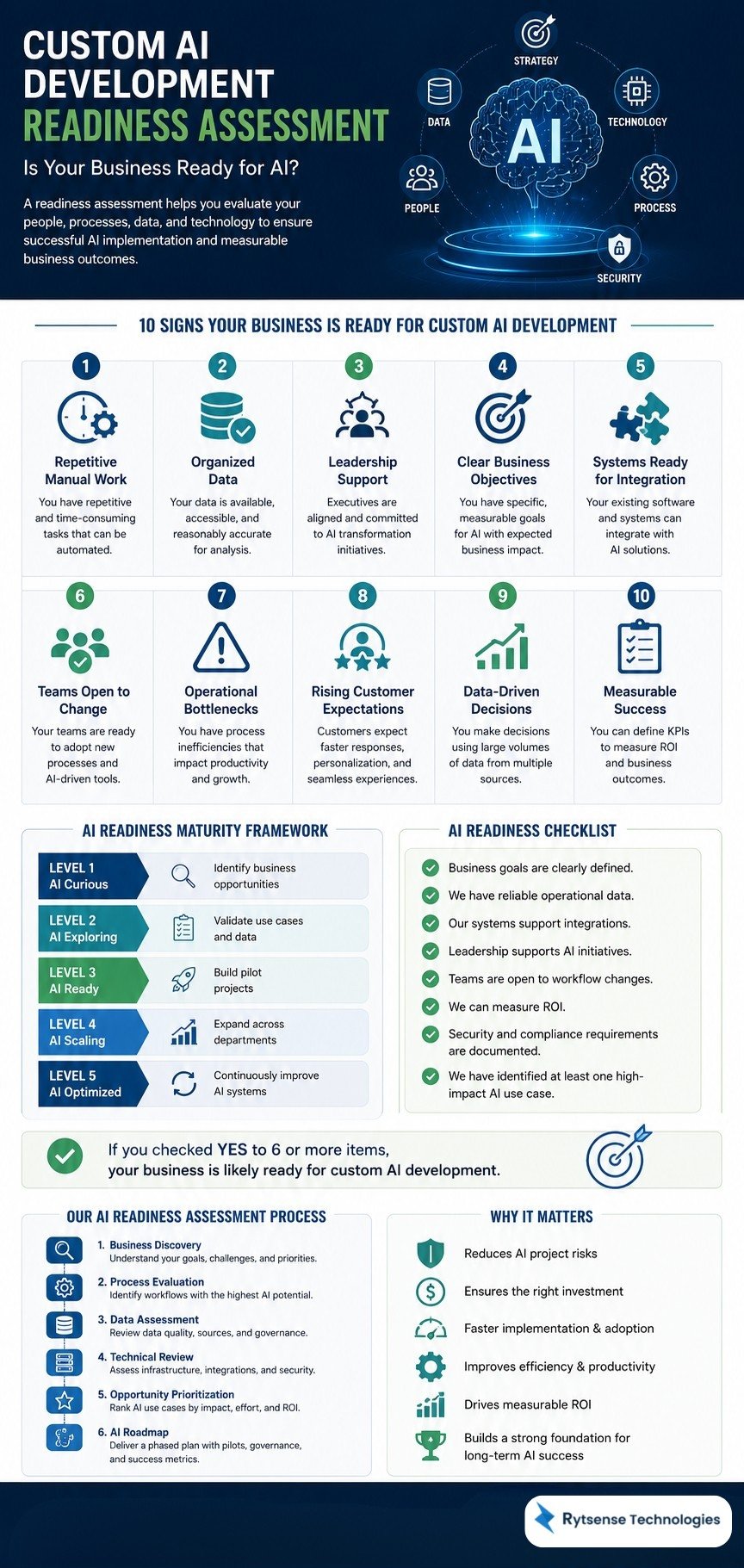
What Is a Custom AI Development Readiness Assessment?
A Custom AI Development Readiness Assessment is a structured evaluation that measures whether an organization has the technical, operational, and strategic foundation required to implement AI successfully.
Rather than focusing only on technology, it evaluates six interconnected business areas:
| Assessment Area | Purpose |
|---|---|
| Business Strategy | Defines measurable AI objectives |
| Business Processes | Identifies automation opportunities |
| Data Readiness | Evaluates data quality and availability |
| Technology Stack | Reviews infrastructure and integrations |
| People & Skills | Measures AI adoption capability |
| Governance & Security | Ensures compliance and responsible AI |
This assessment reduces project risks and provides a realistic implementation roadmap.
10 Signs Your Business Is Ready for Custom AI Development
1. Your Business Has Repetitive Manual Work
If employees spend hours performing repetitive activities such as:
- document processing
- customer support
- invoice validation
- report generation
- scheduling
- compliance reviews
AI can significantly improve productivity.
Ideal automation candidates follow predictable workflows with measurable outcomes.
2. Your Data Is Organized
AI depends on data, not assumptions.
Your organization should have:
- CRM data
- ERP records
- customer interactions
- operational data
- support tickets
- transaction history
- product information
Data does not need to be perfect, but it should be accessible and reasonably consistent.
3. Leadership Supports AI Transformation
AI initiatives require executive sponsorship.
Successful projects typically involve:
- CEO
- CTO
- CIO
- Operations leaders
- Department heads
Without leadership commitment, AI often becomes another pilot project that never scales.
4. You Have Clear Business Objectives
Instead of saying,
"We want AI."
Define outcomes such as:
- Reduce support costs by 30%
- Improve forecasting accuracy
- Automate insurance verification
- Reduce document processing time
- Increase sales conversions
- Improve patient scheduling
Specific business goals create measurable AI success.
5. Existing Software Can Integrate with AI
Modern AI works best when connected with:
- ERP
- CRM
- HRMS
- EHR
- Accounting software
- Knowledge bases
- Customer portals
- Internal APIs
Businesses with connected systems can deploy AI faster.
6. Your Teams Are Open to Process Improvement
AI succeeds when employees view it as an assistant rather than a replacement.
Organizations with strong change management typically achieve faster adoption.
7. Your Operations Have Bottlenecks
Common indicators include:
- slow approvals
- manual reviews
- increasing support requests
- document overload
- growing operational costs
- inconsistent customer responses
These often represent ideal AI opportunities.
8. Customer Expectations Are Increasing
Customers increasingly expect:
- instant responses
- personalized experiences
- self-service portals
- 24/7 availability
- faster issue resolution
Custom AI helps businesses meet these expectations while maintaining service quality.
9. Decision-Making Depends on Large Volumes of Data
Executives making decisions from multiple dashboards, spreadsheets, or reports can benefit from AI-powered analytics that surface insights faster and reduce manual analysis.
10. You Can Measure Success
AI initiatives perform best when organizations define KPIs before development.
Examples include:
- Cost reduction
- Time savings
- Revenue growth
- Customer satisfaction
- Employee productivity
- Process accuracy
- Response time
AI Readiness Assessment Framework
A practical assessment evaluates readiness across five levels.
| Level | Status | Recommendation |
|---|---|---|
| Level 1 | AI Curious | Identify business opportunities |
| Level 2 | AI Exploring | Validate use cases and data |
| Level 3 | AI Ready | Build pilot projects |
| Level 4 | AI Scaling | Expand across departments |
| Level 5 | AI Optimized | Continuously improve AI systems |
This maturity model helps prioritize investments instead of attempting organization-wide transformation at once.
Common Reasons Businesses Are Not Yet Ready
Organizations often struggle with AI implementation because of:
- disconnected business systems
- inconsistent data
- unclear AI goals
- lack of executive ownership
- unrealistic ROI expectations
- insufficient governance
- poor change management
- choosing technology before defining business outcomes
These issues can be addressed through a structured readiness assessment before development begins.
Industries That Benefit Most from AI Readiness Assessments
A readiness assessment is valuable across industries where complex workflows and large datasets exist, including:
- Healthcare – patient scheduling, medical documentation, insurance verification, clinical decision support.
- Financial Services – fraud detection, compliance automation, credit risk analysis.
- Retail & E-commerce – demand forecasting, personalized recommendations, inventory optimization.
- Manufacturing – predictive maintenance, quality inspection, production planning.
- Logistics – route optimization, shipment tracking, warehouse automation.
- SaaS & Technology – AI copilots, customer support automation, product intelligence.
How Rytsense Conducts a Custom AI Development Readiness Assessment
Unlike generic AI consulting engagements, Rytsense focuses on business outcomes before recommending technology.
Our assessment includes:
Business Discovery
Understanding business goals, operational challenges, and growth priorities.
Process Evaluation
Identifying workflows where AI can deliver measurable value.
Data Assessment
Reviewing data sources, quality, accessibility, and governance.
Technical Architecture Review
Assessing integrations, APIs, cloud infrastructure, and security.
AI Opportunity Prioritization
Ranking AI initiatives by feasibility, business impact, implementation effort, and expected ROI.
AI Roadmap
Providing a phased implementation plan that includes pilot projects, deployment strategy, governance, and success metrics.
This structured approach reduces implementation risks and improves long-term adoption.
AI Readiness Checklist
Use this quick self-assessment.
- Business goals are clearly defined.
- We have reliable operational data.
- Our systems support integrations.
- Leadership supports AI initiatives.
- Teams are open to workflow changes.
- We can measure ROI.
- Security and compliance requirements are documented.
- We have identified at least one high-impact AI use case.
If you answered Yes to six or more items, your organization is likely well-positioned to begin planning a custom AI development initiative.
Final Thoughts
AI success is determined long before the first model is trained. Organizations that evaluate their data, processes, infrastructure, and business objectives before development consistently achieve faster implementation, stronger adoption, and better returns on investment.
A Custom AI Development Readiness Assessment provides the clarity needed to prioritize the right use cases, avoid unnecessary costs, and build AI solutions that align with measurable business outcomes.
Whether you're exploring intelligent automation, AI agents, predictive analytics, or enterprise copilots, investing time in readiness assessment is often the difference between an AI pilot that stalls and a solution that delivers lasting value.
Meet the Author

Co-Founder, Rytsense Technologies
Karthik is the Co-Founder of Rytsense Technologies, where he leads cutting-edge projects at the intersection of Data Science and Generative AI. With nearly a decade of hands-on experience in data-driven innovation, he has helped businesses unlock value from complex data through advanced analytics, machine learning, and AI-powered solutions. Currently, his focus is on building next-generation Generative AI applications that are reshaping the way enterprises operate and scale. When not architecting AI systems, Karthik explores the evolving future of technology, where creativity meets intelligence.