Key Takeaways
AI tools in healthcare use machine learning, natural language processing, and computer vision to assist clinicians, streamline operations, and improve patient outcomes — often doing in seconds what used to take hours or not get done at all.
If you're a physician, that might look like a system flagging a subtle pulmonary nodule in a chest CT before you've opened the file. If you're a hospital administrator, it could mean an AI scheduling engine reducing no-shows by 30%. And if you're building a health-tech startup, it means a market projected to exceed $188 billion globally by 2030 is waiting for solutions that actually work in clinical environments. The applications span diagnostics, drug discovery, patient monitoring, administrative automation, mental health support, and precision medicine. This guide walks you through all of it — clearly and honestly, without the hype.
AI tools in healthcare are already transforming clinical and operational workflowsDiagnostic AI improves accuracy and early detectionNLP tools reduce documentation burden by up to 90 minutes/dayPredictive analytics enables proactive care instead of reactive treatmentHealthcare AI adoption is no longer optional—it's strategicRisks like bias and regulation must be actively managedStartups succeed by focusing on specific problems and workflow integration
Why Healthcare AI Is No Longer Optional
Healthcare systems across the world are under pressure that traditional approaches can no longer absorb. Physician burnout is at record highs — over 50% of U.S. clinicians report moderate to severe burnout. Diagnostic errors cost an estimated 40,000 to 80,000 lives annually in the United States alone. Global populations are aging at a pace that will overwhelm the current care delivery infrastructure. And the volume of clinical data being generated doubles roughly every 73 days.
In that context, Healthcare AI tools aren't a futuristic idea — they're an operational response to a system under serious strain. Hospitals using AI-powered workflow tools report reductions of up to 40% in administrative burden. Radiology departments using AI-assisted image analysis are detecting cancers at earlier, more treatable stages. Predictive models are identifying sepsis risk hours before clinical symptoms would otherwise trigger an alarm.
MetricData PointGlobal AI in Healthcare Market (2030)$188.9 Billion projectedReduction in Diagnostic ErrorsUp to 40% in select specialties (AI-assisted)Administrative Time Saved via AI30–50% in high-volume tasksAI-Assisted Drug Discovery TimelineFrom 12+ years to under 4 years (early-stage)Clinician Burnout Rate (US)Over 50% report moderate to severe burnout
These numbers describe a structural shift in how care is delivered, not a technology trend. Healthcare leaders who delay AI adoption aren't being cautious — they're accumulating a strategic disadvantage.
The Core Categories of AI Tools Transforming Healthcare
AI-Powered Diagnostic Tools
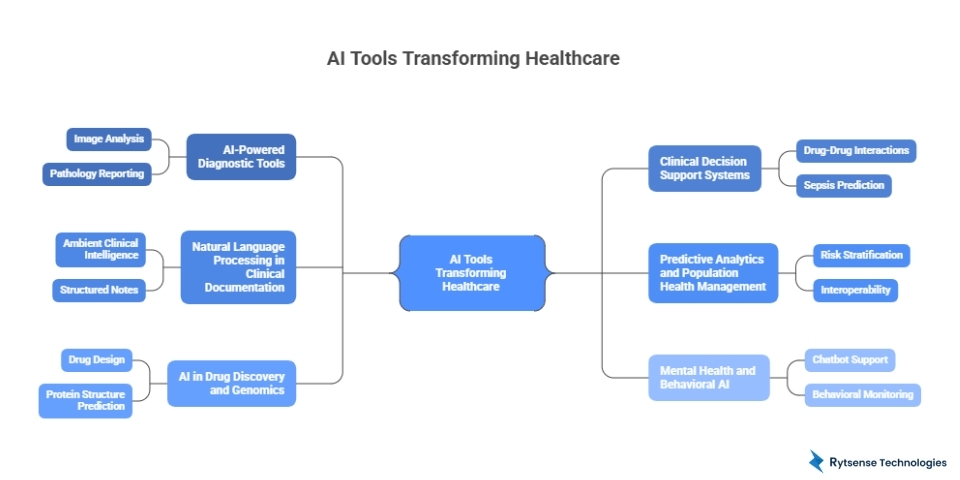
Among the most mature and rigorously validated AI applications in healthcare are diagnostic support systems. These tools analyze medical images — X-rays, CT scans, MRIs, pathology slides, retinal photographs — with a consistency that human reviewers, however skilled, cannot match at scale across a high-volume workflow.
Google's DeepMind has demonstrated that its AI system detects over 50 eye diseases from retinal scans with performance matching or exceeding specialist ophthalmologists. FDA-cleared platforms like Aidoc and Viz.ai are actively deployed across U.S. hospital networks, prioritizing radiology worklists in real time and alerting on-call specialists to time-sensitive findings — intracranial hemorrhages, pulmonary embolisms — within minutes of imaging completion.
Key technologies: Convolutional neural networks (CNNs) for image analysis, transformer models for pathology reporting, and multimodal AI that simultaneously processes images and clinical notes.
Clinical Decision Support Systems (CDSS)
Clinical decision support tools sit alongside the clinician — not replacing their judgment, but augmenting it in real time. They analyze incoming patient data and surface relevant insights: potential drug-drug interactions, evidence-based treatment protocols, early sepsis risk indicators, or alerts when a patient's vital trends suggest impending deterioration.
Epic's AI model for sepsis prediction has been deployed across hundreds of hospitals and contributes to measurable reductions in sepsis mortality by flagging at-risk patients hours before traditional indicators would prompt a clinical response.
For Healthcare Startups: CDSS is one of the most commercially viable entry points into healthcare AI. Workflow-integrated alert systems that demonstrably reduce adverse events attract hospital procurement budgets and serious venture capital. The key differentiator is clinical integration depth — tools that fit inside existing workflows win; tools that require behavioral change struggle.
Natural Language Processing in Clinical Documentation
Physicians spend nearly two hours on documentation for every one hour of direct patient care. AI tools built on natural language processing are beginning to reverse that equation. Ambient clinical intelligence platforms including Nuance DAX (now under Microsoft) and Suki listen passively to doctor-patient conversations and generate structured clinical notes automatically, without the clinician dictating or typing anything.
This isn't a transcription. The AI understands clinical context, maps spoken language to the correct diagnostic codes, and drafts documentation that typically requires only light review. For high-volume practices and hospital systems, reclaiming 60 to 90 minutes per clinician per day produces immediate, measurable ROI.
Predictive Analytics and Population Health Management
Health systems and payers are using predictive AI to identify which patients are most likely to deteriorate, be readmitted within 30 days, or develop chronic conditions before they become acute. These models ingest structured and unstructured data — lab results, imaging findings, social determinants of health, prior claims — and output risk stratification that enables proactive outreach instead of reactive intervention.
Platforms like Health Catalyst, Optum, and Arcadia are established players. But the real innovation frontier is at the intersection of AI and interoperability — systems that integrate data across disparate EHR environments to generate population-level insights that no single data source could produce alone.
AI in Drug Discovery and Genomics
Traditional drug discovery takes 12 to 15 years and costs over $2.5 billion per approved compound. AI is materially compressing that. Insilico Medicine has used generative AI to design novel drug candidates and advance them into clinical trials in under 18 months. DeepMind's AlphaFold predicted the 3D structure of virtually every known protein — a breakthrough that is now enabling researchers to identify therapeutic targets for diseases that previously had none.
In genomics, AI is making personalized medicine scalable — analyzing genetic variants, predicting disease susceptibility, and matching patients to clinical trials with precision that manual curation cannot achieve at population scale.
Start your AI transformation todayContact Us
Mental Health and Behavioral AI
One of the fastest-growing and least discussed categories. Mental health AI tools include chatbot-based therapeutic support (Woebot, Wysa), AI-powered detection of suicidal ideation risk in clinical documentation, and platforms that monitor behavioral signals in patients with serious mental illness via passive smartphone sensor data between clinical appointments.
These tools don't replace therapists. They extend care between sessions, surface early warning signals, and bring some form of support to populations who can't access traditional mental health services — a meaningful intervention in a global mental health crisis that the current workforce cannot address alone.
Real Use Cases Across the Care Continuum
Care SettingAI Application in PracticeEmergency MedicineAI triage prioritizes high-acuity patients; stroke detection AI alerts neurology within 6 minutes of imagingRadiologyAI pre-screens studies, reduces workload 30–40%, decreases missed findings in high-volume readsPrimary CareChronic disease management support, remote patient monitoring, preventive care gap identificationOncologyAI pathology for tumor classification, treatment response prediction, clinical trial matchingMental HealthBehavioral monitoring, session note automation, digital therapeutics, crisis risk predictionRevenue CyclePrior authorization automation, claims scrubbing, denial prediction, coding audit assistance
Benefits, Risks, and What the Evidence Says
What the Evidence Supports
- Faster, more accurate diagnosis in radiology, pathology, and ophthalmology with multiple peer-reviewed trials demonstrating non-inferiority or superiority to unassisted specialist review.
- Meaningful reductions in preventable adverse events when clinical decision support is thoughtfully integrated into existing clinical workflows.
- Significant documentation time savings validated in real-world deployments of ambient clinical intelligence platforms across primary care, hospital medicine, and specialty settings.
- Improved medication adherence and patient engagement through AI-driven patient communication and care coordination tools.
Where Caution Is Warranted
The case for AI tools in healthcare is strong but the risks are real and deserve honest treatment. Algorithm bias is among the most serious concerns. A landmark 2019 study published in Science demonstrated that a widely deployed commercial risk algorithm systematically underestimated the health needs of Black patients, effectively allocating less care to a group with higher objective need.
AI systems trained on datasets that underrepresent certain populations will produce outputs that reflect those gaps. For any organization deploying healthcare AI, bias auditing — before and after deployment — is not optional. It's a patient safety obligation.
Regulatory clarity is also still evolving. The FDA has cleared over 500 AI/ML-based medical devices, but frameworks for continuously learning systems — tools that update their models on new data post-deployment — are still being developed.
Key Evaluation Criteria for AI Healthcare Tools: Training data diversity and representativeness | Model explainability vs. black-box outputs | EHR integration depth and workflow fit | FDA/CE clearance status and regulatory pathway | Peer-reviewed clinical evidence base | Vendor transparency on model updates and monitoring
How Startups and Businesses Are Entering the Space
For entrepreneurs and investors, the healthcare AI market is simultaneously one of the largest opportunities in enterprise software and one of the most complex to navigate successfully. The companies gaining traction share a recognizable profile:
- They solve a specific, validated pain point — not a general-purpose AI platform in search of a healthcare application.
- They integrate deeply with existing clinical workflows rather than requiring behavioral change from time-constrained clinicians.
- They build regulatory strategy into the product roadmap from the earliest stages, not after a product is built.
- They secure clinical partnerships early enough to generate real-world evidence that differentiates them from competitors.
- They capitalize adequately for long procurement cycles — healthcare sales timelines are measured in quarters to years, not weeks.
The most active areas for new market entrants in 2026 are ambient clinical documentation, AI-powered revenue cycle management, care coordination for high-complexity patients, and mental health support platforms. Each has demonstrated a clear willingness-to-pay from health system buyers — the ultimate validation signal in a market that is otherwise notoriously skeptical of technology promises.
For Investors Evaluating Healthcare AIThe market is bifurcating between infrastructure plays (AI platforms, data interoperability tools, clinical foundation models) and point solutions (condition-specific diagnostic tools, specialty workflow automation). Both have strong exit pathways — M&A interest from Epic, Microsoft, Google, and Oracle is active — but they require fundamentally different go-to-market strategies and capital structures.
Choosing the Right AI Healthcare Tool for Your Needs
For Clinicians and Clinical Administrators
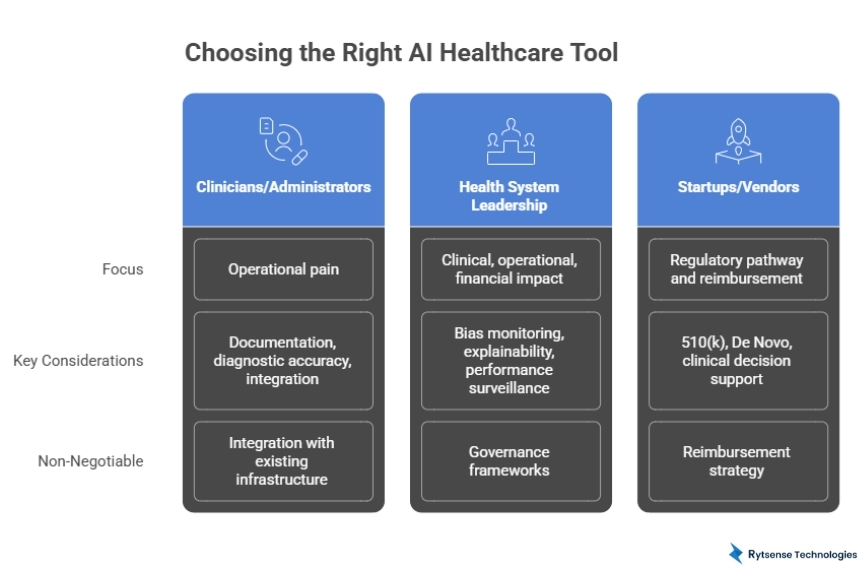
Start with the most acute operational pain. If documentation time is the primary problem, evaluate ambient clinical intelligence tools with published accuracy data and compatibility with your EHR. If diagnostic throughput or accuracy is the issue, assess AI radiology or pathology platforms with FDA clearance and peer-reviewed clinical validation. Integration with your existing infrastructure is non-negotiable — a tool that requires a separate login or parallel workflow will not achieve adoption.
For Health System Leadership
Evaluate AI investments across three dimensions simultaneously: clinical impact (does it improve measurable patient outcomes?), operational impact (does it reduce cost, waste, or clinician burden?), and financial return (what is the realistic ROI timeline and how is it measured?). Governance frameworks covering bias monitoring, explainability standards, override protocols, and ongoing performance surveillance should be defined and contractually committed before any deployment, not developed reactively afterward.
For Healthcare Startups and Technology Vendors
Know your regulatory pathway before you finalize your product architecture. The difference between a 510(k) clearance, a De Novo classification, and qualifying for the clinical decision support exemption under the 21st Century Cures Act will shape your product, your timeline, and your commercialization strategy in fundamental ways. Reimbursement strategy matters equally — a tool with proven clinical value but no billing pathway will consistently struggle to achieve the scale that justifies its development cost.
The Road Ahead: What's Next for AI in Healthcare
The next phase of AI tools in healthcare will be shaped by several converging developments, each of which has implications for clinicians, administrators, builders, and investors.
- Clinical foundation models — systems like Med-PaLM 2 from Google and clinical variants of large language models fine-tuned on medical literature and patient records will become the backbone of general-purpose clinical AI, capable of reasoning across specialties without the narrow scope of current point solutions.
- Multimodal AI — systems that simultaneously process imaging, genomics, clinical notes, wearable sensor data, and social determinants will enable a holistic view of patient health that no single-modality tool can approximate.
- Federated learning will allow AI models to train across multiple healthcare institutions without raw patient data ever leaving institutional walls, addressing the privacy and data governance barriers that have slowed collaborative model development.
- AI-native care delivery models — virtual-first practices where AI handles intake, triage, documentation, and care gap identification will begin to challenge traditional care structures in markets with significant access inequities.
- Regulatory maturation: Both the FDA and the EU AI Act are developing AI-specific frameworks that will define what compliance looks like for continuously learning medical AI systems — creating new obligations and, for compliant companies, competitive moats.
The healthcare system won't look unrecognizable in a decade. But the decision layer, the diagnostic layer, and the administrative layer will be fundamentally transformed by AI tools in healthcare. The tools exist today. The question is how thoughtfully and how responsibly, they're deployed.
Final Thoughts: AI Tools in Healthcare Are Here, The Question Is How You Use Them
Whether you're reading this as a clinician navigating a changing field, an administrator weighing technology investments, a founder building the next generation of health-tech, or an investor mapping where real value is being created, the through-line is the same.
AI tools in healthcare are no longer experimental. They're operating in radiology suites, emergency departments, mental health practices, pharmacy systems, and revenue cycle departments right now. Some are delivering measurable, peer-reviewed outcomes. Some are not. The difference almost always lies in implementation quality, clinical integration depth, regulatory rigor, and organizational readiness to use these tools responsibly.
The best AI in healthcare doesn't disrupt care — it improves it. It gives clinicians more time with patients, catches what human review misses at scale, and extends the reach of health systems into communities that need them most. That's a future worth building toward — carefully, with evidence, and with the patient at the center.
Ready to Bring AI Into Your Healthcare Workflow?Whether you're a clinician exploring AI-assisted diagnostics, a startup building the next healthcare platform, or a health system evaluating intelligent automation — the right AI tools in healthcare can transform your outcomes.Book a Free Consultation
Meet the Author

Co-Founder, Rytsense Technologies
Karthik is the Co-Founder of Rytsense Technologies, where he leads cutting-edge projects at the intersection of Data Science and Generative AI. With nearly a decade of hands-on experience in data-driven innovation, he has helped businesses unlock value from complex data through advanced analytics, machine learning, and AI-powered solutions. Currently, his focus is on building next-generation Generative AI applications that are reshaping the way enterprises operate and scale. When not architecting AI systems, Karthik explores the evolving future of technology, where creativity meets intelligence.