Key Takeaways
AI is reshaping every dimension of retail — from how customers discover and purchase products to how retailers manage inventory, price dynamically, and prevent loss. But innovation at speed in retail also intersects with a growing body of compliance requirements that retailers must navigate carefully.
AI in retail drives measurable gains in personalization, forecasting, and operational efficiencyComputer vision is transforming loss prevention and frictionless checkoutGenerative AI is accelerating product content creation, customer service, and merchandisingCompliance requirements around data privacy, algorithmic pricing, and biometrics are evolving rapidlyRetailers must build compliance into AI systems from design — not as an afterthoughtResponsible AI adoption builds customer trust and reduces regulatory and reputational risk
The AI Retail Landscape in 2026
Retail was among the first consumer industries to adopt AI at scale — recommendation engines, demand forecasting, and dynamic pricing have been deployed by major retailers for over a decade. What's changed is the breadth and depth of AI penetration across the retail value chain.
Today's AI retail applications span customer acquisition, in-store experience, supply chain, workforce management, and financial operations. Generative AI has opened new frontiers in product content, customer interaction, and visual merchandising that were not commercially viable two years ago.
AI ApplicationRetail FunctionBusiness ImpactPersonalization enginesE-commerce, loyalty15–30% lift in conversionDemand forecastingInventory, supply chain20–40% reduction in stockoutsComputer visionLoss prevention, checkout30–60% shrink reductionDynamic pricingPricing, promotions3–8% margin improvementAI customer serviceSupport, returns40–60% query deflection
Key Innovation Areas in AI Retail
Hyper-Personalization
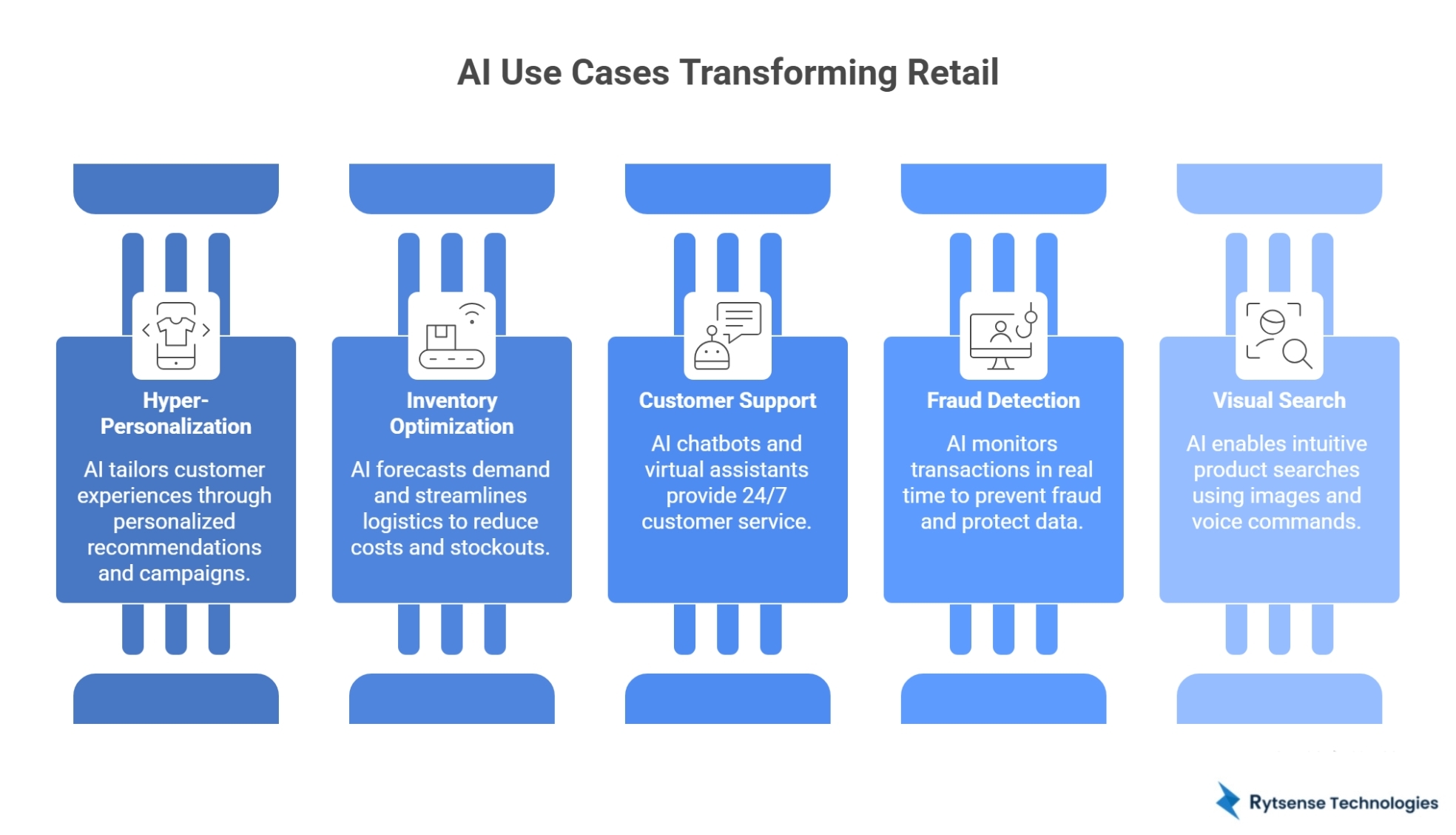
Modern retail personalization goes far beyond "customers who bought X also bought Y." AI systems now integrate purchase history, browsing behavior, real-time context (time, location, weather), loyalty tier, and even social signals to deliver individualized product, content, and offer experiences at every touchpoint.
Retailers using advanced personalization report 15–30% improvements in conversion rates and meaningful improvements in average order value and repeat purchase rates.
Example: Stitch Fix's AI-powered styling algorithm integrates over 100 client attributes and stylist feedback loops to deliver personalized clothing selections — a model that has driven over $2 billion in annual revenue.
Computer Vision for Loss Prevention and Checkout
Computer vision is transforming physical retail in two significant ways. First, AI-powered loss prevention systems monitor store environments in real time to detect theft, shrink, and suspicious behavior — without the cost and limitations of traditional security. Second, autonomous checkout systems like Amazon Just Walk Out use computer vision and sensor fusion to eliminate checkout friction entirely.
For large format retailers, computer vision also enables shelf monitoring — automatically detecting out-of-stock conditions, planogram compliance violations, and pricing errors across thousands of SKUs without manual audits.
Generative AI for Product Content and Merchandising
Generative AI is dramatically accelerating retail content operations. Product descriptions, lifestyle imagery, marketing copy, and localized content that previously required weeks of manual effort can now be produced in hours at a fraction of the cost.
- AI-generated product descriptions scaled across hundreds of thousands of SKUs
- Virtual try-on experiences using generative image models
- Automated styling and outfit recommendation content
- Dynamic banner and promotional content personalized by customer segment
AI-Powered Demand Forecasting and Supply Chain
Demand forecasting is one of the highest-ROI AI applications in retail. Models that integrate historical sales data, seasonal patterns, promotional calendars, external signals (weather, economic indicators, social trends), and real-time sell-through rates dramatically outperform traditional statistical forecasting.
Retailers using AI forecasting report significant reductions in stockouts, markdowns, and excess inventory — addressing the supply-demand mismatch that is one of the most expensive problems in retail operations.
Conversational AI for Shopping and Customer Service
AI shopping assistants — deployed through web, mobile, and messaging channels — are becoming capable of handling complex customer interactions: product search by description, style consultation, order tracking, returns processing, and personalized recommendations through natural conversation.
Retailers deploying conversational AI customer service report deflection rates of 40–60% for routine queries, significant reductions in average handle time for escalated cases, and measurable improvements in customer satisfaction scores.
The Compliance Landscape for AI in Retail
AI innovation in retail does not happen in a regulatory vacuum. Retailers face a growing and evolving set of compliance requirements that intersect directly with their AI strategies — particularly around data privacy, algorithmic decision-making, biometric data, and pricing practices.
Data Privacy and Consumer Rights
Personalization and AI-driven customer experiences depend on collecting and processing extensive customer data. This brings retailers into direct contact with privacy frameworks including:
- CCPA/CPRA (California): Consumers have the right to know, delete, and opt out of the sale of their personal data
- State privacy laws: Virginia, Colorado, Connecticut, Texas, and a growing number of states have enacted comprehensive privacy legislation
- CAN-SPAM and TCPA: Govern AI-driven email and SMS marketing communications
Retailers must ensure their AI personalization systems respect opt-out signals, honor data deletion requests, and provide transparency to consumers about how their data is used.
Biometric Data Regulations
Computer vision applications that use facial recognition, gait analysis, or other biometric identifiers face strict regulation in several US jurisdictions. Illinois BIPA (Biometric Information Privacy Act) requires informed written consent before collecting biometric data and imposes significant statutory damages for violations — creating meaningful liability for retailers using facial recognition for loss prevention or customer identification.
Several cities and states have enacted or are considering outright bans on facial recognition in retail settings. Retailers deploying computer vision must map their data collection carefully against applicable biometric laws before deployment.
Algorithmic Pricing and Antitrust
Dynamic pricing AI has attracted increasing regulatory scrutiny. The FTC has investigated algorithmic pricing coordination, particularly in sectors where multiple competitors use the same pricing software and models. Retailers using AI pricing systems need to ensure their models are not facilitating tacit collusion — even unintentionally through shared third-party pricing tools.
Price discrimination algorithms that charge different prices to different customer segments based on demographic proxies also face scrutiny under consumer protection frameworks.
Emerging AI-Specific Regulation
The EU AI Act, which is now in force, classifies certain retail AI applications — including AI systems that evaluate customer creditworthiness, target consumers through subliminal techniques, and exploit behavioral patterns — in high-risk or prohibited categories. US retailers with EU operations must comply, and US regulators are developing parallel frameworks.
Proactive retailers are building AI governance frameworks now — before mandatory requirements arrive — to reduce remediation costs and demonstrate responsible AI commitment to increasingly AI-aware consumers.
Building Compliance Into AI from the Start
Compliance should not be a legal review step at the end of AI development — it should be embedded in the design process from the beginning. Retailers that treat compliance as a design constraint rather than a post-hoc filter build better systems faster and avoid expensive remediation.
Data MinimizationCollect only the data your AI models genuinely need. Excess data collection creates privacy liability without proportionate value.Consent and TransparencyBe explicit with customers about how AI uses their data. Clear, accessible explanations build trust and reduce regulatory exposure simultaneously.Bias AuditingRegularly audit AI models — particularly personalization, pricing, and customer service systems — for disparate impact across protected demographic groups.Human Override CapabilityEnsure human review is available for AI decisions that significantly affect customers — pricing disputes, loyalty program decisions, and service resolutions.Vendor Due DiligenceWhen using third-party AI platforms, review their data handling practices, security certifications, and contractual commitments around data use carefully.
Implementation Roadmap for Retail Organizations
Step 1: Identify High-Impact AI OpportunitiesPrioritize AI initiatives where data is available, the problem is well-defined, and ROI can be measured. Inventory management and customer service automation are common starting points in retail.
Conclusion
AI in retail presents genuine, measurable opportunities across every function of the business — from customer acquisition and conversion to supply chain efficiency and loss prevention. The retailers who invest thoughtfully in AI capabilities today are building competitive advantages that will be difficult for slower-moving competitors to close.
But retail AI innovation and compliance are not in opposition — they are interdependent. AI systems that respect customer privacy, operate transparently, and handle data responsibly consistently outperform those that don't, because they build the trust that is the foundation of long-term customer relationships.
The retailers who win with AI will be those who move fast, innovate continuously, and do so with the customer's trust as a design principle — not an afterthought.
Meet the Author

Co-Founder, Rytsense Technologies
Karthik is the Co-Founder of Rytsense Technologies, where he leads cutting-edge projects at the intersection of Data Science and Generative AI. With nearly a decade of hands-on experience in data-driven innovation, he has helped businesses unlock value from complex data through advanced analytics, machine learning, and AI-powered solutions. Currently, his focus is on building next-generation Generative AI applications that are reshaping the way enterprises operate and scale. When not architecting AI systems, Karthik explores the evolving future of technology, where creativity meets intelligence.