Key Takeaways
Artificial intelligence is fundamentally reshaping the financial services industry — from how banks detect fraud to how investors manage portfolios and how lenders approve loans in seconds.
AI in finance spans fraud detection, credit scoring, algorithmic trading, and customer serviceMachine learning enables real-time risk assessment and faster loan approvalsRobo-advisors and AI-driven analytics are democratizing investment managementCompliance automation reduces regulatory risk and cost across banking and fintechGenerative AI is accelerating document processing, reporting, and customer interactionsEmerging trends include explainable AI, federated learning, and AI-native banking
What AI Means in Finance
Artificial intelligence in finance refers to the use of machine learning, natural language processing, predictive analytics, and data-driven models to automate and enhance financial services.
Why AI Is Transforming Finance
The financial services sector generates enormous volumes of data every second — transactions, market signals, customer interactions, regulatory filings. Traditional software cannot process this data at the speed or depth that modern finance requires. AI changes the equation entirely.
Banks, insurers, investment firms, and fintech startups are all racing to embed AI into their core operations. The drivers are clear: operational efficiency, reduced risk, better customer experiences, and competitive differentiation.
MetricImpactGlobal AI in Finance Market (2030)$61.3 Billion projectedFraud Detection AccuracyUp to 95% with ML modelsLoan Processing TimeReduced from days to minutesCost Reduction via Automation20–30% in back-office operationsCustomer Retention Improvement15–25% with personalized AI
These numbers reflect not just technological progress but a fundamental shift in how financial value is created and delivered.
Key Use Cases of AI in Finance
AI applications in finance span every major function — from customer-facing services to back-office operations and regulatory compliance.
1. Faud Detection & Prevention
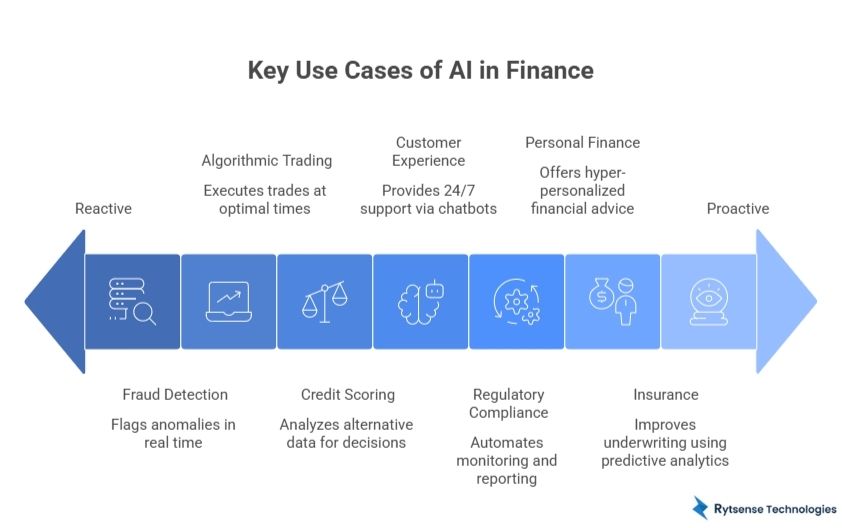
Fraud detection is one of the most mature and widely deployed AI applications in finance. Machine learning models analyze thousands of transaction attributes in real time to identify anomalies that indicate fraudulent activity — without blocking legitimate transactions.
- Behavioral biometrics detect account takeover attempts
- Graph neural networks identify money laundering networks
- Adaptive models reduce false positives while catching new fraud patterns
Example: Mastercard's AI fraud detection system processes 75 billion transactions annually, reducing fraud losses by over 50%.
2. Credit Scoring and Loan Underwriting
Traditional credit scoring relies on a narrow set of variables. AI models incorporate alternative data — utility payments, rent history, social signals, cash flow patterns — to assess creditworthiness more accurately and fairly.
- Expands financial access to underbanked populations
- Reduces default rates through more accurate risk prediction
- Accelerates approval decisions from days to seconds
Example: Upstart, an AI-powered lending platform, approves 44% more applicants than traditional models while maintaining equivalent default rates.
3. Algorithmic and Quantitative Trading
AI has transformed trading by enabling strategies that operate at machine speed across multiple markets simultaneously. Hedge funds and proprietary trading firms use reinforcement learning and deep learning to identify patterns invisible to human traders.
- High-frequency trading executes thousands of orders per second
- Sentiment analysis mines news and social media for market signals
- Portfolio optimization balances risk and return in real time
4. Robo-Advisors and Wealth Management
Robo-advisors democratize access to investment management by delivering algorithm-driven portfolio construction and rebalancing at a fraction of traditional advisory costs. Platforms like Betterment and Wealthfront manage billions in assets through automated, tax-optimized strategies.
- Goal-based investing aligned with individual risk profiles
- Automatic tax-loss harvesting maximizes after-tax returns
- Accessible entry points for retail investors
5. Regulatory Compliance and Risk Management
Compliance is one of the most expensive functions in financial services. AI automates KYC (Know Your Customer), AML (Anti-Money Laundering) screening, regulatory reporting, and audit trail management — reducing cost while improving accuracy.
- NLP extracts structured data from regulatory filings automatically
- AI screens transactions against sanctions lists in milliseconds
- Predictive models flag compliance risks before they escalate
6. Customer Experience & AI Chatbots
AI-powered virtual assistants and AI Chatbots handle millions of customer interactions — answering queries, processing requests, and providing personalized financial guidance at scale. Banks using AI customer service report significant reductions in contact center volume and measurable improvements in customer satisfaction.
- Conversational AI resolves 60–80% of queries without human escalation
- Personalized product recommendations increase cross-sell conversion
- Proactive alerts improve financial wellness for retail customers
Key Benefits of AI in Financial Services
Speed and EfficiencyAI processes transactions, applications, and queries in milliseconds — eliminating bottlenecks that previously took hours or days.Accuracy and Risk ReductionData-driven models outperform rule-based systems in detecting fraud, assessing credit risk, and identifying compliance violations.Cost OptimizationAutomation reduces headcount in repetitive functions while improving output quality, delivering measurable ROI within 12–18 months for most deployments.Personalization at ScaleAI enables financial institutions to deliver tailored products, advice, and communications to millions of customers simultaneously.Competitive DifferentiationEarly AI adopters are building capabilities that are difficult for competitors to replicate, creating sustainable moats in product quality and operational efficiency.
Emerging Trends Shaping AI in Finance
Generative AI for Document ProcessingLarge language models are automating contract review, financial report generation, and regulatory filing — tasks that previously required extensive analyst time.Explainable AI (XAI)Regulators and customers increasingly demand transparency in AI decisions. Explainable AI frameworks allow financial institutions to justify credit denials, flag suspicious transactions, and document model behavior for auditors.Federated Learning for Privacy-Preserving CollaborationBanks can now collaborate on fraud detection models without sharing raw customer data — training on distributed datasets while keeping sensitive information on-premise.Autonomous FinanceAI is evolving from decision support to decision execution. AI agents can automatically manage savings, investments, and bill payments while continuously optimizing portfolios based on market conditions.Multimodal AI for Financial AdvisorySystems that process voice, text, and structured data simultaneously are enabling more natural and comprehensive financial advisory experiences across digital and branch channels.
Challenges and Considerations
Model Bias and FairnessCredit models trained on historical data can perpetuate systemic biases. Financial institutions must rigorously audit models for disparate impact across protected classes.Regulatory UncertaintyAI-specific financial regulations are still evolving across the US, EU, and UK. Compliance strategies must account for changing rules around model explainability, data use, and algorithmic decision-making.Data Quality and IntegrationLegacy systems often contain siloed, inconsistent data. AI performance is directly proportional to data quality — infrastructure investment is a prerequisite for effective AI deployment.Data Privacy ConcernsAI systems that access sensitive financial data create new attack surfaces. Adversarial attacks can manipulate model outputs — making security-by-design non-negotiable.
Implementation Roadmap for Financial Organizations
Step 1: Identify High-Value Use CasesPrioritize AI initiatives where data is available, the problem is well-defined, and ROI can be measured. Fraud detection and customer service automation are common starting points.Step 2: Assess Data ReadinessAudit data quality, completeness, and accessibility. Invest in data pipelines and governance frameworks before model development begins.Step 3: Choose the Right AI TechnologiesSelecting the right technologies is critical to solving specific financial problems.Use machine learning for pattern detection and predictionsApply natural language processing (NLP) for chatbots and document analysisLeverage predictive analytics for forecasting and risk managementStep 4: Pilot, Measure, and ScaleRun controlled pilots with clear success metrics. Use results to build internal confidence and secure funding for broader rollout.Step 5: Govern and Monitor ContinuouslyEstablish model governance frameworks covering bias monitoring, performance tracking, and explainability requirements. AI systems require ongoing oversight — not just one-time deployment.
Conclusion
AI in finance is no longer an emerging technology — it is the competitive baseline. Institutions that have invested early in AI capabilities are seeing measurable advantages in fraud reduction, operational efficiency, customer retention, and risk management.
For financial organizations at any stage of AI adoption, the priority is the same: identify where AI delivers the most value for your specific context, build the data foundation to support it, and implement with rigorous governance from the start.
The future of finance is intelligent, adaptive, and data-driven. The institutions that thrive will be those that embrace AI not as a technology project but as a strategic transformation.
Meet the Author

Co-Founder, Rytsense Technologies
Karthik is the Co-Founder of Rytsense Technologies, where he leads cutting-edge projects at the intersection of Data Science and Generative AI. With nearly a decade of hands-on experience in data-driven innovation, he has helped businesses unlock value from complex data through advanced analytics, machine learning, and AI-powered solutions. Currently, his focus is on building next-generation Generative AI applications that are reshaping the way enterprises operate and scale. When not architecting AI systems, Karthik explores the evolving future of technology, where creativity meets intelligence.