AI Agents in Finance: Transforming Decision-Making, Automation, and Growth
Artificial intelligence agents in finance are intelligent systems that can autonomously analyze data, make decisions, execute tasks, and continuously improve outcomes, without constant human intervention. From fraud detection to portfolio optimization and customer service, AI agents are reshaping how financial institutions operate, compete, and scale.
This shift is not just about automation; it’s about building smarter, faster, and more adaptive financial systems that can respond in real time to market changes and customer needs.
Key Takeaways
AI agents automate and optimize financial decisionsEnable real-time fraud detection and insightsImprove efficiency and reduce operational costsPower personalized financial experiencesRequire strong data, security, and complianceContinuously learn and improve over time
What Are AI Agents in Finance?
AI agents in finance are software-driven entities powered by machine learning, natural language processing, and data analytics. Unlike traditional automation tools, these agents can:
- Understand context
- Make decisions based on real-time data
- Learn from past outcomes
- Execute actions autonomously
They operate across systems such as trading platforms, banking apps, risk engines, and customer support channels, enabling financial organizations to move from reactive to proactive operations. For specialized implementation, custom AI agent development is often required.
How AI Agents Work in Financial Systems
AI agents in finance operate as intelligent, self-improving systems that combine multiple technologies to analyze data, make decisions, and take action in real time. What makes them powerful is not just automation—but their ability to continuously learn, adapt, and optimize outcomes across dynamic financial environments.
Let’s break this down in a deeper, more practical way.
Core Technologies Behind AI Agents
AI agents are built on a layered architecture where each component plays a specific role in decision-making.
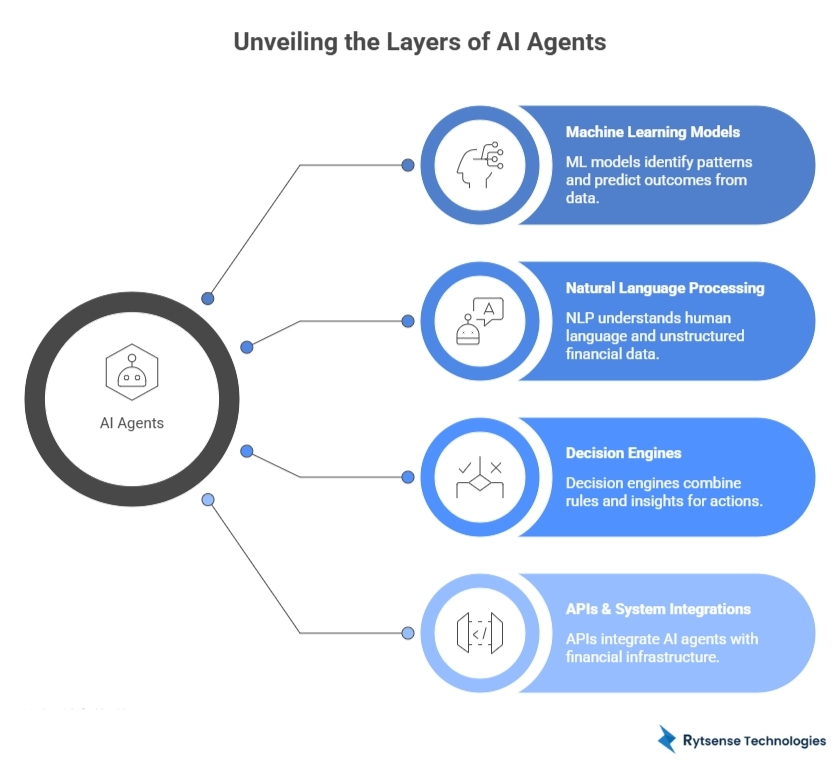
1. Machine Learning Models (The Brain)
Machine learning models are responsible for identifying patterns and generating predictions from financial data. They work with:
- Historical transaction data
- Market price movements
- Customer behavior patterns
- Credit histories
How they function:
- Detect trends (e.g., spending habits, market volatility)
- Predict outcomes (e.g., credit risk, stock movement)
- Continuously improve through training and feedback loops
Example: A credit risk model can analyze thousands of variables (income, spending, repayment history) to predict whether a borrower is likely to default.
2. Natural Language Processing (The Interpreter)
Financial data is not always structured. AI agents use NLP to understand human language and unstructured data sources such as:
- Customer queries (chat, email, voice)
- Financial news and reports
- Regulatory documents
- Social media sentiment
What NLP enables:
- Conversational AI (chatbots, assistants)
- Sentiment analysis for market predictions
- Automated document processing
Example: An AI agent scans global news and detects negative sentiment around a company, triggering a portfolio adjustment.
3. Decision Engines (The Decision Maker)
Decision engines combine business rules, predictive insights, and risk thresholds. They determine what action should be taken based on available data.
Capabilities include:
- Rule-based logic (e.g., flag transactions above a limit)
- AI-driven decisioning (e.g., approve/reject loans dynamically)
- Scenario analysis (best vs worst-case outcomes)
Example: If a transaction deviates from normal behavior and matches fraud patterns, the system instantly blocks it.
4. APIs & System Integrations (The Connector)
AI agents don't work in isolation; they integrate with existing financial infrastructure, such as:
- Core banking systems
- Payment gateways
- CRM platforms
- Trading systems
- Risk management tools
Why this matters:
- Enables real-time execution
- Ensures seamless data flow
- Supports end-to-end automation
Example: Once a loan is approved by the AI agent, it can automatically trigger disbursement through a banking API.
Step-by-Step Workflow of AI Agents in Finance
AI agents follow a continuous operational loop. Each step builds on the previous one, creating a system that improves over time.
1. Data Collection (Input Layer)
The process starts with gathering data from multiple sources:
- Transaction records
- Market feeds (stocks, forex, crypto)
- Customer profiles
- External data (news, economic indicators)
Example: A fraud detection system collects live transaction data from millions of users globally.
2. Data Processing & Pattern Analysis
Once collected, the data is cleaned, structured, and analyzed. AI models:
- Identify normal vs abnormal behavior
- Detect correlations
- Segment users based on behavior
Example: A customer typically spends $200–$500 locally but suddenly initiates a $10,000 international transaction.
3. Prediction & Decision-Making
AI agents predict possible outcomes, evaluate risk levels, and select the best action. Types of decisions:
- Approve / Reject
- Flag / Ignore
- Buy / Sell
- Recommend / Alert
Example: An investment AI predicts a stock downturn and recommends selling before losses occur.
4. Action Execution (Autonomous Response)
Unlike traditional systems, AI agents don't just suggest—they act. Actions may include:
- Blocking fraudulent transactions
- Executing trades
- Sending alerts
- Approving loans
- Rebalancing portfolios
Example: In algorithmic trading, AI agents execute thousands of trades in milliseconds based on market signals.
5. Feedback Loop & Continuous Learning
After every action, the system evaluates outcomes, learns from success or failure, and updates models accordingly. Learning methods:
- Supervised learning (using labeled data)
- Reinforcement learning (reward-based optimization)
- Online learning (real-time updates)
Example: If a flagged transaction turns out to be legitimate, the system adjusts its fraud detection thresholds.
Real-Life End-to-End Example: AI Agent in Fraud Detection
- Data Input: A user makes a transaction in a foreign country
- Analysis: The system compares it with past behavior
- Prediction: High probability of fraud detected
- Decision: Transaction flagged
- Action: Payment blocked + user notified
- Learning: If the user confirms it's valid, the model updates future behavior
Key Types of AI Agents in Finance
1. Autonomous Trading AgentsThese agents analyze market data, predict price movements, and execute trades at high speed.Algorithmic tradingPortfolio optimizationRisk-adjusted decision-making2. Fraud Detection AgentsThey monitor transactions in real time and identify suspicious patterns.Detect anomalies instantlyReduce financial lossesImprove compliance3. Customer Support AI AgentsAI-powered chatbots and assistants handle customer queries efficiently.24/7 supportPersonalized responsesReduced operational costs4. Credit Scoring & Risk Assessment AgentsThese agents evaluate borrower profiles using alternative data sources.Faster loan approvalsMore accurate risk predictionsReduced default rates5. Financial Advisory Agents (Robo-Advisors)They provide investment recommendations based on user goals and risk tolerance.Automated wealth managementPersonalized portfoliosContinuous optimization
Real-World Use Cases Across Financial Services
1. BankingAutomated loan approvalsIntelligent fraud detectionAI-driven customer service2. InsuranceClaims processing automationRisk profilingPolicy recommendations3. Investment FirmsAlgorithmic tradingPortfolio rebalancingMarket sentiment analysis4. Fintech StartupsAI-powered budgeting toolsSmart payment systemsDigital financial assistants5. Compliance & Regulatory MonitoringAutomated reportingReal-time compliance checksRisk alerts
Benefits of AI Agents for Financial Organizations
Faster Decision-MakingAI agents process massive datasets instantly, enabling real-time decisions.Cost EfficiencyAutomation reduces manual effort and operational expenses.Improved AccuracyData-driven insights minimize human errors.Enhanced Customer ExperiencePersonalized services increase satisfaction and retention.ScalabilityAI systems can handle increasing workloads without additional resources.
Challenges and Considerations
Data Privacy & SecurityHandling sensitive financial data requires strict compliance and security measures.Model Bias & AccuracyPoor data quality can lead to biased or inaccurate decisions.Integration ComplexityConnecting AI agents with legacy systems can be challenging.Regulatory ComplianceFinancial institutions must ensure AI systems meet industry regulations.Lack of ExplainabilitySome AI decisions may be difficult to interpret, especially in high-stakes environments.
AI Agents vs Traditional Automation
AspectTraditional AutomationAI AgentsDecision MakingRule-basedData-driven & adaptiveLearning AbilityNoneContinuous learningFlexibilityLimitedHighly flexibleUse CasesRepetitive tasksComplex decision-makingEfficiencyModerateHigh
AI agents go beyond automation — they introduce intelligence and adaptability into financial operations.
How to Implement AI Agents in Finance
Implementing agents isn't just about adopting new technology; it's about aligning intelligence with business goals, regulatory requirements, and operational workflows.
1. Identify High-Impact Use Cases
Start where AI can deliver immediate, measurable value. Focus on specific problems that are data-rich, repetitive or time-consuming, and critical to business performance.
Common starting points:
- Fraud detection and transaction monitoring
- Customer support automation
- Credit scoring and loan approvals
- Algorithmic trading or portfolio optimization
Best practice: Prioritize use cases with clear KPIs like reduced fraud loss, faster approval times, or improved customer satisfaction.
2. Build a Strong Data Foundation
AI agents are only as good as the data they learn from. Key steps:
- Consolidate data from multiple sources (transactions, CRM, market feeds)
- Clean and standardize datasets
- Ensure real-time or near real-time data availability
- Establish data governance policies
Tip: Invest in data pipelines and infrastructure before scaling AI initiatives.
3. Choose the Right AI Models
Different financial use cases require different types of AI models.
- Fraud detection: Anomaly detection models
- Credit scoring: Classification models
- Trading: Time-series forecasting and reinforcement learning
- Customer support: NLP-based conversational models
Best practice: Start with proven models, then customize them based on your business needs.
4. Integrate with Existing Systems
AI agents must work seamlessly within your existing financial ecosystem. Integration points include:
- Core banking systems
- Payment gateways
- CRM platforms
- Trading and risk management systems
Tip: Use APIs and a microservices architecture to ensure flexibility and scalability.
5. Focus on Compliance & Security
Finance is a highly regulated industry. Key areas to address:
- Data privacy (e.g., customer financial data protection)
- Regulatory compliance (KYC, AML requirements)
- Model transparency and auditability
- Cybersecurity measures
Best practice: Build governance frameworks that include monitoring, auditing, and explainability of AI decisions.
6. Monitor and Optimize Continuously
AI agents are not "set-and-forget" systems. What to track:
- Model accuracy and performance
- False positives/negatives (e.g., fraud detection errors)
- Business impact (ROI, efficiency gains)
Continuous improvement involves:
- Retraining models with new data
- Adjusting decision thresholds
- Updating systems based on market changes
Tip: Set up feedback loops so the system learns from real-world outcomes and improves over time.
Ready to transform your financial operations?
Ready to transform your financial operations with intelligent AI agents?Build scalable, secure, and high-performance AI solutions tailored to your business needs. Get Expert Consultation 👉
Future Trends in AI Agents in Finance
Hyper-Personalized Financial ServicesAI agents will deliver highly customized financial recommendations in real time.Autonomous Financial EcosystemsFully automated systems managing investments, savings, and risk.AI + Blockchain IntegrationEnhanced transparency and security in financial transactions.Explainable AIImproved transparency in decision-making processes.Multi-Agent SystemsMultiple AI agents collaborating to optimize complex financial workflows.
Strategic Insights for Businesses and Startups
- Start small but scale fast with AI adoption
- Focus on customer-centric AI applications
- Invest in data quality and infrastructure
- Partner with experienced AI development teams
- Continuously monitor ROI and performance
AI agents are not just a technology upgrade, they are a strategic advantage.
Conclusion
AI agents in finance are redefining how financial institutions operate, from decision-making to customer engagement and risk management. By combining automation with intelligence, these systems enable faster, more accurate, and scalable financial operations.
For businesses, startups, and financial leaders, adopting AI agents is no longer optional; it's essential for staying competitive in a rapidly evolving digital economy.
The key lies in implementing AI strategically, focusing on high-impact use cases, and continuously optimizing systems for better outcomes.
Meet the Author

Co-Founder, Rytsense Technologies
Karthik is the Co-Founder of Rytsense Technologies, where he leads cutting-edge projects at the intersection of Data Science and Generative AI. With nearly a decade of hands-on experience in data-driven innovation, he has helped businesses unlock value from complex data through advanced analytics, machine learning, and AI-powered solutions. Currently, his focus is on building next-generation Generative AI applications that are reshaping the way enterprises operate and scale. When not architecting AI systems, Karthik explores the evolving future of technology, where creativity meets intelligence.