Why Hire Node.js Developers
In the world of backend development, Node.js has emerged as a leading framework for building high-performance and scalable applications—unsurprisingly, demand for skilled developers is increasing at an incredible rate. This guide covers everything you need to know about hire Node.js developers, from understanding their skills and evaluating their salary expectations to determining full-time employees, freelancers, or outsourcing. Whether you are a startup creating your first web application or a large enterprise scaling its infrastructure, this blog will provide you with the knowledge to make an informed hiring decision.
With modern web development at a breakneck pace, Node.js has been an invaluable back-end framework and one that is known for its capabilities and adaptability. Node.js is a framework for startups looking for their minimal viable product (MVP) to the huge company scaling complex systems. Node.js developers carry the experience to create the fastest, most efficient, highly scalable, and high-performance applications. Let's consider some concepts to reflect on when hiring Node.js developers that can help transform your business.
With modern web development at a breakneck pace, Node.js has been an invaluable back-end framework and one that is known for its capabilities and adaptability. Node.js is a framework for startups looking for their minimal viable product (MVP) to the huge company scaling complex systems. Node.js developers carry the experience to create the fastest, most efficient, highly scalable, and high-performance applications. Let's consider some concepts to reflect on when hiring Node.js developers that can help transform your business.
Why You Should Hire Node.js Developers for Scalability & Performance
The top reason to hire a Node.js developer is the framework's ability to handle massive concurrent requests with low latency. With its event-driven, non-blocking I/O model, Node.js efficiently handles thousands of concurrent connections. This is very useful for real-time applications; think messaging applications, live streaming, and online games. A Node.js app is designed to scale indefinitely without the use of new hardware, making it exceptionally economical for projects that require that slow scaling when user bases increase.
JavaScript Everywhere: A Key Reason to Hire Node.js Developers
In addition to everything already covered, when you hire developers experienced in Node.js, you also get the benefit of using JavaScript on both the frontend and the backend. Hiring developers that are proficient in JavaScript will help you achieve consistency in your development stack since Node.js is based on JavaScript. In the end, you will have frontend developers and backend developers working off the same code and logic, which reduces complexity at the development stage when you troubleshoot and maintain the application.
Enormous Ecosystems and Libraries When You Hire Node.js Developers
The Node.js ecosystem is extensive and wide-ranging since it provides a vast number of libraries and modules via a package manager called Node Package Manager (NPM). NPM hosts over 2.5 million packages, and this means that Node.js developers can integrate third-party libraries easily into their platforms, increasing developer productivity, for sure. The ecosystem of packages is so extensive that it can support building all kinds of applications, from web servers to enterprise-level applications.
Real-Time Application Development: Why Companies Hire Node.js Developers
Real-time application development is the widespread use case for Node.js. Since its primary focus is on applications that require fast performance and low latency—including chat applications, collaborative applications, and applications with a constantly live-updating function—Node.js developers use event-driven architecture to create an application that is a real-time experience for the user with a low response time.
Cost-Effectiveness: The Global Talent Pool When You Hire Node.js Developers
If you're looking for ways to save money by hiring Node.js developers in India or hire coders India, it is a great option to explore. The hourly rates for these locations, including India and Eastern Europe (as they often have lower rates than North America and Western Europe), will probably be way lower. Plus, you never have to sacrifice quality, and you can just partner with a reputable Node.js development company to help you scale your project faster while keeping overhead costs low and ensuring your apps scale properly and perform well.
There are an overflow of benefits of hiring Node.js developers that offer businesses a unique combination of scalability, performance, cost savings, an ecosystem with resources, and more. No matter if you're building a real-time application, an enterprise solution, or an eCommerce website, Node.js has been shown to be popular in a lot of companies and as their go-to framework. As such, leverage the proper talent and efficiently drive your project into reality.
Essential Node.js Developer Skills to Look for
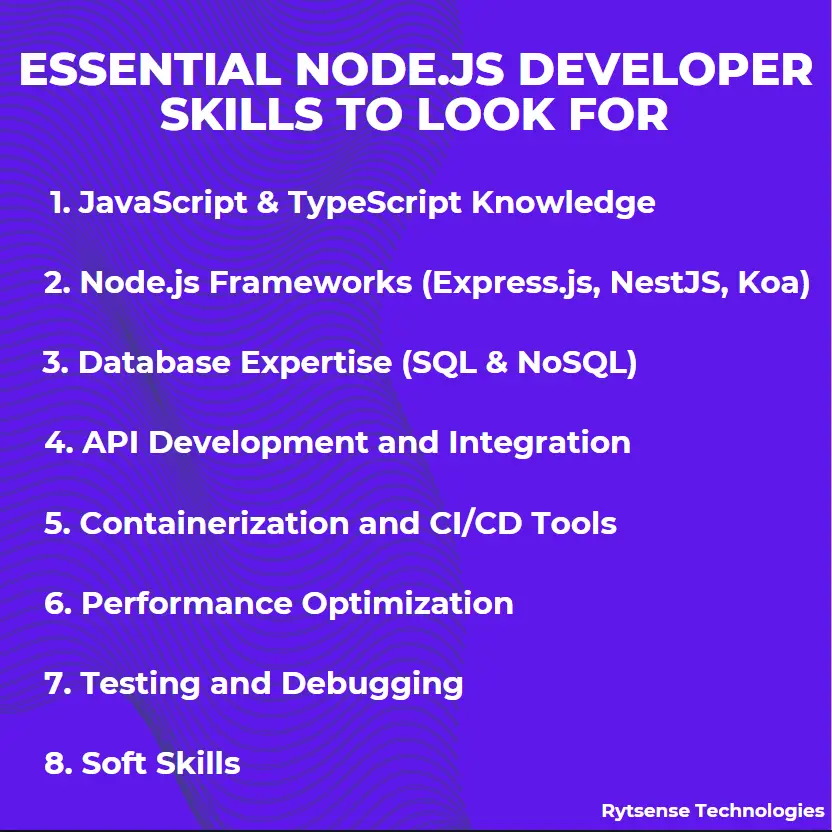
When hiring Node.js developers, it's important to know the exact skills and knowledge that they must have to complete your project successfully. What a Node.js developer must do is create fast, scalable, and performant backend services, while their knowledge and skills will entail a lot more than simply coding. Regardless of whether you’re hiring developers to implement a small project or trying to scale your systems with a fully functioning web application, understanding important skills will lend itself to hiring the right person for your team. Here's a summary of essential Node.js developer skills
JavaScript & TypeScript Knowledge
Node.js is built using JavaScript. Node.js developers need to learn how to program not just with JavaScript but also with the latest contemporary ES6+ features, including arrow functions, async/await, destructuring, and modules.
Node.js is a JavaScript runtime built on Chrome's V8 engine. For proper development of a scalable, performant backend system, it is important for developers to be proficient (not just familiar) in the JavaScript language.
Similarly, as development trends evolve, TypeScript is becoming more prevalent with its static typing of code and benefits of early bug detection during development. Many Node.js developers are going to be using and writing TypeScript as an effort to give their code weight, stability, and meaning.
Node.js is a JavaScript runtime built on Chrome's V8 engine. For proper development of a scalable, performant backend system, it is important for developers to be proficient (not just familiar) in the JavaScript language.
Similarly, as development trends evolve, TypeScript is becoming more prevalent with its static typing of code and benefits of early bug detection during development. Many Node.js developers are going to be using and writing TypeScript as an effort to give their code weight, stability, and meaning.
Node.js Frameworks (Express.js, NestJS, Koa)
While Node.js is a runtime by itself, most Node.js developers will often use a framework (such as Express.js, NestJS, or Koa) to make development easier and faster. Frameworks will offer developers various utilities, such as request utilities, middleware, routing, and templating engines.
- One of the most used frameworks for creating Node.js web servers and APIs is Express.js. Express.js is popular due to its scalability and simplicity.
- NestJS is a great framework for creating scalable applications with Typescript, and it's also ideal for larger enterprise applications.
- Koa is even smaller and allows even more flexibility for your web server.
Database Expertise (SQL & NoSQL)
As a Node.js developer, databases are a fundamental part of backend development. It is important to have experience with SQL (including PostgreSQL and MySQL) and NoSQL databases (including MongoDB).
A Node.js developer should understand the principles of database design at least at a basic level for the sake of optimizing and keeping data consistent across multiple databases.
- SQL databases are valuable when working with business applications that require functionality for a number of queries to be made while also considering the relationships with complex data types (an eCommerce application, for example).
- NoSQL databases are useful when working with user-based products that require ingestion of unstructured data and displaying it (a real-time chatting application or a social media application, for example).
A Node.js developer should understand the principles of database design at least at a basic level for the sake of optimizing and keeping data consistent across multiple databases.
API Development and Integration
Node.js developers frequently design and implement APIs to facilitate communication between servers and clients. Proficiency in building and interacting with RESTful APIs, GraphQL, and other integration tools is essential for developing modern applications.
Having the skillset for API design and integration is important for a Node.js developer to enable efficient data transitions and performance.
- REST APIs were commonly used for most web applications to establish a connection between the front-end and back-end of the application.
- GraphQL has become more popular for creating a more flexible and efficient way to query data.
Having the skillset for API design and integration is important for a Node.js developer to enable efficient data transitions and performance.
Containerization and CI/CD Tools
Modern-day Node.js development typically includes Docker for containerization and CI/CD platforms, like Jenkins, GitLab, or CircleCI. The use of these tools allows the automation of workflows to invoke the workflow of the CI/CD process to help ease the experience of continuous integration, continuous testing, and continuous deployment.
With Docker, a Node.js developer can containerize applications to better deploy and to scale the application. Being conscious of CI/CD pipelines will allow for efficiencies in the development cycle and shorten downtime of deploying updates.
With Docker, a Node.js developer can containerize applications to better deploy and to scale the application. Being conscious of CI/CD pipelines will allow for efficiencies in the development cycle and shorten downtime of deploying updates.
Performance Optimization
Performance optimization is one of the most important abilities for a Node.js developer. While Node.js was designed with extreme scalability in mind, there are still things a developer must understand to ensure performance doesn't happen by accident. A developer must understand some of the following skills:
- Load balancing is used to effectively distribute traffic across multiple servers.
- Caching is used to speed up response times and lessen database load (maybe using Redis).
- Asynchronous programming allows multiple requests to be processed simultaneously without blocking.
Testing and Debugging
Testing is a crucial aspect of development, and, therefore, Node.js developers will be required to write tests for their code. They will also have to be familiar with the testing frameworks of their choice, i.e., Jest, Mocha, or Chai, when testing their application to verify it is working properly and is bug-free.
You should also have debugging skill sets. Every Node.js developer will be required to debug their application at some point and will want to find bugs as quickly as possible. Developers want to ensure their application is consistently providing a good user experience.
You should also have debugging skill sets. Every Node.js developer will be required to debug their application at some point and will want to find bugs as quickly as possible. Developers want to ensure their application is consistently providing a good user experience.
Soft Skills: Communication & Problem-Solving
Aside from technical knowledge, Node.js developers must have good soft skills as well. They need to easily convey technical information to the technical team, and they need to communicate with the non-technical officers on the team as well. Developers also need good problem-solving skills, especially since they are often working on complex systems where there is a good amount of data being processed and multiple users interacting with the system in a meaningful way.
A Node.js developer who collaborates well with product managers, front-end developers, and designers is a great way to add valuable capital to your organization.
When you search for Node.js developers, you really need to understand how their knowledge of JavaScript, backend frameworks, databases, performance tuning, etc., differs. At the same time, soft skills (especially their communication skills and their problem-solving skills) are equally important to ensure you have the long-term success you are looking for.
Regardless of whether you hire local developers or hire offshore developers (for example, hire developers in India), having these key soft skills will help you create a scalable and ever-growing application for your business needs.
Partnering with a specialized Node.js development firm like Rytsense Technologies ensures access to vetted talent with both technical and soft skills; they can provide the right team of software developers with the right Node.js skills and the soft skills to make your project happen.
A Node.js developer who collaborates well with product managers, front-end developers, and designers is a great way to add valuable capital to your organization.
When you search for Node.js developers, you really need to understand how their knowledge of JavaScript, backend frameworks, databases, performance tuning, etc., differs. At the same time, soft skills (especially their communication skills and their problem-solving skills) are equally important to ensure you have the long-term success you are looking for.
Regardless of whether you hire local developers or hire offshore developers (for example, hire developers in India), having these key soft skills will help you create a scalable and ever-growing application for your business needs.
Partnering with a specialized Node.js development firm like Rytsense Technologies ensures access to vetted talent with both technical and soft skills; they can provide the right team of software developers with the right Node.js skills and the soft skills to make your project happen.
Ready to hire Node.js developers who understand your project needs?
Let’s build something great together.
How Much Does Hiring Node.js Developers Cost?
Usually, cost will be one of the first things you need to consider when hiring Node.js developers. The main tool for developing scalable and effective backend systems is Node.js, a potent JavaScript runtime. Hiring Node.js developers can cost a lot of money, depending on a number of variables.
Experience and Hourly Rates
Depending on the developer's level of experience, Node.js developers' hourly charges can vary significantly. The cost increases with experience, as is the case with most development-related positions. The hourly rates are broken down by experience level below.
- Junior Node.js Developer (0 to 2 Years): Rates vary widely by region. In 2025, junior devs in the U.S. typically start at $30-$70/hour, reflecting rising entry-level salaries due to increased demand for tech talent and inflation adjustments. Many are just beginning their careers, often with bootcamp, self-taught, or university backgrounds. having little or no experience, whether they're recent graduates or self-trained. Junior developers are best suited to perform very simple projects, bug fixes, and general support for more experienced team members, as junior developers will require additional time from the experienced team member or leadership for mentoring and assistance.
- Mid-Level Node.js Developers (2-5 Years): Managerial-level developers gain most of their skills and experience in industry by working on projects in a real environment. Mid-level coders typically make between $50 and $100 per hour. They are capable of handling most components or functions independently, including but not limited to building APIs or optimizing existing systems. Developers are not expected to be in a position to provide consulting-style development. Intermediate-level Node.js developers are generally best for small-to-medium-sized projects and can be the most economical fit with many businesses.
- Senior Node.js Developers (5+ Years): Senior developers will have a good amount of experience and an ability to take responsibility for the systems architecture. They will generally know how to incorporate microservices and cloud deployment into a Node.js application. The general earnings per hour for top developers is between $80 and $140.
- While this is more than most mid-level developers, hiring a senior developer can reduce costs in the long run with their ability to assist with complex problems as well as expertise in efficient code and optimized performance. Hiring a senior Node.js developer can help reduce temporal costs and future costs in technical debt and delays.
- Expert or Lead Node.js Developers (10+ Years): Experts and lead developers in advanced knowledge areas, such as Web3, AI, cybersecurity, etc., can charge $100 to $200+ hourly. Expert developers will have a wealth of experience working on large-scale, mission-critical applications that have many complex elements and performance requirements concerning those elements. Because of this, when looking for support for advanced or next-generation technologies, hiring an expert to execute the function is well worth it.
- Version control using Git and GitHub
Location-Based Salary Variations
Where your Node.js developer is located is essential because there are various options for hourly rates, and they charge drastically different prices depending on where they live. Here are the average going rates by geographic area:
- North America: The United States of America and Canada typically possess the highest rates for Node.js engineers. Junior developers charge approximately $31-$50 per hour regardless of location. While a senior Node.js developer will find an hourly rate at about $150+ at the high end. This is mostly due to the fact that the standard cost of living is significantly higher, and the role is in high demand, which all contributes to the high salaries.
- Western Europe: Hourly rates for developers in this region typically range from $60 to $120. Since the UK and Germany are more sustainable, tech firms that value backend developers have higher prices for their services. However, these prices will be lower than in North America.
- Eastern Europe: For Node.js developers, Eastern Europe has a rich pool of talented developers at a lower cost than Western Europe. Developers typically charge $30-$80 per hour, making it best for companies to find good talent while maintaining a lower hourly rate. Likewise, Poland and Ukraine have good tech ecosystems with many talented developers who work for a significantly lower hourly rate than Western Europe.
- India & Southeast Asia: If you are hiring developers in India or Southeast Asia, you are looking at the lowest prices. In these nations, developers bill between $18 and $40 per hour. India has an expansive base of skilled developers—many of whom specialize in Node.js backend development. These countries are very cost-unit efficient for businesses looking to scale teams or build long-term projects.
- Australia & New Zealand:The hourly rate for Node.js developers in Australia and New Zealand ranges from $61 to $100. Prices are somewhat cheaper than in Western Europe and North America, but the need for skilled developers is increasing, which may create a niche in the Asia-Pacific region.
Hiring Models and Their Impact on Cost
The way you choose to recruit Node.js engineers also affects the overall cost:
- Freelance Developers: Freelancers traditionally charge hourly or project-based, giving you maximum flexibility, but often require increased project management on your part. The hourly charge typically ranges from $30 to $100, depending on the area and level of expertise. Freelance developers are most suitable for short-term projects or where you want to use a developer on a trial basis before committing to them full-time.
- Full-Time In-House Developers: Full-time Node.js developers are more expensive since you have to pay their full salary, any benefits, and overhead costs. Full-time developers in Western Europe or North America can make between $70,000 and $150,000+ per year. While this is a lot more money than contracting a freelancer, you get the benefit of a dedicated resource on your project.
- Outsourcing Agencies: If you need a full development team, then an outsourcing agency is a viable option. Outsourcing agencies generally charge higher fees (again, like a developer salary) but provide a complete solution and will scope your project, provide project management, complete with quality assurance, etc. You usually pay hourly, ranging from $30 to $120 per hour, depending on the agency's location and overall expertise.
- Staff Augmentation:This model involves hiring external developers to work alongside your existing team, which is ideal for scaling quickly without the long-term commitment of full-time hires. Rates for staff augmentation typically range from $40 to $120 per hour.
Choosing the Right Hiring Model for Node.js Developers
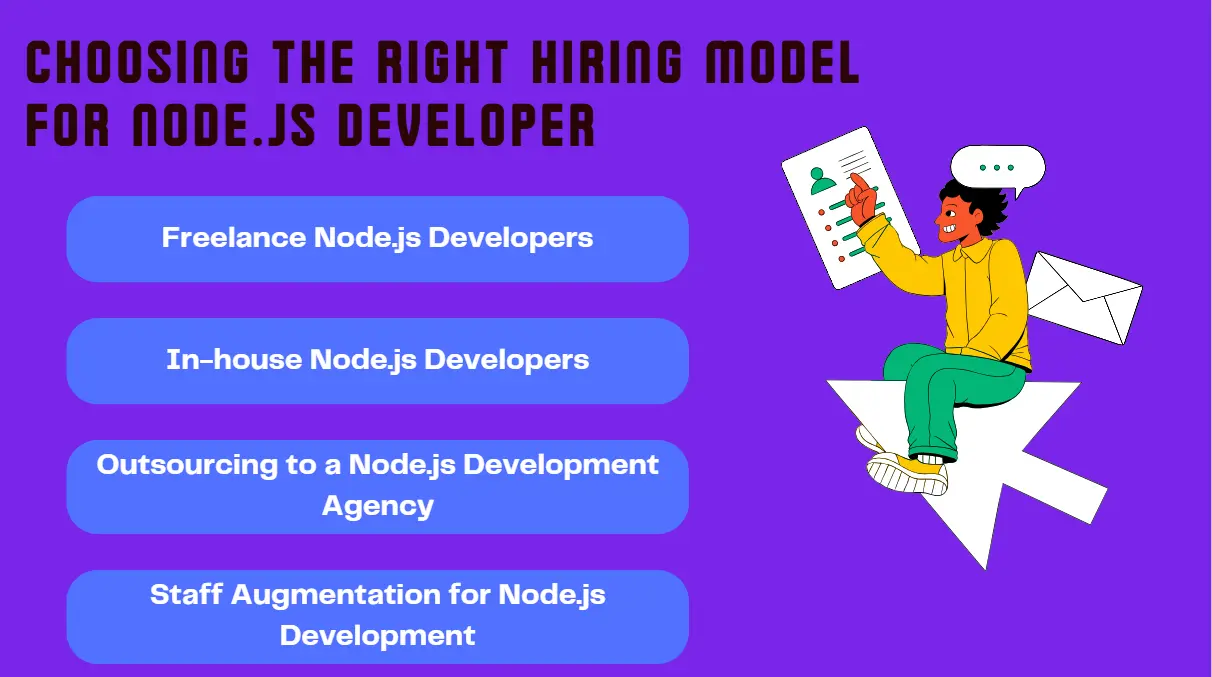
When hiring Node.js developers, you will want to choose an appropriate hiring model that drives the success of your project. Whether you hire developers in-house, freelance, or use an agency, each model has advantages and disadvantages. Your goal is to find the model that best meets the needs of your project, your budget, and your long-term goals. Below we are going to discuss hiring models and how to determine what model is best for you.
Freelance Node.js Developers
- If you want to hire Node.js developers to complete a short-term project, a project or task, or just want flexibility, then freelancers are the way to go! Traditionally, freelancers typically charge competitive hourly rates while offering flexibility for work assignments.Freelancers are located on platforms like Upwork, Fiverr, and Toptal. This hiring model is especially useful for businesses that have short-term or sporadic workloads or for small projects that do not require someone full-time.
Pros:
- Affordable—Freelancers generally charge less than
- Two full-time employees. Startups & companies looking to keep costs down usually find freelancers to be a better option in terms of cost.
- Flexibility—You can hire freelancers on demand. This is ideal for quick fixes, issues that require a bug fix, or if you are working on a prototype where not much is at stake.
- Speed—Freelancers will often start work immediately, providing quick turnaround if you require something short-term.
Pros:
- Availability: Freelancers often have multiple clients, so they may not be able to commit to the project or be available for urgent work, especially if they are freelancing full-time.
- Quality Inconsistency :Some freelancers are great at what they do, while others are not and may not be that great depending on the level of expertise they have, so the work done will not be consistent in the depth of work.
- Tip:If you intend to hire coders in India or some cheaper countries, then freelancing platforms are very informative in getting competent professionals who can provide you an excellent job at a fraction of the cost.
In-house Node.js Developers
- Hiring in-house developers is the best option for companies that need continual support for ongoing projects, as having full-time developers makes them a part of your team to work closely with you and allows you to gain greater control over the project's direction
Benefits
- Control: You have complete control over where the project is going and how you want it executed daily.
- Team: Developers will be in-house, working with other team members such as product managers, designers, and QA engineers to work closely with each other and improve collaboration and workflow in the development process.
- Commitment: Employees are generally more likely to stay with an organization in the long term than independent practitioners, which allows for consistency in projects without needing to restaff frequently.
Cons
- More Expensive:Compared to the overhead of full-time employed developers, like salaries, benefits, office space, and equipment, all of which can add up quickly for a small business or a startup.
- Inflexible: Permanent/full-time developers are generally bound to one project at a time, which could impact your ability to scale upwards and downwards in numbers of workers.
- (Advice: If you decide to employ developers in-house, make sure to choose them with your long-term views in mind.) You should consider offering market salaries as well as growth options in order to keep your developers.
Outsourcing to a Node.js Development Agency
Outsourcing to a Node.js development agency is a great model if your business requires a full-on end-to-end process for a completed product. Agencies typically come with a team of experts who are knowledgeable in all areas of related technology (e.g., back-end frameworks such as Node.js, front-end technologies, and UI/UX design).
Benefits
Cons
Tip: Hiring a Node.js development company is a great way to save the time and expense of looking for a full development team that can easily scale to deliver expertise across the several domains that your project is likely to involve.
Benefits
- Full-service Solutions: Agencies provide a "one-stop shop" with an entire team (project manager, designers, and developers) that can save you the time and effort of finding team members.
- Speed and Quality of Work: With experienced project managers and developers, an agency will have full-time employees to be able to produce good work faster than a freelance team of less experienced people and is a good fit for large projects or complex projects.
- Scalability: Agencies typically have experience with varying workloads, including large projects with many developers. Depending on the requirements of the project, you can swiftly scale your crew.
Cons
- Higher Costs:Although agencies offer a complete solution, they usually charge higher rates, which will be offset by the relief you get by not having to go through the process of hiring and managing employees, as they generally have many overhead costs of running an agency.
- Lack of Control::Often with agencies, there may be less ability to control the development process and the day-to-day engagement level compared to engaging a team in-house.
Tip: Hiring a Node.js development company is a great way to save the time and expense of looking for a full development team that can easily scale to deliver expertise across the several domains that your project is likely to involve.
Staff Augmentation for Node.js Development
Staff augmentation is a hybrid model that allows you to augment your current staff with Node.js developers on a temporary and longer-term basis. If you have an internal team but need additional resources to meet deadlines or complete particular tasks, staff augmentation works well in a myriad of situations.
Benefits
Drawbacks
Tip: If you are needing to hire developers in India or any other country with a large developer pool, staff augmentation will allow you to augment your existing staff without the long-tailed commitment.
Selecting the appropriate hiring model for Node.js developers is crucial for the success of your development project. You can plan to hire for full-time roles, hire freelancers, or freelance as an agency, and ultimately, it will depend on the size of your project, costs, and deadlines. The majority of development by agency, freelancer, and full-time developer will end up around the same level of cost. However, if you want affordable, quality development, consider hire coders India or searching for offshore work in areas like Eastern Europe or Latin America. Whatever you choose, check that the levels of technical expertise are appropriate for your project.
Benefits
- Flexibility: Depending on the demands of the project, staff augmentation gives you the freedom to scale up or down your workforce.
- Access to Niche Talent: this model allows you to bring in niche experts who cannot be found on your existing team to do niche work such as microservices or cloud architecture.
- Cost-effective: Staff augmentation can be less expensive than hiring full-time developers, especially for projects requiring specific expertise.
Drawbacks
- Integration Issues:New team members may have difficulties onboarding into existing systems/processes.
- Limited Commitment: Augmented employees will not have the same commitment to your company's long-term needs and goals as staff.
Tip: If you are needing to hire developers in India or any other country with a large developer pool, staff augmentation will allow you to augment your existing staff without the long-tailed commitment.
Selecting the appropriate hiring model for Node.js developers is crucial for the success of your development project. You can plan to hire for full-time roles, hire freelancers, or freelance as an agency, and ultimately, it will depend on the size of your project, costs, and deadlines. The majority of development by agency, freelancer, and full-time developer will end up around the same level of cost. However, if you want affordable, quality development, consider hire coders India or searching for offshore work in areas like Eastern Europe or Latin America. Whatever you choose, check that the levels of technical expertise are appropriate for your project.
Where to Hire Node.js Developers: Best Sourcing Options
When it comes to discovering Node.js developers, there are many effective channels depending on project size and deadline.
Job Boards & Freelance Platforms
Upwork: Best used for short-term contracts or testing developers for medium- to long-term jobs.
Toptal: Provides a list of high-quality, pre-vetted developers that are great for complicated projects.
LinkedIn & GitHub: Used for sourcing skilled developers and evaluating their work.
Toptal: Provides a list of high-quality, pre-vetted developers that are great for complicated projects.
LinkedIn & GitHub: Used for sourcing skilled developers and evaluating their work.
Offshoring & Nearshoring
Eastern Europe, India, & Latin America: These areas have well-trained developers with reasonable rates, ideal for companies that want to save on development costs.
Tip: If you are looking to hire talent in India, the country has many skilled Node.js developers with good backend technology skills.
Tip: If you are looking to hire talent in India, the country has many skilled Node.js developers with good backend technology skills.
How to Evaluate Node.js Developer Candidates
Once you have created a pool of candidates, the next step is to evaluate their capabilities and viability for your project. The methods of evaluation may include
Technical Evaluation
- You can provide candidates with real-world problems like building an API or taking an existing system and improving its performance. This will allow you to evaluate their ability to code.
- You may also be able to check their GitHub portfolio to assess past projects and code quality.
Soft Skills Evaluation
- Communication:You should assess how well candidates convey complex technical issues or how they approach problem-solving.
- Collaboration:Node.js developers may collaborate with other teams; therefore, gauging their collaboration skills would be useful
Behavioral Interview Questions
- Ask candidates about their past projects, challenges, and how they dealt with them.
- Analyze their ability for task and project ownership.
Partner with Rytsense Technologies to Build the Best Node.js Developers Team
At Rytsense Technologies, we use Node.js for our projects. If your team collaborates with us, we’ll establish a business partnership. You’ll know the upfront costs, including any additional expenses like onboarding.
We ensure fair and consistent pricing for all projects. By working with Rytsense Technologies—your trusted partner—you get access to skilled Node.js developers at cost-effective rates, wherever you need them.
We provide a reliable remote team of experienced Node.js developers who deliver high-quality work at competitive prices. You’ll also benefit from expert guidance and structured support throughout your project timeline, ensuring smooth production and timely feedback.
We ensure fair and consistent pricing for all projects. By working with Rytsense Technologies—your trusted partner—you get access to skilled Node.js developers at cost-effective rates, wherever you need them.
We provide a reliable remote team of experienced Node.js developers who deliver high-quality work at competitive prices. You’ll also benefit from expert guidance and structured support throughout your project timeline, ensuring smooth production and timely feedback.
Conclusion
Choosing the right developer is crucial to bringing your vision to life. Your decision—whether to hire full-time developers, freelancers, or an agency—depends on your project’s scope, budget, and timeline. If cost efficiency is a priority without sacrificing quality, consider hiring developers from India or offshore hubs like Eastern Europe and Latin America. No matter which route you take, ensure your team has the technical expertise to deliver outstanding results.
If you're looking for affordable, high-quality Node.js development, Rytsense Technologies is ready to help—so you can build confidently and scale fast.

The Author
Karthikeyan
Co Founder, Rytsense Technologies