Key Takeaways
The four core machine learning types supervised, unsupervised, semi-supervised, and reinforcement learning form the foundation of modern AI development.Each ML type solves different business challenges, from prediction and automation to anomaly detection and autonomous decision-making.Startups use ML for rapid innovation, MVP development, AI integration, and generative AI capabilities, while enterprises focus on scalability, governance, and workflow automation.ML adoption enables organizations to unlock predictive analytics, intelligent automation, real-time insights, and improved decision-making.Working with an AI development company helps businesses overcome challenges like data quality, model drift, infrastructure, integration, and compliance.
What Are the 4 Types of Machine Learning?
The four types of machine learning used across modern AI development services are:
Supervised Learning
Unsupervised Learning
Semi-Supervised Learning
Reinforcement Learning
These machine learning types power today’s AI solutions, enabling organizations to automate workflows, enhance decision-making, scale AI systems, and build intelligent applications.

Why These 4 Types Matter in Today’s AI Landscape
Machine learning is at the center of artificial intelligence development, powering everything from predictive analytics and deep learning applications to generative AI tools and custom AI solutions.
Businesses — whether startups or enterprises — rely on ML for:
- Data-driven decision-making
- Predictive analytics
- AI automation
- Natural language processing
- Intelligent workflow systems
- Real-time insights
As AI adoption expands across industries, these four ML types help define how organizations design, deploy, and scale intelligent technologies.
Type 1: Supervised Learning — The Foundation of Predictive AI
Supervised learning is the most widely used machine learning approach because it delivers high accuracy, works well with structured data, and is essential for building reliable predictive analytics, AI-powered automation, and intelligent business applications.
In supervised learning, the model is trained using labeled datasets — meaning every input has a corresponding correct output. This allows the AI system to understand patterns, relationships, and dependencies within the data.
How Supervised Learning Works (In Simple Terms)
- You provide the model with inputs (e.g., customer details).
- Each input is paired with a known output (e.g., will they churn or stay?).
- The AI model learns the mapping between input features and correct output labels.
- After training, the model predicts outputs for new, unseen data with high accuracy.
This makes supervised learning ideal for tasks where outcomes are already known and need to be predicted for the future.
Popular Algorithms in Supervised Learning (Explained Briefly)
1. Linear RegressionUsed for numerical predictions. Example: forecasting sales volume based on pricing, seasonality, and marketing spend.2. Logistic RegressionUsed for classification tasks (yes/no, true/false). Example: predicting whether a customer will convert.3. Random ForestAn ensemble-tree based algorithm that improves accuracy and reduces overfitting. Example: fraud detection in banking.4. Support Vector Machines (SVM)Effective for separating classes with clear boundaries. Example: classifying spam vs non-spam emails.5. Deep Neural NetworksPower advanced AI systems — image recognition, NLP, sentiment analysis, and more. Example: detecting tumors in radiology images.
These algorithms form the backbone of many AI development services, powering intelligent applications across industries.
Use Cases of Supervised Learning Across Industries (Expanded)
Supervised learning plays a transformational role across different sectors:
1. Forecasting Sales & Demand (Retail / E-commerce)Businesses use supervised models to predict: Product demandInventory needsSeasonal sales spikesCustomer purchase behavior This helps optimize stock levels, reduce operational waste, and increase revenue. 2. Spam & Email Classification (Internet Services)AI models analyze email metadata, content, and patterns to categorize messages as: SpamPromotionalImportant This improves email security and user experience. 3. Customer Churn Prediction (Telecom / SaaS)Supervised learning models identify early signs of churn such as: Reduced usageFailed paymentsInteraction drop-offs Businesses can then take proactive measures to retain customers. 4. Document Classification (Enterprise Automation)AI systems categorize documents into: InvoicesContractsFormsSupport tickets This is crucial for workflow automation and intelligent document processing. 5. Disease Detection & Medical Imaging (Healthcare)Deep learning models detect: TumorsInfectionsAbnormalities Trained on thousands of labeled medical images, these systems support faster and more accurate diagnosis.
Want to Build Predictive AI Models?Contact us to explore custom AI solutions tailored for your business needs. Get a Custom AI Development Strategy →
Type 3: Semi-Supervised Learning — Smarter Learning With Less Labeled Data
Semi-supervised learning sits between supervised and unsupervised learning, offering the accuracy of labeled data while taking advantage of large pools of unlabeled data. This makes it one of the most efficient and cost-effective machine learning approaches for modern AI development.
In many real-world scenarios, organizations have millions of data points but only a small subset is labeled — and labeling data can be expensive, time-consuming, and labor-intensive. Semi-supervised learning solves this by using a small amount of labeled data to guide the learning process, while the unlabeled data helps the model understand broader patterns.
This makes it ideal for industries dealing with high data volume, complex datasets, or situations where expert annotations are limited.
How Semi-Supervised Learning Works (Simple Breakdown)
- A portion of the data is labeled (e.g., 5–10%).
- A much larger portion remains unlabeled.
- The model first learns from the labeled data.
- It then uses patterns in the unlabeled data to enhance and refine its predictions.
- The result is a model that performs close to fully supervised systems but with far less labeling cost.
This hybrid learning approach is widely used in deep learning, neural networks, natural language processing, and enterprise AI systems where scalability is key.
Ideal Use Cases for Semi-Supervised Learning (Expanded)
1. Speech Recognition (Voice Assistants, Call Centers, Telecom)Audio data is massive and difficult to label manually. Semi-supervised learning helps improve: Transcription accuracySpeaker identificationVoice-based command systems This enables more natural and accurate AI-driven voice experiences. 2. NLP Classification (Chatbots, Document Processing, Sentiment Analysis)Text data is abundant but rarely labeled. Semi-supervised learning supports: Topic classificationIntent detectionSentiment analysisAutomated document organization It improves NLP model quality while reducing labeling efforts. 3. Fraud Detection (Banking, Fintech, Cybersecurity)Fraud cases are rare and difficult to label — but unlabeled transaction data is huge. Semi-supervised models detect: Suspicious transactionsIdentity theft patternsAnomalous user behavior This strengthens security and reduces financial risk. 4. Healthcare Diagnostics (Medical Imaging, Lab Reports, Predictive Care)Medical data requires expert labeling, which is expensive and limited. Semi-supervised learning enhances: Early disease predictionMedical image analysisPatient risk scoringAI-assisted diagnosis It accelerates healthcare innovation while maintaining accuracy and compliance. 5. Large-Scale Enterprise AI SystemsEnterprises generate massive amounts of unstructured data. Semi-supervised learning helps build: Customer segmentation modelsRecommendation systemsPredictive analytics enginesIntelligent workflow automation This allows businesses to use their existing data more strategically.
Type 4: Reinforcement Learning — Learning by Action and Reward
Reinforcement Learning (RL) is a powerful branch of machine learning where an AI agent learns by interacting with an environment, taking actions, and receiving rewards or penalties based on the outcomes.
Unlike supervised or unsupervised learning, reinforcement learning focuses on trial-and-error learning, making it ideal for dynamic and unpredictable environments.
In RL, the agent continually improves its strategy — known as a policy — by maximizing long-term rewards. This makes reinforcement learning extremely valuable for systems that must make sequential decisions, adapt to changing conditions, and operate autonomously.
How Reinforcement Learning Works (Simple Breakdown)
Reinforcement learning follows a continuous loop:
- Environment: The surrounding system where the agent operates (game board, road, warehouse, robot workspace).
- Agent: The AI system making decisions.
- Action: The choice or move the agent makes.
- Reward: Positive or negative feedback based on the action.
- Policy Update: The agent refines its strategy to improve future outcomes.
Over time, the agent learns the best actions to take in various situations, similar to how humans learn through experience.
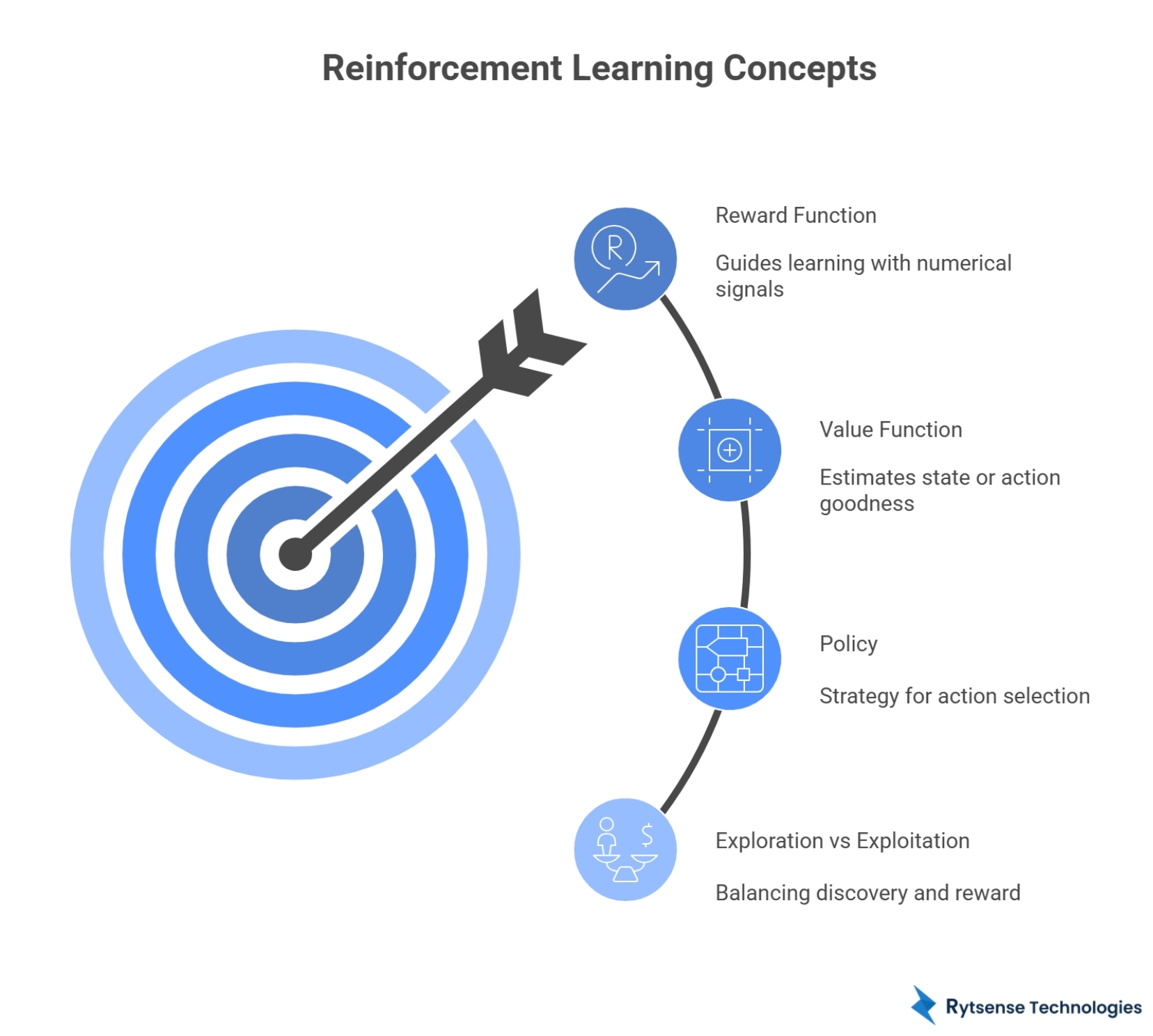
Key Concepts in Reinforcement Learning
1. PolicyThe strategy the agent follows to decide what action to take.2. Reward FunctionA numerical signal guiding the agent’s learning process.3. Value FunctionAn estimate of how good it is to be in a certain state or perform a certain action.4. Exploration vs ExploitationExploration: Trying new actions to discover better strategies.Exploitation: Using known actions that give high rewards.Balancing these is crucial for strong RL performance.
Where Reinforcement Learning Is Used (Expanded Use Cases)
1. Robotics (Industrial Automation, Assembly Lines, Warehousing)Robots trained with RL can:Navigate obstaclesPick and place objectsOptimize movement pathsAdapt to unexpected conditionsThis enhances automation, efficiency, and safety in modern manufacturing.2. Autonomous Vehicles (Self-Driving Cars, Drones)Reinforcement learning helps vehicles learn complex tasks such as:Lane keepingSpeed controlCollision avoidanceReal-time route optimizationThe continuous feedback loop allows autonomous systems to improve their decision-making over time.3. Supply Chain Optimization (Logistics, Warehousing, Delivery Networks)RL helps businesses optimize:Routing of delivery trucksInventory placementWarehouse robotics workflowsReal-time schedulingThis leads to lower operational costs and higher supply chain efficiency.4. Game AI (Strategy Games, Simulation Games, Training Environments)RL is widely used to create intelligent game agents capable of:Playing at superhuman levelsAdapting to opponents’ strategiesLearning long-term planning and tacticsExamples include AlphaGo, chess engines, and reinforcement-based training environments used for AI research.5. Real-Time Decision-Making Systems (Finance, Energy, Retail)Reinforcement learning supports dynamic, fast-paced environments such as:Automated trading agentsPower grid optimizationDynamic pricing modelsPersonalized recommendation enginesThese systems must react instantly to changes — RL provides the adaptability needed.
How Startups Use ML vs Enterprises
Machine learning adoption looks very different for startups and large enterprises, even though both aim to leverage AI technologies to innovate, optimize operations, and create competitive advantages. Their goals, constraints, and development strategies vary significantly — and understanding these differences helps determine the most effective AI roadmap for each.
1 How Startups Use ML 1. Rapid MVP DevelopmentFocus on building lean AI-powered prototypes quickly to test market fit: Smart search, Personalized recommendations, AI-driven analytics.2. AI Integration into AppsUse pre-trained models or lightweight frameworks to embed image/text recognition, chatbots, and voice assistants.3. Generative AI FeaturesEnable automated content generation, smart productivity tools, and AI copilots to differentiate faster.4. Cloud-Based DeploymentRely on cloud platforms (AWS, Azure) for on-demand computing and cost-efficient experimentation.2 How Enterprises Use ML 1. Predictive Analytics at ScaleGenerate insights from massive datasets for finance modeling, supply chain forecasting, and demand planning.2. Complex Workflow AutomationAutomate intelligent document processing, AI-driven quality checks, and call center ecosystems.3. AI Governance & CompliancePrioritize model interpretability, data privacy, and ethical frameworks for regulatory adherence.4. Legacy System IntegrationSeamlessly integrate ML solutions with older ERP systems, on-premise databases, and custom APIs.
What Both Startups and Enterprises Have in Common
Despite their differences, both groups depend heavily on expert-driven AI development services to:
- Build high-performing AI models
- Ensure reliability and accuracy
- Deploy scalable AI systems
- Integrate ML into existing workflows
- Reduce risk and optimize development time
- Maintain long-term sustainability
"Startups seek faster innovation. Enterprises seek stability and scale. Machine learning bridges both needs when executed strategically."
Both benefit from expert-driven AI development services that ensure accuracy, scalability, and long-term value.
Challenges in Modern ML Development
ML development is not just about choosing an algorithm — it requires strategic planning, robust infrastructure, and continuous optimization.
Key Challenges
- Data quality and availability
- Model drift and performance issues
- Integration with existing systems
- Ethical AI concerns
- Computational cost
Businesses increasingly rely on experienced AI developers to solve these challenges and deploy production-ready ML systems.
How an AI Development Company Supports ML Projects
AI development companies help organizations navigate the full lifecycle of ML implementation.
Services Include
- ML architecture design
- Data preparation and model training
- AI integration with enterprise systems
- Custom AI solution development
- Predictive analytics systems
- Deep learning model development
- Generative AI applications
- Long-term monitoring and optimization
This ensures businesses build reliable, explainable, scalable AI systems with minimal risk.
Conclusion
The four types of ML — supervised, unsupervised, semi-supervised, and reinforcement learning — are the core building blocks of artificial intelligence today.
Understanding them helps businesses make informed decisions about AI investment, model selection, and digital transformation strategies.
Machine learning continues to transform industries such as healthcare, finance, retail, logistics, manufacturing, and real estate. Organizations that leverage the right ML approach gain competitive advantages, operational efficiency, and long-term scalability.
Looking to develop AI models, automate workflows, or integrate intelligent systems into your business?Partner with Rytsense Technologies for expert Machine Learning and AI development services. 👉 Create Custom AI & Machine Learning Solutions
Meet the Author

Co-Founder, Rytsense Technologies
Karthik is the Co-Founder of Rytsense Technologies, where he leads cutting-edge projects at the intersection of Data Science and Generative AI. With nearly a decade of hands-on experience in data-driven innovation, he has helped businesses unlock value from complex data through advanced analytics, machine learning, and AI-powered solutions. Currently, his focus is on building next-generation Generative AI applications that are reshaping the way enterprises operate and scale. When not architecting AI systems, Karthik explores the evolving future of technology, where creativity meets intelligence.