Key Benefits of Using AI in Software Development
As the digital space is rapidly changing now, the advantages of
AI software development company
are more obvious with time. From automating mundane activities to faster prototyping, AI is altering the way contemporary software is developed, tested, and released. By combining sophisticated AI instruments with generative AI, developers and organizations are able to increase productivity, accuracy, and scalability.
In this blog, we delve into how AI developer company is revolutionizing software development and why introducing it to your development flow is critical to remain competitive.
According to recent studies
80% of businesses are expected to have AI-integrated development models and tools, compared to only 20% due to have adopted in 2026.
What are the Benefits of AI in Software Development?
AI for software development
is the practice of applying artificial intelligence technologies — including natural language processing, machine learning, and generative models — to assist in, as well as automate, some aspects of the software development life cycle. Developers are able to utilize AI for code generation, bug detection, test automation, and for enhancing the performance of systems, as well as managing those projects in real-time. Instead of adding AI as a tool to replace developers, one might frame AI as a productivity and consistency tool that not only improves productivity but also consistency and innovation velocity. There may be ways of combining the power of AI into software teams' best practices to produce applications that are more innovative, more usable, smarter, more performant, and let organizations use the AI software development company in the applications as part of their workflows around higher-level, strategic, or creative decisions. The
benefits of AI in software development
include faster processes and improved software quality. By embracing the benefits of AI in software development, teams can unlock greater efficiency and smarter solutions.
Also Read: What Is AI in Software Development? A Beginner’s Guide
The Application of AI in Software Development
Artificial Intelligence (AI) is having a disruptive effect on
software development
and allows teams to build smarter, quicker, and more dependable applications. Developers, testers, and project managers are now using AI across a variety of methods and tasks across the software development life cycle to improve workflows, drive productivity, and improve user experience. Here are some important use cases where AI is directly impacting development:
AI Code Generation
Developers are taking advantage of code-generation tools to substantially generate code for boilerplate, auto-complete functions, and create complete code snippets from natural language. What these products effectively do is reduce the manual effort of coding itself, and allow developers to think about logic and coming opportunities for change.
Smarter Testing and Debugging
AI can take testing a step further. It can automatically create and recognize test cases, identify edge cases, and help with real-time bug detection. AI-based quality assurance tools that consistently learn from previous test cycles can deliver applications with higher code fidelity and with fewer manual decisions from testers.
Predictive Project Management
AI analyzes historical project data, identifies code commit patterns, and uses team velocity to forecast deadlines. Project managers utilize these predictions to better plan sprints and resources.
Automated Code Review and Quality Verification
Using AI to scan code, identify bugs, security vulnerabilities, or instances of poor practices. DeepCode, Codacy, and other platforms provide suggestions that improve the code quality and its security throughout the development process.
More User Personalization
AI algorithms scan data on how users behave with software in order to help developers create increasingly personalized applications. An AI development company in USA ensures applications can adapt intelligently by providing recommendations and personalized interfaces according to user needs. The benefits of AI in software development include creating more user-centric applications, enhancing personalization, and improving overall user satisfaction.
Feature Prioritization Based on Data
Product teams can deploy AI to analyze in-app user feedback, user behavior with the software, and market trends to support decisions on which feature to build next. This provides user expectation alignment with software development and ultimately delivers real value to users. The benefits of AI in software development include smarter feature prioritization, data-driven decision-making, and improved alignment with user needs.
Intelligent Autonomous Development Assistants and DevOps Automation
Generally available AI bots can perform repetitive
DevOps Services
tasks such as deployment, resource monitoring, or log scanning. Smart assistants can ease the workload of
entry-level software developers
and aid in faster development, releasing, and implementing, while providing better consistency in performance.
UX Design
AI is transformative for UX (User Experience) design in enabling teams to design interfaces that are more instinctive, personalised, and data-driven. Designers are taking advantage of AI to analyze user behavior patterns, generate wireframes, and different versions of designs at the same time. Designers can use generative AI to create actionable recommendations for design improvements by considering real-time feedback, interaction/heatmap usage, and accessibility. Designers can also use generative AI to expedite the prototyping phase by developing high-fidelity mockups from the descriptions of user flows. By leveraging AI technology, design teams can track and optimize user journeys, optimize the responsiveness of interactions with interfaces, and develop super personalized experiences that adapt to users' preferences in real time -- leading to improved user experience and satisfaction. The benefits of AI in software development include enhancing UX design through automation, personalization, and real-time user insights, helping teams deliver more effective digital products.
Architectural Design
AI is helping developers change the way they design software architectures by allowing them to make more intelligent and adaptable decisions. Development teams are using AI to analyze prior performance data, simulate system load and capacity, and anticipate capacity needs, before deciding among microservices, monoliths, or serverless architectures.
Using AI at each level of
AI software development Company in India
—from planning to post-launch support—makes teams more efficient use of their resources and provides a better software experience. As AI tools are advancing all the time, their role will also grow and is focused on supporting developer processes and providing the opportunity to innovate at scale. The benefits of AI in software development also extend to continuous improvement, innovation, and smarter workflow management across the development life cycle.
Also Read: Understanding the AI Development Lifecycle: Phases and Challenges
Barriers to AI in Software Development
1. Quality and access to data
AI models are only as good as their training data, which must be large, accurate, diverse, and well-labeled. Often, developers encounter difficulties in fetching, scrubbing, and organizing data, which are closely tied to the quality and trustworthiness of the models.
2. Algorithmic Bias and Fairness
If the training data is biased, whether deliberately or not, the AI can learn those biases and reflect that in its output. In certain cases, this might result in biased user treatment or inaccurate results. This is particularly crucial in high-stakes scenarios, such as in healthcare or finance.
3. Integration with Existing Systems
AI integrated with an existing stack almost always requires reworking architecture, tooling, workflows, etc. Even with collecting a set of labeled data, teams invariably have to re-engineer parts of their existing system to make it AI-friendly. This will hold up deployment and cost money.
4. Explainability (i.e., Everything is a black box)
Many newer forms of
IoT Artificial Intelligence
, like deep learning, have limited traceability. Developers and stakeholders can't always understand how decisions are made, which diminishes trust in the decision. This is especially problematic for companies bound by current regulations in their industry.
5. Lack of Skills That Are Required for AI and ML
Implementing AI effectively requires skills in machine learning, data science, model tuning, and responsible AI. Many software teams lack the talent necessary to deliver the right AI solutions effectively, leaving them misaligned or simply misinformed.
6. Security and Privacy Issues
AI applications typically require investigating data that is sensitive or personal. Mismanaged, these systems introduce security vulnerabilities, breach privacy laws, or make the organization liable in legal matters.
7. Maintenance and monitoring
AI models require ongoing evaluation of performance and could require continuous retraining and monitoring as data changes over time. Unlike traditional software, AI does not necessarily follow a fixed logical path or constraint, and requires ongoing monitoring and maintenance for it to remain accurate or useful.
8. Expensive Computational Resources
Training and deploying AI models, especially generative AI models, can be a computationally intensive process and consume significant resources. That raises infrastructure costs and can prevent smaller teams and start-ups from making use of the work.
Also Read: What Is AI in Software Development? A Beginner’s Guide
Accelerate Your Software Development Cycle with AI
1. Faster Development Cycle
There is no doubt about the fact that time is a variable that developers save with the use of AI. Code assistance directly makes use of AI technology, as AI-supported coding assistants or suggestions can minimize repetitive coding work, and generative AI can deliver coding snippets or even generate whole code modules with tools. The benefits of AI in software development include saving development time, reducing manual effort, and increasing coding efficiency through smart automation..
Benefits:
AUTOMATED CODE COMPLETION AND GENERATION
● Reduced Manual Efforts
● Reduced Time-to-Market
● AI coding assistants and tools: AI tools and AI code assistants such as PathMind, allow developers to no longer need to address boilerplate code, so they can turn their full attention to core logic and innovation.
2. Enhanced Code Quality and Fewer Bugs
Artificial Intelligence tools are trained on vast amounts of code to find bugs, vulnerabilities, or non-ideal code that either the brain may miss, or your team may just be unable to get to. This means better quality code and fewer problems down the line after deployment. Individually and collectively, here is how AI will enhance your code quality:
Automatic code reviews:
● Flagging bugs at the point of coding.
● Refactoring recommendations
● Machine Learning models continue the learning process of anomalies, which will help your software be more secure and trustworthy.
3. More Efficient Testing
Testing software is a manual, repetitive activity, and continues to be the source of human errors. The right AI technology relieves testers from mundane tasks like:
● Generative intelligent test cases
● Identifying edge case scenarios and exploratory testing
● Performing Regression testing at scale
AI Testing Benefits
Testing cycles move quicker as a result of:
● Smart test case generation
● Use of predictive analytics to highlight possible bugs
● Support for (CI/CD)
● At the end, this provides you with a faster turnaround when gathering feedback into the pipeline for testing, and confidence in the product has increased.
4. Improved Project Management Through Predictive Analytics
AI tools put the power of data into the hands of project managers. By taking into account historical data, team productivity, and code velocity, AI can estimate project timelines and resource needs. The benefits of AI in software development include accurate project forecasting, better resource allocation, and improved decision-making for project managers.
AI in Project Management:
● Predicting project delays
● Identifying bottlenecks
● Improving resource allocation
Using AI-based data insights, teams can better align business objectives with development results.
5. Customized Developer Experience
Generative AI can analyze the developer's work and preferences. Whether it be offering suggestions for coding best practices or recommending design patterns, AI brings a personalized learning curve. The benefits of AI in software development include personalized coding assistance, improved learning efficiency, and smarter development recommendations.
Personalized Features:
● Personalized code suggestions
● Custom learning pathways
● Personalized mentoring and support
6. Rapid Prototyping and Innovation
With generative AI, applications can take concepts to prototypes in short order, so ideas can be iterated on faster and tested faster in the market. This creation speed is essential for startups and agile companies alike.
Innovative Use Cases:
● Intelligent MVP (Minimum Viable Product) development
● Wireframes for an AI UI/UX..
● Functional mock-ups can be created in hours, instead of weeks.
Rapid product release cycles will allow design solutions that optimize performance and user experience with the least amount of design and development effort and shortest possible digital product lifecycle.
7. Better Decision Making Powered by Data-Driven Insights
AI learns from large data sets from version control systems, tracking logs of users and error reports to provide actionable insights.
Data-Driven Development:
● Feature prioritization based on observed user trends
● Release readiness evaluation
● Impact assessment of code opinions
AI enables more strategic software development, aligning with customer requirements.
8. Scalable Maintenance and Support
AI manages support tickets, examines user input, and autonomously updates systems and apps by usage patterns.
AI Maintenance Capabilities:
● Auto patch updates
● Intelligent chatbot support
● Systems that self-heal and anomaly detection
With AI reducing manual intervention, operations are much more seamless post-deployment and maintenance.
Also Read: How to Adapt AI to Software Development: Top Techniques & Resources
Real-World AI in Practice for Software Development
AI is not the future — it's here. With it comes new ways to design, develop, implement, and optimize software in every industry. AI is helping organizations to make more intelligent, reactive, and scalable software, whether it’s better backend functionality or enhancing customer-facing functionality. Below are some of the exciting real-life examples that show how AI is transforming the world of software:
Fraud Detection Systems
Financial technology (fintech) companies are leveraging the power of machine learning (ML) and artificial intelligence (AI) driven algorithms to detect suspicious activities and fraudulent transactions in real-time. These fraud detection systems learn from historical data about previous known actions and continuously self-train to be more accurate. The result is fewer financial losses to an organization while reducing risk to create safe experiences for users.
Predictive Analytics Dashboards
Artificial Intelligence allows developers to build smart dashboards that take historical information, behavior data, and performance metrics, and group that data to help users make data-driven decisions. AI distribution models give users the ability to visualize their data and anticipate future consumption based on demand, performance, and positional information for assets and capabilities.
Smart Recommendations Systems
Online retail and over-the-top (OTT) platforms, such as Netflix, utilize AI to curate the best possible viewing experiences for otherwise universal entertainment consumers. How you sometimes see different content on your home screen is due to recommendations driven by your previous viewing, add-ons, other consumers' viewing behaviors across the totality of the platform, and what is "streaming" or "trending." These smart recommendation systems and prediction algorithms improve consumer engagement while increasing the final value to consumers through better content, conversion rates, and satisfaction.
Automated Deployment Pipelines
DevOps teams use AI to optimize CI/CD processes. AI can spot integration problems even early, rollback, change, and schedule releases to optimize for speed and reliability.
AI-Based Testing Frameworks
Software teams bring AI into their testing environments to automatically generate test scenarios, test edges, and raise the priority of serious bugs. This improves reliability and reduces the
software development life cycle
(testing) without adding load to the QA (Quality Assurance) process.
Conversational Interfaces & Chatbots
Many organisations implement AI-powered chatbots for excellent immediate customer support and support onboarding. These chatbots can understand natural language, provide a relevant response, and escalate issues when required, achieving reduced support overhead, a better user experience.
Code Refactoring and Optimization
AI tools such as DeepCode, Codex, help developers by scanning their existing code for suggestions to improve existing code by (i) pointing out duplicate code, (ii) suggesting best logical structure for their code, and (iii) ensure they are following industry best practices – creating cleaner, more maintainable code.
Real-Time Language Translation
The application of global software uses AI to provide real-time language translation and localization ability. This encourages software to be used by bigger audiences while keeping the correctness about language and culture.
Looking Ahead: The Rise of Generative AI in Development
Generative AI
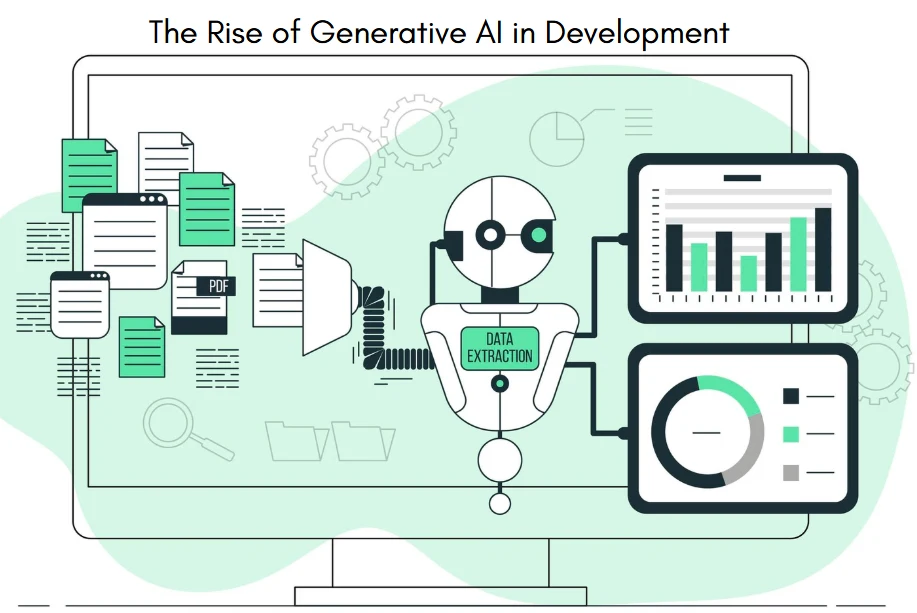
is set to be a transformative force in the future of software development. With generative AI tools alongside, developers are not just using tools but partnering with intelligent collaborators who can contribute to the development process. Just as the sophistication of an AI model continues to evolve,
natural language processing
(NLP) models will advance to the point where developers can describe a feature, function, or UI element in some sort of plain English, and generative AI tools will take those words and transform them into actual code. We're only beginning to see the systematic shift that will change how we write software.
Generative AI will soon create software applications alongside application developers, will auto-suggest architectures, and will conduct code reviews. Developers will be reliant on generative AI for rapid prototyping, system design, bug and issue fixing, and optimization. The union of the developer and generative AI will substantially improve problem-solving speed, improve code quality, and create a cycle of continuous improvement and innovation.
The emergence of low-code and no-code generative AI platforms will also play a large role here, allowing users with no coding experience to build applications with minimal input. This will open up application development to millions of new developers, which will accelerate the digital transformation process in every industry, and particularly for startups and small businesses that have limited engineering resources. The benefits of AI in software development also extend to democratizing software creation, empowering non-technical users, and enhancing development speed.Generative AI is not an assistant, but rather a partner in the creative and technical process. As the technology continues to mature over time, development teams that embrace these tools and productivity claims will evolve their productivity, smarter automation, and faster innovation cycles. The benefits of AI in software development include improving productivity, enabling smarter automation, and supporting continuous innovation. By leveraging generative AI, organizations can unlock the benefits of AI in software development through more efficient workflows, better decision-making, and scalable solutions.
Also Read: Choosing the Top Enterprise AI Development Firm for Your Company
Conclusion
The Benefits of
AI in Software Development
reach beyond automation. There is higher quality coding, productivity with teams, and innovation through collaboration, all happening through
AI Development Company in USA
and application.
By embracing newer AI (and generative AI) capabilities, companies can become differentiators when building digital products that fight for customer attention, while producing clever, faster, and more customer-driven applications.
Meet the Author

Co-Founder, Rytsense Technologies
Karthik is the Co-Founder of Rytsense Technologies, where he leads cutting-edge projects at the intersection of Data Science and Generative AI. With nearly a decade of hands-on experience in data-driven innovation, he has helped businesses unlock value from complex data through advanced analytics, machine learning, and AI-powered solutions. Currently, his focus is on building next-generation Generative AI applications that are reshaping the way enterprises operate and scale. When not architecting AI systems, Karthik explores the evolving future of technology, where creativity meets intelligence.