Key Takeaways
Python is used by 90% of AI developers because of extensive libraries like PyTorch and TensorFlow. There's a balance between Python and C++, which is important. C++ powers real-time systems, R excels in statistics and Java dominates enterprise environments. AI systems have a lot of languages with each having unique strength. Cloud-native designs are now influencing future AI development trends.
Which programming languages are used most often in AI development?
AI technology is now becoming commonplace in modern life with AI’s widespread adoption, it is crucial to know which programming languages are used most often in AI development. It is particularly important for developers, entrepreneurs, or anyone interested in the field of AI.
Python has to be the most popular programming language in AI Development, especially for AI technologies for 90% of AI developers. The reason for Python's popularity can be the ease of its grammar, its versatile AI libraries such as TensorFlow, PyTorch, Scikit-learn, and its greatly supportive frameworks for performing machine learning tasks. An important aspect of Python is its AI tools. Important tech firms like Google, Netflix, and Instagram use Python for building their AI tools, which in turn reinforces its popularity.
Python has two most suitable competitors. The most prominent of which is R, which stands in the second position, especially for data science and analysis. It has strong capabilities for performing complex modeling and visualization of data, and is good for research in an academic setting where mathematics is very rigorous. Java also maintains a strong stand in the enterprise world due to its good scalability and capability to integrate with the established business systems. This is the main reason for the big financial business.
Efficiency and speed are the two most critical features for AI applications, and very popular frameworks and real-time applications, such as self-driving cars and robotics, are powered by C++. It also has core engines for propelling JavaScript for AI technologies to be used in browsers. This allows the use of client-side machine learning with tools such as TensorFlow.js, which is also available alongside C++.
Some of the other languages that stand out to me in comparison are Scala with Apache Spark for big data. Julia is for scientific computing, and within modern AI development, LISP and Prolog specialize in symbolic AI mathematics and are very niche.
An AI project may get great benefit or suffer from the choice of programming languages. With this guide, even if you are a novice or a seasoned developer, you will have the resources and knowledge to make informed decisions on AI programming languages.
Why to select a Programming Language in AI Development
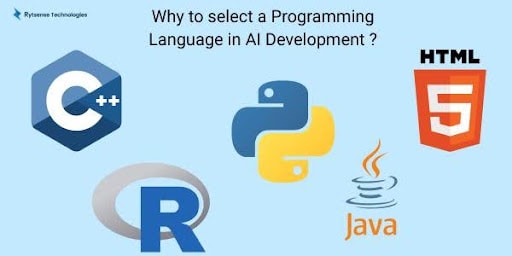
Choosing the right programming language may risen the development's quality, give access to advanced libraries, and can allow the AI system to function optimally. Conversely, selecting the incorrect language can introduce system complications, slow performance, and limit the system to deprecated AI technologies.
When you think which programming languages are used most often in ai development, it has language's ecosystem of libraries, community support, ease of learning, and performance, to name a few, are certain factors to consider when you select a language for AI. Additionally, for tasks such as machine learning, natural language processing, and computer vision, the performance of the language in question, alongside its user base and community, is of high importance.
The Undisputed Leader: Python
In the debates and discussions surrounding the most appropriate language for AI and its development, Python takes a central position. The high-level, general-purpose programming language is well known, much appreciated, and often favored as the go-to AI language, and for a multitude of reasons.
Python continues to top the logic chart for AI development owing to its easy-to-read code. The AI developers can seamlessly tackle advanced challenges without having to deal with complex code structures. Python's code philosophy, which states “readability counts,” further reinforces its position for AI development that largely involves testing.
The Factors Behind Python's Popularity in AI Development
There are many reasons why Python is so popular and common in AI development. For one, the language has many traits and features that make it especially suited for AI projects.
Python's greatest advantage is its comprehensive suite of AI-related libraries. NumPy's N-dimensional arrays and associated mathematical functions, and Pandas's high-performance data structures for data manipulation and analysis are just a few examples of Python's AI-related libraries. Furthermore, the comprehensive machine learning tools for classification, regression, and clustering provided by Scikit-learn make it one of the best libraries for machine learning.
When it comes to deep learning, Python has got the most popular frameworks. TensorFlow, Google's open-source platform, offers best and end-to-end solutions for machine learning at scale. PyTorch is developed by Meta, provides flexible and intuitive tools for research and development.
Data collection & cleaning, along with model training and deployment, are vital in AI development. Python's capabilities and its ability to excel in data science workflows make it one of the primary languages in AI development, as it guarantees support for the entire machine learning pipeline.
The Applications of AI Using Python
Python is a well-known computer programming language useful for artificial intelligence because of its extensive applications. For example, in natural language processing projects, Python is used extensively in libraries NLTK and spaCy for text processing and analysis, while in computer vision, image processing, and analysis are performed using OpenCV and PIL.
Python-based AI systems are used by many AI-powered systems of large technology companies such as Netflix, Spotify, and Instagram, which employ Python-based AI systems for Netflix's recommendation algorithms, music recommendation systems, and photo tagging, respectively. The adoption of Python by such key industry players only reaffirms Python's standing as one of the most popular and frequently used programming languages in AI development.
R: A Powerhouse in Statistics
As Python is popular and well-known, R has its place as one of the most used programming languages for AI, mostly in the context of statistical analysis and data science. R is a programming language created for statistical computing & graphics, which makes it a potent asset for certain AI applications.
R's key strength is its thorough statistical analysis as well as sophisticated visualization of data. Unlike various programming languages, R is built to deal with difficult statistical operations and producing graphics that can be published in high quality. This specialization makes it invaluable for AI projects that require rigorous statistical analysis.
R's Implementation in AI Development
R's strengths stem from its precision in modeling and interpreting results. In AI applications across healthcare, R's statistical prowess comes into play, especially in predictive analytics, where deciphering the logic behind a prediction is crucial. Financial institutions also rely on R for risk modeling and fraud detection systems.
Equally notable is R's extensive ecosystem of packages, especially the Tidyverse compilation, which offers unrivaled capabilities for statistical data manipulation, modeling, and visualization. In AI, data and results visualization are of utmost importance. For that purpose, R provides ggplot2, which creates stunning visualizations that help AI developers understand their data and communicate results.
AI developers in academia prefer R, especially for statistically oriented AI projects, because implementing and validating complex models is straightforward. This combination of adoption and ease has resulted in a steady flow of advanced AI methods being implemented in R prior to being translated to other languages.
C++: The Performance Champion
In the AI development landscape, C++ is not the first language one associates with the field. However, it is instrumental. The language is at the forefront of low-level programming. Systems with AI capabilities rely heavily on C++ for efficient, high-level performance.
C++ is clearly the programming language of choice in instances when speed and execution time are vital. This is the case for most of the modern AI frameworks, which are based on the C-like syntax programming language, for instance, TensorFlow and PyTorch. This ensures the requisite speed for efficiently training huge neural network models and sifting through massive datasets.
C++ in Modern AI Systems
The use of C++ in AI applications is clearly reinforced by the C++ advantages. One of the most exciting and emerging fields of AI—autonomous cars—requires instantaneous processing of data coming in from sensors. Each millisecond of data is critical and can pose safety and security challenges. Split-second decisions based on market information are critical for high-frequency trading systems. In these instances, one cannot substitute the critical and core value of speed that C++ adds.
The applications of robotics systems, C++ programming for AI systems, are in the training of robotics systems geared toward interpreting visual data, dealing with information, and controlling mechanical actuators in real-time C++. This programming language is crucial to the responsiveness and reliability of the systems, which is the reason C++ remains one of the most preferred programming languages for real-time and embedded AI systems.
The programming language's ability to interface with hardware directly translates to value in specialized hardware such as GPUs, for parallel computing in deep learning frameworks. Specialized hardware in AI accelerators, C++ is widely used as one of the most specialized programming languages.
Java: Enterprise AI Development
Although less renowned than Python, Java holds significant value in the AI development domain. With the primary focus targeted at the enterprise, the language offers reliability, flexibility, seamless new adoptee, and AI adoption integrations, which AI-enabled applications at the enterprise level necessitate.
The advantage of Java is the one for all principle, making it useful for AI systems intended to work in multiple and varying platforms and environments. Large and single union with multiple and diverse branches often encounter complicated and cross-sectional IT systems. Java's independence, bypassing many enterprise-level hurdles, makes AI integration way smoother than it used to be.
Java's Enterprise AI Strengths
Using Java to incorporate AI into enterprise systems is the highly used, most optimal and advantageous move for enterprise-focused firms when somebody asks which programming languages are used most often in ai development. Most of the large enterprises operate within a well-established Java ecosystem, keeping everything in the same language, which makes everything a lot simpler when trying to add new features such as AI. Java's integration advantages are one of the reasons it is among the most used in corporate environments.
The language’s sophisticated development tools and strong typing system structure make it useful for large-scale AI projects, which require code maintainability and collaboration between multiple teams. Java’s integrated ecosystem of enterprise libraries and frameworks offers powerful tools for constructing scalable AI systems that are capable of enterprise-level workloads.
JavaScript: AI in the Browser
The application of JavaScript in AI development may catch some off guard, but it has certainly found its clients in the browser-based AI application. JavaScript makes it possible for AI to operate in web browsers through the use of TensorFlow.js and other browser-centered AI frameworks.
The reasoning for using this AI application is very compelling. AI models processing and computation on a client’s device enables a delay-free response, enhancing real-time interaction. Privacy improves as sensitive information is not required to leave the device for processing. The server’s burden is minimized on operating costs owing to the dispersion of computation to the clients’ devices.
JavaScript AI Applications
Browser AI applications, like real-time video conferencing with background blurring, sign language interpretation, and augmented reality filters, use AI powered by JavaScript within the browser. These applications show and know the growing importance of JavaScript in regard to its interoperability with web technologies and its adoption as one of the primary languages for AI programming.
It is more accessible to web developers. Web developers can build intelligent applications with ease, as they do not need to learn a new language. Thus, the ease of adoption and development is instrumental in the growing availability of development frameworks powered by AI technologies.
Specialized Languages for Specific AI Domains
In the context of which programming languages are used most often in ai development, there is a tremendous need to address the existence of domain-specific languages, especially Julia, which are overshadowed by more popular languages.
Julia: Scientific Computing and AI
Julia is one of the more recent languages that high-performance scientific computing has adopted when you think about which programming languages are used most often in ai development. It is intended to solve the “two-language problem” where the conventional approach is to build a prototype in a low-performing language, such as Python, and rewrite it in a performant language, such as C++. Julia, on the other hand, offers a simple development environment and is efficient for execution.
In scientific machine learning applications, where AI models need to interface with intricate physical simulations, Julia’s focus on mathematics and its performance attributes make it particularly useful. Julia’s capabilities are appreciated in climate modeling, pharmaceutical research, and in-depth financial modeling, which are emerging as new frontiers for programming languages most utilized in AI.
Scala: Big Data AI
Scala’s AI applications that involve working with large datasets benefit greatly from its close association with Apache Spark. Its functional programming capabilities are particularly suited for applications in distributed computing, providing ease in executing large-scale data processing, and aiding in feeding AI systems.
Lisp and Prolog: Symbolic AI
While furthering breakthroughs in AI, the majority of the focus has been on working with its statistical side. However, there are some important applications for symbolic AI. Because it is centered on symbol computation and logic, Prolog and Lisp retain their usefulness for expert systems and knowledge representation.
New Trends in AI Programming Languages
As new languages and features are added, the AI landscape only promises to evolve further. AI programming is receiving more focus with the following developments in mind:
The expectation is being set for new AI programming languages with even more targeted capabilities. These specialized languages offer optimized abstractions and tools, sparing working for and with competing generic-purpose languages, to boost efficiency with regard to performance and productivity.
As quantum algorithms evolve, they will enable practitioners to run certain classes of computations on quantum forms of AI more efficiently, integrating quantum algorithms with AI computations. Hence, the current development of quantum computing languages such as Q# and Qiskit will emerge in connection with the advancement of quantum AI.
The advancement of AI technologies through cloud services is changing the adoption of new languages and frameworks as they evolve to suit cloud-native designs, thus reshaping the most popular programming languages associated with AI development as businesses switch to cloud AI.
Also Read: AI Decision Making: Benefits, Challenges & Future Trends
Choosing the Most Appropriate Language for Your AI Initiative
To select the most effective AI language for your project, when you wonder which programming languages are used most often in ai development, you should go through the most popular languages associated with AI development, dividing them based on more specific project requirements.
The Role of AI Development Companies
Notably, the top AI development companies in USA and across the globe deeply understand multiple languages. This multi-language capability enables the companies to select the optimal technology stack for each project.
Familiarity with various languages and their intricate nuances enables the best AI development company in USA to understand that each project has distinct requirements. They have adept programmers in different languages to ensure that the best solution is provided for every client's needs. This flexibility is often a deciding factor in competition in the industry.
Building AI Teams and Skills
Organizations striving to enhance their internal AI capabilities should focus on the most critical programming languages in AI to design a hiring and training strategy. The most versatile AI developers have experience with multiple languages and are readily able to select the right tool for every task.
No AI team can forego basic Python skills. Equally, teams that focus on improving application performance should have C++ skills. Organizations with a significant enterprise infrastructure are greatly aided by Java AI capabilities. At the same time, teams that conduct research require R skills and are often in need.
A more effective method would be to build a team with a full range of programming languages to cover the most commonly used ones in AI development instead of concentrating on a single language. This type of diversity guarantees the successful completion of a project with the most suitable technology stack.
Also Read: Latest AI Developments
Future Considerations for AI Development
With the advancement of technology, the programming languages used will surely change. There is potential for new languages to be created specifically for AI workloads. Existing languages, on the other hand, will keep evolving to provide better support for AI.
As edge computing becomes more significant for AI, resource-constrained devices will be a priority. This may expedite the adoption of programming languages better suited for edge devices. The expansion of AI hardware accelerators may somehow shift language popularity depending on how well they exploit specialized processors.
Selecting the Most Appropriate AI Programming Language For Your AI Platform
It single-handedly defines the success of the project. This decision is critical in its consideration of several constituent parts that would fit the specific needs of the planned objectives.
First, you may check the main focus of the said project. For example, if the goal is to construct machine learning algorithms to perform data analysis, then Python, with its extensive frameworks and libraries, is the language of choice. For real-time systems that demand a high degree of performance, C++ would outperform its competitors in both speed and efficiency, as it is the most performant language used for executing GPU algorithms.
When you think of which programming languages are used most often in ai development, another consideration would be the knowledge base of your team. This issue is interrelated with the idea of selecting the most appropriate programming language. For example, if a specific layer of the platform is already written in Java, and the team uses Java, then it would cost less to keep on adding on the Python layer instead of rewriting the whole system in Java.
Also, the scope and complexity of your AI platform would affect the programming language to be used. Java is a safe option for enterprise-level applications because of its structural robustness and ease of scale. For some research-oriented projects, R is a well-regarded statistical programming language, while Python is best- known for its ease of prototype development.
For companies who want to look to develop an advanced AI platform, engaging seasoned AI development firms can be invaluable. Language selection and implementation can be expertly addressed. Rytsense Technologies offers comprehensive AI development services with deep expertise across multiple programming languages used most often in AI development.
Having provided proven AI technologies across multiple markets, Rytsense Technologies is in a position to assist in traversing the multifaceted world of AI programming languages and the technology stack that best serves the project. His understanding of the distinctiveness of different programming languages positions AI developers to direct clients to the best choices that match their AI platform’s needs.
If you require rapid prototyping in Python, high-performance computing in C++, or even enterprise-grade solutions in Java, Rytsense Technologies has the right solutions to all your problems, with the added benefit of having the results surpass your expectations.
Conclusion
The most effective combinations of solutions for AI when sourcing for which programming languages are used most often in ai development, usually has parts developed in different programming languages. Part of the logic in machine learning can be developed using Python, while the performance-critical sections can be developed in C++. Interfaces for browsers can be done in JavaScript, and the more advanced statistical operations can be done in R. In AI development, blended solutions are more effective, so knowing how and when to use each language is important.
AI development is forever changing and upgrading. For somebody who is trying to be the best Python user in the world, I would recommend focusing on new languages and innovations.
The approach to partition recommendation systems, autonomous vehicles, or conversational AI systems does not matter. They all share the same paradigms: you do not need to be the best in one programming language, but rather use the right one and the appropriate tools to master the programming languages that surround AI.
Meet the Author

Co-Founder, Rytsense Technologies
Karthik is the Co-Founder of Rytsense Technologies, where he leads cutting-edge projects at the intersection of Data Science and Generative AI. With nearly a decade of hands-on experience in data-driven innovation, he has helped businesses unlock value from complex data through advanced analytics, machine learning, and AI-powered solutions. Currently, his focus is on building next-generation Generative AI applications that are reshaping the way enterprises operate and scale. When not architecting AI systems, Karthik explores the evolving future of technology, where creativity meets intelligence.