-
Key Takeaways
- “Code Red” is not a crisis, but a strategic reset signaling OpenAI’s renewed focus on ChatGPT performance and reliability.
- Google’s Gemini 3 has become a serious competitive threat, pushing OpenAI to accelerate innovation.
- Core AI quality now matters more than feature expansion, with speed, accuracy, and reasoning taking priority.
- GPT-5.2 reflects OpenAI’s rapid-response strategy under competitive pressure.
- The AI industry has entered a permanent competition phase, where leadership must be continuously defended.
OpenAI Declares ‘Code Red’ - The AI Race With Google Has Entered a New Phase
In a dramatic turn for the generative AI industry, OpenAI CEO Sam Altman has declared an internal “Code Red” an urgent company-wide mandate to improve ChatGPT as competitors like Google’s Gemini 3 surge ahead in performance and market momentum, according to reports from The Wall Street Journal.
This blog explores what Code Red in AI actually means, why it matters, and how it may reshape the future of artificial intelligence tools used by millions daily.
What Is OpenAI’s “Code Red”?
In early December 2025, Sam Altman sent a company-wide memo declaring a Code Red at OpenAI signaling an emergency-level focus on improving ChatGPT’s core AI capabilities.
Unlike a regular update cycle, a Code Red means:
- Redirecting engineering resources to prioritize ChatGPT improvements
- Pausing or delaying other initiatives like AI agents, AI advertising, and personal AI assistants
- Intensifying development timelines to accelerate AI model releases and quality upgrades
This is the most decisive signal yet that OpenAI feels real pressure from rivals encroaching on its AI leadership.
Why Now? The Threat From Google’s Gemini 3
OpenAI’s urgency stems from the rapid rise of Google Gemini 3, which has been outperforming OpenAI’s existing GPT models on key AI benchmarks and gaining attention from both AI developers and enterprise AI users.
Experts point to three main reasons Gemini’s growth matters:
- Superior performance metrics especially in AI reasoning, long-context handling, and coding tasks
- Google’s AI infrastructure advantage combining massive data centers with custom silicon and seamless product integration
- Growing AI adoption and ecosystem integration, especially among developers and businesses seeking scalable AI systems
As competition intensifies, OpenAI is racing to respond before its AI market share declines further.
What’s Being Prioritized Under “Code Red”?
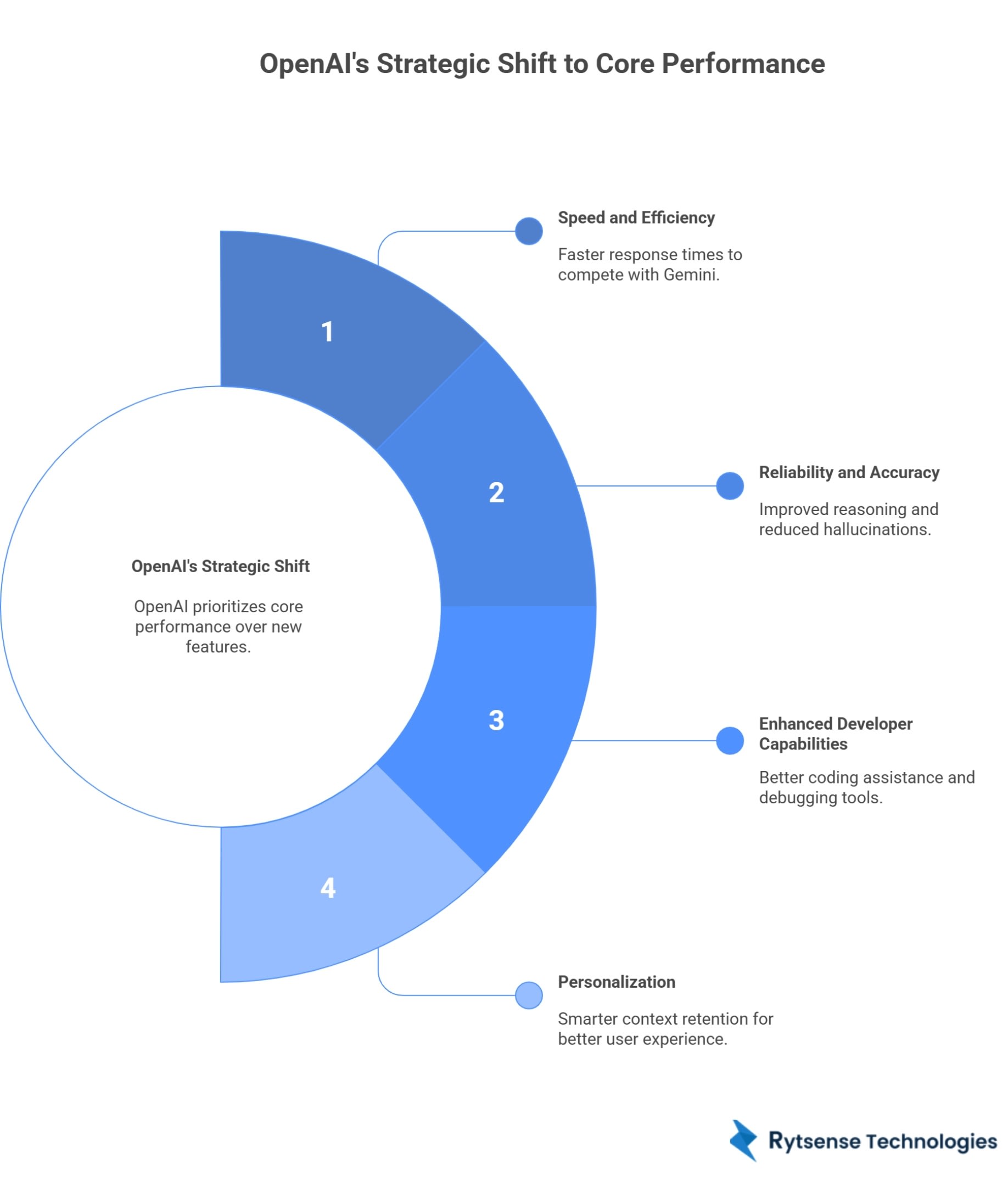
Instead of adding flashy new features, OpenAI is sharpening its focus on core performance and reliability, including:
-
Speed and Efficiency
Faster response times and reduced latency to compete with Gemini’s responsiveness. -
Reliability and Accuracy
Improved reasoning, reduced hallucinations, and more consistent outputs. -
Enhanced Developer Capabilities
Better coding assistance, debugging help, and improved performance on complex tasks. -
Personalization
Smarter context retention to boost user experience over long interactions.
This means some previously planned features, like ad-based monetization tools or shopping assistants, are now on hold.
The Launch of GPT-5.2 — The First Product of a Code Red Push
OpenAI’s declaration of Code Red was quickly followed by the release of GPT-5.2, signaling that the internal urgency was not symbolic but operational. The model rollout came just days after the announcement, underscoring how seriously OpenAI is treating competitive pressure in the AI landscape.
Rather than positioning GPT-5.2 as a radical redesign, OpenAI appears to have focused on measurable improvements to core capabilities, the exact areas highlighted under the Code Red mandate.
Improved Reasoning and Coding Quality
One of the most visible upgrades in GPT-5.2 is its stronger performance in logical reasoning and software development tasks.
Key improvements include:
- Better handling of multi-step reasoning and complex problem-solving
- More accurate and structured coding outputs across common programming languages
- Improved explanation quality for technical concepts and code logic
- Reduced errors in longer or more complex prompts
These refinements are especially important as ChatGPT continues to be used as a daily tool by developers, engineers, and technical teams, where reliability directly affects productivity.
Stronger General Intelligence Benchmarks
GPT-5.2 also shows gains in general intelligence benchmarks, which measure how well a model performs across a wide range of tasks rather than excelling in narrow domains.
This includes:
- Better understanding of nuanced prompts
- Improved contextual awareness in long conversations
- More consistent performance across knowledge, reasoning, and creative tasks
By strengthening general-purpose intelligence, OpenAI aims to ensure ChatGPT remains competitive not just in isolated use cases, but as a versatile AI assistant across industries.
Enhanced Performance for Business and Productivity Workflows
Another major focus of GPT-5.2 is its suitability for business workflows and enterprise use cases.
Improvements are evident in:
- More reliable outputs for decision-support tasks
- Stronger summarization and analysis capabilities
- Better consistency in professional and operational contexts
- Improved performance in repetitive, high-volume tasks
These enhancements reflect OpenAI’s growing emphasis on enterprise adoption, where predictability, accuracy, and scalability matter more than experimental features.
Why GPT-5.2 Reflects a Code Red Strategy
The timing and focus of GPT-5.2 suggest it is a direct product of the Code Red push, rather than a routine release. Instead of introducing consumer-facing novelty, OpenAI prioritized:
- Performance gains over feature expansion
- Stability over experimentation
- Competitive benchmarks over long-term moonshots
This approach aligns with the company’s immediate goal: reasserting leadership in a rapidly tightening AI race, particularly as competitors demonstrate strong gains in model quality and efficiency.
What It Means for Users and Developers
This “code red” situation has several implications for everyday users and the broader AI community:
Better Everyday AI Interactions
Users may experience:
- Faster ChatGPT responses
- More accurate AI-generated answers
- Stronger AI-powered coding support
Temporary Instability
Fast-tracked development can introduce:
- Bugs or regressions
- Feature inconsistencies across AI model versions
- Behavioral changes developers must adapt to
A Shift in AI Market Dynamics
Google, OpenAI, Anthropic, and others are now in a true performance war pushing innovation forward but also accelerating the pace of change in AI development standards.
A Historic Moment in the AI Arms Race
Just a few years ago, OpenAI dominated generative AI. Today, competition is intense enough to trigger a company-wide Code Red.
This marks a transition from AI market dominance to continuous AI competition, reshaping how artificial intelligence companies operate.
Final Thoughts: What Should You Watch Next?
As we move into 2026, here’s what to keep an eye on:
- Future GPT releases and enhancements
- Benchmark comparisons between ChatGPT and Gemini series models
- Enterprise AI adoption trends and preferences
- Regulatory and safety debates as models grow more capable
OpenAI’s code red might be a sprint but it’s one with long-term implications for millions of users and countless businesses integrating AI into their future.
Stay ahead of rapid AI shifts like OpenAI’s Code Red. Learn how advanced AI models can be applied responsibly and effectively to real business use cases.
Meet the Author

Karthikeyan
Connect on LinkedInCo-Founder, Rytsense Technologies
Karthik is the Co-Founder of Rytsense Technologies, where he leads cutting-edge projects at the intersection of Data Science and Generative AI. With nearly a decade of hands-on experience in data-driven innovation, he has helped businesses unlock value from complex data through advanced analytics, machine learning, and AI-powered solutions. Currently, his focus is on building next-generation Generative AI applications that are reshaping the way enterprises operate and scale. When not architecting AI systems, Karthik explores the evolving future of technology, where creativity meets intelligence.