How to Become AI Developer: Skills, Courses & Roadmap
Introduction
Artificial Intelligence
(AI) is no longer ‘in the future’ – it’s now! AI is here and is changing the world, from self-driving cars and virtual assistants to recommendation systems and fraud detection.
With companies further incorporating AI into every aspect of their businesses, the need for trained AI programmers has never been greater.
If you’re wondering how to become an AI developer or looking to build a career in this exciting field, you’re in the right place.
Our complete guide to becoming an
AI development company in USA
covers everything you need—from the essential skills to learn, to the tools and platforms that will set you up for success in AI.
According to 2026
, industries using AI have seen productivity grow nearly fourfold, from 7% to 27%.
Workers with AI skills now earn a 56% higher wage on average, and job postings for AI-related roles have increased by 38%, showing AI is boosting both productivity and employment opportunities.
What is an AI Developer and What Do They Do?

"AI developers" are a type of software specialist who build, design, and deploy systems that possess human-like thinking and decision-making capabilities.
They are based on
machine learning
(ML),
deep learning
(DL), and advanced algorithms that enable computers to learn from data and perform challenging tasks just as humans do, but without explicit programming.
An AI engineer tends to have their hand in multiple pies, like:
- Creating chatbots with NLP in the cloud
- Building recommender systems at e-commerce organizations
- Building self-driving systems
- Adoption of AI-driven image and voice recognition capabilities
In contemporary AI engineering, AI developers are instrumental in combining classic programming languages, such as
Python
, Java, or C++, with the latest AI frameworks such as
TensorFlow
, PyTorch, and Scikit-learn to create intelligent and scalable solutions.
These team members work together closely with AI engineers, data scientists, and research teams to translate AI-powered concepts into reality.
How to Become AI Developer
If you’re trying to figure out how to become AI developer, generally you need to take the following steps:
Become Proficient in Programming:
Study a popular programming language, such as Python, known for its AI development-friendly libraries and community.
- Learn AI Basics — Learn the fundamentals of AI, such as neural networks, supervised and unsupervised learning, and model evaluation.
- Dive Into Machine Learning and Deep Learning: Deeper explore the world of machine learning and deep learning.
- Trails: Practice what you learn by developing AI applications, contributing to open source AI projects, or interning at a startup that focuses on AI engineering.
- Stay Current and Focus: The artificial intelligence field moves quickly. Specialise in NLP or computer vision, or robotics to make more in the market.
Also Read: How to Develop AI: Step-by-Step Guide for Beginners
How to Become AI Developer: Foundational Skills and Tools You Must Learn
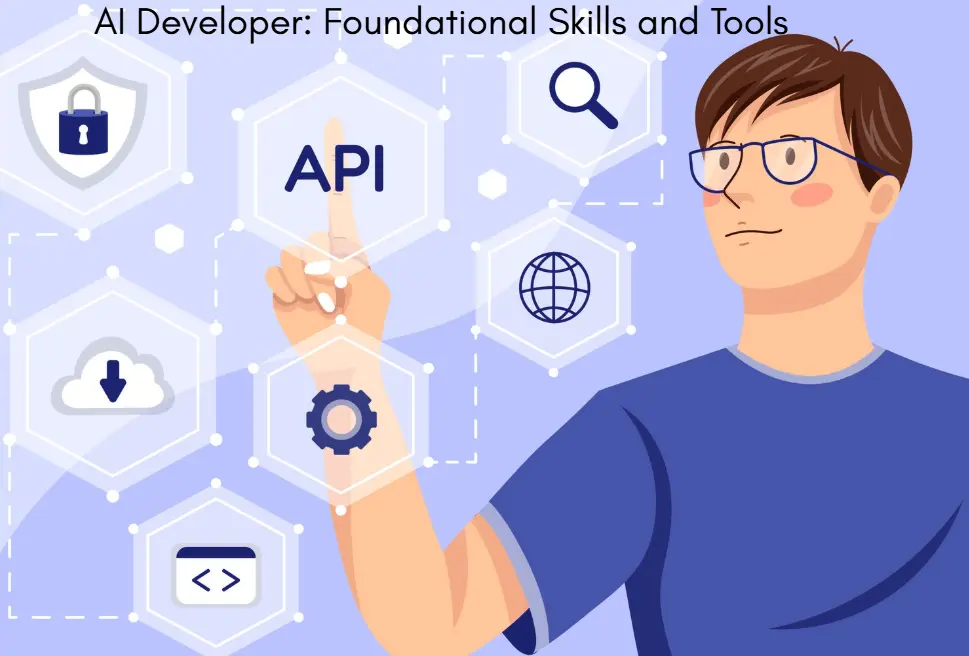
If you are serious about becoming an AI engineer, start by building a strong foundation in both theoretical and practical knowledge.
Programming Language Proficiency
Clean syntax and the abundance of libraries like NumPy, Pandas, TensorFlow, and PyTorch have made Python the most popular language for AI. We also work with
hiring Java Developers
, C++, and R depending on the project.
Mathematics and Statistics
AI is powered by math. You need strong skills in:
● Linear Algebra (vectors, matrices)
● Calculus (derivatives, gradients)
● Probability and Statistics (Bayesian methods, distributions, etc.)
● These are the basic constructs in most machine learning and AI systems.
Machine Learning & Deep Learning
- It’s essential to understand how machine learning works. Learn about:
- Supervised, unsupervised, and reinforcement learning
- Algorithms such as decision trees, SVM, and K-nearest neighbors
- Deep learning approaches such as neural networks, CNNs, RNNs, and LSTMs
Natural Language Processing (NLP)
NLP powers applications like chatbots and voice assistants, making it a crucial domain.
● Tokenization and embeddings
● Sequence-to-sequence models
● Transformers and attention mechanisms
Data Science and Big Data
AI development is driven by massive amounts of data. Key data science skills include:
● Data cleaning and preprocessing
● Exploratory Data Analysis (EDA)
AI Tools and Frameworks
● TensorFlow and Keras: Deep learning
● PyTorch: Research and model prototyping
● Scikit-learn: Traditional machine learning
● Hugging Face Transformers: State-of-the-art
Natural Language Processing
for TensorFlow and PyTorch.
Also Read: How AI Decision-Making Is Transforming Industries Across the Globe
How to become AI developer: a step-by-step guide

So this is a tried and tested roadmap you might want to embark upon if you want to go into AI development:
Step 1: Get Started With Programming
Start with Python. Get comfortable with:
- Variables and data types
- Loops, conditions, and functions
- List and dictionary
- Object-oriented programming
Step 2: Learn Mathematics for AI
Bring an inquisitive mind and adequate mathematical knowledge. Take a course in Mathematics for AI—this will help you solve complex problems by understanding the algorithms involved.
Focus on:
- Linear algebra: matrix operations, eigenvalues
- Statistics: descriptive and inferential
- Calculus: derivatives for optimization
Use online resources to build confidence.
Step 3: Investigate Machine Learning Algorithms
Learn ML through projects—it's a great way to demystify machine learning.
- Predict house prices
- Spam detection using Naive Bayes
- Customer segmentation with K-means
Step 4: Now, Go to Deep Learning
Learn about:
- Neural networks
- Activation functions
- Backpropagation and optimization
Build projects like:
- Image recognition using CNN
- Text classification using RNN
- GANs for image generation
Step 5: Play with NLP and Generative AI
Work on:
- Sentiment analysis
- Chatbot development
- Transformers for language translation (e.g., BERT, GPT)
- Explore generative AI tools such as ChatGPT, Claude, and Bard to learn prompt engineering and LLMs.
Step 6: Build AI Projects
Practice is key. Build hands-on AI projects to demonstrate your skills:
- Face detection app
- Voice assistant
- AI recommendation engine
- Fraud detection system
- Host your code on GitHub and document your process.
Step 7: Learn AI Frameworks
Begin working with the tools that the pros use:
- TensorFlow for production-ready deployment
- PyTorch for research and experimentation
- Scikit-learn for quick modeling
- OpenCV for computer vision
Step 8: Master Data Science and Big Data
Once you’re confident with basic scripts, bring your skills into data science and big data.
Understand how to:
- Process structured and unstructured data
- Use SQL and NoSQL databases
- Plot data with Matplotlib, Seaborn, PowerBI, etc.
Step 9: Specialization
Follow AI news, blogs, and research papers.
You can specialize in:
- NLP Engineer
- Computer Vision Engineer
- Data Scientist
- Robotics Engineer
- AI Researcher
Also Read: What Is AI Product Development? Process, Tools & Examples
How to Become AI Developer in 2026 and Why Skilled Talent Is So Hard to Find
AI Developer
roles are highly sought after in 2026 as the technology is rapidly deployed across sectors. Businesses are implementing AI systems to automate tasks, enhance customer experience, and provide data-driven intelligence—which means they need talent that can develop and implement intelligent solutions.
Key Reasons for High Demand:
1. Widespread AI Adoption Across Industries
Healthcare, finance, retail, and logistics companies are all employing AI tools and models for tasks such as predicting diagnoses, detecting fraud, deploying chatbots, and providing smart recommendations. This widespread prevalence has led to the necessity of AI developers.
2. Shortage of Skilled AI Talent
Demand for AI engineers is on the rise, but the number of builders proficient in machine learning, deep learning, natural language processing, and AI software development is far behind—inflating demand and wages.
3. Emergence of Generative AI and LLMs
Generative AI models like ChatGPT, Claude, and Gemini have reshaped the market, forcing companies to hire developers who can fine-tune or integrate large language models into business workflows.
4. Competitive Advantage Through AI
Companies are heavily investing in AI to stay competitive. Those who get AI right can cut costs, improve operational efficiency, and deliver a superior customer experience—making AI developers valuable strategic assets.
5. Increased Investment in AI Startups
It’s a time of unprecedented funding for AI startups and tools, creating a rush to hire AI developers and engineers to build novel products and features.
Also Read: What is the AI App Development Cost in 2026?
Exploring AI vs. ML Careers: What Sets the Roles Apart
Amidst all of the industries reshaped by artificial intelligence, there are two job titles that are particularly likely to be mixed up: AI developer and machine learning (ML) developer. Although the titles are closely related and sometimes interchangeable, there are certain nuances in focus, skills, and responsibilities. This distinction is important to know if you're learning how to become AI developer company or if you're thinking about AI engineering as a career.
AI Developer
An
AI chatbot development services
create intelligent systems that can make decisions, learn, and reason like a human. Their job may involve mixing several AI disciplines, like machine learning, deep learning, computer vision, and natural language processing. They build AI-based applications that can learn, adapt, and get better over time.
Key Responsibilities of an AI Developer:
Here are a few tasks that the artificial intelligence developer is responsible for
- Developing AI-based applications (like chatbots, recommendation engines)
- AI in real-life software solutions
- Using AI principles to build fair, scalable systems
ML Developer
The role of a machine learning developer, of course, is particularly centered on developing and tuning machine learning models. Although they’re also part of the wider AI developer category, ML developers are more often focused on data and algorithmic accuracy than full AI systems.
What Does an ML Developer Do?
- Building and training machine learning models
- Handling data for training and validating the model
- Statistical approach to model performance assessment
- Hyperparameter tuning and model in production
- ML developers frequently collaborate with data scientists and specialize in predictive analytics, classification models, or anomaly detection.
Also Read: AI and Machine Learning Development Services: What’s Included?
AI Developer Roles and Earnings
With the rise in artificial intelligence (AI), jobs in AI-driven sectors are also on the rise. No matter if you're taking the first step to be an AI developer or thinking about transitioning to hire AI engineers, knowing what the positions are and how much they pay is a must.
1. AI Developer
Role: Develops with machine learning, deep learning, and NLP, and develops AI-powered apps and intelligent systems.
- Average Salary (Global): $110,000 – $150,000/year
- India: ₹10 – ₹30 LPA
- Remote (Freelance): $50 – $100/hour
2. Machine Learning Engineer
Role: Builds and tunes machine learning models.
- Median Salary (Global): $120,000 – $160,000/year
- India: ₹12 – ₹35 LPA
- Remote: $60 – $120/hour
3. AI Engineer
Function: A more general title commonly for those who develop and deploy AI systems in real-world, production settings. This is a role which sits in the middle of AI dev and engineering, so you'll be looking at scale, performance and integration.
- Mean Salary (Worldwide): $130,000 – $170,000 per Annum
- India: ₹15 – ₹40 LPA
- Remote: $70 – $130/hour
4. Deep Learning Engineer
Role: Concentrates on developing and deep learning.
- Average Salary (Worldwide): $140,000 – $180,000 per year
- India: ₹18 – ₹45 LPA
- Remote: $80 – $140/hour
5. NLP Engineer (Natural Language Processing)
Role: Develop models for sentiment analysis, translation, text generation, and chatbots, among other natural language processing applications. This role has become essential with the emergence of LLMs and AI tools, such as ChatGPT.
- Average Salary (Worldwide): $125,000 – $165,000. Annual pay for this level of responsibility is satisfactory.
- India: ₹16 – ₹42 LPA
- Remote: $75 – $135/hour
6. Computer Vision Engineer
Role: Creates software to analyze visual information for facial recognition, self-driving cars, and medical imaging. It primarily depends on deep learning networks such as CNNs.
- Average Salary (Global): $130,000 – $175,000/yr
- India: ₹14 – ₹38 LPA
- Remote: $70 – $130/hour
7. AI Research Scientist
Role: Works on advanced research related to artificial intelligence. This role is research-intensive and includes publication, experimentation with novel AI models, and state-of-the-art AI development techniques.
- Average Salary (Worldwide): $150,000 – $220,000/year
- India: ₹20 – ₹50 LPA
- Remote: $90 – $150/hour
8. AI Architect
Role: Design upper-level AI engineering solutions, constructions, and frameworks. It works closely with data engineers and developers as well as stakeholders to guide AI system alignment with business goals.
- Average Salary (Worldwide): $160,000 - $230,000. While average salaries vary based on the country and position, in a country like the US, consultants' jobs come with averages of $161,000 and $230,000 for analysts and project or product managers, respectively.
- India: ₹22 – ₹55 LPA
- Remote: $100 – $160/hour
Conclusion
You don’t just suddenly become an AI development Company in India, but it is a never-ending learning path. With the emergence of generative AI, AI frameworks, and some powerful machine learning algorithms, there is no better time to invest in this very high-paying career.
Learn the right programming languages, know the AI developer company, do real AI projects, and be curious. Through dedication and hard work, you can become a world-class AI engineer who is leading the way in changing the landscape of artificial intelligence.
Meet the Author

Co-Founder, Rytsense Technologies
Karthik is the Co-Founder of Rytsense Technologies, where he leads cutting-edge projects at the intersection of Data Science and Generative AI. With nearly a decade of hands-on experience in data-driven innovation, he has helped businesses unlock value from complex data through advanced analytics, machine learning, and AI-powered solutions. Currently, his focus is on building next-generation Generative AI applications that are reshaping the way enterprises operate and scale. When not architecting AI systems, Karthik explores the evolving future of technology, where creativity meets intelligence.