Key Takeaways
The successful development of an AI copilot starts with market evaluation and understanding the specific use cases for a given enterprise. The effectiveness of an overall system performance in an enterprise environment is influenced by the AI/LLM foundation (e.g., GPT-4, Claude, Llama) as well as security and implementation integrations. To protect sensitive business data AI copilots in enterprise environments must include substantial data encryption measures, access controls and regulatory compliance controls in a copilot’s design. Additional costs (hidden costs) such as data preparation, complexity of integration, ongoing maintenance and instructional training for end-users could account for 30%-50% of the total cost of the implementation.Having feedback systems and expert oversight in place would ensure an AI copilot maintains its relevance while adapting to business requirements in changing contexts.
How to Build an AI Copilot for Enterprises: Features, Costs & Step-by-Step Process
Creating an
AI copilot for enterprises
involves steps such as strategic planning, AI foundation selection, scalable architecture design, security & compliance, & ongoing monitoring. Based on complexity of the apps, development costs can range anywhere from $50,000 to $500,000. To make your chances of success better, being smart about the definitions of your features, the user experience, and engaging an expert partner will yield the best results.
The
AI copilot for enterprises
is a game-changing model for intelligent assistance, automating back offices and processes. Organizations across the globe are adopting AI-powered copilot systems to innovate their processes, increase productivity, and stimulate transformation. These emerging AI enterprise systems combine
Natural Language Processing (NLP), Large Language Models (LLMs)
, and a mix of
enterprise machine learning
to create well-rounded platforms for enterprise AI assistance.
Creating an AI copilot for enterprises involves steps such as strategic planning, AI foundation selection, scalable architecture design, security & compliance, and ongoing monitoring. This guide outlines the required steps, features, costs, and best practices to successfully develop an
AI-powered copilot for companies
that deliver measurable business value.
The global generative AI market size was priced at USD 43.87 billion in 2023 and will grow from USD 67.18 billion in 2024 to USD 967.65 billion by 2032, according to
Fortune Business Insights
. It exhibits a CAGR of 39.6% during the forecast period. In 2023, North America dominated the market with a share of 49.78%.
Steps to Develop an AI Copilot for Enterprises

1. Crafting a Strategy: Identifying Target Market and Goals for Your AI Copilot for Enterprises
Building a strategy is the single most important part of your development of an AI copilot. Prior to beginning your development work, all organizations need to establish a target market, business goals and considered use cases for the AI copilot. This includes gathering market data on size, growth rate, and overall market need, as well as assessment of requirements and goals of stakeholders.
The target market data will help guide the need for specific industries (e.g., healthcare, manufacturing, specialty services), size of organizations (e.g., start-ups, small, medium, large enterprises) and pain points / challenges faced by employees that the AI copilot will address when deployed (e.g., increase efficiency, automate customer service, etc.). This information enables developers to develop targeted solutions that offer genuine value added in the workplace.
Once the target market is established, the organization is then able to develop organizational goals. Measurable goals could include; productivity increases, decreases in costs, reductions in errors, increases in employee satisfaction, etc. These goals can set the tone of priority in the development work and also provides measurable benchmarks for implementation success.
2. Defining Features & UX Strategy for Enterprise AI Copilot
Definition of features and user experience strategy are important considerations when
developing an AI
copilot successfully. Users in the enterprise require interfaces that are easy to interact with, that seamlessly integrate into the user's workflows & actions, and that provide robust functionality that will enhance their workflows rather than complicate them.
Simplicity, efficiency, and accessibility should be at the core of the UX strategy. Enterprise users require AI copilots that can be seamlessly incorporated into existing workflows without extensive training or changing user behavior. This requires interfaces that feel like "home" and yet include very powerful new capabilities.
3. Choosing the Right AI/LLM Foundation for Your AI Copilot for Enterprises
It is essential to select an appropriate foundation to achieve effective enterprise use cases. Evaluating LLMs (Large Language Models) and frameworks is critical for an organization’s unique use case, including use case performance characteristics, the restrictions of deployments, and organizations' overall objectives.
Some examples of foundation models are GPT-4, Claude, Llama, and enterprise-focused models, all with distinct advantages across performance, cost, deployment, & level of customization. Factors to consider include data sensitivities, processing requirements, and budget.
More practical enterprise consideration models can incorporate model performance both outside of accuracy and response time, including but not limited to scalability, security features, and maintenance. Hybrid approaches often afford companies optimal performance and security by pairing two models together or using a combination of both cloud and on-premise as an enterprise deployment model.
Also Read: Enterprise AI Chatbot Development Cost
4. Designing the Architecture: Building the AI Stack for Enterprises
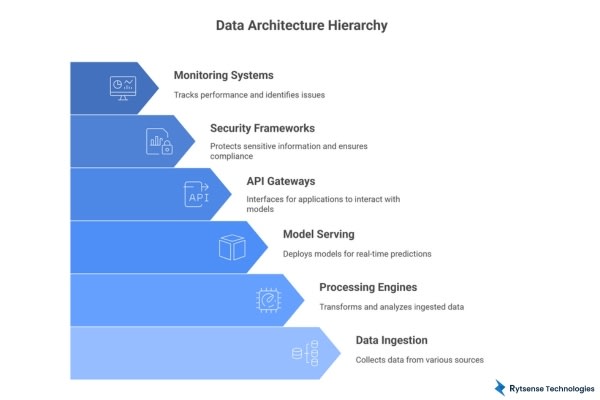
The primary objective in the architecture design is building a sustainable, scalable architecture where the AI copilot can operate while abiding by enterprise standards for security, performance, and reliability. The architecture should allow for current requirements, reflecting a good adaptation to future upgrades and expansions.
The architecture will incorporate important building blocks such as:
- Data ingestion layers
- Processing engines
- Model serving infrastructure
- API gateways
- Security frameworks
- Monitoring systems
The architecture should be able to meet the burden of both real-time interactions and adding batch-processing capacity while sustaining high availability and fault tolerance.
For scalability in AI architectures, consideration should be given to computational requirements, data storage, network requirements, and load balancers. The enterprise architecture will require the ability to effectively manage workloads differently while providing the same level of performance across varying usage patterns, including peak workloads.
5. Enhancing Intelligence: Model Training & Human-in-the-Loop for Enterprise AI Copilot
Training models and human-in-the-loop systems are critical for producing AI copilots that apprehend enterprise-specific situations and continuously enhance their capabilities. This pertains to modifying model foundations on the basis of distinctions in data that emerge during operations and establishing feedback loops that allow for ongoing learning and adaptation.
Training tasks encompass data collection and preprocessing, as well as a number of core tasks, such as model fine-tuning, validation, and deploying the changed models in organization environments. Enterprise-specific training data assists the AI copilot to learn upon industry-related terminology, business processes, and the organizational preferences of mission aspects that produce a more relevant, accurate, and thoughtful response.
Human-in-the-loop systems enable continuous improvement by capturing user feedback on AI applications, correcting errors, and monitoring performance. Human-in-the-loop systems provide an assurance that AI copilots are accurate in their own responses. There is a continuous reinforcement loop that enables adaptation to changing business needs and user expectations over time.
6. Ensuring Security, Privacy, and Compliance in AI Copilot for Enterprises
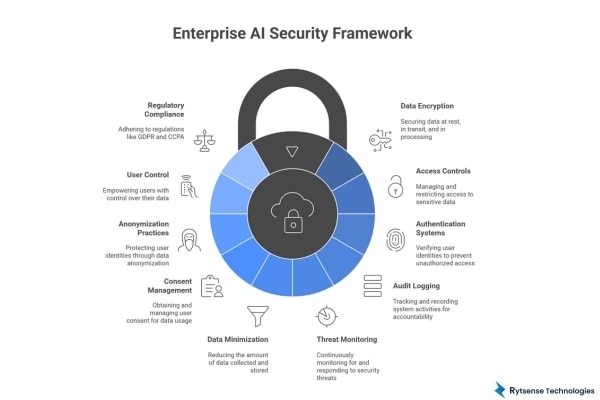
Security, privacy, & compliance are the primary concerns when enterprises implement
enterprise AI
. Organizations must include comprehensive & descriptive security frameworks to protect sensitive information, comply with regulations and standards, & maintain user trust throughout the AI copilot lifecycle.
Included in security measures are encryption of data, access controls, authentication systems, audit logging, and threat monitoring. Security must cover data at rest, in transit, and in processing, and provide comprehensive security coverage across all components of the system.
Privacy considerations consist of the minimization of data, consent management, anonymization practices, and user control. In practical way,
AI copilot for enterprises
will need to comply with regulations such as GDPR, CCPA, and industry-specific requirements while still allowing AI copilot functionality and user experience to be normalized.
7. Performance Monitoring & Measurement for Enterprise AI Copilot
Performance Monitoring & Measurement systems provide rich insights into the AI copilot's working or effectiveness, user satisfaction, and business impact. These systems may monitor KPIs, discover improvement opportunities, & ensure consistent service quality over time.
Monitoring systems ought to offer real-time dashboards, automated alerting, & complete reporting capabilities. This allows for the ability to fix any issues proactively and continuously improve AI copilot performance based on usage patterns and business outcomes.
Also Read: Top Enterprise AI Development Company | Key Selection Guide
Future-Proofing: Trending Features for AI Copilot for Enterprises
Future-proofing means adding new and emerging technologies & anticipating changing enterprise needs to make sure the continued relevance and effectiveness of an
AI copilot for enterprises
. This means keeping up with developments in AI, user expectations, and industry trends.
The trending features include multimodal abilities, advanced reasoning skill, enhanced context resolution, deeper personalization, and increased integrative capabilities. Improvements in
generative AI
continue to expand the possibilities for creating content, analyzing content, and automating functions across a range of business functions.
For future-proofing organizations should be designing the
AI copilot for enterprises
using a modular architecture to accommodate incremental feature additions and updates, without requiring a full build of the system. This allows for continued development while protecting existing investments and maintaining operations.
Privacy-First and On-Premises Deployment of AI Copilot for Enterprises
With privacy-first and on-premises deployment options, concerns about data security, regulatory compliance, and operational control can be addressed by an enterprise. These approaches offer enterprises a way to gain the
benefits of AI
capability while having more control of the information and compliance requirements related to sensitive data.
On-premise deployment provides firms with control over data, reduced latency, and increased security from the isolation of infrastructure. However, significant investments in hardware, maintenance, and expertise are required for a firm’s on-premise deployment option. Therefore, enterprises should weigh the pros and cons of the additional complexity and continued operational ownership with on-premise deployment.
Hybrid deployment options offer firms with on-premise and cloud hybrid deployments options to balance security risks, deployment performance, and costs. Hybrid deployment enables firms to maintain sensitive data on-premise, while accessing cloud-based capabilities for non-sensitive processing and scaling workloads.
Know More: AI agent development cost
Development Cost Insights for AI Copilot for Enterprises
Cost Estimation Based on Complexity
The cost of development can vary significantly based on the complexity of the AI copilot, desired features, and the scope of implementation. Understanding the causes of costs will allow organizations to thoughtfully forecast costs and provide the right level of resources to successfully develop the AI copilot.
Generally, basic AI copilots with standard features can vary in levels of investment from $50,000 to $150,000; advanced AI systems with unique or custom capabilities may start at $200,000 and go up to $500,000, or more. Each development estimate includes development, testing, deploying and initial period training.
Key Cost Drivers in Enterprise AI Copilot Development
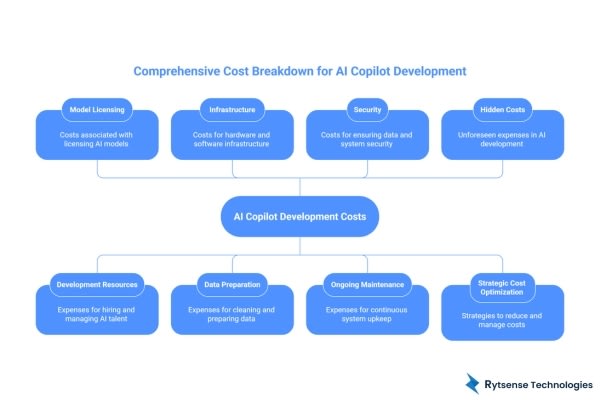
The primary causes of cost for the enterprise AI copilot development include model licensing, development resources (engineers, data scientists, UX designers, and project managers who have AI enterprise experience), infrastructure, data preparation, security, and ongoing maintenance, considerations for
custom ai development company
partnerships to help optimize costs and ensure quality outcomes.
The total model licensing costs can in turn, vary based on usage volume, feature requirements, and deployment distribution factors. Desiring development resources is the building of specialized human capabilities such as AI engineers, Data Scientists, UX designers, project managers, and others with AI enterprise experience.
Hidden Costs
Unseen expenses generally consist of things such as data preparation, complexities involved with
Enterprise Integration
, security audits, compliance certificates, user training, and iterative model refreshes. Unseen costs may account for 30-50% of the overall project costs so should be considered in your early budget plan.
Recurring operating costs include things like infrastructure maintenance, model refreshes, security monitoring, & support staff (internal/external). Companies or organizations should budget for these recurring, on-going expenses to ensure the operational sustainability of their AI "copilot" over time.
Strategic Cost Optimization
Cost optimization strategies include utilizing existing infrastructure, using out-of-the-box models, implementing phased rollouts, and working with veteran AI development companies. A
Best AI Development Company in USA
can provide a means for cost optimization while also providing some degree of compliance and assurance of quality.
Partnering with Experts: Custom AI Copilot for Enterprises by Rytsense Technologies
Unmatched Experience and Expertise
Rytsense Technologies offers a wealth of experience creating
AI enterprise solutions
solving problems for companies and organizations. They offer clients the experience they can trust when developing their
AI copilot for enterprises
. The Rytsense Technologies team has a unique ability to harness deep technical knowledge and business competence to develop AI-powered solutions that can drive results.
As their experience spans several industries and use cases, their expertise helps tailor solutions to unique enterprise requirements and will adjust client understanding to create effective solutions. Their area of expertise spans
AI Agent Development
, scope for machine learning, and broader enterprise systems.
AI Copilot Solutions Suite for Enterprises
Rytsense offers a complete AI Copilot solutions suite to cater for wider enterprise needs. Their solutions include customer service automation, data analysis copilots, content generation systems, and process optimization tools, realized with the enterprise in mind.
Their approach is always geared towards automating repetitive tasks, improved data-enhanced decision making, and seamlessly integrating into enterprise systems as an AI solution. This can ensure enterprise AI Copilot capabilities are delivered as true business value and low complexity.
AI Copilot Features and Benefits
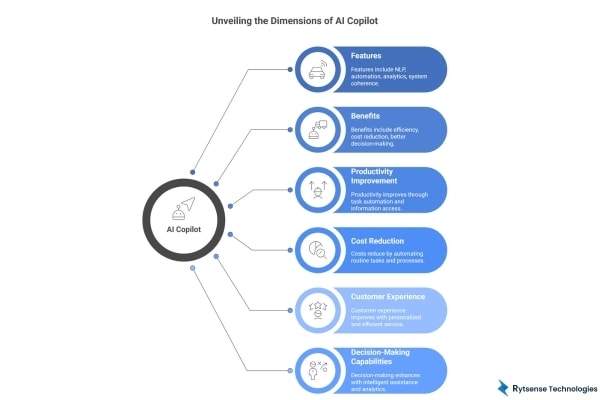
Business
AI Copilot features
may improve productivity & business operations. Essential capabilities include natural language processing, intelligent automation, predictive analytics, and coherence with current enterprise systems.
AI Copilot benefits
consists of efficiency, reduced operating costs, better decision-making capabilities, and better experiences for customers. These benefits come from routine task automation, faster access to information, and intelligent assistance that enhances human abilities, not eliminates them.
AI Copilot Use Cases and Best Practices
Common
AI Copilot Use Cases
involve customer support, sales assist, data analysis, creating content, & process automation. Each use case requires specific features and capabilities based on business needs and user expectations.
AI Copilot Best Practices
include focusing on user experience, security of data, implementing phased deployment, providing training, and developing agendas for success. These suggested best practices will improve the chance for successful implementation and user adoption.
Challenges and Solutions related to AI Copilot
The
AI Copilot Challenges
encompasses issue such as:
- Data quality issues
- The complexity of integration
- User objections
- Security apprehensions
- The need for maintenance
Organizations need to actively deal with these challenges to guarantee success with their deployment and operation of AI Copilot technology.
Solutions related to AI Copilot entails planning, stakeholder engagement, securing stability, and systems for continuous monitoring. Working with experienced development partners has proven organizations navigate these challenges toward ensuring they take measures to minimize their risks and maximize their benefits.
Conclusion
Designing and developing an effective
AI copilot for enterprises
is not easy task. They take planning, execution, and continuous optimization whenever possible. Organizations should consider technical requirements, business objectives, user needs, and operational constraints when developing AI copilot solutions.
The
AI Copilot Development Process
includes the development of the strategy through deployment and maintenance. Success with AI copilot relies on selecting the right product and
AI Development Services
, ensuring to assign security measures, and obtaining user adoption with effective design and training.
The digital transformation of the
AI copilot for enterprises
can provide opportunities for organizations to increase productivity, and efficiency, and reduce costs while improving the decision making organization. Establishing AI Copilot, tools, processes supplier with best practices along with experienced, knowledgeable providers, like Rytsense Technologies has proven to successfully implement AI Copilot, that will provide value to the business while ensuring competitive advantage in a fast evolving business environment.
Meet the Author

Co-Founder, Rytsense Technologies
Karthik is the Co-Founder of Rytsense Technologies, where he leads cutting-edge projects at the intersection of Data Science and Generative AI. With nearly a decade of hands-on experience in data-driven innovation, he has helped businesses unlock value from complex data through advanced analytics, machine learning, and AI-powered solutions. Currently, his focus is on building next-generation Generative AI applications that are reshaping the way enterprises operate and scale. When not architecting AI systems, Karthik explores the evolving future of technology, where creativity meets intelligence.