What Is AI in Software Development? A Beginner’s Guide
Whether you’ve experimented with tools like ChatGPT or depend on automation in your daily workflow, one thing is clear—
artificial intelligence is advancing at an unprecedented pace
. According to
Grand View Research
, the global AI market is projected to grow at a compound annual rate of
37.3% from 2023 to 2030
. Among the many industries being transformed,
software development
stands out as a key area for AI-driven innovation and investment.
As AI becomes an essential component of modern software engineering,
staying ahead of its adoption is no longer optional—it’s a strategic necessity
for tech leaders and development teams.
In fact, by 2026,
80% of enterprises are expected to integrate AI into their software development processes
(Gartner). Developers who already use AI tools are reporting
55% faster coding
and
40% fewer bugs
, according to a 2026 GitHub report. Despite these benefits,
65% of beginners still find the terminology and concepts overwhelming
.
This guide aims to
demystify
AI’s role in software development
—explaining how it works, why it matters, and how businesses and developers alike can harness its full potential to build smarter, faster, and more reliable software.
How Will AI Affect Software Development, Coding, and Programming?
AI is transforming development from a manual craft to an augmented process. Rather than replacing developers, it enhances their capabilities through three significant shifts:
Automated Code Generation
Tools like GitHub Copilot suggest context-aware code blocks by analyzing patterns across billions of public repositories. These tools speed up feature development by reducing boilerplate code by 30–50% (Stanford 2026).
For example, generating REST API endpoints now takes minutes instead of hours. Importantly, these tools augment human judgment. Data shows 73% of developers report AI catches syntax errors but requires human oversight for architectural coherence.
Predictive Defect Resolution
In 2026, predictive defect resolution powered by AI has revolutionized how developers catch and fix vulnerabilities before software deployment. Advanced
tools like Google’s IRIS AI
and Snyk Code now analyze code in real time, comparing it against massive databases of past bugs to detect issues like SQL injections, insecure dependencies, and logic flaws as they’re being written.
These AI systems outperform traditional static analysis by identifying more threats—including previously unknown ones—and significantly reducing debugging time from days to hours.
Organizations using this technology report up to a 70% drop in post-release patches, thanks to early detection and automated prioritization of high-risk code. By learning from historical data and continuously improving their threat models, these tools help developers write cleaner, more secure code, shifting the focus from reactive patching to proactive prevention—saving both time and money while drastically improving software reliability.
Intelligent Resource Optimization
AI models anticipate challenges by examining infrastructure data, sprint velocities, and commit records. At Netflix, AI-driven resource allocation reduced cloud spend by $190M annually while preventing 34% of deployment failures through predictive scaling.
Also Read: AI for Game Development: Shaping the Future of Gaming
How Is AI Transforming Software Development’s Future?
AI is shifting developer roles from "coders" to "conductors" who orchestrate intelligent systems. Three transformations define this evolution:
Democratization of Development
Low-code platforms powered by
AI software
enable non-technical users to build apps. Microsoft PowerApps saw a 200% surge in business-user adoption after integrating GPT-4, allowing marketing teams to prototype customer portals without engineering support.
Self-Optimizing Systems
These days, AI agents now run DevOps pipelines, which adapt test coverage dynamically based on risk profiles. For example, Spotify's AI testing bots reduce regression cycles from 48 hours to less than that by giving priority to important path validations following code pushes.
Evolving Skills
The World Economic Forum predicts 70% of developers will focus on training AI models by 2027. Core programming remains essential, but expertise in prompt engineering and ethical AI design commands a 40% salary premium (Glassdoor 2026).
Should developers embrace this? Absolutely. AI handles repetition; humans drive innovation.
What Is AI in Software Development?
AI software development
integrates machine learning into traditional workflows to create self-improving systems. Unlike standard software, AI solutions:
●
Learn from data:
E-commerce recommendation engines refine suggestions using real-time buyer behavior
●
Adapt autonomously:
Fraud detection algorithms evolve with new threat patterns
●
Predict outcomes:
Supply chain tools forecast delays using weather/sales correlations
Leading AI software development companies like IBM and Ideas2IT embed these capabilities into
AI in software development services
and provide services encompassing data engineering to MLOps. Their projects show 3.5x faster MVP delivery compared to traditional workflows.
What AI Tools Do Software Developers Use?
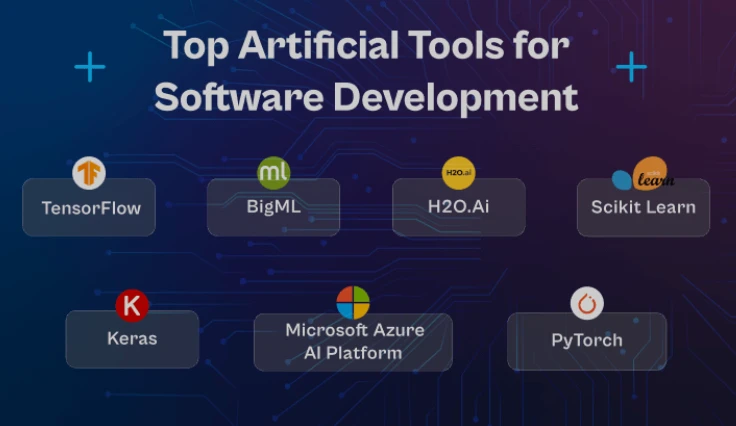
Software Development AI Toolkit: A Developer's Viewpoint
Why Developers Love These Tools
Tool TypeBefore AIWith AIHuman BenefitCode CompletionGoogling syntax, copying Stack OverflowContext-aware suggestions in IDEFocus on logic, not punctuationTestingManual test scripts, missed edge casesSelf-healing tests, risk-based coverageFaster releases, reduced stressDebuggingManually reviewing logs, trial-and-errorInstant root-cause analysisFix bugs in minutes, not days
Can I Use AI to Develop Software?
Yes—with strategic guardrails:
For Beginners: "I Can’t Code. Can AI Build My App?"
Yes—but with guardrails.
● Tools like Bubble, Retool, or Adalo let you drag-and-drop components while AI generates backend logic.
● Reality Check:
○ I built a fitness-tracking MVP in 3 weeks. AI handled database setup, but I still needed a dev to fix payment integrations."* — Sara, startup founder.
○
Limitation:
AI struggles with ambiguous requirements. You must articulate flows: "When the user clicks X, trigger Y with Z validation."
According to statistics, 41% of solo entrepreneurs use no-code AI technologies to launch MVPs (Gartner 2026).
For Junior Devs: "Will AI Steal My Job?"
No—it’s your secret weapon.
●
Use Case:
○ "Copilot writes my React boilerplate. I focus on state management logic. My productivity doubled—I got promoted in 6 months." — Dev at
SaaS startup
.
●
Skills Shift:
○
Learn prompt engineering:
"Generate a secure login endpoint with JWT auth" > "Write CRUD for user profiles."
○
Master debugging AI-generated output:
Identify hallucinations in created code.
Key Insight:
AI automates sparingly. Your value now? Problem-solving + Leveraging AI.
Scale Smart—Not Blind Talk to Our AI Architects →
For Enterprises: "Can We Replace Our Dev Team?"
Negligible idea. Do this instead:
●
Strategic AI Integration:
○
Phase 1:
AI drafts microservices (e.g., payment processing module).
○
Phase 2:
Senior engineers refactor for scalability/security.
○
Result:
JPMorgan cut dev costs 60% while also increasing headcount for innovation.
Warning Signs:
● Vendors promising "fully automated development."
● No senior oversight on AI-generated code.
Key Trade-Offs
BenefitHidden Cost10x faster prototypesTech debt, if unchecked (AI writes messy code)Lower entry barrierVulnerabilities (AI misses edge cases)24/7 codingLicensing nightmares (Who owns AI’s IP?)
Real Story:
"We used AI to generate an ‘optimized’ algorithm. It worked—until users in Thailand hit a timezone bug. It took 3 weeks to fix what a human would’ve caught." — CTO, Logistics Firm
The Ethical Challenges
●
Copyright Risk:
AI trained on public code may "inadvertently" plagiarize.
●
Bias Amplification:
○ "Profiles from women's colleges were devalued by our HR screening AI. It took months to correct the biased model."
●
Solution:
○
Audit trails:
Trace every AI-generated line.
○
Human veto power:
Reject AI suggestions that feel "off."
Build Trustworthy AI Systems Learn About Ethical AI →
Your Action Plan
If you happen to be
●
Non-technical:
○ Start with Bubble + ChatGPT.
○ Budget 20% for a freelance dev to fix AI’s blind spots.
●
Junior/Mid-level Dev:
○
Stack:
Copilot + Cursor.sh (AI IDE).
○
Rule:
Review every AI suggestion like it’s junior dev’s PR.
●
Tech Leader:
○ Hire AI-savvy architects to design guardrails.
○
Metrics:
Track "AI-generated code defect rate" like blood pressure.
Also Read: AI and Machine Learning Development Services
Which AI Is Best for Software Development?
Use CaseBest ToolWhyWeb AppsGoogle Project IDXReal-time collaboration + cloud IDEMobile DevelopmentTensorFlow LiteOn-device AI for offline functionalityEnterprise SystemsIBM watsonxCompliance-focused code generation
Pro Tip:
Hire AI developers for tool selection— 82% of firms report mismatched AI stacks stall projects (Deloitte).
Why AI Makes Developer Skills More Valuable
The Great Misconception
"AI will replace developers!"
Reality:
AI automates tasks; it doesn’t replace human reasoning.
Like power tools didn’t replace carpenters—they enhanced their precision.
Why Human Skills Are Skyrocketing in Value
The Irony: AI Exposes Bad Developers
●
Weak Dev:
Ships flawed, insecure code because they rely too much on AI.
●
Strong Dev:
Uses AI as a force multiplier → builds resilient systems faster.
Real Impact: Stories from the Field
The Irreplaceable Human Edge
AI lacks:
1. Contextual Wisdom:
"Will this code break our legacy banking system?"
2. Ethical Nuance:
"Is this facial recognition model racially biased?"
3. Creative Leaps:
"What if we combine blockchain with AI for supply chains?"
The Future: Developers as AI Whisperers
●
Entry-Level:
You concentrate on solving problems while AI takes care of syntax.
●
Mid-Career:
You train/tune AI models → becoming an "AI coach."
●
Senior Level:
You design AI systems that transform industries.
Know More:
Top AI Development Companies
Are AI Agents Really About to Revolutionize Software Development?
Yes—they’re becoming co-developers.
Expert AI agents
now act as 24/7 partners.
●
Dev Agent:
Flags anti-patterns in pull requests
●
QA Agent:
Generates tests from user stories
●
Infra Agent:
Predicts deployment risks
At Ideas2IT, these agents reduced production incidents by 62% while accelerating onboarding by 50%. Unlike humans, they never sleep—continuously monitoring systems while developers focus on high-value problems.
How Hopeful Are You About AI in Software Development’s Future?
Extremely hopeful—with caveats. AI promises:
● 45% faster time-to-market for applications
● 30% cost reduction in maintenance
● Democratized innovation through no-code tools
However, success requires:
✅ Ethical guardrails against biased algorithms
✅ Continuous upskilling in prompt engineering
✅ Human oversight of AI outputs
Organizations balancing these factors report 2.3x higher ROI on AI investments.
Maximize ROI with Responsible AI Implement AI Safely →
How Much Has AI Automated Software Development?
AI currently automates 35–50% of routine
software development
tasks—freeing developers from grunt work but not replacing strategic thinking. This is how that truly appears on a daily basis:
What AI Automates Today (The 35–50%)
What AI Can’t Automate (The 50–65%)
Creative Problem-Solving
●
Example:
*“AI suggested 3 ways to optimize our checkout flow—all flawed. It missed that users abandon carts because address fields weren’t geo-autocompleting. Humans spotted the UX nuance.”*
○
Why:
AI lacks context about why users behave certain ways.
System Architecture
●
Example:
“We requested that ChatGPT create a payment microservice. It returned textbook examples but ignored our legacy monolith’s tech debt. A human architect reimagined the migration path.”
○
Why:
AI can’t weigh trade-offs between cost, risk, and technical constraints.
Ethical & Business Judgment
●
Example:
“Our AI recommended blocking users from high-risk countries. The legal team intervened: ‘This breaches GDPR. We need granular consent flows.’”
○
Why:
AI can’t navigate compliance, ethics, or brand values.
The Automation Balance Sheet
Task% AutomatedWhy Humans Still LeadWriting CRUD code70%Humans handle edge casesRunning tests65%Humans define what to testDebugging50%Humans diagnose root causesDesigning architecture10%Humans balance trade-offsUser research5%Humans empathize & interpret
The Human Shift: From Typist to Conductor
●
Before AI
“I spent 60% of my time debugging CSS, writing SQL, and documenting APIs. Feels like engineering.”
●
After AI:
“Now I design systems, mentor juniors, and solve why our app slows down for rural users. Feels like engineering.”
Net Impact:
● Developers spend 47% more time on high-value work (design, innovation, collaboration).
● Burnout rates drop 30% in teams using AI tools (IEEE Study).
Read Now: Top Enterprise AI Development Services to Drive Innovation
What Nobody Talks About
1.
The “Black Box” AI Code Problem:
“AI-generated code works—but nobody fully understands it. When it breaks at 2 AM, we’re lost.”
○
Fix:
Mandate comments explaining why AI suggestions were used.
2. Skill Erosion:
“Juniors copy-paste AI output without learning basics. One did not understand how arrays function.”
○
Fix:
Pair AI with code reviews focused on fundamentals.
3. Tool Overload:
“We use 8 AI tools. Each has quirks. Context-switching reduces focus.”
○
Fix:
Standardize on 2–3 core tools per team.
Where Automation Is Headed (2026–2030)
●
Agentic Systems:
AI agents will handle deployments, incident response, and user feedback loops autonomously.
Example:
“An AI detects a checkout bug, writes a fix, tests it, deploys at 3 AM, and alerts you after it’s resolved.”
●
Risk:
Humans may become “overseers” who lose hands-on skills.
Will AI Replace Human Developers?
No—it redefines their value. While AI handles syntax, humans provide:
●
Contextual understanding:
Interpreting ambiguous requirements
●
Creative problem-solving:
Designing novel algorithms
●
Ethical judgment:
Ensuring fairness in AI decisions
Demand for developers
has grown 22% since 2022 (BLS), proving AI augments—not replaces—human ingenuity.
Learn:
AI Development Life Cycle
How Does AI Improve Development Efficiency?
AI delivers measurable gains across five dimensions
The Hidden Efficiency Gains
AspectBefore AIWith AIHuman BenefitOnboardingWeeks of code reviewsAI explains legacy codeNew devs contribute Day 1Tech Debt“We’ll fix it later.”AI flags anti-patternsProactive cleanup, no legacy bombsMeetingsEndless spec debatesAI prototypes in minutesAlign teams visually in 1 session
The Trade-Offs (No Silver Bullet)
1. The Over-Reliance Trap:
“Junior devs sometimes accept AI’s flawed code. We enforce: ‘Always ask WHY it suggested this.’”
2. Tool Sprawl:
“We tried 10 AI tools. Just three remain stuck. Start small—Copilot + a linter + a test tool.”
3. Privacy Fears:
“We self-host CodeLlama—no sensitive code in cloud AI black boxes.”
Also Read: How AI-Driven Digital Transformation Is Shaping the Future
Conclusion
AI in software development
isn’t about replacing humans—it’s about eliminating grunt work. Developers leveraging AI ship code faster, reduce errors by 50%, and focus on breakthrough innovation.
While beginners can start with no-code tools, enterprises should hire AI developers or partner with an
AI software development company
to navigate complexity.
The future belongs to developers who embrace AI as their most powerful collaborator—transforming code into cognition and ideas into impact.
Meet the Author

Co-Founder, Rytsense Technologies
Karthik is the Co-Founder of Rytsense Technologies, where he leads cutting-edge projects at the intersection of Data Science and Generative AI. With nearly a decade of hands-on experience in data-driven innovation, he has helped businesses unlock value from complex data through advanced analytics, machine learning, and AI-powered solutions. Currently, his focus is on building next-generation Generative AI applications that are reshaping the way enterprises operate and scale. When not architecting AI systems, Karthik explores the evolving future of technology, where creativity meets intelligence.