Key Takeaways
AI in oil and gas market will reach $4.21 billion by 2028 with 92% companies investing to cut costs by 25%. AI reduces unplanned downtime by 30-50% and maintenance costs by 25% through continuous equipment monitoring. BP, Shell, and Saudi Aramco achieved 10% efficiency gains and 30% cost reductions using AI technologies. Companies save 20-30% operational costs within two years through AI-driven automation and optimization.High investment costs ($5-50 million), talent shortage, and data quality issues remain major AI adoption barriers.
AI in Oil and Gas Industry: Real-World Applications, Benefits, and Key Challenges
The application of AI in the oil and gas industry, including AI & ML applications in oil and gas industry and AI implementation in oil and gas industry, is transforming the way energy companies operate efficiently. Partnering with a reliable
AI ML development company
helps enterprises implement these solutions effectively and achieve measurable results.
According to
PRN
, the global AI in oil and gas market is projected to reach $4.21 billion by 2028 with a CAGR of 10.96%. More than 92% of oil and gas enterprises are investing in AI technologies to improve productivity by at least 25%.
The application of AI in oil and gas industry
AI in oil and gas firms focuses on operational efficiency and cost reduction. By leveraging advanced algorithms, machine learning, and data analytics, AI & ML applications in oil and gas industry analyze massive volumes of data from drilling sites, sensors, and machinery. This provides actionable insights for operators to make informed decisions and improve outcomes.
AI in Oil and Gas Industry anticipates equipment failures, identifies potential drilling sites safely, and minimizes environmental impact. Qualified engineers and technicians collaborate with AI systems to reduce operational risk. By continuously monitoring live data, AI in oil and gas sector ensures safety, cost containment, and optimized production.
Top AI Use Cases in Oil and Gas Sector
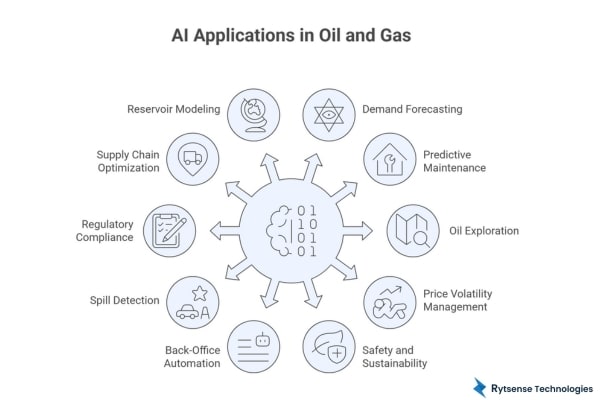
AI in Demand Forecasting
AI algorithms are used to analyze historical data, market trends, and other economic indicators to determine oil and gas demand in the future. Machine learning models assess weather patterns, consumer behavior, and geopolitical events. AI implementation in oil and gas industry ensures predictive insights for planning and logistics.
Predictive Maintenance with AI & ML Applications in Oil and Gas Industry
AI & ML applications in oil and gas industry
continuously study the health of equipment. Sensors monitor temperature, vibrations, and pressure. AI in oil and gas firms predicts machinery failures before they occur, reducing downtime by 30-50% and lowering maintenance costs by 25%.
AI in Oil Exploration & Data Analysis
AI captures seismic data, geological surveys, and drilling logs to determine the potential oil reserves. Machine learning algorithms study rock formations and underground structures more efficiently than traditional methods. This increases the success rate of exploration efforts by 20% with a reduced cost of exploration.
Managing Price Volatility with AI
AI models detect global market trends, supply-demand relationships, and other political factors that can impact oil pricing.
AI models
will allow companies to receive real-time information that can guide commercial pricing strategies and support companies' efforts to hedge against price volatility, to protect profit margins amid fluctuating oil prices.
AI for Safety & Sustainability
Computer vision
monitors unsafe worker habits, equipment issues, and gas leaks. AI & ML applications in oil and gas industry optimize energy use, cutting carbon emissions by 10–15%.
RPA and AI in Back-Office Operations
Robotic Process Automation and AI can improve and simplify back-office operations for oil and gas. RPA can help automate tasks such as invoice processing, timely compliance reporting, and data entry without human intervention and also improves overall reporting quality. The use of RPA in back-office operations can eliminate inefficiencies and generate up to 40% in cost savings while reducing human errors.
AI for Spill and Hydrocarbon Detection
AI uses trained neural networks and big data, along with video and satellite imagery, to rapidly detect oil spills and hydrocarbon leaks from storage tanks, wells, pipelines, and offshore drilling sites. Applying computer vision algorithms to aerial or satellite imagery can alert the industry to spills within minutes. Ultimately, this allows teams to mobilize quickly in an effort to contain environmental damage before it escalates.
Generative AI in the Oil and Gas Industry for Regulatory Compliance and Risk Management
Generative AI
provides support in the oil and gas industry for automating regulatory compliance monitoring and documenting compliance reports by continuously tracking changes to regulations, allowing applications to rapidly assess operational risk and predict safety incidents while ensuring compliance with environmental standards in multiple jurisdictions.
AI-Driven Supply Chain Optimization
AI optimizes supply chain logistics, including transportation routes and inventory management. Machine learning models can predict disruptions to supply chains and to minimize costs, achieving typical savings of 15–20%. Further, they help improve delivery efficiency.
AI for Reservoir Modeling & Characterization
AI uses existing geological data to construct 3D models of underground reservoirs. These models can be used to predict how reservoirs will behave, identify optimal drilling locations and estimate production rates, potentially increasing oil recovery rates by 5–10%.
Also Read: AI Agentic in Banking: Transforming the Future of Financial Services
Real-World Applications of AI in Oil and Gas Industry
BP
BP has implemented AI by partnering with technology companies. The company uses AI for predictive maintenance on over 20,000 wells daily, reducing inspection costs by 75%. BP has deployed AI systems to analyze drilling data and optimize drilling parameters in real-time as data is acquired.
Shell
Shell has implemented AI-enhanced digital twins for its offshore platforms. These AI-enabled digital twins predict failures by simulating equipment behavior, saving Shell $1 million per platform and increasing production efficiency by 10%.
Saudi Aramco
Saudi Aramco employs artificial intelligence for analysis of seismic data and for reservoir management. With their artificial intelligence systems, Saudi Aramco is able to analyze petabytes of data to identify new opportunities for drilling. The AI-engineered operational model has improved production accuracy and reduced exploration costs by 30%.
How AI in Oil and Gas Enterprises Improves Efficiency
Data–Driven Decisions
AI is able to process data from thousands of sensors concurrently, providing executives with actionable insights. Decision-makers receive dashboards in real-time with important production metrics, equipment status, and information about the changing market, which supports timely and accurate decisions about their businesses.
Optimized Extraction and Lower Downtime
Through automation, AI optimizes drilling parameters, including pressure, speed, and direction. Using machine learning, AI can adjust extraction levels, taking into account reservoir conditions, leading to maximized output while reducing damage to equipment. Overall, through AI operations, operational downtime is reduced from 15% to 5%.
Real-time Insights for Smarter Operations
AI supports an environment of ongoing monitoring of operations at multiple sites. AI generates alerts in real-time, notifying operators of deviation from "normal," which encourages immediate corrective action. This improves operational efficiency by 25% and reduces the time to respond to critical events.
Key Benefits of Advantages of Artificial Intelligence Implementation in Oil and Gas Industry
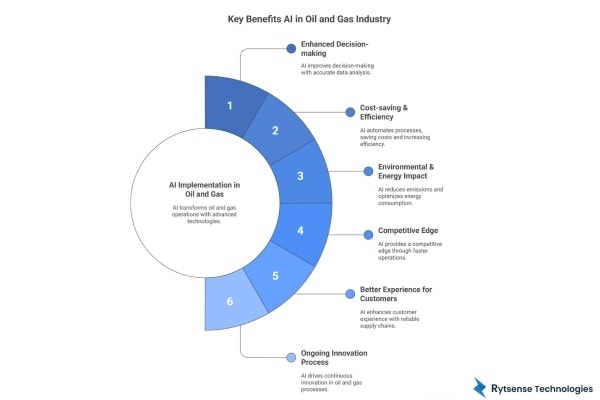
Enhanced Decision-making
AI can analyze performance patterns, providing recommendations using historical and predictive data, with approximately 40% higher accuracy in analyzing complex datasets compared to traditional methods.
Cost-saving & Efficiency
AI & ML
applications in oil and gas industry automate processes and recommend predictive maintenance while in some cases optimizing resource allocation, leading to operational cost savings of 20-30% within two years of implementation. Working with an experienced AI ML development company ensures these solutions are tailored to specific operational needs.
Environmental & Energy impact
AI in the oil and gas industry
can help reduce waste and carbon emissions while optimizing energy consumption. For instance, AI-powered smart systems can reduce environmental emissions by up to 15%.
Competitive Edge
The early adopters of AI have gained advantages against their competitors by operating faster, optimizing resource management, cutting down their production costs, and enabling faster responses to market changes.
Better Experience for Customers
AI helped improve trust and reliability of the supply chain, ensuring timely deliveries, along with using predictive analytics to maintain consistent pricing and product quality per contract terms.
Ongoing innovation process
AI-enabled innovation for exploration methods, drilling strategies, and refinery processes, and many companies are using AI, and are discovering optimization processes continually, while an entire duct trail, or path, is set via retrospective AI continuously evolving.
Challenges in Adopting AI in the Oil and Gas Industry
Resistance to Change
The potential for workforce resistance to AI adoption is considerable, as workers fear job loss and need significant training to adapt to new AI systems. Changing the culture of large organizations can take two or more years.
Data Quality Issues
AI requires clean, structured data. The oil and gas industry uses legacy systems that create various inconsistent data formats. Once data is integrated from multiple systems, it must be cleaned and standardized to ensure accuracy for
AI model training and predictions
.
Compliance & Cybersecurity Risks
AI systems handling sensitive operating data are subject to potential cybersecurity threats. AI regulatory frameworks and liability for
AI-driven decisions
remain uncertain globally. Data privacy concerns highlight the need for robust security frameworks.
Cost of Investment
The initial cost of implementing AI systems can be between $5 million to $50 million or more for larger-scale applications. Costs for hardware, software, and talent acquisition must be borne by the business, resulting in delayed ROI timelines of 3 to 5 years.
Lack of AI talent
There is a shortage of
AI and data science
talent in the oil and gas industry. Professionals with both AI expertise and industry-specific knowledge are hard to find, which slows AI adoption in the industry.
Also Read: Top AI and ML development companies
Emerging AI Technologies in the Oil and Gas Industry
Machine Learning and Deep Learning
Machine Learning (ML) monitors equipment and predicts system failures, achieving up to 95% accuracy; meanwhile, deep learning algorithms analyze seismic images to identify potential drilling sites with higher accuracy than traditional methods.
Computer Vision and Remote Monitoring
AI-based cameras can monitor drilling sites, detecting safety violations and equipment issues in real-time. Drones equipped with computer vision inspect pipelines and offshore platforms, reducing inspection costs by up to 60%.
Digital Twins for Optimization
AI implementation in oil and gas industry uses digital twins create virtual versions of physical assets. Simulations provide advanced testing of operational scenarios. Digital twins provide insights on maintenance timing and system optimization without risking real-world operations.
NLP for Automation
Generative AI in the oil and gas industry and Natural Language Processing (NLP) engines can create reports, evaluate technical documents, and extract insights from unstructured data. They can also engage with employees via chatbots to answer routine maintenance queries.
The Future of AI in the Oil and Gas Industry
Intelligent Fields and Autonomous Operations
Companies will deploy fully autonomous drilling rigs as well as completely autonomous refineries, requiring minimal human intervention. Intelligent fields will optimize their own production in response to real-time conditions; potential efficiency gains could be as high as 50%.
Sustainability through AI
AI enables carbon-neutral operations through optimized resource management and emissions reduction. It generates predictive models to help oil and gas companies transition to renewable energy more efficiently.
Predictive Analytics in Energy Transition
AI technology will help guide oil and gas companies through the energy transition, helping to identify diversification opportunities, optimizing asset portfolios, and predicting market shifts towards renewable energy.
Rytsense Technologies: Driving AI Innovation in the oil and gas sector
Rytsense Technologies provides state-of-the-art
Custom AI solutions
in oil and gas firms. We specialize in machine learning, predictive analytics, and IoT integration to implement AI applications for companies. We develop tailored AI platforms for predictive maintenance, exploration optimization, and supply chain management. Our processes can achieve a 40% reduction in implementation time and ecosystem compatibility to ensure the successful deployment of our AI tools. Let Rytsense Technologies help you deploy the future of your oil and gas operations through our innovative AI solutions.
Conclusion
The use of
AI in the oil and gas industry
signifies the systemic evolution of energy sector companies as a whole. AI supports activities from predictive maintenance to exploration optimization, achieving measurable improvements in efficiency, safety, and profitability.
Even given the challenges of initial implementation, such as cost and talent shortages, the
benefits of AI
outweigh the challenges. Companies embracing AI will be able to make data-driven decisions and achieve operational excellence, over competitors. As technology continues to evolve, AI will continue to drive sustainable and innovative growth.
Meet the Author

Co-Founder, Rytsense Technologies
Karthik is the Co-Founder of Rytsense Technologies, where he leads cutting-edge projects at the intersection of Data Science and Generative AI. With nearly a decade of hands-on experience in data-driven innovation, he has helped businesses unlock value from complex data through advanced analytics, machine learning, and AI-powered solutions. Currently, his focus is on building next-generation Generative AI applications that are reshaping the way enterprises operate and scale. When not architecting AI systems, Karthik explores the evolving future of technology, where creativity meets intelligence.