Key Takeaways
AI chatbots cost upto $10,000- $150,000+ but may deliver upto 80-95% response accuracy, which makes them a better long-term investment. If you outsource AI chatbot development, it saves upto 50-60% on costs while reducing the development time from 6-18 months to 2-8 months. Enterprise-grade AI chatbot solutions may include advanced AI agent development and multiple integrations that make them ideal for huge corporations with complex requirements. Choose the right AI chatbot development service for websites that needs technical requirements, balancing cost, and long-term scalability.
Why choosing the right AI Chatbot Development Service for Websites is crucial in 2026

Digital environment, nowadays, is where websites need to constantly engage their visitors 24 hours per day, we need to turn to AI Chatbots. Choosing a proper AI chatbot development service for websites could make or break your online business. In 2026, customers want immediate follow-up to their questions. They don't want to wait for an email to be responded to or a phone call. A decent AI chatbot can provide the needed assistance to your website visitors during and evening, day or night.
When you choose to implement the wrong chatbot service, you may miss possibilities for converting customers. No one likes to be frustrated by a dictatorial chatbot that never understands their requests or delivers the wrong answers. However, when you choose the correct AI Chatbot Development servicefor websites, that's when the magic happens. Your website visitors' questions can be answered right away, your sales team gets better qualified leads, and your business experience greater growth.
<a href="https://rytsensetech.com/ai-chatbot-development-services/" className="text-blue-500 underline">What Is an AI Chatbot & Why It Matters for Websites</a>
An AI chatbot is a computer program designed to effectively communicate with humans using text. AI chatbots answer questions and provide assistance to visitors of websites. AI chatbots are useful because they can help customers any time, day or night. AI chatbots can help customers quickly with instant responses, and visitors do not have to wait to get help. Conversing and getting help from an AI chatbot can improve the website guest experience, and save businesses money.
AI chatbots vs. traditional bots
An AI chatbot is like you have a clever assistant on your website. It's capable of chatting with visitors through text or voice. Traditional chatbots can only talk about a limited few things and rely on pre-programmed logic. Conversely, AI chatbots are smarter by learning from conversations.
Traditional chatbots are quite dumb. They follow simple logic. If a person gave them something new, it leaves them stumped. AI chatbots are fundamentally different. They use artificial intelligence to understand what people really mean; it doesn't matter if they don't use the exact wording.
FactorTraditional ChatbotsAI ChatbotsDevelopment Cost$2,000 - $8,000$10,000 - $150,000+Monthly Operating Cost$10 - $100$50 - $1,000+Response Accuracy40-60% for complex queries80-95% for complex queriesSetup Time1-3 weeks4-12 weeksUser SatisfactionLow (30-50%)High (70-90%)Multi-language SupportLimitedAdvancedVoice IntegrationUsually not availableAvailable with advanced featuresBest ForSimple FAQ handlingCustomer service, sales, complex support
How AI Chatbot Development Services for Websites improve <a href="https://rytsensetech.com/ai-development/use-cases-of-ai-chatbots-in-business/" class="text-blue-500 underline">customer engagement and conversions</a>
There are many benefits of AI chatbot development servicesfor websites that benefit businesses. First, AI chatbots make customers happy. When people receive instant answers, they will buy more. Second, AI chatbots save a ton of money. AI chatbot development services allow businesses to do more with fewer customer service people, and one chatbot can help thousands of customers simultaneously.
They also collect useful information. AI chatbots learn what customers ask about most. This information may help businesses improve their products and services. AI chatbots will never forget anything. They remember what each customer likes and can always provide personalized recommendations.
Website Development
There are a variety of chatbots available to suit your needs. The different types vary in the way they can be utilized and their related costs. Let's examine the major types:
Rule-Based Chatbots
Rule-Based Chatbots are the simplest form. They follow a set of rules you define. If a person asks question A, the chatbot delivers answer B. Economically priced and simple to configure, but can't grapple with multi-faceted questions.
Keyword-Based Chatbots
Keyword-Based Chatbots search for words typed by people. If they find the word "price," they may respond with pricing information. These are an improvement over the rule-based chatbots, but still fall short of fulfilling all questions.
Menu-Based Chatbots
Menu-Based Chatbots allow users to select answers via buttons (think phone system - press 1 for sales, press 2 for support). These are easy to use, but can be cumbersome for users who know what they want.
Contextual (AI-powered) Chatbots
Contextual (AI-enabled) Chatbots are the most sophisticated. They can engage the entire conversation, and not just work off of individual words. They can remember topics discussed previously and enable deeper communication.
Hybrid Chatbots
Hybrid Chatbots combine/merge types. A chatbot may use menus for easy questions, and AI for more complex questions to get the benefit of both worlds.
Voice-Enabled Chatbots
Voice-Based Chatbots allow users to talk instead of typing it. This is more convenient for mobile users and those with disabilities. You can create an build an AI chatbot with voice assistant features if you want to make your website more accessible to people.
Also Read: Top 10 AI Chatbot Development Companies in USA in 2026
Which AI Chatbot Development Service for Websites fits your business model
When selecting an AI chatbot development service for websites, it is important to know your customers and their habits. Rule-based chatbots work for simple questions. More sophisticated AI-powered chatbox solutions work with more complex questions involving multi-step problem solving, technical support, etc. AI-powered chatbots can give personalized recommendations and continue conversations based on context. They probably need to integrate with your customer relationship management systems and/or databases in order to provide more complete and personalized answers.
Choosing a chatbot service depends on preferred communication options of customers. Text-based customers want rich text formatting, file sharing, and mobile-optimized display options. Voice-based customer features include real-time speech-to-text conversion, natural voice synthesis, and different accents and languages. A voice-enabled chatbot uses different technical infrastructure than text-based and involves additional design considerations for speech recognition accuracy and user interface design.
Organizations using chatbots in any vertical and business model will require unique implementation strategies. E-commerce companies will typically utilize a hybrid solution chatbot to address basic, and possibly moderate, inquiries, while technology and software-as-a-service organizations can rely solely on an AI-powered chatbot to manage technical conversations. Healthcare organizations need to ensure chatbots conduct both voice and text interactions while remaining compliant with HIPAA. Personal care organizations, such as financial services firms, have the basis of regulation in mind, while also codependently ensuring customer service efficiency; often resulting in a need for heightened security features and compliance monitoring functionality.
Business TypeCustomer Query TypeCommunication PreferenceRecommended Service TypeKey FeaturesE-commerceSimple to ModerateText + VoiceHybrid chatbot with product catalog integrationProduct search, order tracking, payment processingSaaS/TechComplexText-preferredAI-powered technical support botAPI integration, troubleshooting workflows, documentation accessHealthcareComplex + SensitiveVoice + TextHIPAA-compliant AI assistantAppointment scheduling, symptom checker, secure messagingFinancial ServicesComplex + RegulatoryText-preferredSecure AI advisorAccount management, fraud detection, compliance featuresEducationModerateText + VoiceLearning-adaptive chatbotProgress tracking, content delivery, assessment toolsHospitalitySimple to ModerateVoice-preferredMultilingual service botBooking management, local recommendations, concierge services
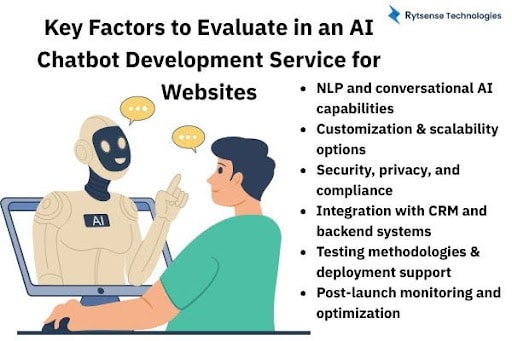
Key Factors to Evaluate in an AI Chatbot Development Service for Websites
When you are trying to find the best service provider, there is a lot to consider. Don't just run with the cheapest option. Here's what matters most:
NLP and conversational AI capabilities
NLP and Conversational AI Capabilities is very important. NLP generally means Natural Language Processing. This is what helps chatbots understand human language. Good AI Development Services will have strong NLP tools, meaning that your chatbot will be able to interact better with customers, even if they misspell something or use slang.
Customization & scalability options
Enterprise chatbot ecosystems must adopt a modular microservices architecture for horizontal scaling, inclusive of auto-scaling Kubernetes deployments, Redis clustering, and database sharding. Customization frameworks will have dependency injection, plugin architectures, and configuration-driven workflow engines, and infrastructure as code and API versioning strategies will bring consistency to your deployment of new features.
The increasing use of Infrastructure as Code (Terraform, CloudFormation) is allowing modern platforms to provision environments quickly. Elastic load balancing with application layer routing should allow your enterprise chatbot to scale concurrency from hundreds to millions of interactions.
Security, privacy, and compliance
Security implementations call for AES-256 encryption and TLS 1.3 protocols, certificate pinning, SAML 2.0, OAuth 2.0, multi-factor authentication, data residency compliance, GDPR compliance, and SOC 2 Type II certification including automated data anonymization, consent management, and audit logging including all fields on the logs. Data residency compliance includes data centers that span regions and specific storing of regional data.
Integration with CRM and backend systems
Integration architecture needs ESB implementations to support many communication patterns, DB connectivity, API gateways, and custom connector development that supports synchronous REST APIs, asynchronous message queuing, event-driven architectures (EDAs), pooling of connections, transaction management, real-time data synchronization, and ETL pipelines. Custom connector development involves ETL pipelines to perform data normalizations, configurations for field mapping, and conflicts resolution methods for concurrent data updates.
Testing methodologies & deployment support
The testing strategies include unit testing, integration testing, and conversation flow validation including natural language understanding testing, which requires accuracy metrics and entity extraction accuracy metrics. The deployment strategies have automated rollback triggers, canary deployments, monitoring error rates and performance metrics.
Post-launch monitoring and optimization
Production monitoring checks integration with distributed tracing, application performance monitoring, and customized metrics dashboards. Machine learning model performance checks integration with drift/population analysis, A/B testing, and automated model (re)training. Conversation analytics checks integration with sentiment analysis, topic modeling, and other LDA algorithms. Optimization activities include the use of intent clustering to improve training data, introduce caching layers for response times, and continuous integration pipelines for model redeployment.
Also Read: ROI of Generative AI – How to Measure and Maximize It
Development Approaches & Service Models
There are multiple ways to build a chatbot, with each approach having it's positive attributes and negatives:
No-Code Platforms vs. Low-Code Solutions vs. Custom Frameworks
FactorNo-Code PlatformsLow-Code SolutionsCustom FrameworksDevelopment Cost$500 - $5,000$5,000 - $25,000$25,000 - $200,000+Monthly Operating Cost$20 - $300/month$100 - $1,000/month$500 - $5,000+/monthDevelopment Time1-4 weeks4-12 weeks3-12+ monthsTechnical Skills RequiredNone (drag & drop)Basic coding knowledgeAdvanced programming skillsCustomization LevelLimited templatesModerate flexibilityUnlimited customizationScalabilityLow to MediumMedium to HighVery HighIntegration CapabilitiesBasic APIs onlyGood API supportComplete system integrationMaintenancePlatform handles updatesShared responsibilityFull responsibilitySecurity ControlPlatform dependentLimited controlFull controlAI/NLP CapabilitiesBasic keyword matchingModerate NLP featuresAdvanced AI/ML capabilitiesMulti-language SupportLimited optionsGood supportUnlimited languagesVoice IntegrationBasic or noneModerate supportFull voice capabilitiesData OwnershipPlatform dependentMixed ownershipComplete ownershipVendor Lock-in RiskHigh riskMedium riskNo riskBest ForSimple FAQ botsBusiness process botsEnterprise AI solutionsPopular PlatformsChatfuel, ManyChatBotpress, DialogflowRasa, Custom Python/Node.jsDeployment OptionsPlatform hosting onlyPlatform + self-hostingAny hosting environmentTeam Size Needed1-2 people2-5 people5-20+ peopleOngoing SupportPlatform communityPlatform + developerFull development team
No-Code Platforms allow you to build a chatbot without programming experience, allowing you to and drop pieces to form the conversation your bot will have. No-code platforms are quick and cheap, but in certain cases they limit what the bot can do. For simple bots they are useful.
Low-Code Solutions can separate the technical parts of your bot to allow you some options but not the full freedom a no-code platform provides. These solutions are easy to use, but small businesses often find them to have the perfect level of control.
Custom Frameworks are fully programmed, will cost more, and have longer build cycles, however, you know exactly what your bot is capable of. Typically these solutions are used by larger companies that have a unique requirement.
Also Read: Top AI Development Companies
In-house development vs. outsourcing an AI Chatbot Development Service for Websites
You then need to determine whether you will build your AI chatbot in-house or when to engage the services of an AI chatbot development service for your website. Building in-house can provide you complete control but you will need to find and hire experienced developers. Outsourcing bot development will often be quicker and cheaper, especially if you find the right partner.
FactorIn-House DevelopmentOutsourcing AI Chatbot ServiceTotal Project Cost$300,000 - $1,000,000$50,000 - $400,000Development Time6-18 months2-8 monthsTeam Size5-15 people3-8 people (vendor managed)Hourly Rate$80-200/hour$30-100/hourSetup Cost$50,000 - $200,000$10,000 - $150,000Annual Maintenance$100,000 - $300,000$20,000 - $80,000Control LevelCompleteShared with vendor
Many companies engage the services of top chatbot development companies in USA and have met satisfactory results, as opposed to solving issues by themselves. The highly experienced chatbot developers are anxious to share their knowledge of best practices gained from exposure in their many engagements across various industries.
Pros and cons of each model
Development ModelProsConsNo-Code PlatformsQuick deployment and setupCost-effective solutionNo programming experience requiredDrag-and-drop interfaceIdeal for simple chatbotsLower barrier to entryMinimal technical maintenanceLimited functionality and customizationRestricted bot capabilitiesMay not scale with complex requirementsVendor lock-in potentialLimited integration optionsBasic conversation flows onlyLow-Code SolutionsBalance of ease and controlSome technical customization availableFaster than custom developmentPerfect for small to medium businessesModerate learning curveGood cost-to-functionality ratioTemplates and pre-built componentsNot fully customizableStill some platform limitationsMay require basic technical knowledgePotential scalability constraintsLimited advanced AI featuresDependency on platform updatesCustom FrameworksComplete control over functionalityUnlimited customization possibilitiesCan meet unique business requirementsScalable for enterprise needsAdvanced AI integration capabilitiesProprietary features possibleNo vendor dependenciesHigher development costsLonger build and deployment cyclesRequires experienced developersComplex maintenance requirementsHigher technical expertise neededGreater time investment
Implementation ModelProsCons
In-House Development
Complete control over the project
Direct communication with development team
Internal knowledge retention
Aligned with company culture
Immediate availability of team
Long-term asset building
IP ownership and security
Need to hire experienced developers
Higher recruitment and training costs
Longer ramp-up time
Limited expertise in specialized areas
Ongoing salary and benefit costs
Potential knowledge gaps
Resource allocation challenges
Custom Frameworks
Faster project completion
Often more cost-effective
Access to specialized expertise
Proven best practices from multiple projects<br/li>
No hiring and training overhead
Immediate access to experienced team
Cross-industry knowledge
Established development processes
Less direct control over development
Communication challenges possible
Dependency on external partner
Potential quality variations
Knowledge transfer requirements
Contract and vendor management
Possible time zone differences
IP and security considerations
Know More: Enterprise AI Development company
Popular Platforms, Tools & Frameworks for AI Chatbot Development Services
Now let’s look at the tools that developers actually use to build chatbots. Knowing these will help you make better decisions:
Dialogflow
This is Google’s chatbot platform. It is powered by Google’s great NLP capabilities and the fact that it integrates seamlessly into many other Google services. Many developers love Dialogflow because it has a lot of NLP power, is user friendly and easy to use.
Rasa
This is an open-source framework. Open source means that it is has no monetary cost, however it does require a somewhat technical person to set up. Overall, Rasa is very flexible and can be customized to a great extent. Developers love Rasa for its flexibility and customization.
Botpress
This is also an open-source tool. Botpress is noted for being user-friendly, attractive, yet can support complex development. Some developers choose Botpress for medium complexity builds.
Microsoft Bot Framework
This is useful if your company has a strong Microsoft Brand. The platform integrates seamlessly into the Office 365 suite of products and services.
Custom LLM-based chatbot solutions
Custom LLM-based chatbot solutions - This is the latest and greatest technology in AI-based chatbots but it is the most expensive too. You could think of it as ChatGPT on your website; it’s incredibly smart.
Comparing open-source, no-code, and enterprise-grade frameworks
When weighing open-source, no-code, and enterprise frameworks consider your requirements. Open-source is flexible and customizable but requires technical skills to build applications. No-code is easy to use but can have limitations. Enterprise-level will introduce higher costs but offer the best features and support.
FactorOpen-Source FrameworksNo-Code PlatformsEnterprise-Grade FrameworksSetup Cost$0 - $5,000$500 - $5,000$50,000 - $500,000+Monthly Cost$50 - $500$20 - $300$1,000 - $10,000+Development Time2-6 months1-4 weeks3-12 monthsTechnical SkillsAdvanced programmingNone requiredExpert level requiredCustomizationUnlimitedVery limitedUnlimitedScalabilityHigh (with expertise)Low to mediumVery highSupportCommunity forumsPlatform supportDedicated support teamSecurityYou handle everythingPlatform dependentEnterprise-grade securityIntegrationCustom APIs neededLimited APIsAdvanced integrationsHostingSelf-hostedPlatform hostedFlexible hosting optionsExamplesRasa, BotpressChatfuel, ManyChatIBM Watson, Microsoft BotBest ForTech-savvy teamsSmall businessesLarge enterprises
Cost Breakdown of AI Chatbot Development Services for Websites

We all know money matters, so let's look at some of the costs. The costs of chatbots can vary widely based on complexity and features as follows:
Chatbot TypeCost RangeDevelopment TimeFeaturesBest ForBasic Chatbots (Rule-based FAQ)$5,000 - $15,0002-6 weeksSimple Q&A, pre-written scriptsSmall businessesIntermediate AI Chatbots (NLP-enabled)$15,000 - $50,0006-12 weeksNatural language understanding, complex conversationsMedium businessesAdvanced AI Chatbots (Contextual + ML)$50,000 - $150,0003-6 monthsMemory, learning from interactions, personalizationLarge businesses with complex needsEnterprise-Grade Solutions$100,000 - $1M+6-18 monthsAdvanced AI agent development, multiple integrations, full customizationLarge corporations
AI Chatbot Development Costs
Basic Chatbots (rule-based FAQ bots)
Average costs can range from $5,000 to $15,000. Basic chatbots can generally handle simple questions, relying on pre-written script flow-chart style logic trees. These basic chatbots are ideal for small businesses with very simple use cases.
Intermediate AI Chatbots (Natural Language Processing - NLP)
Cost will be average $15,000 to $50,000. Intermediate chatbots accept natural language better and have more logic trees available, thus allowing for greater complexity of continued conversation. Most medium-sized businesses categorized their issues or developed a simple chatbot with this choice.
Advanced AI Chatbots (Contextual + ML models)
Typically average between $50,000 and $150,000. These types of Advanced AI chatbots remember previous conversations and learn from interactions. They are most beneficial to businesses with user journeys which are complicated and/or complex customer needs.
Enterprise-Grade AI Chatbot Solutions
It can cost anywhere from $100,000+ or up to multiple million.
Enterprise-grade chatbot projects
also include the advanced agent-based
AI development
, multiple integrations, and significant customization. Typically large corporations pursue enterprise-grade AI Chatbot Solutions.
Factors Impacting Cost:
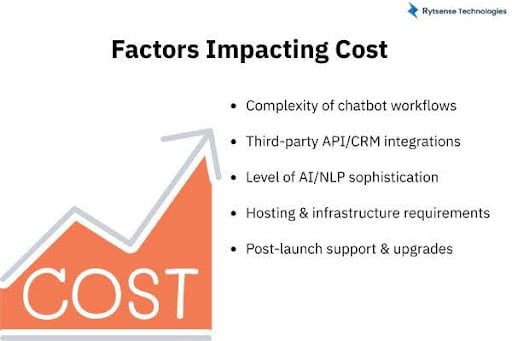
Complexity of chatbot workflows
The complexity of the chatbot and the workflows it can do is the biggest variable. Question and answer bots are relatively cheap (less than $50,000). Bots that can do multiple things and have complex workflows are much more expensive than a consumer chatbot.
Third-party API/CRM integrations
Enterprise chatbot deployments often center on connecting the chatbot to other systems using RESTful APIs, GraphQL endpoints, and webhook architectures. Every integration involves licensing fees and development complexity. CRMs such as Salesforce, HubSpot, and Microsoft Dynamics all require dedicated connector development, authentication infrastructure (OAuth 2.0/SAML) and mapping data schemas.
Integration costs will typically vary from $2,000-$15,000 per system based on the complexity of the API and data syncing and synchronization required. Multi-tenant architecture may require individual API keys and rate limiting, while enterprise deployments would require middleware layers for security compliance and data transformation.
Level of AI/NLP sophistication
The complexity of natural language processing algorithm can affect costs related to infrastructure as well as development time. Rule-based chatbots are simple, inexpensive, and computationally cheaper.
Transformer-based models run on GPU and TPU, while advanced conversational AI solutions utilize contextual awareness and can determine multi-intent. Business enterprise chatbots packaged with any of these NLP implementations require distributed computer architecture with load balancers for availability. Cloud-based NLP offerings can have a per request cost to use the API.
Hosting & infrastructure requirements
Hosting services scale exponentially to accommodate burgeoning chatbot sophistication and user concurrency. Simple chatbots can thrive on shared hosting services that provide basic PHP / Node.js support. However, AI-driven conversational agent implementations require containerised deployments, Docker orchestration, Kubernetes clusters for auto-scaling, and CDN hosting for near-zero latency delivery across the globe.
Database technologies will also vary in their requirements from collaborative yet basic MySQL instances for initial bots, distributed NoSQL implementations (MongoDB, Cassandra) for managing multi-actor (multi-user, multi-bot instances) conversational states across complex enterprise applications with user analytical support.
Post-launch support & upgrades
There will be continued costs in post-launch support and upgrades after the launch. You will want to budget for ways to maintain, support, upgrade, and evolve.
When considering
enterprise AI solutions
of any type, keep in mind that costs and prices are generally positively correlated with better outcomes - the difference between the
best AI development company in USA
Vs others, could be $5000. If it seems to be low upfront while providing better outputs with lower issues and challenges, you might want to consider using a company that has demonstrated success with your type of project.
You should regard the cost of
enterprise AI chatbot development cost
as an investment, not simply an expense. An effective chatbot can save from thousands to tens of thousands hours of human labour and can lead to more than a modest revenue increase from sales.
Deployment & Integration Best Practices
How to integrate AI Chatbot Development Service for Websites seamlessly
The work does not end once you have built the chatbot. There needs to be more work completed to ensure your chatbot is functioning as intended on your website. Believe it or not it is best to make an even more detailed plan. Here are some important practices to consider:
If you are looking to seamlessly integrate your AI chatbot development service for websites, you need to plan. You can plan about where your chatbot will appear within your website and how it will work for your site visitors. You can't just throw it in the bottom corner and hope it works as intended.
Ensuring brand consistency across mobile & desktop
Branding consistency between mobile and desktop is important. Your chatbot should visually & its tone should fit in with your brand. Make sure you try using the same colors, fonts and tone of voice as the rest of your website.
Testing across edge cases, languages, and user journeys
Vigilant testing protects businesses from bad chatbot results on mobile and desktop interfaces. No one should see these! As for the edge cases of testing, read for, input gibberish, inappropriate questions, pushing system limitations, and adversarial prompt injections. Make sure to validate the fallback responses for random characters, profanity, and normal breaks in conversation flow.
When testing for your international customers, you must perform complete multi-language testing to ensure semantic correctness with UTF-8 character encoding, and validation for cultural correctness, localized response, acceptance of error management influenced by different languages, and compliance by global standards.
Soft launch strategies & performance monitoring
You can soft-launch chatbot solutions and actively monitor performance to catch awkward errors before they appear. Start by only showing the chatbot to a small percentage of your website traffic. Monitor the outage and fix problems before the normal percent of traffic see it.
When deploying customer service AI chatbot solutions, organizations must remember that these solutions operate under very high scrutiny and oversight requirements.
Key technical considerations:
Data Sensitivity Management: customer service chatbots process personally identifiable information (PII), payment data, account information, and confidential business information. Put in place data classification standards, use encryption in transit and at rest, and specify risk based on regulations (e.g. General Data Protection Regulation (GDPR), California Consumer Privacy Act (CCPA)), specific industry privacy standards (e.g. credit card processing standards PCI DSS)
- Escalation architecture: You can build a deterministic escalation based on:
passing a confidence score threshold based on Natural Language Understanding (NLU)using sentiment analysis to detect frustration, anger or distress detecting topics that indicate high-risk (e.g. legal threats, safety issue, complex technical issue) using keywords indicators conversations are too long or that loops occurred, indicating unresolved issues - Monitoring & Supervision plan: Implement dashboards for real-time monitoring of:
correctness and hallucinationscustomer satisfaction and successful resolution metricsescalation frequency and reasonflow of conversation, highlighting where breakdowns are occurringevidence of compliance violations or policy breaches - Quality Assurance strategy: establish a continuous assessment approach using:
automated testing using predetermined conversation scenarioshuman-in-the-loop validation for edge casesregrouping and retraining the model based on conversation logs A/B tests to measure response resizing, i.e., length, grammar, spacing etc. Adversarial testing to discover what potential comments would yield
Risk Mitigation Techniques
- Instigate circuit breakers that will automatically escalate based on confidence in the system.
- Run shadow mode tests before full deployment.
- Ensure availability of the human agent during periods of significant emotional stress.
- Include a clear disclaimer that AI is not infallible and still has limitations.
- Define protocols for liability associated with anything the AI produces in terms of advice or decisions.
From a technical standpoint, it should be a priority to include fail-safe provisions that tip the balance toward human, rather than automated, action to avoid customer dissatisfaction or regulatory exposures by not following up on unsupervised AI interactivity.
Decision-Making Checklist: Choosing the Right AI Chatbot Development Service for Websites
Just a simple checklist so you can try to make the right decision:
- Define chatbot goals to startAre you trying to do customer support, generate leads, or automate internal processes? Different purposes mean different features and capabilities.
- Evaluate customization & scalability needsTake some serious time to reflect on your customization and scalability needs. Do you see yourself adding features later? Are you expecting to scale traffic? If so, you will want to select a provider that can grow along with you.
- Balance cost with long-term ROIThink conservatively about your costs, versus ROI in the long run. The cheapest service might end up costing you more, if it doesn't work as you had hoped. Your measure of ROI should simply look at how much a good quality chatbot could save you in terms of staffing cost, and a growth in sales.
- Assess service provider’s expertise, case studies & client reviewsTake time to thoroughly assess the service provider's knowledge, experties, unique Approach, to Studies, and reviews and feedback. You want to select providers who have experience with businesses and organizations like yours so that they better understand your business model.
- Look for reviews, and ask for references.Think about whether you need General AI Development Services, or if you want specialists in only chatbot development. In some cases if you want to develop a project that is Chatbot Specific, then these specialists may offer better overall value.
Conclusion
Choosing the right AI Chatbot Development Service for your website is likely one of the more important decisions you will make for your small business online in 2026! The right Chatbot can revolutionize your customer service, ultimately increase your sales and efficiencies, and subsequently help you save money. The wrong decision will create frustrated customers, and a materially wasted investment.
Never forget that the cheap option is not always the best value in the long-range sense. Take into account your needs, growth plans, and what your customers expect. Look for service providers like Rytsense Technologies that understand your industry and others that can provide additional services as you grow.
Make sure to take time to define your goals before you start your search. Simple FAQ bots can be developed within a few days, and the complexity will often dictate the amount of time to develop and deploy. If you are looking for a much larger solution, for example an AI powered agent, there are available solutions in the market that will cater to your needs and budget.
Finding the right balance between the functional solution you want, the right cost, and the growth needs of your principles is the key.
Meet the Author

Co-Founder, Rytsense Technologies
Karthik is the Co-Founder of Rytsense Technologies, where he leads cutting-edge projects at the intersection of Data Science and Generative AI. With nearly a decade of hands-on experience in data-driven innovation, he has helped businesses unlock value from complex data through advanced analytics, machine learning, and AI-powered solutions. Currently, his focus is on building next-generation Generative AI applications that are reshaping the way enterprises operate and scale. When not architecting AI systems, Karthik explores the evolving future of technology, where creativity meets intelligence.