Key Takeaways
Agentic AI vs generative AI centers on autonomy, generative AI creates content from prompts while agentic AI independently pursues goals through multi-step workflows.
Generative AI excels at creative tasks like content creation, marketing, and design, requiring human oversight for each interaction and output verification.
Agentic AI manages complex processes autonomously, from customer service resolution to supply chain optimization, adapting strategies based on environmental feedback.
Hybrid approaches combining both technologies deliver optimal results, generative AI for creative frontends and agentic AI for autonomous backend process management.
Organizations must consider governance, safety, and ethical implications when deploying either technology, establishing clear human oversight roles and accountability frameworks.
Agentic AI vs Generative AI: Understanding the Differences
Agentic AI vs Generative AI are fundamentally different: generative AI produces content in response to prompts, while agentic AI independently pursues goals as defined by multi-step workflows. The difference between agentic AI and generative AI is one of the most significant changes in contemporary artificial intelligence.
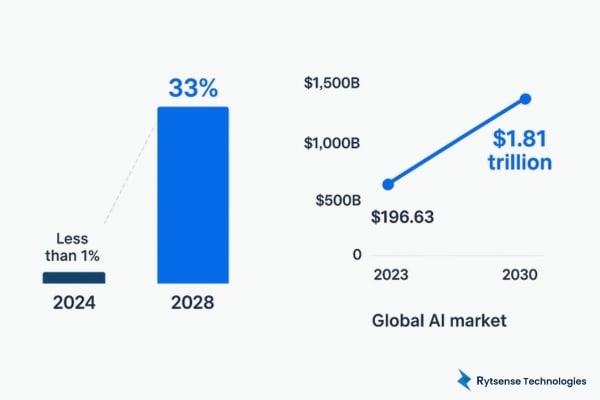
According to Gartner, it is estimated that by 2028, agentic AI will permeate 33% of enterprise software applications, up from less than 1% in 2024. The global AI market was valued at $196.63 billion in 2023 and is projected to grow to $1.81 trillion by 2030, with both generative and agentic AI contributing to this growth.
What is AI?
Artificial intelligence describes computer systems that accomplish tasks that would otherwise require human-like intelligence. AI systems can learn and improve from using data, can identify patterns, and can make decisions. AI is an umbrella term used in relation to a number of different technologies, machine learning for generative models, natural language processing and computer vision.
AI may be divided into several other categories in contemporary AI, and each category can be utilized for different purposes. Classical AI follows predetermined rules to accomplish tasks. Machine Learning AI learns/domains by detecting patterns in specific domains, and deep learning is when a neural network is utilized to deal with complicated tasks.
Why the distinction matters?
Recognizing the distinction between agentic AI vs generative AI informs business planning and technology expenditure. Generative AI develops elements grounded on prompts, while agentic AI functions autonomously toward an objective. The difference affects implementation, costs, risks, and results.
Organizations require a fresh perspective on AI decision-making models. If organizations select the wrong model, they will waste money or miss the intended results. An appropriate model identifies opportunities for efficiency and innovation. The responsibility of determining the most appropriate technology lies on the business leader.
What is Generative AI?
Generative AI is used to develop text, images, code, music, and video. The technology leverages extant synthesized data and extracts patterns to learn about those patterns before it produces original content based on those learning.
Generative AI combines established deep learning techniques to produce original content. Deep learning models that are feasible examples include transformers and neural networks. Other existing examples of generative AI technology include GPT models, DALL-E, and Midjourney. All models produce creative outputs from prompts provided to the models.
Key Characteristics of Generative AI
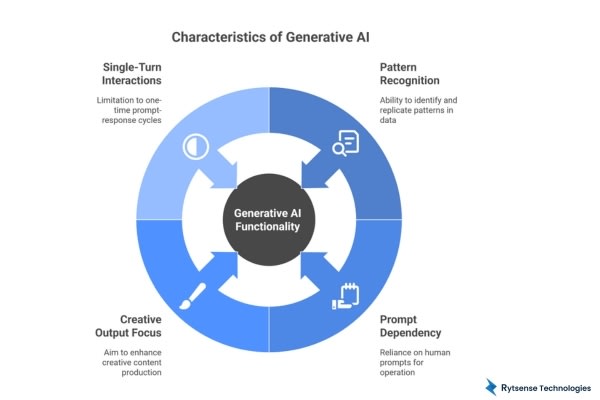
Generative AI has specific features that define its functionality: pattern recognition, prompt-dependent, creative inclination, and being a one-shot activity. Recognizing these characteristics will help organizations look for ways to apply generative technology to replace or augment tasks in their environments.
Pattern Recognition and Replication
Generative AI is proficient in recognizing patterns in all types of training data and can learn relationships between words, pixels, or sounds, and reproduce learned patterns developed in novel combinations to produce content based on those patterns, e.g., content seems to be original and is actually based on learned patterns.
Generative AI uses probability distributions to generate components of content based on training. Generative AI models can predict the next word, pixel, or note, for example. Models use statistics to inform the appropriateness of elements of created content. The hierarchy of the training in the data set means higher quality training results in higher quality text and consequently other generative products.
Prompt Dependency
Generative AI requires a human prompt to operate. Users write prompts with the details of what they want. The AI interprets those instructions. It will create generated content in the requested format, based on the user's request.
Without being prompted, generative AI will not function. It does not operate autonomously without human requests. It requires some human engagement in order to fulfill a creative prompt, which places it in distinction from an autonomous system.
Creative Output Focus
The main purpose of generative AI is to create content for the user. Generative AI produces marketing text, pictures, a code snippet, or design. It is meant to enhance creative output. The technology promotes more efficient workflow for human-created content.
The quality of output diminishes as the instructions provided to generative AI diminish. Well-executed and elaborate prompts will yield quality. Generative AI can produce better creative work than if it were done by the author alone. The time needed to complete other typically repetitive creative works can be reduced when utilizing generative AI.
Single-Turn Interactions
Most generative AI works within the limitation of one turn. You submit a prompt, and it provides the output. The generative AI does not have long-term goals or objectives in the work that it is doing. It simply does one task and waits for the next prompt.
When used in this way, the generative AI has limited memory. The AI will forget the prompt and related responses after its memory is exceeded. Multi-turn exchanges do exist. However, they do not continue to be goal-oriented. Each prompt is its own, relatively independent interaction.
Generative AI Use Cases
Content Creation for SEO
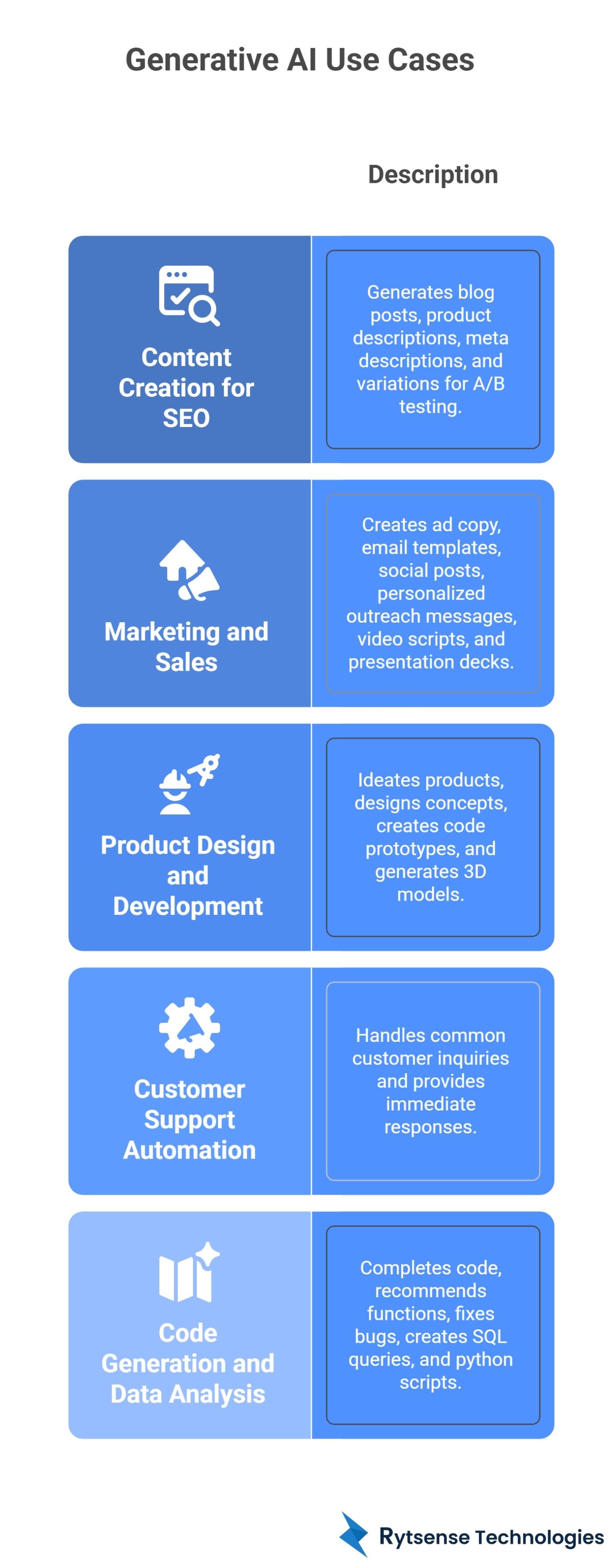
AI for creative content generation is changing the content marketing landscape. It produces blog posts, product descriptions, and meta descriptions. SEO teams utilize these tools to optimize keywords. The technology can also produce variations for A/B testing.
Content creators still have control of the content. They will edit and tweak what the AI generates.
Marketing and Sales
Marketing teams utilize generative AI to create marketing materials for their campaigns. The technology writes ad copy, email templates, social posts, and more. Sales teams create personalized outreach messages and tailored content to increase engagement with their customers.
Generative AI can even be applied to video scripts and presentation decks. It is possible to capture a brand voice or perspective if teams train the generative language model properly. With the purchased outputs, marketing teams are able to scale their efforts and save their organization time.
Product Design and Development
Designers leverage generative AI to ideate products or design concepts - several variations of designs can be generated by the technology. Engineers can create code prototypes in an exploratory prototyping environment in a matter of minutes. Product teams can iterate on initial ideas in a much more efficient manner than previously.
The use of 3D modeling is another clear use of generative AI in the design community. Architecture and fashion industries also employ generative design approaches which further add to the innovation cycle of design products.
Customer Support Automation
Chatbots enabled with generative AI are being used to handle common customer inquiries. They can provide immediate responses to commonly asked questions. This gives customer support teams more time to focus on more complex inquiries that customers may have. Not to mention, the advancements in generative AI enhance the customer experience because there is always someone available to support them online.
Generative AI systems give customer inquiries helpful contextual responses in a natural language understanding scenario.
The systems provide useful contextual answers, and they understand natural language requests. The quality of the answer is determined by the training data.
Code Generation and Data Analysis
Developers use generative AI-based tools to complete code. The technology recommends functions and even fixes bugs. Data analysts create SQL queries and python scripts. The productivity of programming work can increase considerably.
Code documentation becomes an automated activity. Testing scenarios can be created in a fraction of time. Technical teams can spend less time writing boilerplate code.
Discover how emerging AI types like Agentic and Generative AI can transform your business operations and innovation speed.
What is Agentic AI?
Agentic AI refers to AI systems that create autonomous workflows to achieve an objective, without authority from a human user. Different from generative AI, agentic systems take the initiative and create a multitude of steps to achieve a larger goal, and complete these steps with little to no human oversight.
The definition of agentic AI spells out the importance of having intentional actions whereby agents work to achieve a goal. These intelligent agents in machine learning, and their actions extend beyond generated responses as they continuously adapt to conditions. Feedback loops will improve the performance of agentic systems over time.
Agentic or agent-based AI systems will work by perceiving their environment, determine a plan of action to observe and make a decision. In completing task actions, multiple actions will happen sequentially in order to meet the objective. This is a monumental shift from passive AI to having AI that is active.
Core Components of Agentic AI
Goal Persistence
Agentic systems persist in their objectives for extended periods of time. They do not forget tasks to do after an interaction with a human user. Goals and objectives are sustained indefinitely until the task is completed, or the user explicitly cancels the goal. Goal persistence enables agentic AI to carry out complex multi-step processes.
The AI monitors progress toward objectives. It alters its plans when faced with challenges. Goal-driven AI models assign priority based on significance. Long-term planning can take place.
Environmental Awareness
Agentic AI is consistently monitoring its operational environment. The agent will rely on sensors and data feeds through APIs to achieve situational awareness. The observation of changes that demand a response will occur. Adaptive AI will react to new information in the environment.
Contextual understanding goes beyond a single back-and-forth interaction. The AI accumulates comprehensive models of the environment. Awareness leads to intelligence in decision-making. Instead of assuming static conditions, responses are developed based on current conditions.
Tool Integration
These agentic systems possess the ability to access and use multiple tools. For example, the AI can connect to databases and pull data from APIs relevant to its tasks, and it can incorporate specific software platforms. Function calling will allow an environment of complex operations to function. The AI will operate all of these services to fulfill a set task.
The ability to connect and incorporate all of these tasks will flow automatically. The system will be able to select the tools necessary for each subtask. AI orchestration platforms will be able to operate multiple different components autonomously. The minimalistic operation of using different tools performs tasks extraordinarily efficiently.
Feedback Learning
Agentic AI improves when it analyzes outcomes. Successes and failures can assist it in determining or mapping out what to do next. Common reinforcement learning techniques can be applied to maximize the decision-making for the next event. It can analyze metrics associated with its performance on goal-related components and adjust behaviors based on those metrics.
In many ways, all of these systems will be learning from experience. Patterns will emerge through repetition. Over time, the system will develop adaptive strategies. This creates agents that become increasingly effective.
How Agentic AI Works
AI in automation and workflows begin with goal identification. The agent identifies parameters for achieving the goal. Complex tasks are organized into smaller, more manageable subtasks. The agent establishes a plan to achieve the goal, mapping out the steps needed.
The agent then executes the plan one step at a time. At each step, the agent continuously monitors the progress of the overall project. If a problem arises, the agent plans for a new path. It assesses alternative tactics and proceeds on a new course of action.
After completing each step, the agent closes the feedback loop. The results of completed steps inform the next decision-making point within the workflow. The agent continues this same cycle until the goal has been achieved. Human intervention is optional except during certain instances.
Agentic Workflow Explained
Agentic AI operates within a structured workflow that breaks down complex goals into "sub-goals." The agentic system manages planning, executing a plan, monitoring effects, and adapting to it autonomously. Examples from practice illustrate how individual and team-based agentic AI can manage business processes, customer processes, and operations without continuous human input.
Real-World Applications
At the organizational level, agentic systems manage a complete business process. For example, some systems coordinate the entire supply chain without human interaction. A customer service agent can address questions or issues in their entirety. Financial systems can continuously monitor markets and execute buy or sell orders automatically.
Healthcare agents can schedule a patient appointment, order tests, monitor care progress, etc. Manufacturing agents can help develop optimal production schedules. Specific examples provide evidence of fully autonomous AI workflows in practice.
Agentic AI Use Cases
Generative AI technologies cover multiple business functions, industries, and innovative applications. Organizations are using generative AI for content creation, marketing automation, product design, customer support, and code generation.
Customer Service Automation
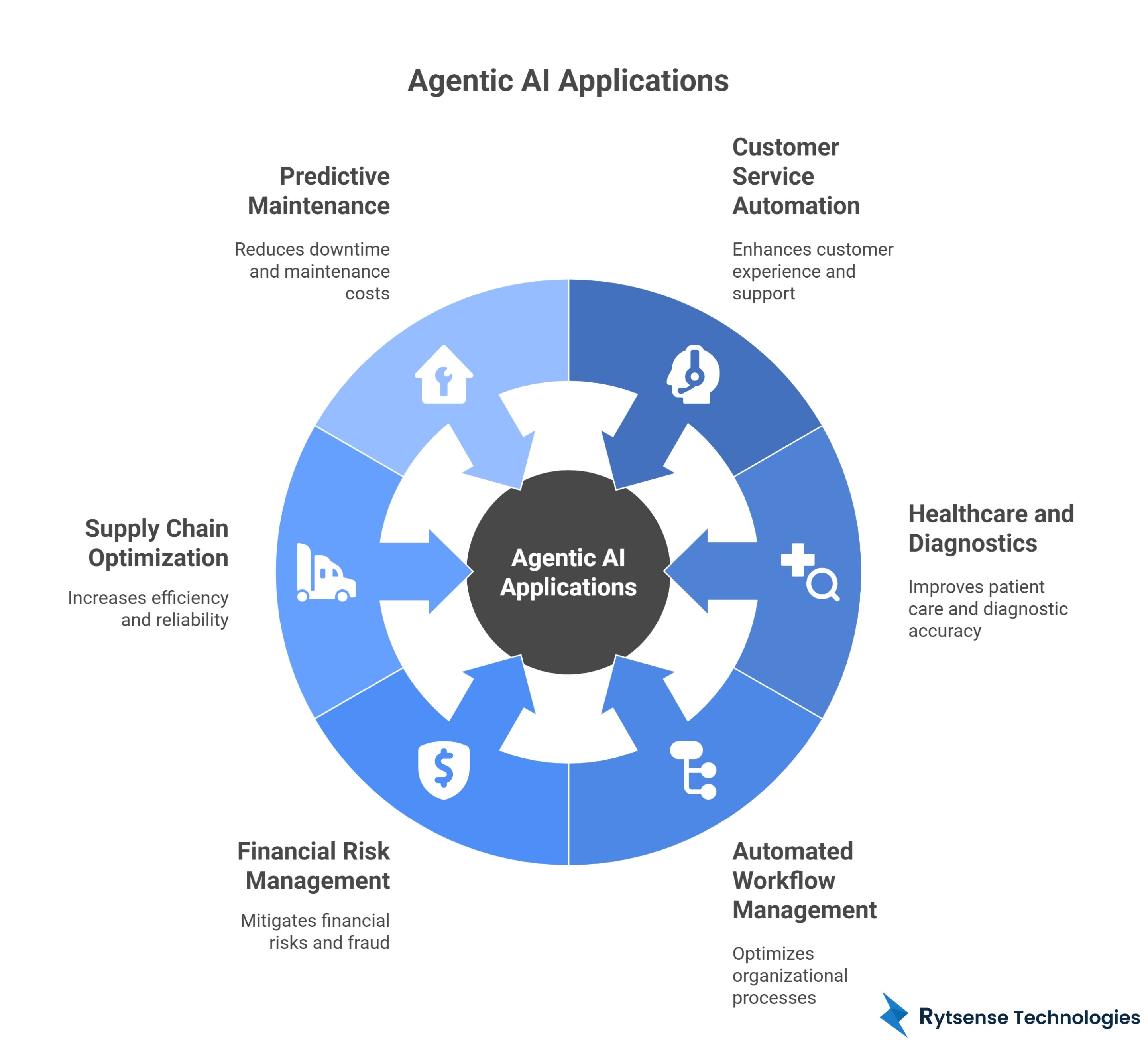
Agentic AI is dramatically changing customer experience and customer support. These systems do not just provide answers to questions, but actually resolve issues. For example, we might envision an agent investigating an account discount problem, making any necessary contacts in various departments, implementing one or more solutions, and then following up with the customer to ensure satisfaction.
The technology is designed for resolving complex inquiries involving multiple steps that are structured in a coherent workflow. The agent only escalates an inquiry to a human when absolutely necessary to help resolve the customer issue. The agent significantly reduces the time to resolution for customer concerns. In fact, customer satisfaction increases substantially, largely because the agent proactively resolves problems.
Healthcare and Diagnostics
Agentic AI applications such as diagnostic assistants share benefits in healthcare. These systems gather patient symptom information, assign additional diagnostic tests, analyze test results, make treatment recommendations, and monitor patient vital signs over time. They generate alerts when patient intervention is required.
Predictive AI in industries, especially in healthcare, can help to prevent complications. Early warning systems save lives. Care coordination is improved through automated workflows that allow medical professionals to focus on decisions of higher levels of importance.
Automated Workflow Management
Organizations are adopting agentic systems for process optimization purposes. These agents support organizations by overseeing document processing, monitoring approval workflows, and allocating resources. They can identify problems in a process and take action automatically to resolve them.
AI for process optimization can reduce operational costs. The efficiency savings tend to get multiplied over time. Human workers can deal with exceptions to the process rules or strategic decisions post-savings.
Financial Risk Management
Financial institutions are deploying agentic applications of AI to help with risk management and loss prevention. Agentic systems will witness constant and real-time transaction activity looking for patterns of fraud. They can analyze market situations around the clock, and account rebalancing occurs automatically, based on red flags.
AI risk management and governance as a tool to mitigate losses. There are also AI applications for transaction compliance monitoring in real-time. Alert systems will notify a financial professional of significant events.
Supply Chain Optimization
The supply chain can benefit from using agentic systems to help control logistics. Inventory levels can be automatically optimized and re-optimized. Transit routing could be adjusted according to weather or traffic.
Manufacturing and supply chains achieve unprecedented levels of efficiency. Costs decrease and reliability increases. The response to disruptions becomes faster and more effective.
Predictive Maintenance
Monitoring industrial equipment mitigates the likelihood of failures. Agentic AI analyzes sensor data to identify signs of impending failure and adjusts maintenance schedules on the fly. Spare parts are ordered and received, and maintenance takes place, all before failure has actually occurred.
The result is a dramatic reduction in downtime, longer-lasting equipment and less maintenance costs due to the use of dynamic scheduling.
Agentic AI vs Generative AI – Key Differences
| Phase | Duration | Investment Range | Expected Returns | Key Milestones |
|---|---|---|---|---|
| Pilot Project | 3–6 months | $100K–$500K | Learning & validation | Proof of concept |
| Initial Deployment | 6–12 months | $500K–$2M | 15–20% efficiency gain | Single facility success |
| Full Scale Rollout | 12–24 months | $2M–$5M | 25–35% total improvement | Multi-site deployment |
| Maturity & Optimization | 24+ months | Ongoing investment | Sustained competitive edge | Continuous innovation |
The difference between generative AI vs agentic AI lies in autonomy, purpose and function. Generative AI creates output based on a prompt, while agency AI executes goals autonomously (i.e., goals set by the user and unless instructed to stop, agentic AI will initiate multi-step workflows on its own). Awareness of these differences informs selection of technology, implementation approach and risk management framework.
Agentic AI operates within a structured workflow that breaks down complex goals into "sub-goals." The agentic system manages planning, executing a plan, monitoring effects, and adapting to it autonomously. Examples from practice illustrate how individual and team-based agentic AI can manage business processes, customer processes, and operations without continuous human input.
Core Purpose
The fundamental distinction between Agentic AI vs Generative AI is in purpose. Generative AI enhances - AI generates text based on the user's parameters. It functions as an advanced creative agent.
Agentic AI meets objectives without human intervention. Agentic AI should be thought of as eliminating problems in a comprehensive manner. Agentic AI functions as an autonomous assistant whose success is determined by whether an objective was met, rather than the quality of a product.
Generative AI vs Agentic AI
Autonomy and Decision Making
The main distinction between agentic AI vs generative AI is the level of autonomy. Generative systems require prompts for any action to be taken, and they only autonomously make decisions about content production. Agentic systems will independently initiate actions and can make both strategic and tactical decisions as they pursue the goal. The degree of autonomy results in differing trust expectations and implementation paradigms.
Prompt-Dependent vs Autonomous Goal Pursuit
Generative AI takes no action unless prompted. Each output is generated only with a prompt. The only decision to be made is what content to generate; prompt response remains limited in scope and temporality.
Agentic AI takes independent action toward an objective. It determines needed steps to meet its goal. Its decisions provide strategy, tactics, and execution harmoniously, completing a task without human intervention.
Workflow and Functionality - Single-Shot Responses vs Multi-Step Planning and Execution
Generative AI completes large tasks into discrete tasks with one prompt = one output. If a comprehensive project is needed, individuals must go through a sequential process of asking generative AI a prompt, waiting for an output and input for the next prompt. Individuals fit together the project in the comprehensive workflow that may coordinated in more complex timelines and/or project.
Agentic AI solves the overall project tasks as one task. Agentic AI establishes a sequence of needed steps to accomplish a goal. Once executed, Agentic AI works independently until it meets its goal. It has coordinating software that enables each step to achieve a goal.
Working with AI business ideas are built on understanding the differences. Generative approaches will suffice better for discrete tasks and respond to problem and complex stationary tasks.
How each AI handles complex scenarios
Generative AI comprehends prompts based on context and provides relevant responses. That said, the context window limits long-term memory. When context involves range but the nature of the situation explains too much information, outside management of context is needed.
In contrast, agentic AI takes on a persistent context, remembering past actions or outcomes.
When the environment causes a change, agentic AI will adjust its strategies, using the context of the ongoing situation, as well as past context, sometimes a lot. Complex situations often utilize cumulative knowledge, unlike generative AI which picks out and builds on the relevant context only for the moment.
Adaptive AI systems perform well in dynamic environments, while generative holds for static situations. Overall, it is the complexity and variability of the tasks which will determine the best sort of AI use.
Limitations and Risks
Generative AI Limitations: Hallucination, Accuracy, Verification Challenges
Generative AI sometimes creates confidently stated false information. These "hallucinations" appear plausible but have no basis in fact. Accuracy isn't guaranteed with every output, and this is due to the training's historic basis. Ultimately it is the responsibility of the user to verify output.
Copyright issues arise with generative AI-created content, based on derivative works from using data sources of training data; the rules and regulations are unclear. Additionally, the biases in training data will be present in the outputs.
Assuring quality control requires a human touch or intervention. Automated verification isn't yet a realistic occurrence or solution. Critical tasks will require human input hours to establish reasonable verification. In sum, there will be practice limitations due to all of these aforementioned limitations and risks.
Agentic AI Risks: Goal Misalignment, Autonomous Error, Security Vulnerabilities
Agentic AI pursuing the wrong goals creates significant problems. Misalignment between intended and actual goals can inflict significant damage. Autonomous errors will accumulate over non-overseeing human agency, and for humans to attempt to mitigate those errors, the agent must be stopped in its execution.
Security risks and vulnerabilities will enable agents to be used maliciously. Compromised agents may harm extensive (and potentially permanently) damage. AI safety and accountability will be critical considerations.
Multi-agent systems in AI will present challenges in coordination across agents. Conflict in objectives of agents will result in deadlock. Emerging behaviors will be unpredictable. Agents will require careful engineering to mitigate these issues.
Whether you need decision-making intelligence or creative generation, our experts can help you choose the right AI approach for your business.
Choosing Between Generative AI and Agentic AI
Deciding between gen ai vs agentic ai requires consideration of the business needs, complexity of the use case, and available resources. Important decision factors are required levels of autonomy, levels of oversight, budgets, and strategic goals. The best outcomes often come from hybrid approaches that can exploit the various strengths of these technologies.
When to Use Generative AI
Generative AI is well-suited for occasions where creative augmentation, human-in-the-loop support, and consideration of cost will be requisites. Generative approaches are commonly taken in organizations for content production, design ideation, and when some element of verification is needed. In these examples, the generative AI infers knowledge at very high speed while a human retains responsibility and accountability for the output.
Creative augmentation and flexibility
Generative AI tools made for organizations will be awesome for tasks that are more for creative. Things like marketing content, design concepts / ideation, and code snippets might benefit from this technology. This takes the speed of an agents in nature with human creative implementation - the fact that the output still relies on a human to refine its outcome.
Organizations who are interested in augmenting and neutralizing creativity, they will likely take a generative approach and both the output and the amount of outputs will allow more flexibility. Similarly, this will allow organization to chose the best of between a number of variations.
Human oversight requirements
For applications where verification is necessary, humans are favored over generative AI. With generative AI, a human must review any generated content and approve it for use. However, all critical decisions remain in the control of humans. This is necessary for satisfying regulations and quality requirements.
Content that is customer-facing will require oversight. Legal and medical implementations will need verification. To mitigate these requirements, generative AI is able to generate drafts for final review by a human.
Cost-conscious implementations
When a company examines the cost of generative AI Development Services compared to agentic implementations, they will find that costs are significantly lower. Additionally, the infrastructure and technology requirements are considerably less. Companies may be able to get started with existing prompts while also deriving value immediately. ROI may also appear quickly for the right use cases.
Companies with little budget for AI may implement generative technology first, starting with the lower costs and scaling as technology and use-case needs arise. During the initial adoption phase, risk is low.
When to Use Agentic AI
Agentic AI technologies are most effective when organizations want to realize massive scale automation, when the environment is adapting and responding to different variables or factors, and when moving towards a strategic goal (or goal formation process). Agentics can be incorporated into organizational workflows or production processes that require complex or lengthy processes to execute, and when validation capabilities are required.
Large-scale automation
Agentic systems benefit operations that handle thousands of transactions. With the use of AI-augmented auto, volume is handled at a capacity that humans simply cannot. The automating processes results in consistency at each step of the operations, and each transaction carries a much lower variable cost.
Manufacturing, logistics, and finance are well suited for agentic AI to achieve scalability. The automating of repetitive activity and continuous processing will allow labor to attend to exceptions and value-added improvements.
Adaptive response and complex orchestration
Dynamic systems demand adaptable AI-based solution. Market conditions change, customer behaviors change, and operating conditions changes constantly. Agentic AI Systems will automatically amend strategies. There are coordination AI platforms that can direct any number of systems within a broad response framework.
Processes that require orchestration of complex workflows across multiple organs/department would as well, benefit from agentic principles. System integration can be automatic for most, if not all, processes. End-to-end transactions can be automatism degree higher than 80%, with major increases in visibility and manageability.
Strategic goal pursuit
Long term goals are also suitable towards an agentic AI capability. Using a agentic AI system, long-term goals can be pursued across days, weeks, months, etc. The system will track status, capabilities and reroute actions when necessary. Long-term (strategic) investments in capability will support future goals and remain true to the Charter without constant guidance.
Many companies are also pursuing transformation projects using an agentic Go. The agentic ai systems create a sustainable, continuous improvement mindset and activity will become embedded in operations. Achieving intended goals can be accelerated and become embedded activities.
Hybrid Approaches
Generative Frontend + Agentic Backend
Countless implementations utilise both technologies. Generative AI produces content that the customer sees, while Agentic AI handles processes on the backend. These Hybrid AI approaches, which uses the strengths of both technologies.
The flexible and structural nature of the customer-facing interfaces stays intact, while the efficient operationalisation of backend processes continues unimpeded. The hybrid AI delivers a reinforced user experience with operational efficiencies.
Agentic orchestration of generative tools
Agentic systems have a high degree of control over multiple generative AI applications. The agent decides when content needs to be created or processed, selects the most appropriate generative tool, and composes the prompt. The agent integrates the content into larger cumulative performances.
This approach allows for the best outcomes of both technologies, leading to smarter arrangements of the content produced. Process complete faster while the agent allows for less human interaction.
Feedback loops and human-in-the-loop escalation
Sophisticated implementations embrace human collaborative mechanisms. Agents send escalations if the decision-making becomes too difficult or nuanced for AI. Human feedback will continually improve the agent's performance. Through a process of learning loops, increasingly performing systems will emerge.
Some of these arrangements will have protocols for escalation that will help with critical applications and higher order thinking. Human assessment in less routine situations will also help with the integrations of these systems to manage edge states.
Trends and Future Directions
There are identifiable trends in the evolution of artificial intelligence that indicate futures for both generative and agentic use cases. The advancements of natural language processing, autonomous systems, and agent collaboration are allowing businesses to transact differently. The idea of the combination of both generative and agentic approaches promises embedded intelligence that achieves a balance of creativity and autonomously moving towards a goal.
Generative AI Trends
Generative AI is maturing in content quality, data modalities, and natural language understanding. AI-powered content creation solutions are becoming commonplace across sectors. As these language models evolve, they will become even more sophisticated, efficient, and accessible. This evolution will lead to democratization of advanced content creation capabilities for organizations of any size.
AI-powered content and creative tools
Workflows involving generative AI tools for businesses for rapid large-scale design and content creation continue to advance. The creation of images of such high quality, they appear to originate from a product or commercial photographer. With video generation soon to become a necessity, audio synthesis for voice and music that is indistinguishable from reality will soon and in many cases already be the norm.
Generative AI applications have made their way into businesses; departments from marketing and product design to engineering will certainly benefit. Productivity will skyrocket in the meantime.
Advancements in NLP and language models
Better understanding of human language: Modern NLP tools can now grasp tone, intent, and emotion, allowing businesses to create more natural and personalized customer interactions.
- Smarter chatbots and virtual assistants: Advanced language models make customer support faster and more accurate by handling complex queries and providing relevant solutions in real time.
- Improved content creation: NLP helps companies generate blogs, reports, and product descriptions that sound more human and require less manual editing.
- Industry-specific intelligence: Businesses can train AI models with their own data, enabling more accurate insights and recommendations for sectors like healthcare, retail, or finance.
- Reduced errors and bias: Newer models are designed to produce more reliable and balanced responses, improving trust and brand reputation.
- Seamless integration: NLP-powered tools can now be easily added to existing business systems, helping automate workflows and enhance team productivity.
Agentic AI Trends
The development of agentic AI is being focused on software autonomy, industrial automation, and collaborative agent ecosystems. Co-located applications of multiple specialized agents will work together to solve complex problems. As reliability continues to develop, the agentic AI domain is growing in industrial application. These trends are establishing agentic software as foundational to the future of business operations and infrastructure.
Autonomous Software and Industrial Agents
Agentic systems are more frequently being used in software development. Code agents manage complete projects. They autonomously conduct testing, deployment, and monitoring. Development cycles speed up considerably.
Industrial AI-powered automation is implementing agentic approaches. Factory floors function with little to no humans. Quality assurance is improved by constant monitoring of processes. Safety risks are improved through proactive detection.
Agent ecosystems and collaborative AI
Multiple agents working collaboratively can solve complex issues. Each agent possesses a specific and specialized purpose. Communication is standardized through protocols. The collective intelligence of multiple agents allows them to cooperate and achieve insights beyond their individual capabilities.
Companies are using agent ecosystems for enterprise operations. Departments have specialized agents. Integrating specialized agents leads to seamless and creative business processes.
Convergence of Generative and Agentic AI
The convergence of Agentic AI vs Generative AI is creating systems that can build intelligence. Embedded intelligent systems will contain generative AI to develop content while also pursuing autonomous action to achieve goals. Adaptive strategies will utilize both creative problem-solving and ongoing execution actions. The collaboration between humans and autonomous software (both agentic and generative) will continue to advance, disrupting work and productivity.
Embedded Intelligence
In the next phase, both capabilities become embedded within systems that mimic human-like processes. Agents create content on an ad-hoc basis in service of goal-directed behavior. Generative models build upon agentic feedback and adapt. The line between generative processes and agentic systems begins to dissolve in the contexts in which they are used.
This new form of converged capabilities allows for unprecedented possibilities. Systems are both creative and goal-directed. Business value compounds when embedded in an organization.
Adaptive Strategies
The waste management of creative processes and goal-directed systems will lead to nuanced strategies and programming. Generative capabilities create novel solutions. Agentic persistence will ensure goals are accomplished. Adaptability improves with learning over time.
Organizations can develop a competitive advantage with these systems. Innovation will happen at a faster pace. These systems will improve execution simultaneously.
Creative Problem-Solving
Problems that require creativity and persistence will benefit the most in human problem contexts. The combined systems will generate novel solutions.
Human-Agent Collaboration
Human AI is about collaboration. Humans working together with AI. Generative AI enhances human creativity, and Agentic AI extends human ability. Working in concert, they complete tasks in ways that were impossible alone.
Workforce strategies consider the potential of AI. Jobs evolve rather than disappear. New jobs include managing AI systems. There is a new level of productivity.
Agentic AI vs Generative AI in Specific Industries
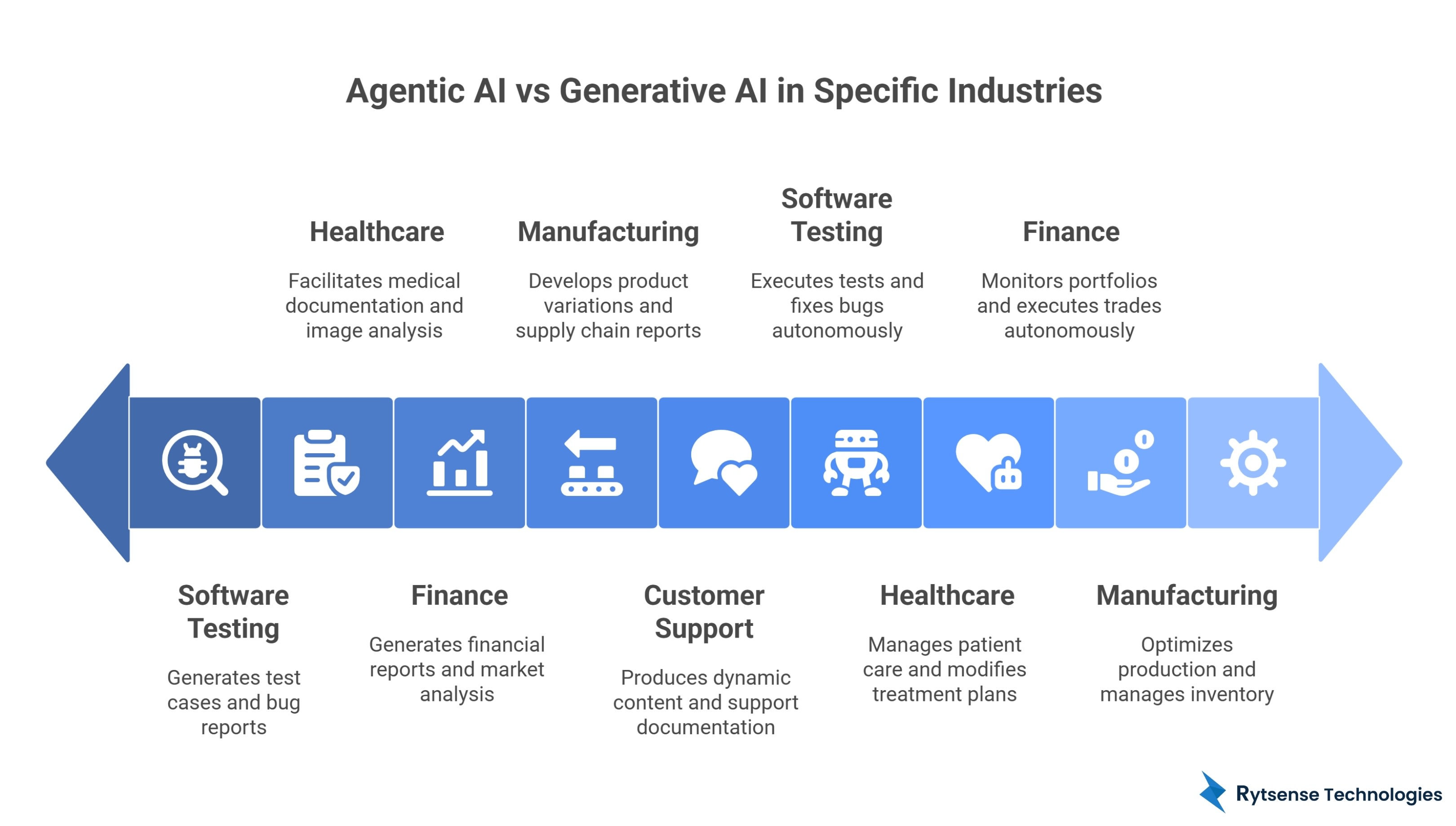
Different industries are realizing Agentic AI vs Generative AI using similar concepts but the application will differ due to different operational requirements. For example, generative AI will be used one way in software testing, healthcare, finance, manufacturing, and customer support. Each industry will demonstrate a different way to utilize each type of technology while helping to address the challenges and opportunities unique to each sector.
| Industry | Generative AI Applications | Agentic AI Applications |
|---|---|---|
| Healthcare | Medical documentation, image analysis | Patient care coordination, diagnostic workflows |
| Finance | Report generation, market analysis | Trading execution, risk monitoring |
| Manufacturing | Design variations, documentation | Production optimization, maintenance scheduling |
| Customer Support | Response templates, knowledge base articles | End-to-end issue resolution, proactive outreach |
| Software Testing | Test case generation, bug report writing | Autonomous test execution, continuous monitoring |
Software Testing and Quality Assurance
Generative AI creates scenarios and test cases on its own. Test data is generated according to specifications. Documentation will be done automatically. Testing teams are more efficient.
Agentic AI executes comprehensive test suites with zero human intervention. It finds bugs and confirms fixes, while continuous testing occurs through the development process. The overall quality improves and cost decreases.
How is agentic AI different from generative AI in testing? Generative AI creates artifacts while agentic AI manages quality end-to-end.
Healthcare
Generative AI facilitates medical documentation. Patient history is summarized. Imaging analysis identifies abnormalities, and research papers are synthesized rapidly.
Agentic AI manages patient care. It schedules appointments, orders tests, and tracks patient progress. It can also modify treatment plans based on response. The quality of care improves through all-encompassing management.
Finance and Risk Management
Generative AI generates financial reports and analysis. Market commentary is generated, and investment research is rapidly scaled with generative AI.
Agentic AI will monitor a portfolio in real-time. It will rebalance according to an specified risk parameter. Fraud monitoring will be done through agentic AI autonomously, as will compliance monitoring.
Manufacturing and Supply Chains
Generative AI can develop variations of a product. Manufacturing documentation is developed automatically. Supply chain reports are created automatically.
Agentic AI can optimize production schedules. Inventory management can occur without human involvement. Supplier relationships are managed methodically. Efficiency increases dramatically.
Customer Experience and Support
Generative AI produces unique, dynamic content for marketing that can then be personalized. Support documentation is automatically developed as needed. Customer communications can be automated and standardized.
Agentic AI can manage customer journeys from start to finish. Issues are resolved without following a manual process by a human technician. Proactive support stops issues from happening at all. Customer satisfaction scores are significantly improved.
Governance, Safety, and Trust Considerations
Human-AI Collaboration
Organizations proceed with trust-building partnerships with AI Agent Development Service providers slowly. Trust comes with proven reliability over time. Having trust, and the ability to establish it, comes from transparency in AI functions which establishes the fundamentals for oversight governance.
Privacy and Security
Encryption, access controls, and monitoring preserve user data. Frequent security audits identify weaknesses. Regulatory privacy statutes limit operations of AI capabilities. Even compliant, the system or organization must continue to manage privacy as an ongoing effort.
Ethical AI Deployment
To score things for fairness, there are fairness metrics that can help improve the systems. Additionally, social responsibility impacts how organizations change and how their overall AI strategy will be implemented.
Conclusion
The future of AI agents flows toward increasingly complex collaborative systems. In fact, multi-agent systems will call on the GOAT (Generalized, Organizing, Analytic, Technical) depth of safe and effective agents to address increasingly complex problems. An effective business strategy with AI must incorporate an understanding of both generative and agentic capabilities.
Choosing between Agentic and Generative AI depends on your business vision — our team can help you design, develop, and deploy the right solution.
Meet the Author

Karthikeyan
Connect on LinkedInCo-Founder, Rytsense Technologies
Karthik is the Co-Founder of Rytsense Technologies, where he leads cutting-edge projects at the intersection of Data Science and Generative AI. With nearly a decade of hands-on experience in data-driven innovation, he has helped businesses unlock value from complex data through advanced analytics, machine learning, and AI-powered solutions. Currently, his focus is on building next-generation Generative AI applications that are reshaping the way enterprises operate and scale. When not architecting AI systems, Karthik explores the evolving future of technology, where creativity meets intelligence.