Key Takeaways
Agentic AI enables autonomous banking operations with 40% faster processing and 65% cost reduction. Priority use cases include automated credit decisions, fraud detection, and customer onboarding with 6-18 month ROI. Success requires robust governance, regulatory compliance, and human oversight to mitigate AI risks. Implementation should start with pilot projects, then scale enterprise-wide with dedicated AI-compliance teams.Future banking will feature autonomous AI agents delivering invisible, personalized financial services.
Agentic AI in Banking: Transforming the Future of Financial Services
Agentic AI in Banking
marks a major change in banking operations. Recent industry surveys reveal that 78% of banks plan to adopt
AI Agents in banking
by 2026. Unlike most AI systems, agentic AI does not need a human operator, can work on multi-step tasks, and employs machine learning to better understand its environment. Agentic AI provides new capabilities from customer service to risk management, and already, first movers report 40% faster transaction processing and 65% decreased operational cost.
Overview Agentic AI in Banking
This section offers a thorough overview of agentic AI technology within the context of banking by defining essential terminology and outlining how autonomous AI systems are critical to competitive strategy and operational effectiveness for any modern financial institution.
What is Agentic AI?
Agentic AI is a form of AI that can take independent action to achieve a specific goal, without constant human supervision. An
agentic AI agent
may perceive its environment, make decisions, take action, and learn from its experience. Specifically, in banking, agentic AI systems can understand rich financial scenarios, interact with many different systems, and take action across several different departments.
Key Characteristics of agentic AI include:
- Autonomy: Act independently from human action
- Goal-directed behavior: Work towards a specific goal
- Situational awareness: Know context of the situation
- Learning: Learn from experience
- Decision-making: Make decisions based on available data
Why Agentic AI in Banking Matters Today
The banking industry is experiencing challenges unlike any other time in history. More or increased customer expectations, regulatory compliance demands, and pressure from FinTechs are putting strains on archaic banking models. Banking processes typically include many points of contact, manually, and lengthy approval processes.
Agentic AI in Banking
solves these issues by:
- Cutting operational expenses by 30-50% through automation
- Providing an exceptional customer experience through 24/7 non-invasive assistance
- Allowing for enhanced real-time risk monitoring
- Speeding up organizational decision making
- Providing automatic regulatory compliance
The Evolution of AI to Agentic AI in Banking
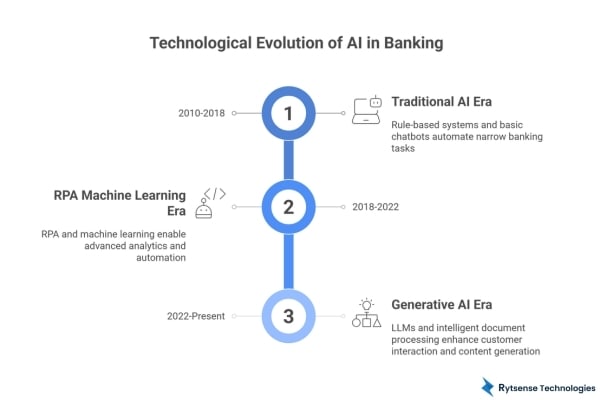
This section outlines the technological evolution from traditional rule-based systems to agentic AI, focusing on significant developments in the journey, including Robotic Process Automation (RPA), machine learning,
generative AI
, and finally, a significant advance to fully autonomous decision-making systems in banking.
From Traditional AI and RPA to Generative AI
The evolution of AI within banking can be experienced in three proven eras.
The Era of Traditional AI (2010-2018):
- Rule-based systems for basic automation
- Simple chatbots with limited human-like response capabilities to answer customer inquiries
- Basic directives for possible fraudulent determination
- Limited to discrete, narrow based work
RPA Machine Learning Era (2018-2022):
- Robotic Process Automation doing repetitive tasks
- Machine learning coding for pattern recognition
- Advanced analytics for simple loan risk assessment
- Built upon legacy bank systems
Generative AI Era (2022-Present):
- Large language models based from Natural Language Processing on large datasets
- Content generation for reports, communications, and loan applications
- More customer interactivity
- Intelligent document processing.
Also Read: AI for Business Development: The 2026 Complete Guide
How Agentic AI in Banking Represents the Next Leap
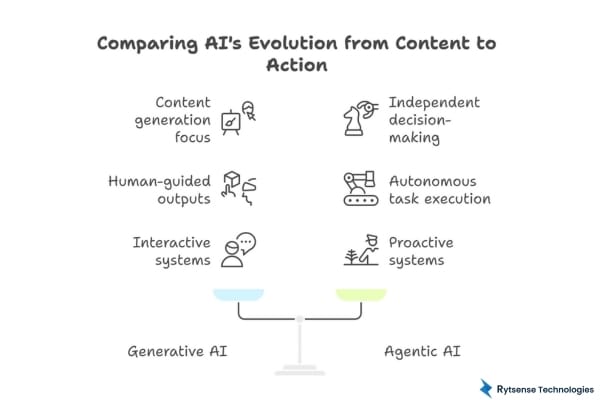
Agentic AI is a fundamental shift from reactive systems to proactive systems. While generative AIs and agentic AIs differ in their ways of operating, it is important to highlight that agentic AI goes beyond generating content and actively takes action. Check
generative AI vs agentic AI
in this table. This new evolution allows to:
Traditional AIGenerative AIAgentic AIRule-based responsesContent generationIndependent decision-makingHuman-triggered actionsHuman-guided outputsAutonomous task executionSingle-purpose toolsMulti-modal capabilitiesMulti-agent orchestrationReactive systemsInteractive systemsProactive systems
Top Use Cases of Agentic AI in Banking

This section describes the most impactful
use cases of agentic AI in banking
operations from credit underwriting to fraud detection, to automating customer service call centers, while demonstrating measurable impact and implementation options for each case.
Use CaseKey FunctionsBenefitsImplementation ComplexityCredit Underwriting & Loan DecisioningReal-time data analysis, risk assessment, automated approvals, continuous monitoring80% faster processing
25% reduction in defaults
Improved accuracyHighPayments & Transaction AutomationPayment routing optimization, failure resolution, compliance management, FX optimization60% faster settlements
Reduced operational costs
Improved success ratesMediumFraud Detection & AMLReal-time monitoring, pattern recognition, suspicious activity detection, automated reporting90% reduction in false positives
Faster threat detection
Regulatory complianceHighLegal & Compliance ManagementAutomated reporting, contract analysis, policy monitoring, regulatory change tracking70% reduction in compliance costs
Improved accuracy
Risk mitigationMediumCustomer Onboarding & ServicesKYC automation, document verification, personalized recommendations, 24/7 support50% faster onboarding
Enhanced customer experience
Reduced manual workLow-Medium
Smarter Credit Underwriting & Loan Decisioning
Agentic AI disrupts traditional credit decision-making by assessing thousands of data points in real time. Agentic AI can:
- Access data sources related to credit histories, bank statements, and alternative data
- Leverage algorithms to assess risk factors
- Make lending decisions within minutes instead of days
- Monitor borrower actions after the loan is funded
- Adjust credit related to changes in users’ actions
Advantages:
- Reduction in loan processing times by 80%
- Savings generated by reduced default rates of 25%
- Improved precision of risk assessment actions
- Improved user satisfaction
Payments & Transaction Automation
Agentic AI
intelligent banking automation
take actions by processing of payments.
- Automatically route payments through best payment management channels
- Detect payment failures, and resolve
- Document compliance for cross-border transactions
- Improve foreign exchange rates
- Handle payment disputes automatically
Fraud Detection and Anti-Money Laundering (AML)
AI-powered fraud detection
systems provide all-encompassing protection with:
- Real time transaction monitoring
- Pattern analysis in multiple accounts
- Detection and reporting of suspicious activity
- Automated reports for regulatory compliance
- Risk scoring and prioritization of alerts
Use cases for
agentic AI in banking
to prevent fraud include:
- Behavioral biometrics analysis
- Network analysis for detection of money laundering
- Real time risk scoring
- Automated suspicious activity reports
Legal, Compliance & Risk Management
Compliance with regulations in banking using AI enables:
- Automatic reporting to regulators
- Contract analysis and risk assessment
- Policy monitoring and updates
- Audit trail
- Regulatory changes
Financial risk management with AI
provide:
- Market risk
- Credit risk monitoring
- Operational risk
- Stress testing
- Capital adequacy
Customer Onboarding & Personalized Services
Customer experience with AI agents
changes banking relationships with:
- Automated Know Your Customer processes
- Verifying and validating documents
- Risk profiling and recommending products
Personalized banking with AI agents
- 24/7 support
Also Read: Top 10 Use Cases of Conversational AI in Healthcare
Deployment Strategies for Agentic AI in Banking
This section describes three
main deployment strategies for agentic AI in banking
: as an overlay to existing systems, built-in AI native architectures, or, for maximum efficiency and to mitigate implementation risk, designed as a complete re-imagining of the banking process itself.
Overlaying Agentic AI on Existing Systems
Strategies for deploying
agentic AI in banking
usually begin with an overlay approach.
Pros:
- Lower cost to implement
- Limited disruption to current operations
- Rapidly get to market
- Integrating into existing workflows with lower complexity
Steps:
- Identify viable processes for AI overlay
- Build API connectors to legacy systems
- Train the AI agents using current data
- Launch using a phased rollout approach
Building Agentic AI by Design in Banking
An implementation instance can also pull agentic AI architecture from the ground up.
- Banks adopting a cloud-native stack
- Has got Microservices architecture
- API-first design may ensure scalability while compliance maintenance
- Security infrastructure of Banking is integrated
Reimagining Banking Processes with Agentic AI
Benefits of agentic AI in banking
extend to complete process transformation:
Traditional ProcessAgentic AI Enhanced ProcessManual document reviewAutomated intelligent analysisSequential approval chainsParallel processing with AI agentsStatic risk modelsDynamic, self-updating algorithmsReactive customer serviceProactive problem resolution
Technology Ecosystem Enabling Agentic AI in Banking
This section describes the technical infrastructure, platforms, and integration needed to successfully deploy an agentic AI system: multi-agent, data platforms, cloud platforms, and ultimately banking-specific solutions to credit risk, like Rytsense.
Platforms and Frameworks
Key technology platforms are leading the way in agentic AI:
- Microsoft Azure AI: An entire suite of tooling and services for AI
- AWS Bedrock: Foundation models and infrastructure for AI
- Google Cloud AI: Advanced machine learning capabilities
- IBM Watson: Enterprise-level AI solutions
- Rytsense: Offering specific agentic AI in financial servicesspace
Rytsense specifically offers up-to-date agentic AI platforms developed for banking institutions, with pre-built AI agents for common banking activities, enhanced tools to assist with regulatory compliance, and support for connections to other systems.
Know More: A Complete Guide to Hire Indian Developers for FinTech in 2026
Multi-Agent Systems and Orchestration
Multi-agent AI systems in banking
coordinate multiple specialized agents:
- Customer Service Agents: Respond to inquiries and provide assistance.
- Risk Management Agents: Monitor risk and evaluate risk factors.
- Compliance Agents: Facilitate adherence to regulatory requirements.
- Transaction Processing Agents: Carry out payments and transfers.
- Analytics Agents: Create reports and other insights.
Data, Infrastructure, and Integration Needs
Successful
agentic AI applications in banking
require the following considerations:
Data Requirements:
- Adequately cleaned data from a data storage engine.
- Capability to stream data in near real-time.
- Ongoing data quality management.
- Ability to process data in a privacy-preserving way.
Infrastructure Requirements:
- Access to performant and high-computing capabilities.
- A highly scalable cloud infrastructure.
- Application security frameworks.
- API management features.
Risks and Governance of Agentic AI in Banking
This section tackles the key challenges and
governance of agentic AI in banking
, such as regulatory framework, ethics, model risks, interpretability risks, and necessary governance structure to assure responsible banking application of AI.
Ethical, Regulatory & Compliance Challenges
In the realm of
agentic AI in banking
, there are several fundamental issues that emerge relating to governance of the technology:
Regulatory Challenges
AI regulatory compliance challenges
- Data privacy obligations
- Algorithmic transparency mandates
- Cross-border regulatory differences
Ethics Issues:
- Bias in AI processes decision making
- Fair lending practices
- The protection of customer data
- Algorithmic accountability
Model Risks, Interpretability, and “Rogue” Behaviors
The following
risks of agentic AI in banking
may emerge:
- Model drift: AI losing its efficiency over time
- Unexpected behaviors: agents emerging outside of the founders’ parameters
- Interpretability: Diminished capacity of explaining AI’s decision making
- Systemic risks: network effects of AI failures
Human Oversight and Governance Mechanisms
Good governance will require the governance of human oversight and protection measures:
- Multi-level oversight: Monitoring of the AI takes place through the technical, business, and compliance teams that created it.
- Continuous monitoring: AI performance should be monitored, including real time controls at the lowest available level of risk.
- Escalation protocols: Gaps in the project-management approach to risk should be communicated as a prevention of action of AI failure.
- Regular audits: Periodic reviews and risk assessments should take place periodically of the system.
- Training programs: The staff that oversees or manages the AI should also be provided opportunities to learn about the AI system.
Strategic Roadmap for Agentic AI in Banking
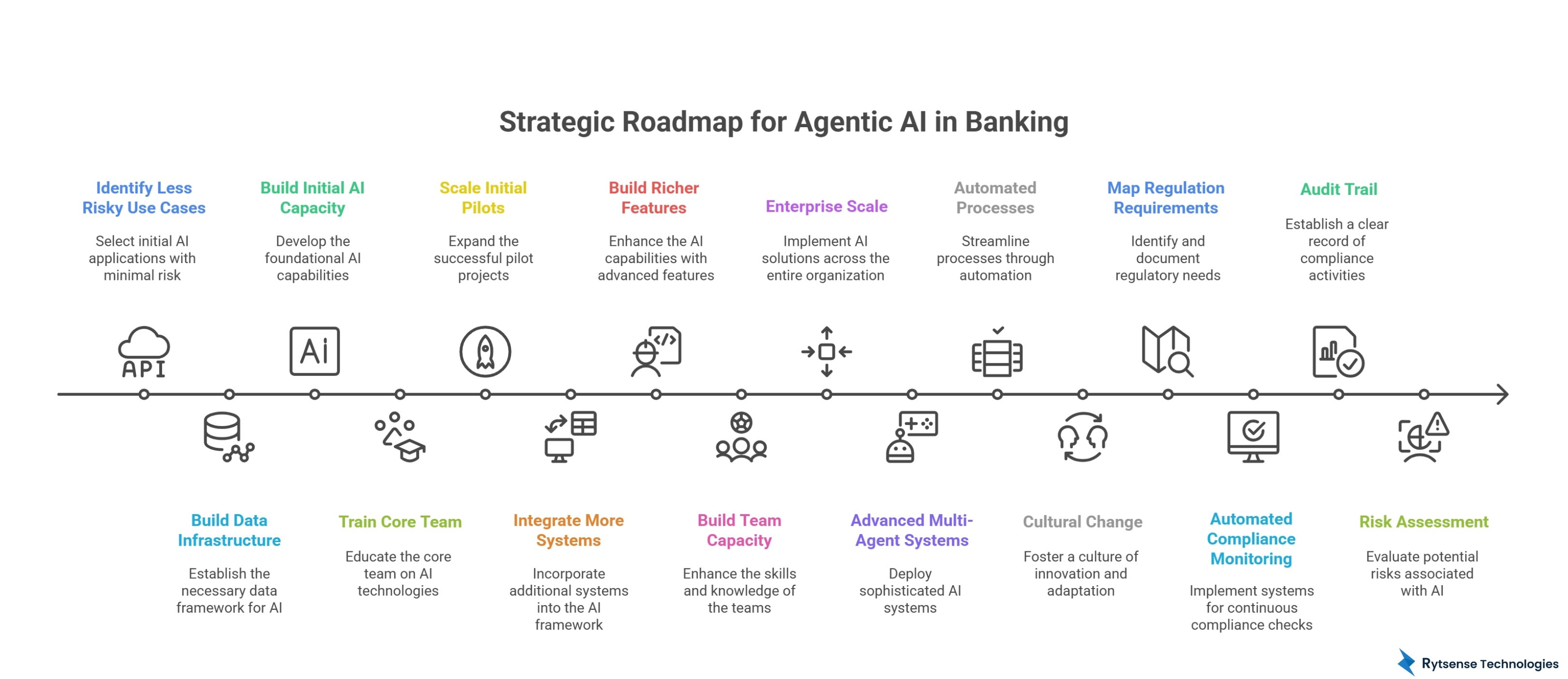
In this section, you will find a practical implementation framework for banks adopting agentic AI. This framework describes phased approaches to deployment, integrating compliance practices, team building approaches (across retail and commercial), and managing change approaches for a successful organizational transformation.
Starting Small with Pilot Projects
Effective initiatives start with manageable pilot projects:
Phase 1: Establishment (3–6 months)
- Identify less risky use cases
- Build the data infrastructure
- Build the initial AI capacity
- Train the core team
Phase 2: Growth (6–18 months)
- Scale the initial pilots
- Integrate more systems
- Build out richer features
- Build the capacity of the teams
Stage 3: Transformation (18+ months)
- Enterprise scale
- Advanced multi-agent systems
- Automated processes
- Cultural change
Embedding Compliance from Day One
Compliance integration should include:
- Mapping regulation requirements
- Automated compliance monitoring
- Audit trail
- Risk assessment
Building AI-Compliance Collaboration Teams
Your
AI-driven compliance in banking
cross-functional teams should include:
AI/ML engineers
- Compliance officer
- Risk manager
- Business representatives
- Legal council
Change Management & Cultural Shifts
Successful adoption requires:
- Executive leadership
- Employee training
- Clear communication
- Performance metrics
- Continuous feedback loops
The Future Outlook of Agentic AI in Banking
This section looks at emerging trends and
future of agentic AI in banking
, exploring how retail and SME banking will be transformed, changes in the competitive landscape, and the evolution to a more autonomous and invisible banking experience.
How Retail and SME Banking Will Transform?
Agentic AI for retail banking will provide:
- Hyper-personal financial advice
- Automated financial planning
- Dynamic spending optimization
- Proactive financial health monitoring
Agentic AI in SME Banking will provide:
- Automated cash flow management.
- Intelligent loan structuring.
- Supply chain finance optimization.
- Risk-based pricing based models.
Competitive Landscape & Market Implications
Agentic AI in banking
will future disrupt the competitive landscape through:
- Reduction of operational costs.
- Improvement of customer experience.
- Faster product and service delivery and overall innovation.
- Improvement of risk management.
Towards Autonomous and Invisible Banking
Future of AI in financial institutions development will be:
Autonomous AI in financial services
- Invisible banking experiences.
- Self-directed AI in finance (money management).
- Proactive AI orchestration in financial services
Conclusion
Agentic AI in Banking
marks the dawn of the next generation of financial services transformation. As financial institutions face greater competition, regulatory complexity, and customer expectations and demands, bank function transformation using agentic systems through
AI-enabled digital transformation in banking
will have no equal, opening the consideration of unprecedented amounts of innovation and efficiency.
The technology promises to change everything from customer onboarding to risk management, with early adopters showing significantly improved operational efficiency and customer satisfaction already. Successful implementation will require careful planning and sufficient governance frameworks while facilitating ethical applications of AI.
Organizations such as Rytsense are leading this transformation with companies to provide specialized solutions for banks to utilize in their own systems for use in agentic AI, regulatory adherence, and improved risk management through operational efficiency.
The journey of autonomous banking and intelligent banking has begun, and the banks adopting agentic AI today will be best positioned in the financial industry of the future. Success will require a combination of meaningful implementation of AI, including ongoing learning and adaptability, along with being responsible when deploying AI to achieve business objectives and maintain customer-centric approaches.
Meet the Author

Co-Founder, Rytsense Technologies
Karthik is the Co-Founder of Rytsense Technologies, where he leads cutting-edge projects at the intersection of Data Science and Generative AI. With nearly a decade of hands-on experience in data-driven innovation, he has helped businesses unlock value from complex data through advanced analytics, machine learning, and AI-powered solutions. Currently, his focus is on building next-generation Generative AI applications that are reshaping the way enterprises operate and scale. When not architecting AI systems, Karthik explores the evolving future of technology, where creativity meets intelligence.