Key Takeaways
AI developer salary varies widely depending on experience, specialization, and business impact.
In India, pay typically ranges from ₹6 LPA for freshers to ₹50+ LPA for senior AI engineers with advanced skills.
In the US and global markets, skilled AI/ML engineers often earn $130K–$240K+ annually, especially with equity and bonuses.
Companies offering advanced AI development services or AI-first product teams pay higher due to talent scarcity.
Full-stack expertise (ML + data engineering + deployment + MLOps) significantly increases compensation.
Businesses must plan compensation strategically to attract the right talent and avoid skill gaps.
AI professionals focused on real-world deployment and measurable value consistently earn more.
What is the salary of an AI developer?
Why These Salary Benchmarks Matter - For Businesses and For Talent
If you're building a product, a startup, or scaling a business, getting AI right is more than implementing models. It means hiring people who know how to translate data into business value. Without realistic compensation planning, two problems emerge:
- Underpaying or underestimating can make it hard to attract or retain real talent especially when engineers have global alternatives or multiple offers.
- Overpaying or misallocating resources can inflate your burn rate, especially for early-stage startups, without guaranteeing value.
For professionals or aspiring AI engineers, understanding realistic salary bands helps you evaluate offers, negotiate better, and choose career paths wisely — especially when applying for AI developers for hire and technical roles in competitive companies.
So, in a rapidly evolving field like AI — where demand, tools, and expectations shift fast — clarity on compensation is more than a number. It's about aligning incentives, skills, and business value.
What Drives Differences in AI Developer Compensation
Why does the pay range span so widely — from ₹6 lakhs to ₹50+ lakhs (or $130k to $240k globally)? Several factors stack up in the artificial intelligence development job market.
Experience & Seniority
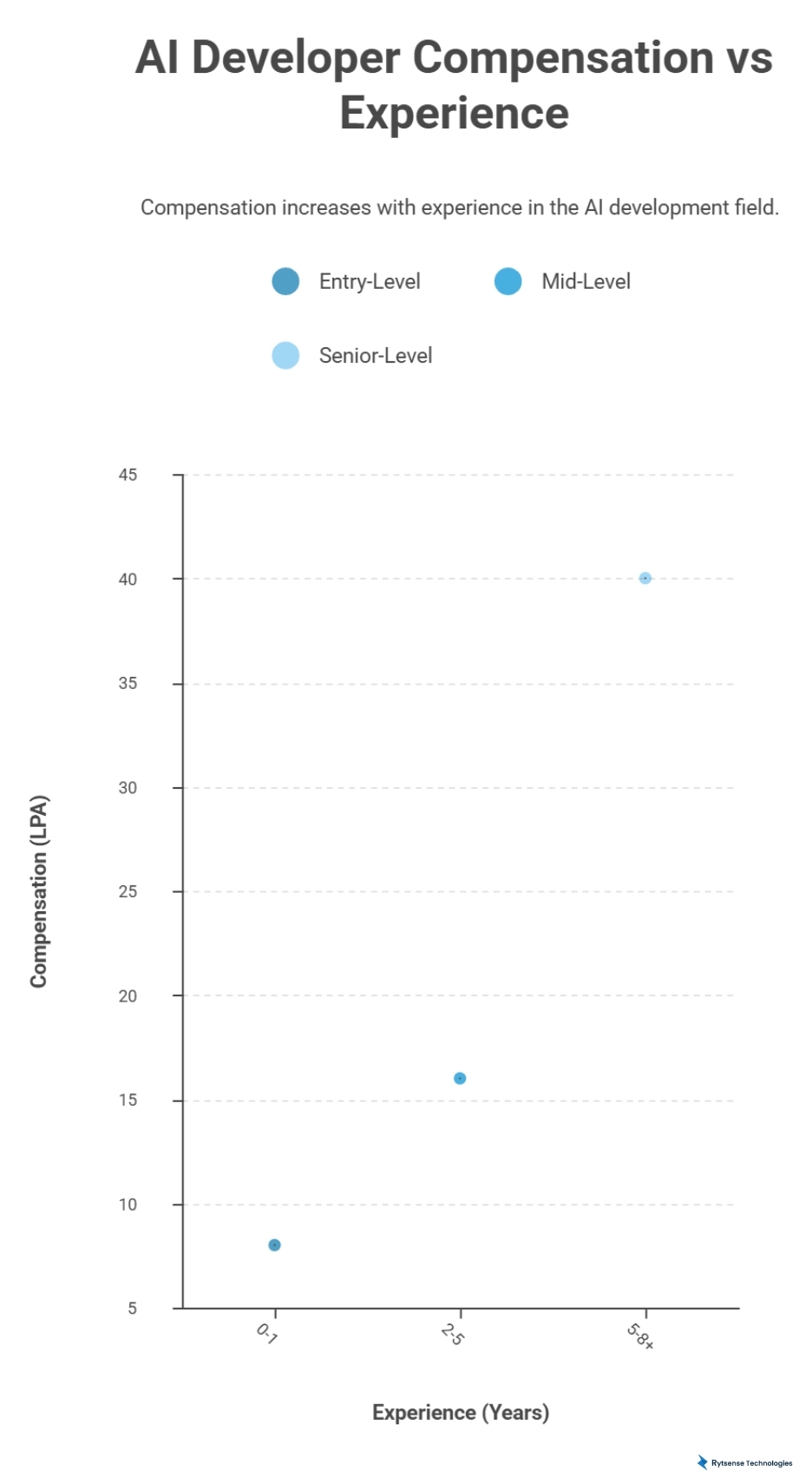
At entry-level — fresh graduates, juniors or engineers with 0–1 years of experience companies often offer modest packages. In India that typically means ₹6–10 LPA.
As you move to 2–5 years, mid-level roles often see a jump — reflecting both improved skills and increasing responsibility. Many mid-level machine learning engineers in India earn in the ₹12–20 LPA (or slightly higher) band.
For senior engineers — those with 5–8+ years, proven track record, or deep specialization compensation reaches ₹30–50+ LPA or more, particularly in product-based firms or companies offering AI development services.
In global markets, same logic applies: entry-level US AI/ML engineers might start modestly, while mid and senior candidates see much higher packages, especially when stock, bonus, and other benefits are considered.
Specialization, Skill Depth & Role Complexity
Not all AI software development roles are created equal. An engineer writing basic ML scripts might earn far less than someone:
- Building scalable deep-learning pipelines
- Working on generative AI / LLMs
- Handling MLOps and infrastructure
- Developing computer vision or NLP solutions
Companies increasingly value end-to-end AI competence: from data ingestion to model building to deployment, scaling and maintenance. Engineers with this depth — especially with domain knowledge or expertise in cutting-edge subfields — command premium salaries.
Specialized skill sets — like expertise in deep learning frameworks, cloud-AI infrastructure, MLOps, data engineering + AI hybrid roles — often differentiate "average" AI engineers from "top-tier" ones. This directly reflects in pay.
Industry, Company Type & Geography
Where the role sits makes a big difference. Product-driven companies, AI-first organizations, or a specialized best AI development company in USA / India tends to pay more than generic outsourcing firms. Deep-tech firms often appreciate specialization more, and are willing to invest in higher compensation when they see long-term value.
Geography also plays a role. Cities like Bengaluru, Hyderabad, and other major tech hubs tend to offer higher pay than smaller cities (though even tier-2/tier-3 cities are catching up as remote & distributed work grows).
For international or global remote roles (or those in high-cost geographies), compensation tends to reflect cost of living and market competition — hence salaries (in USD or local equivalents) are higher than in India.
Supply–Demand Dynamics, Market Trends & Scarcity
The demand for skilled AI and machine learning development services continues to surge across sectors — but supply is limited.
Yet, the supply of skilled, experienced AI professionals remains limited. That scarcity — especially of engineers capable of delivering full-stack AI solutions — pushes up compensation. Firms are willing to pay extra to attract, retain, and compete for top-tier talent.
Moreover, as AI adoption deepens — not just for proofs-of-concept, but for production-level, scalable AI — demand for engineers who can handle real-world complexity (data pipelines, model deployment, maintenance, scaling) is increasing. That raises the value of "practical, production-ready AI skills", influencing salary upward.
What AI Developer Salaries Look Like (2025 Snapshot)
Here's a more concrete breakdown of what AI / ML engineers across experience levels and geographies can expect in 2025 — keeping in mind variation by role, skill, company and location.
Entry / Junior Roles
- India: Freshers or juniors often start with ₹5–10 lakhs per annum.
- Global / US / Abroad (or remote global firms): Entry-level AI/ML roles may start around US $70,000 – $90,000 (or equivalent), depending on company and role.
These early roles typically involve assisting in ML/data pipelines, basic modeling, data cleaning, and possibly supporting more senior engineers or data scientists. Expectations are modest; experience and learning are the focus.
Mid-level Engineers
- India: With a few years of experience, many AI/ML engineers see packages in the ₹12–20 LPA range (some may reach ₹15–25 LPA depending on skill set and company).
- Global / US-level roles: Mid-level AI professionals often earn between US $90,000 – $130,000+ (base or total compensation), depending on role, specialization, and company.
At this level, engineers often start owning projects, contributing to production models, collaborating cross-functionally, and sometimes mentoring juniors. This added responsibility, coupled with growing expertise, reflects in better compensation.
Senior / Specialized Engineers
- India: Senior AI/ML engineers or those with specialized skills (deep learning, MLOps, generative AI, full-stack AI, domain-specific AI) commonly get ₹30–50+ LPA.
- Global / Top-tier companies or remote global hires: For experienced roles — especially at leading tech firms — total compensation (salary + bonus + stock) can reach US $180,000 – $240,000+ or more, depending on job scope, location, and seniority.
These roles often demand not only deep technical skills, but also understanding of product/business value, leadership, architecture design, model deployment at scale, cross-functional coordination, and maybe management of data/ML pipelines.
Moreover — for engineers involved in cutting-edge work (e.g. generative AI, large-language models, production-scale AI infrastructure) — firms may offer strong incentives, equity, bonuses, remote work flexibility, or other perks to attract and retain talent.
Implications for Startups, SMEs & Businesses Hiring AI Talent
If you are in a position to hire — or plan to integrate AI into your product or service — these salary structures carry strategic implications.
Budgeting & Hiring Strategy
Begin with realistic budgeting. For an entry-level AI/ML engineer in India: plan for ₹6–10 LPA. For a sound mid-level hire: ₹12–20 LPA — and for senior, specialized talent: ₹30–50 LPA+ (or more, depending on responsibilities).
If you need global or remote-level talent expect significantly higher costs (especially if salary is dollar-denominated), but remember that value could scale dramatically depending on project scope.
Budgeting needs to account not only base salary — but also bonuses, potential equity/stock, hardware/infrastructure cost (if AI training or deployment needs expensive servers), ongoing upskilling, retention incentives, and associated benefits.
Role Design: Generalist vs Specialist vs Full-Stack AI Engineer
Decide carefully what you need:
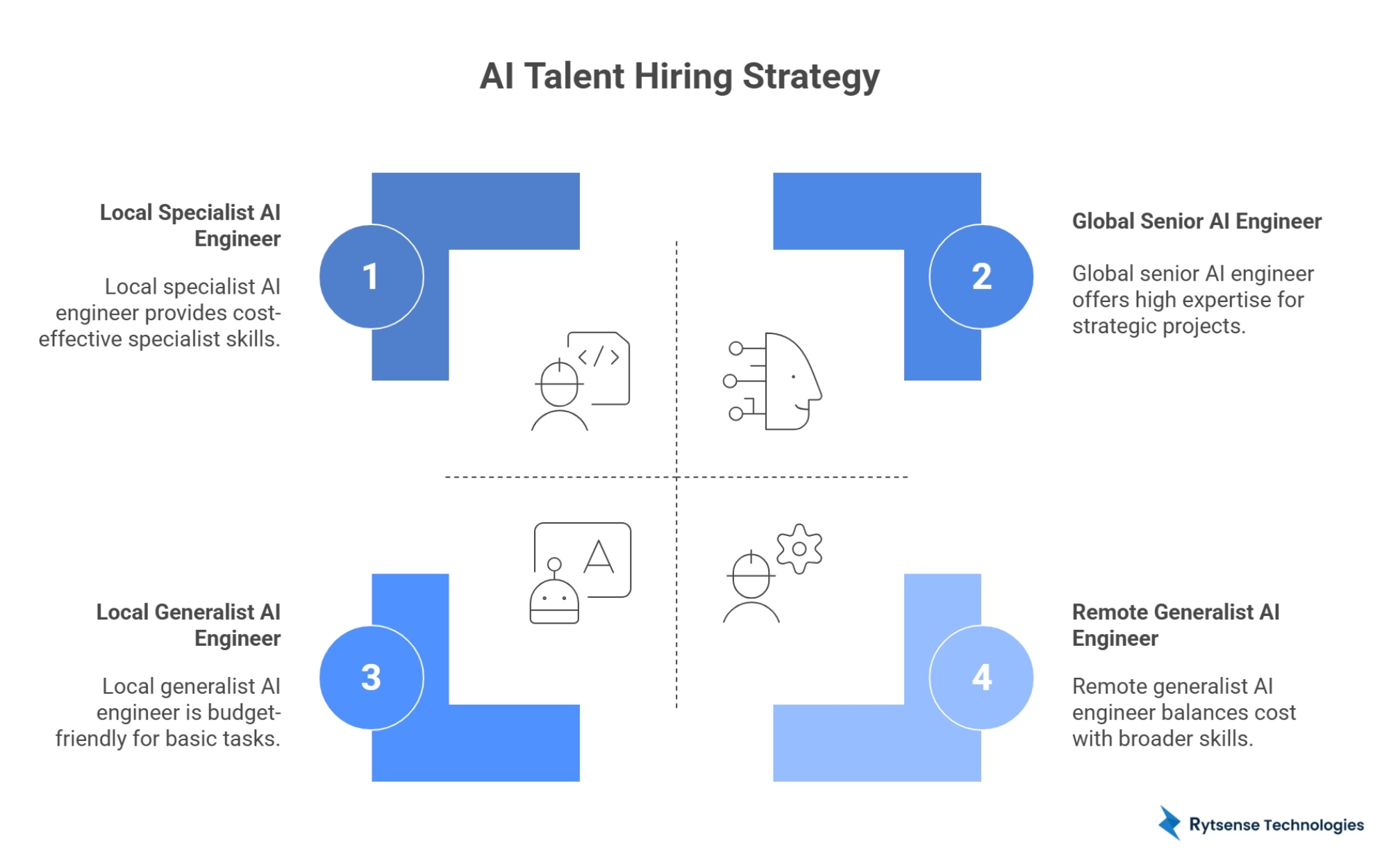
- Simple data-analysis or light ML tasks → a junior or mid-level generalist may suffice.
- Building scalable AI-powered products, deploying ML in production, handling data pipelines, scaling AI workloads → go for specialists or full-stack AI engineers with end-to-end skills (data + ML + production + infrastructure).
- For strategic, high-impact projects (e.g. generative AI, computer vision, complex data products) → invest in top-tier senior engineers or remote global hires with deep domain knowledge.
Being clear about role expectations helps avoid overpaying for underutilized skill, or underpaying for needed expertise.
Total Compensation: Beyond Base Salary
Top firms are no longer competing on base salary alone. They offer equity, stock options (ESOPs), bonuses, flexibility (remote/hybrid), learning budgets, and perks. Especially for senior and specialized AI roles, these often form a significant part of total compensation.
As a hiring organization, considering total compensation, not just cash outflow, — could help you attract strong talent without overshooting cash budgets.
Hiring in India vs Remote / Offshore / Global Talent - Pros & Cons
Hiring domestically (in India) remains cost-effective, especially for mid-level or junior roles. Growing demand and remote adoption means Indian engineers are more accessible than ever. Also, many business sectors (fintech, healthcare, enterprise, SaaS) are looking to build in India.
However, for advanced AI needs e.g. building cutting-edge models, ML infrastructure, global-scale AI products — remote global talent or seasoned international engineers may bring deeper expertise, even though costs are higher.
For many companies, a hybrid model (mix of local mid-level engineers + a few global/senior experts) offers a good balance of cost, expertise, and scalability.
Strategies for AI Professionals to Maximize Career Growth & Earnings
If you are an AI engineer — or planning to become one — here's how to build toward the upper end of the pay spectrum.
Build Specialty & Depth: Go Beyond Basic ML
The market values engineers who can offer more than basic data analysis or simple ML. Specialize in high-demand areas: deep learning, computer vision, natural language processing / large language models, MLOps, production-grade ML pipelines, cloud-AI, scalable AI systems.
Engineers who can handle real-world end-to-end AI workflows — from data ingestion to deployment, monitoring, scaling, are rare and command premium pay.
Create Real Projects & Demonstrable Value
Having credentials — degrees or certifications helps. But what stands out more are real projects, deployed solutions, measurable impact. That could be a product feature powered by AI, a deployed ML pipeline, or a scalable AI infrastructure.
Practical experience shows you can deliver, not just code. That differentiates you from many aspirants and pushes you toward senior/lead pay bands.
Target Right Companies and Roles
Product-based companies, deep-tech startups, R&D-focused teams, global firms — they often value specialization and pay better. Instead of generic roles in outsourcing or services, aim for companies where AI is core to their product/business.
Also consider remote or global firms — especially if you have strong skills as they often pay globally competitive rates.
Negotiate for Total Compensation & Non-Monetary Benefits
Don't focus only on base salary. Negotiate for equity (if startup), bonuses, flexible working, remote-friendly policies, skill-upgrade budgets, learning allowances, and perks. These add up, and in many cases — especially in startups — equity can multiply long-term total compensation.
Even in established firms, bonuses + stock + perks + remote flexibility can significantly boost overall value.
Emerging Trends That Are Shaping AI Salaries & Demand
Knowing current salaries is helpful — but what truly matters is how the future of AI talent is evolving. Several major shifts are influencing how companies hire and compensate AI professionals:
- Higher value for specialized AI skill sets: As organizations move from pilot projects to real, scalable AI deployment, they prefer engineers who excel in areas like generative AI, deep learning, MLOps, and model deployment rather than broad generalists. This trend directly boosts salaries for niche experts.
- Skills taking priority over degrees: Employers increasingly focus on what candidates can build and deliver, not just their academic qualifications. Strong portfolios and hands-on experience now hold more weight, creating opportunities for self-taught developers and non-traditional learners.
- Remote and global hiring becoming the norm: With distributed workforces rising, companies are sourcing AI talent globally. Skilled engineers in India can earn international-level pay when working with US or global tech firms — greatly expanding earning potential.
- AI adoption expanding across industries: Sectors like healthcare, banking, e-commerce, manufacturing, and enterprise tech are rapidly incorporating AI widening the demand for skilled professionals beyond traditional tech companies.
- Focus on total compensation, not just salary: To attract and retain top AI talent, employers are offering stock options, bonuses, learning budgets, remote flexibility, and other perks — creating more competitive and attractive overall packages.
Together, these trends reinforce why AI remains one of the most rewarding and secure career paths, offering increasing financial opportunity for those who invest in relevant skills.
Conclusion - How to Align Talent, Expectations & Strategy
AI development is not simply about building models — it's about creating tangible business value through intelligent systems. Compensation reflects the level of responsibility and the impact engineers deliver.
For businesses: Treat AI hiring as a strategic decision. Define roles clearly, plan realistic compensation aligned with skill depth, and weigh the right mix of local and global talent. Think in terms of total value skills, retention, and long-term contribution.
For AI professionals: Deepen expertise, gain hands-on deployment experience, and build strong portfolios that demonstrate real product results. Aim for roles where AI drives core business outcomes that's where career and salary growth accelerates.
As AI continues to spread across every industry in 2025 and beyond, the difference in compensation between entry-level and high-performing AI engineers is widening. For those willing to learn, specialize, and innovate, the financial rewards can be truly exceptional.
Meet the Author

Karthikeyan
Connect on LinkedInCo-Founder, Rytsense Technologies
Karthik is the Co-Founder of Rytsense Technologies, where he leads cutting-edge projects at the intersection of Data Science and Generative AI. With nearly a decade of hands-on experience in data-driven innovation, he has helped businesses unlock value from complex data through advanced analytics, machine learning, and AI-powered solutions. Currently, his focus is on building next-generation Generative AI applications that are reshaping the way enterprises operate and scale. When not architecting AI systems, Karthik explores the evolving future of technology, where creativity meets intelligence.