1. How Good Is Java For Your Web Application Development?
Java is still one of the world’s robust programming languages because of its fair collection of advantages; it’s a great fit for web developers because of its strength and stability, and can help developers create sustainable, cost-effective web applications. With a reputation for platform independence, an abundance of libraries, and solid community support, Java Developer is employed by corporations and startups to build an array of products, from e-commerce platforms to complex enterprise systems. But in a world full of development technologies, you might be asking yourself these days: “Web application development in Java, is it still a good move?”
In this blog, we’re going to take a look at the pros, use cases, and major benefits of using Hire developers in India, so you’re better informed to make your choice.
2. What does Java do, and its duties in web app development
What Is Java?
Java is a high-level object-oriented programming language developed by Sun Microsystems (now acquired by Oracle). Renowned for its “write once, run anywhere” mantra, Java lets developers write applications that can run on any system or device that supports the Java Virtual Machine (JVM).Java is used for:
- Web applications
- Enterprise software
- Mobile apps (via Android)
- Cloud-based services
- Backend systems
Java’s Role in Web App Development
The role of a Hire Java Developer in web app development the content say that Java assumes a server-side/backend genre. It's how developers add logic and behaviour to web applications, how they process user input, how they generate data, and how they interface with databases and other services.- Spring / Spring Boot – To create REST APIs and microservices.
- JavaServer Pages (JSP) – for server-side rendering
- Hibernate - for ORM (Object-Relational Mapping)
- Apache Tomcat: Most widely used servlet container
- Maven/Gradle – to build the project and manage its dependencies.
The Key Responsibilities of Java in Web App Development
1. Business Logic Implementation
Java manages the basic logic for the application, such as input-handling, workflow execution, and business-rule enforcement.2. Server-Side Programming & API Systems
The APIs and server-side services written are in Java, which interact with the front-end interfaces, as well as mobile apps and other systems.3. Database Interaction
Applications written in Java communicate with databases (such as MySQL, PostgreSQL, Oracle DB) through either the JDBC or an ORM tool.4. Security Management
Java provides built-in support for data validation, authentication, authorization, and secure communication (e.g., SSL/TLS).5.Scalability & Performance
Java applications are built to scale well and manage heavy user load, especially when constructed with help from frameworks like Spring Boot.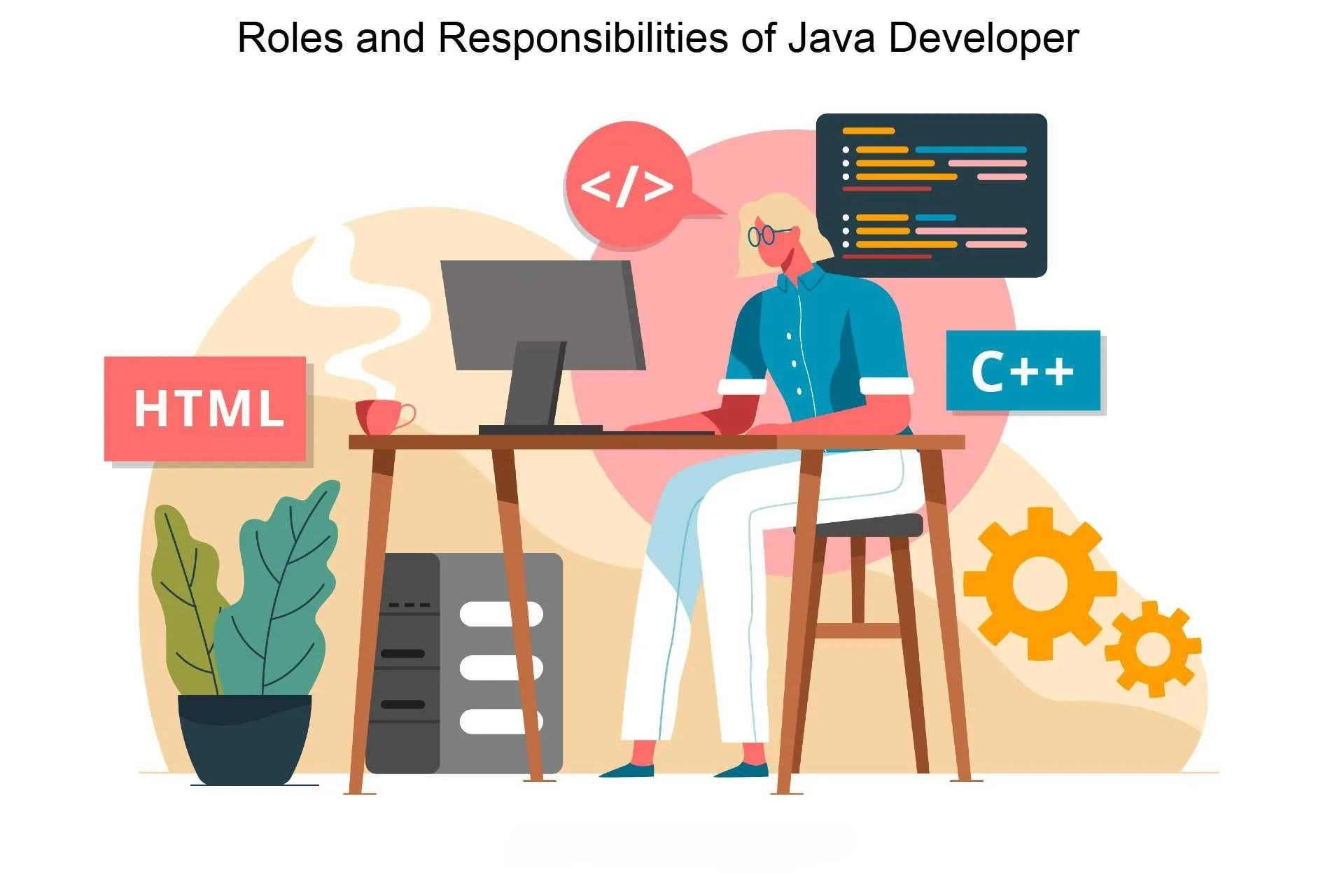
3. Why Java is used for Web Application Development
Java is still one of the favored languages for programming web applications with its scalability and other features, such as security and platform independence, and an extensive ecosystem. It provides a solid foundation for anything from small websites to large-scale enterprise applications.
1. Platform Independence
Java’s code is developed and it runs on any device or platform with a Java Virtual Machine (JVM), which is adaptable for multiple deployment services.2. Robust Framework Support
Frameworks such as Spring, Spring Boot, Struts, and Hibernate also have servers that simplify development, increase build velocity, make testing easier, and facilitate scalable architecture.3. Enterprise-Grade Scalability
Java is one of the most scalable when it comes to the size of the system — think e-commerce systems, banking software, SAAS projects that scale because it was written in Java and they could just add instances and keep going.4. Strong Security Features
For one, Java has security-oriented APIs, such as authentication, encryption, and role-based access, among others, and an inherently secure runtime environment, which is inherent for web apps that will process sensitive data.5. Huge Talent Pool and Community
With a global community of millions of Java developers, companies have easier access to talent, community support, and open-source libraries to build innovative applications.6. Multi-Threading & Performance
Java has a strong ability for multi-threaded processing, so it can keep a good high-concurrency in the web interface, such as real-time messaging or transaction systems, etc..7. Rich Ecosystem and Tooling
IDEs such as IntelliJ and Eclipse, build tools such as Maven and Gradle, and Java help us to speed up our software development and deployment process.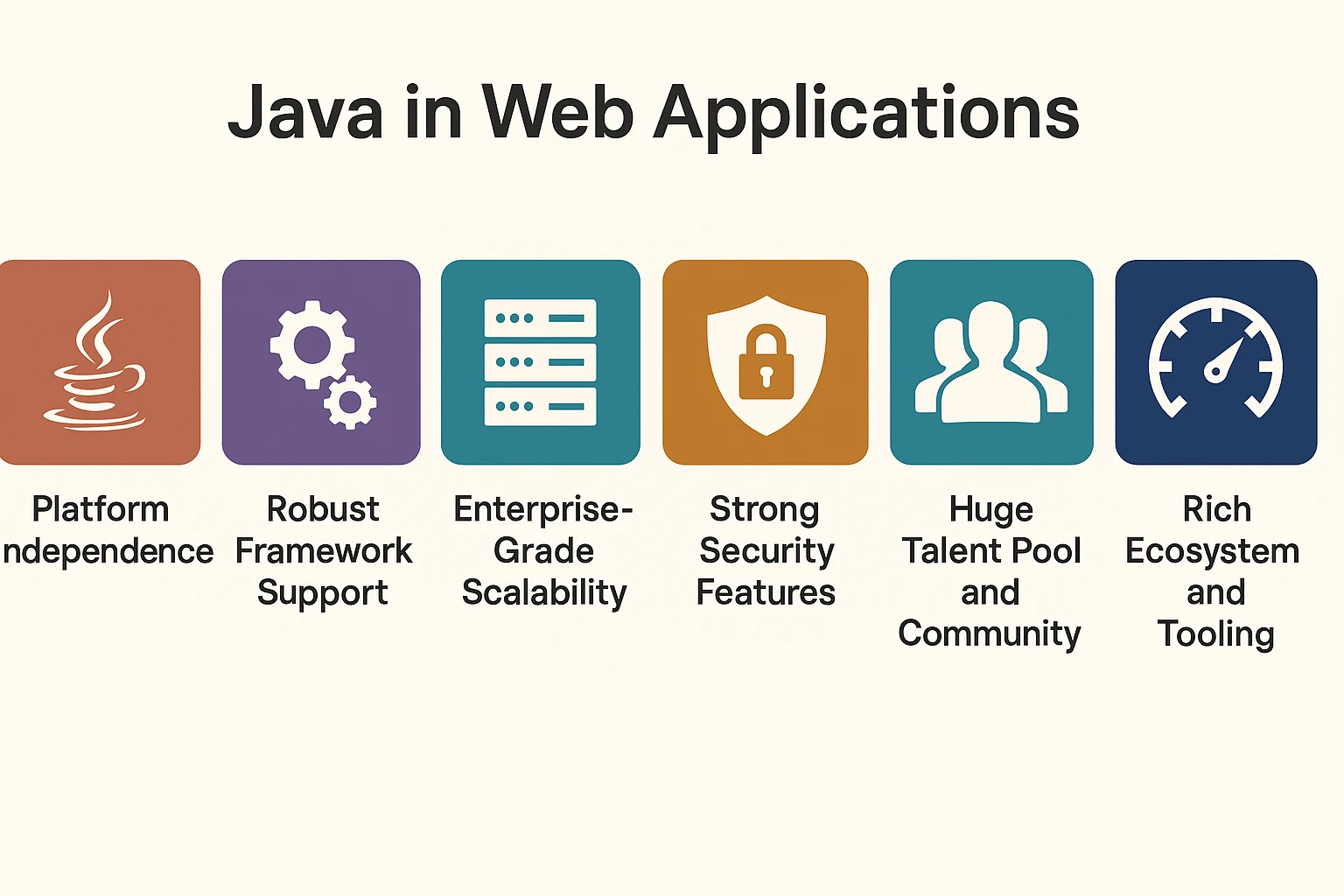
4. What are the Steps to create a web application using Java?
1. Define Requirements & Scope
● Define your business objectives, your users, and key features.● Select what kind of web app you want to create: monolithic, microservices, REST API, etc.
● Make wireframes/UI mockups if necessary.
2. Prepare Your Development Environment
● Have JDK (Java Development Kit) – the version would be Java 8 or above.● Get yourself an IDE like IDEA, Eclipse, or NetBeans.
● Add Maven or Gradle so you can handle the dependency and project management.
3. Choose Your Tech Stack
● Back-End Framework: Spring Boot preferred, but Jakarta EE or Struts are accepted too.● Front-End: Front-end frameworks are React and Angular.
● Database: MySQL, PostgreSQL, MongoDB.
● Build Tool: Maven or Gradle.
4. Design the Architecture
● Use MVC (Model-View-Controller) or microservice architecture.● Package your app: controller, service, repository, model.
● Use of RESTful services with Spring Boot + REST Controllers.
5. Implement the Application
● Use Models (Entities) to shape your data.● Write Controllers to accept HTTP requests.
● Develop Services to encapsulate business logic.
● Connect to the Database with JPA or JDBC.
● Via Templates or API, you can either render data or return to the front-end.
6. Add Security & Authentication
● Use Spring Security for login/auth.● Go with a token-based approach - JWT (JSON Web Tokens) or OAuth2.
●Sanitise inputs to guard against XSS/SQL injection.
7. Test the Application
● Write the unit test cases with JUnit/TestNG.● Use Postman (or Swagger) to test the APIs.
● Run and write integration and browser-based tests (Selenium if necessary).
8. Deploy the Application
● Create a build of the app through Maven/Gradle (. war or. jar file).● Deploy on server as Apache Tomcat, AWS EC2, Docker , etc.
9. Monitoring
● Track performance using Prometheus + Grafana or through New Relic.
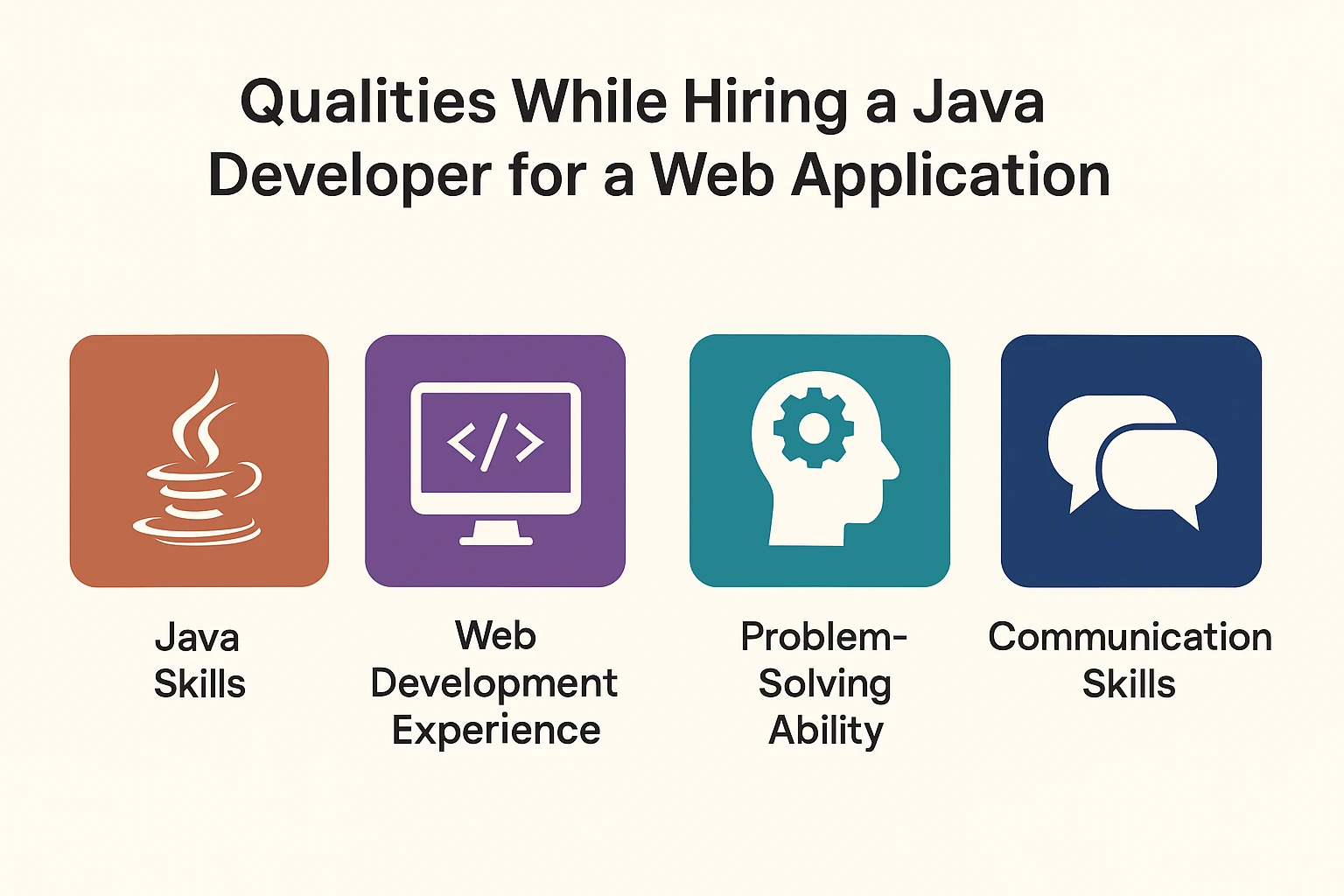
5. The Must-Have Qualities while Hiring a Java Developer for a Web Application
1. Technical Expertise
● Find deep, hands-on experience in:● Basic concepts of OOP, collections, and multithreading in Core Java.
● Web frameworks such as Spring Boot, Hibernate, Spring MVC
● RESTful APIs and microservices orchestrations
● Database integration - JPA / Hibernate with MySQL, Postgres, or MongoDB
● Reading JUnit, Mockito, and Reference Books.
2. Relevant Experience
● Have they done stuff like this before for web (for example: Did they work on any e-commerce site, dashboard, admin panel)?● Experience in scaling and securing (performance) Java applications
● Knowledge of web application architectural patterns (MVC, layered architecture)
3. Problem Solving & Critical Thinking
● Strong proficiency in dissecting business requirements into clean, efficient code● Experienced with debugging, testing, and refactoring
4.Communication Skills
● Articulate ideas, problems, and solutions succinctly● Ability to work in teams and collaborate with others.
● Familiar with documentation and code reviews
5. Cultural Fit & Work Ethic
● Matches with your company’s values and work style● Responsive, preemptive, and prudent in off-site or remote office or partial office mode
● Open to feedback and a lifelong learner
6. Engagement Model And Availability
● Are you hiring full-time, part-time, freelance , or a dedicated teammate? Make sure the time zone, schedule, and type of contract are as they should be.7. Portfolio & References
● Review previous work, samples of your code, or your repositories or applications.● Request references or client recommendations for verification of authenticity
6. Conclusion
Even today, Java is one of the strong contenders for developing web apps that do not look hazy at all. It is platform-independent and known for its powerful ecosystem (Spring Boot) and strong emphasis on performance and security, enabling you to create enterprise-scale applications. It doesn’t matter if you are building an MVP for a new startup or a colossal system. Hire Java Developers provides the versatility, community support, and long-term stability that can make your web app dreams into a successful reality.

The Author
Karthikeyan
Co Founder, Rytsense Technologies