Key Takeaways
- Intelligent technology helps large organizations scale operations without adding unnecessary complexity.
- Automation promotes efficiency as this takes care of redundant and data-intensive activities.
- Data-driven systems enhance the departments in consistency and decision-making.
- Platform Integration is necessary to achieve scalability across the enterprise.
- Human control is still essential in governance, ethics, and strategic decision making.
- Scalability is based on adaptability, data quality, and responsible implementation in the long term.
How Large Organizations Use Intelligent Technology to Scale
Large organizations scale with intelligent technology by automating routine processes, analyzing large volumes of data for informed decisions, and integrating systems across departments to improve efficiency, consistency, and operational visibility.
Understanding Intelligent Technology in Large Organizations
Intelligent technology refers to systems that can process data, recognize patterns, and support decision-making with minimal manual input. Scaling, in relation to large organizations, concerns not only the increase in size, but also complexity when managing an operation that is increasingly growing in scale alongside the number of teams, regions, and platforms.
Companies like Rytsense Technologies prioritize practical intelligence that integrates with business workflows instead of focusing on experimental or superficial automation.
Instead of replacing people, intelligent systems are used to manage information at scale, reduce friction, and support teams with reliable insights.
Handling Data Complexity in Large Organizations
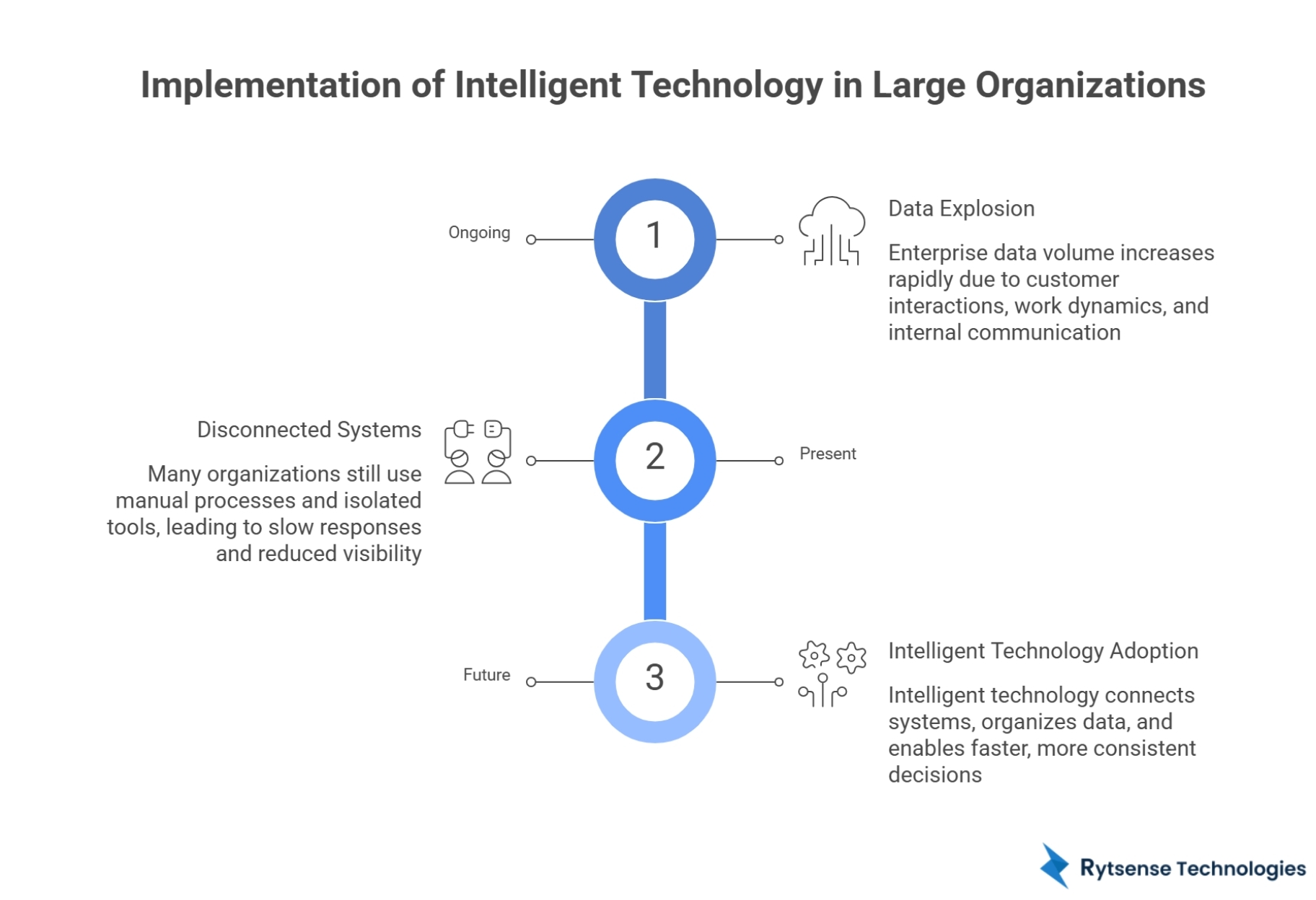
The volume of data being produced by enterprise environments is increasing at a rate that has never been seen before. The number of interactions with customers, the dynamics of work, financial documentation, and internal communication all add to the increasing loads of information.
A vast number of organizations are still using disconnected tools and manual processes. This reduces response time, introduces variability, and reduces visibility. Intelligent technology addresses these challenges by connecting systems, organizing data, and enabling faster, more consistent decisions across the organization.
Fundamentals of Intelligent Technology
At a foundational level, intelligent technology combines several capabilities:
- Multi-source data collection.
- Pattern recognition of structured and unstructured data.
- Rule-based workflow or repetitions workflow automation.
- Analytics and reporting-based decision support.
In the case of large organizations, the capabilities are implemented in a gradual and strategic manner, as opposed to being implemented simultaneously.
Decision-Making with Data on an Enterprise Scale
With the increase in the size of organizations, the process of the decision-making process becomes more complicated because of the amount and types of data involved. Intelligent technology helps large enterprises move away from intuition-based decisions toward structured, data-informed approaches.
Intelligent platforms enable leaders and teams to consolidate data across systems to:
- Compare performance between regions and departments.
- Detect trends that are hard to spot.
- React more quickly to operational and market changes.
- Minimise delays due to disjointed reporting processes.
The change promotes consistency and transparency, particularly where the decisions impact various business units at the same time.
Key Elements that Support Scaling of the Enterprise
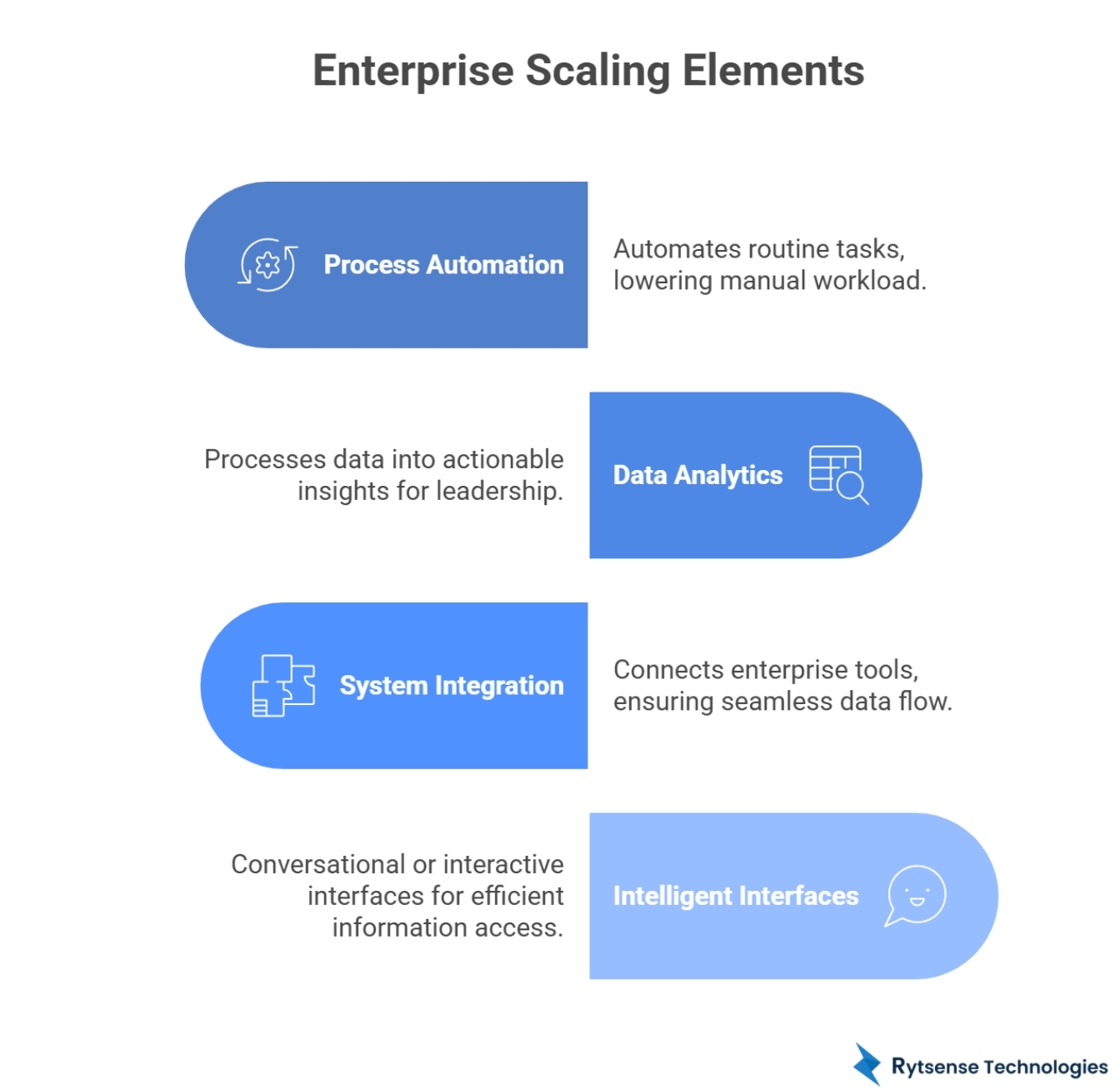
Intelligent systems based on some important elements are usually scaled by large organizations.
1. Process Automation
Automation lowers the manual workload by automating routine tasks, like data entry and routing, reporting, and updates to the system.
2. Data Analytics and Insights
Analytics systems process raw data into actionable insights that enable the leadership to determine trends, risks, and opportunities.
3. System Integration
Enterprise tools, including CRM systems, ERP platforms, analytics dashboards, can be integrated, ensuring that the flow of data moves without restrictions between the departments.
4. Intelligent Interfaces
Other organizations use conversational or interactive interfaces. In certain cases, this includes solutions built through custom AI chatbot development services to help employees or customers access information efficiently.
The Role of Integration in Sustainable Scaling
Adding new tools is not enough to scale successfully. It is based on the effectiveness of the communication between systems. Intelligent technology supports sustainable growth by enabling integration across platforms rather than creating additional silos.
The major advantages of integration are:
- Owing to re-access of data between departments.
- Less redundancy of work and overlaps.
- Better visibility on end to end processes.
- More convenient interaction between the operations, finance, IT and leadership.
As systems become linked, the organizations can scale without adding operational friction. With integration as the base, automation, analytics and decision support are capable of operating to enterprise scale.
Business Benefits of Intelligent Technology
It is possible to add value intelligently in cases where the systems are applied with specific goals.
Key Benefits Include:
- Better operational efficiency.
- Rapid access to relevant information.
- Less overlap of effort when working on teams.
- Improved interdepartmental coordination.
- Growth-oriented scalable processes.
Measurable Business Impact across Enterprise Teams
| Business Function | Practical Impact |
|---|---|
| Operations | Enhanced working processes and reduced paperwork. |
| Finance | Rapid reporting and data authentication |
| Customer Support | Better processing of questions. |
| IT | Improved system monitoring and integration. |
| Leadership | Strategic planning, which is supported by data |
Scaling Pressure and Market Reality
Intelligent technology is no longer optional for large organizations. Organizations lose competitive advantage by being slow to automate and use analytics, which results in inefficient risk management, sluggish decision-making, and ineffective data management.
The inability to scale without smart systems can result in increased operation expenses and lack of agility.
Striking a balance between Technology and Human expertise
Intelligent systems are capable of data processing and structure handling, but as long as human teams are required:
- Strategic decision-making
- Ethical judgment
- Relationship management
- Exception handling
The best business organizational cultures embrace technology to supplement human beings, rather than substituting them.
Responsible AI practices in large organizations
Responsible use of intelligent technology requires:
- Well-defined data governance policies.
- Openness in automated decision making.
- Safe management of confidential data.
- Frequent checking of accuracy and bias.
Such practices assist organizations to grow in a responsible manner without losing credibility with stakeholders.
How Intelligent Technology Supports Enterprise Operations
Large enterprises apply intelligent technology across multiple areas.
- Operations: Measuring performance indicators, Managing internal requests, Coordinating supply chains.
- Finance: Automating reporting processes, Identifying finance anomalies.
- Customer Experience: Systematizing data of customer interaction, Routing the questions to suitable teams.
- IT and Infrastructure: Predictive maintenance, Optimization of system performance.
A machine learning development company or many of these engineering teams are behind many of these initiatives, aimed at refining and making models reliable over the long run.
Organizational Strategy of Application
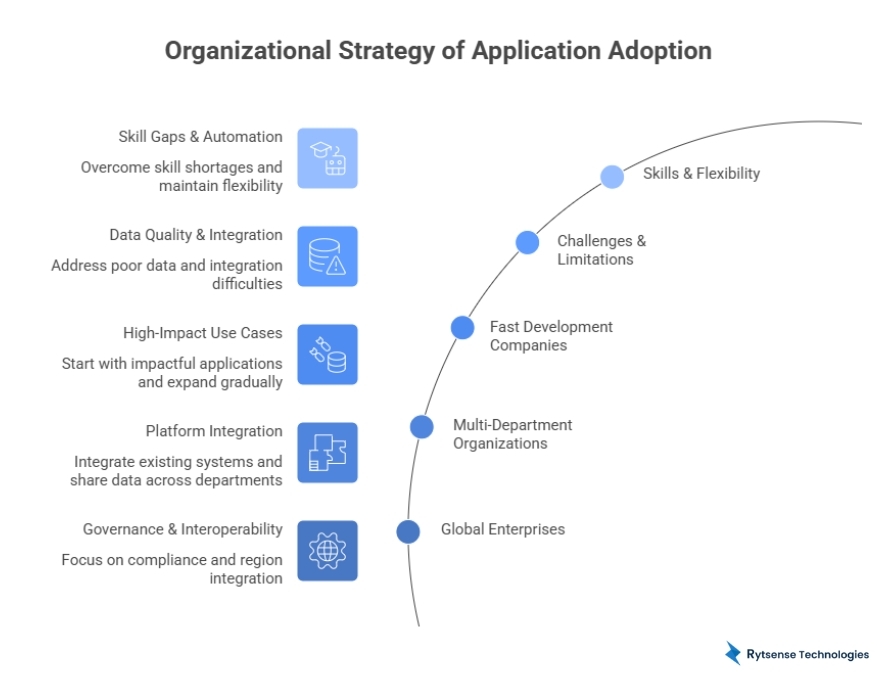
- 1. Global Enterprises: Target governance, compliance, and region interoperability.
- 2. Multi-Department Organizations: Focus on integration of existing platforms and access to shared data.
- 3. Fast development Companies: High-impact use cases are the ones to start and then extend to the organization.
- 4. Challenges and Limitations: Despite its benefits, intelligent technology adoption comes with challenges: Data quality can be poor which may restrict effectiveness. Difficulty of integration scales.
- 5. Lack of skills can delay implementation: Excessive automation may decrease the flexibility.
The treatment of these early enhances the long term results.
The Future of Intelligent Enterprise Scaling
Future intelligent systems will focus more on context awareness, real-time analytics, and adaptive learning. Businesses will move to platforms that can be scaled to meet business needs rather than fixed automation systems.
The ability to scale will become increasingly reliant on how the organizations balance the need to be flexible, govern and collaborate with humans.
Conclusion
Large organizations scale effectively with intelligent technology by focusing on automation, data-driven decision-making, and system integration. These systems lower complexity and enhance transparency in operation and consistency when used in a responsible manner.
Organizations such as Rytsense Technologies focus on simple, business-aligned intelligence that supports long-term growth without overpromising or unnecessary complexity.
Meet the Author

Co-Founder, Rytsense Technologies
Karthik is the Co-Founder of Rytsense Technologies, where he leads cutting-edge projects at the intersection of Data Science and Generative AI. With nearly a decade of hands-on experience in data-driven innovation, he has helped businesses unlock value from complex data through advanced analytics, machine learning, and AI-powered solutions. Currently, his focus is on building next-generation Generative AI applications that are reshaping the way enterprises operate and scale. When not architecting AI systems, Karthik explores the evolving future of technology, where creativity meets intelligence.