What Is the Main Advantage of Multimodal AI? A Business-Focused Insight for 2025
The main advantage of multimodal AI is its ability to combine and interpret multiple data types, text, audio, video, images, and real-time sensor signals, to deliver highly accurate, context-aware decision-making. Unlike traditional artificial intelligence that learns from one data source at a time, multimodal systems understand the real world more like humans do — with multiple senses working together.
This deeper context leads to better predictions, smarter automation, and more intelligent applications that support modern digital transformation. Whether you are a startup innovator or an enterprise leader, multimodal AI is becoming the new standard for building AI-driven solutions that scale efficiently and solve real problems.
What Is Multimodal AI? (Clear Definition)
Multimodal AI is a form of artificial intelligence that can process, analyze, and generate insights from multiple data modalities at once, such as:
- Text and speech
- Images and video
- Behavioral patterns
- Sensors and IoT signals
- Structured and unstructured data
Traditional machine learning relies on limited data perspectives. Multimodal systems combine NLP, computer vision, predictive analytics, and neural networks to deliver more human-like understanding.
It's not just an AI solution — it's intelligence designed to make real-world decisions with higher confidence.
How Does Multimodal AI Work?
Deep learning models merge different data streams into a shared representation layer. This supports:
- Context-rich interpretation
- Faster learning cycles
- Fewer errors
- More accurate outcomes
The combination unlocks AI decision-making that is powerful enough for dynamic environments such as healthcare, finance, and autonomous systems.
Top Business Advantages of Multimodal AI
Multimodal AI is quickly becoming the foundation of enterprise-grade artificial intelligence. By combining multiple data sources - such as images, text, voice, video, and real-time sensor data - it enables reliable automation, faster decision-making, and better customer engagement than traditional AI.
Below are the most impactful advantages and why organizations across industries are rapidly integrating multimodal AI systems.
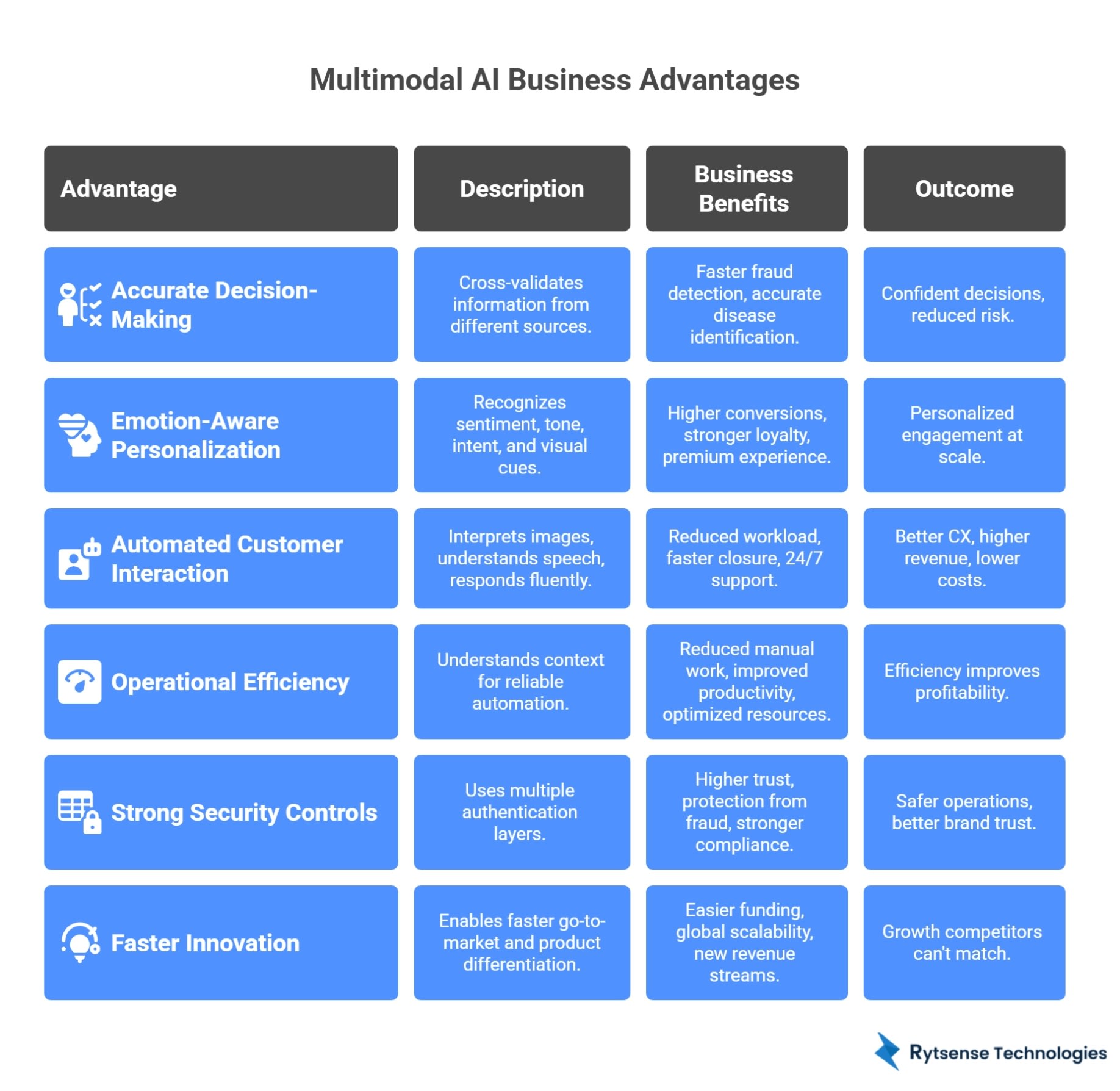
1. Most Accurate and Context-Aware Decision-Making
Traditional AI may misunderstand a situation when input data is limited. Multimodal AI cross-validates information from different sources, ensuring:
- Fewer false positives
- Real-time insights
- Improved predictions
Business benefits:
- Banks detect fraud faster by analyzing behavior + voice stress patterns
- Doctors identify diseases more accurately through medical reports + scan data
Outcome: Confident decisions with significantly reduced risk
2. Richer, Emotion-Aware Personalization
Customers expect experiences tailored to their needs. Multimodal AI recognizes sentiment, tone, intent, and visual cues - just like humans.
Examples:
- Retail apps recommending products based on voice queries + browsing behavior
- Streaming platforms adjusting content dynamically based on reactions
Business benefits:
- Higher conversions
- Stronger customer loyalty
- Premium brand experience
Outcome: Personalized engagement at scale — like Netflix, but everywhere
3. Fully Automated and Human-Like Customer Interaction
Today's users want fast resolutions across chat, voice, and mobile apps. Multimodal AI-powered chatbots and virtual assistants can:
- Interpret uploaded images (ID verification, product issues)
- Understand speech patterns and emotions
- Respond with natural language fluency
Business benefits:
- Reduced call-center workload
- Faster ticket closure
- 24/7 global support
Outcome: Better CX → Higher revenue with lower operational costs
4. Operational Efficiency & Lower Costs Through Smart Automation
When AI understands context, automation becomes reliable enough to handle mission-critical tasks:
| Business Operation | Result After Multimodal AI |
|---|---|
| Internal workflow approvals | Zero delays, fewer errors |
| Insurance/finance claims | Faster validation, fraud control |
| Manufacturing monitoring | Reduced downtime, proactive repairs |
Business benefits:
- Reduced manual work
- Improved productivity
- Optimized resource usage
Outcome: Efficiency that directly improves profitability
5. Strong Identity, Compliance & Security Controls
With increasing cyber threats, identity verification must be intelligent. Multimodal AI uses multiple authentication layers:
- Face recognition
- Voice biometrics
- Document analysis
- Behavioral patterns
Business benefits:
- Higher trust for digital payments
- Protection from scams and identity fraud
- Stronger compliance for regulated industries
Outcome: Safer digital operations → better brand trust
6. Faster Innovation & Strong Competitive Advantage
Companies integrating multimodal AI today are becoming tomorrow's leaders. Why?
- Faster go-to-market for new AI applications
- More product differentiation
- Ability to tap into new revenue streams like AI-powered features
Business benefits:
- Startups secure funding more easily with advanced AI offerings
- Enterprises unlock global scalability without increasing labor
Outcome: Multimodal AI unlocks growth that competitors can't match
How This Advantage Plays Out in Real Scenarios
| Situation | Traditional AI | Multimodal AI |
|---|---|---|
| Customer support response | Understands only typed messages, missing emotional cues or shared content | Detects tone of voice, sentiment, user history, and visuals shared by the customer, leading to more empathetic and personalized responses |
| Fraud detection | Focuses primarily on unusual transaction patterns, which can generate false alerts | Analyzes biometrics, device identity, behavioral patterns, and location signals to accurately differentiate genuine users from threats |
| Medical diagnosis | Reviews structured data like clinical notes, which may not tell the full story | Combines radiology scans, vital measurements, doctor observations, and even speech-based symptoms to improve diagnostic precision |
Why This Matters for Trust and Reliability
By validating every decision using multiple complementary inputs, multimodal AI significantly increases the reliability of its predictions. It reduces the possibility of misinterpretation because it seeks alignment among different signals rather than depending on a single data point. This approach results in higher credibility and makes AI systems safer and more suitable for critical use cases.
Organizations adopting multimodal systems experience notable improvements in areas such as accuracy of outcomes, mitigation of operational and compliance risks, and practical relevance of insights. Instead of theoretical intelligence, businesses receive decisions grounded in the actual context in which events occur.
This capability represents a core driver of modern digital transformation. Companies investing in AI development services are no longer just adding automation - they are enabling systems that think and adapt more like humans, ensuring technology supports business goals with clarity, confidence, and real-world understanding.
Why Businesses Should Adopt Multimodal AI in 2025
Organizations are shifting from task automation to intelligent business systems. Multimodal AI solutions enable:
- Superior customer experiences
- Real-time operational intelligence
- Enhanced automation
- Better personalization
- Cost-efficient data utilization
Startups gain speed. Enterprises gain stability.
How Multimodal AI Enhances Digital Transformation
Modern organizations deal with complex, scattered data. Multimodal systems integrate:
- CRM, ERP, IoT signals
- Voice, text, visual inputs
- Historical, live data feeds
This enables:
- Unified intelligence across business operations
- High-accuracy interventions
- Real-time decision execution
It is the engine behind true AI transformation - not just technology upgrades, but complete process modernization.
Benefits for Startups vs Enterprises
| Benefit | Startups | Enterprises |
|---|---|---|
| Innovation | Build disruptive AI products faster | Improve legacy systems intelligently |
| Efficiency | Reduce development cost | Automate workflows at scale |
| Competitive edge | Enter markets earlier | Sustain leadership with smarter operations |
| Personalization | Strong product-market fit | Customer loyalty & retention improvements |
Whether scaling from MVP or modernizing global operations, AI integration powered by multimodal data drives growth forward.
Industry-Wise Multimodal AI Use Cases
Here are unique use cases you can highlight:
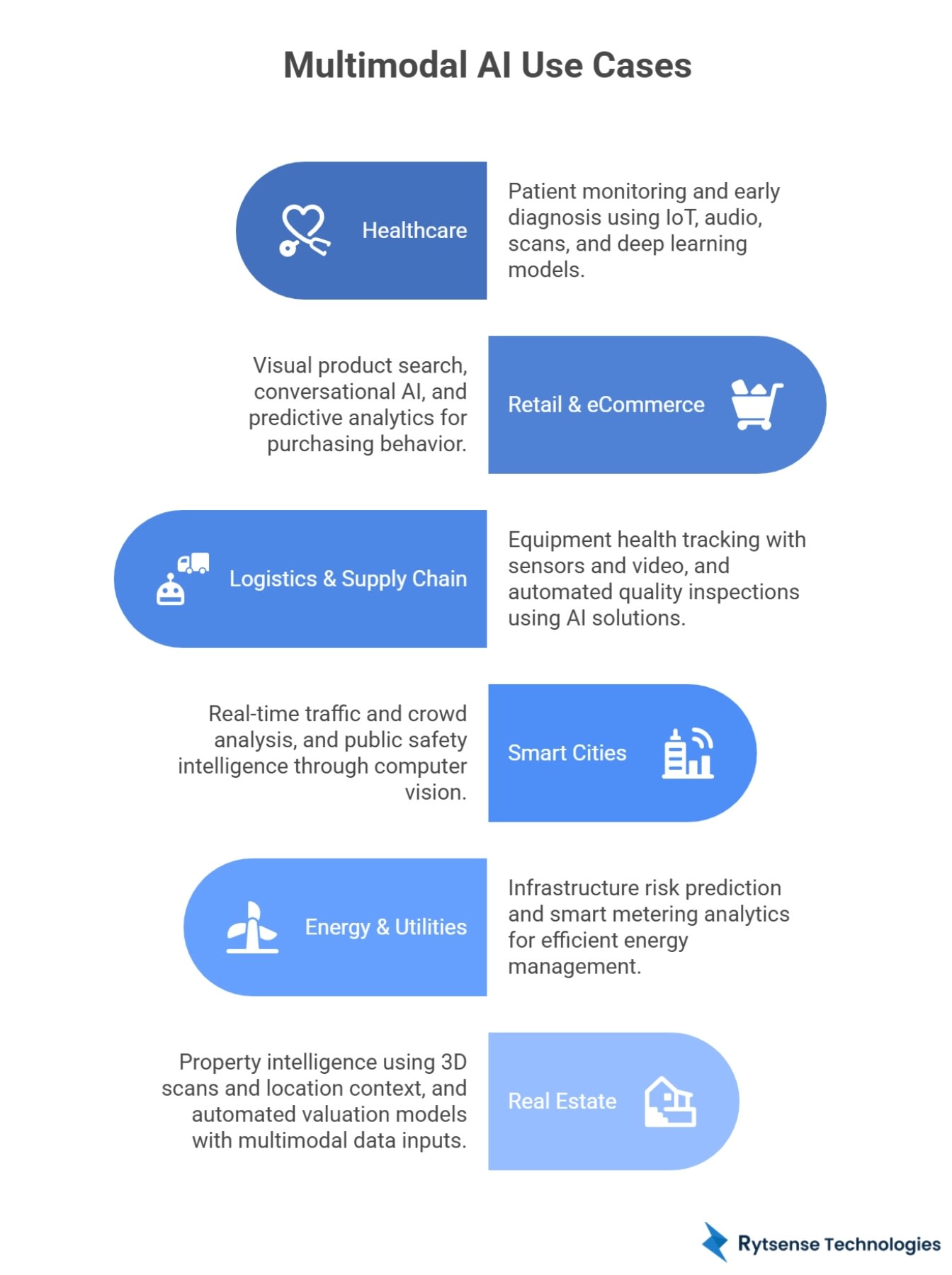
Healthcare
- Patient monitoring through IoT, audio, scans
- Early diagnosis using hybrid deep learning models
Retail & eCommerce
- Visual product search + conversational AI
- Predictive analytics for purchasing behavior
Logistics & Supply Chain
- Equipment health tracking with sensors + video
- Quality inspections automated using AI solutions
Smart Cities
- Real-time traffic + crowd analysis
- Public safety intelligence through computer vision
Energy & Utilities
- Infrastructure risk prediction
- Smart metering analytics
Real Estate
- Property intelligence using 3D scans + location context
- Automated valuation models with multimodal data inputs
All these show AI development services are expanding across future-ready industries.
Challenges Multimodal AI Solves That Traditional AI Cannot
- Not enough data for accurate decisions
- Difficulty with personalization
- Manual intervention in automation
- High rate of false positives
- Delayed decisions in high-risk environments
Instead of reacting late → Multimodal AI anticipates.
Multimodal + Generative AI: Innovation Multiplied
Combining multimodal AI with generative AI creates:
- Self-learning decision engines
- Content + context generation
- Greater automation + reasoning capabilities
This synergy powers:
- AI agents
- Virtual assistants
- Autonomous intelligence in enterprises
The future of AI software development is multimodal + generative - operating like human co-workers.
AI Development Strategy for Businesses
To build strong AI systems, organizations must:
- Select high-value use cases
- Audit multimodal data pipelines
- Use scalable neural networks and training sources
- Ensure compliance & data governance
- Collaborate with expert AI developers early
Custom AI development is key because every enterprise has unique data and workflows.
Future of Multimodal Artificial Intelligence
2025 and beyond will see:
- AI agents with emotion + intent understanding
- Cross-platform learning without re-training
- Real-time data processing for automation
- Smarter AI models with explainability
- Enterprise adoption as a default strategy
AI is transitioning from assisting humans → collaborating with humans.
How to Start with Multimodal AI (Simple Roadmap)
| Step | Action |
|---|---|
| 1 | Start with a proof-of-value AI pilot |
| 2 | Integrate multimodal datasets |
| 3 | Deploy scalable cloud or hybrid infrastructure |
| 4 | Expand applications into multiple operations |
You don't need huge data from day one. You need the right data applied intelligently.
Final Thoughts
The primary advantage of multimodal AI is its ability to make high-quality, context-aware decisions that reflect real-world complexity. Businesses adopting this technology are:
- More efficient
- Faster at innovation
- Competitive in evolving markets
- Ready for AI-enabled futures
It drives a new generation of intelligent business systems, reshaping how companies operate, grow, and deliver value.
Meet the Author

Karthikeyan
Connect on LinkedInCo-Founder, Rytsense Technologies
Karthik is the Co-Founder of Rytsense Technologies, where he leads cutting-edge projects at the intersection of Data Science and Generative AI. With nearly a decade of hands-on experience in data-driven innovation, he has helped businesses unlock value from complex data through advanced analytics, machine learning, and AI-powered solutions. Currently, his focus is on building next-generation Generative AI applications that are reshaping the way enterprises operate and scale. When not architecting AI systems, Karthik explores the evolving future of technology, where creativity meets intelligence.