Key Takeaways
The Golden Rule of AI is to empower humans, not replace them — enhancing intelligence, trust, and innovation.
AI development services help businesses achieve faster decisions, higher productivity, cost optimization, and strong market competitiveness.
The future of AI is built on human + machine collaboration, where strategy, creativity, and empathy remain human strengths.
Responsible AI development must follow ethical standards including fairness, transparency, accountability, privacy, and inclusiveness.
To overcome challenges like data quality, cost, and skill shortages, companies need expert AI integration and strategic planning.
From startups to enterprise-level organizations, AI is now essential for digital transformation and long-term success.
What Is the Golden Rule of AI?
The golden rule of AI is: Use Artificial Intelligence to empower humans not replace them.
AI should enhance human intelligence, improve decision-making, increase productivity, and unlock innovation, while keeping ethical responsibility, transparency, and user trust at the core.
1. What Is the Golden Rule of Artificial Intelligence?
Artificial intelligence development is rapidly evolving across industries — from automated processes to predictive analytics and beyond. But regardless of the technology, one universal rule guides success:
AI works best when it makes human capabilities stronger, smarter, and faster — not obsolete.
This mindset ensures AI systems remain:
- Human-centric
- Trustworthy and responsible
- Aligned with user expectations
- Designed for improving life and business outcomes
Why This Golden Rule Matters Today
There’s a common misconception that AI models are built to replace jobs. But in reality, AI augments people — offering:
- Better insights
- Faster workflows
- Improved creativity
- Safety in high-risk operations
From healthcare decision-making to smart manufacturing, humans + AI > humans OR AI alone.
It’s the foundation for success in any AI development company, AI application, or enterprise digital transformation strategy.
What Really Is AI? A Quick Overview
Artificial Intelligence (AI) refers to computer systems designed to mimic human intelligence not just by following instructions, but by analyzing data, learning patterns, and making decisions on their own. The primary goal of AI technologies is to enhance human abilities, automate tasks, and help businesses make smarter decisions faster.
Today, AI is the backbone of many modern software development services and business innovations. Whether it’s understanding speech, detecting fraud, powering self-driving cars, or predicting what customers want, AI systems learn continuously and improve as they access more information.
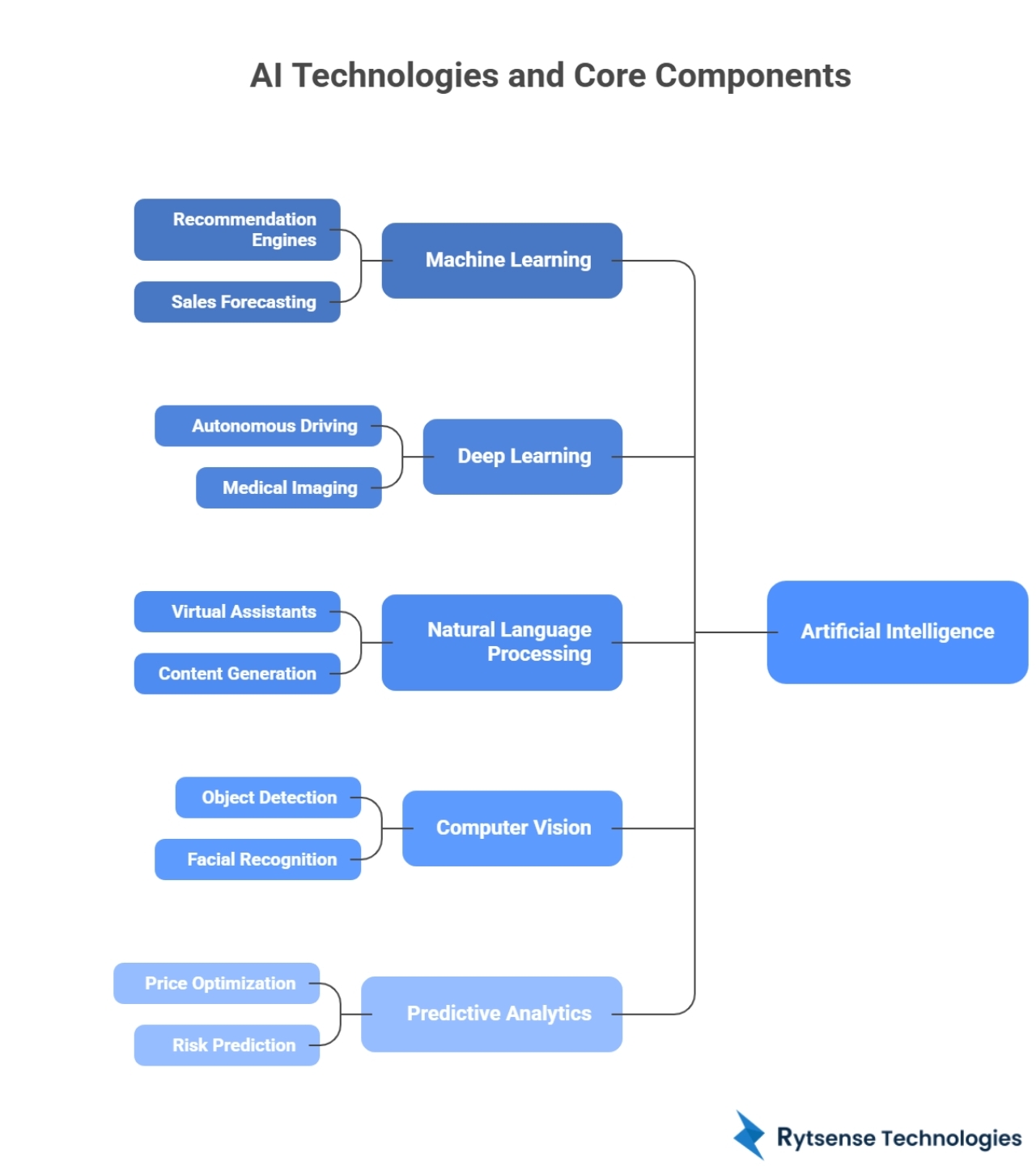
Core Technologies That Make AI Intelligent
AI is not a single technology it is powered by multiple disciplines working together:
1️⃣ Machine Learning (ML)
Machine learning allows systems to learn from historical data and improve over time. Instead of manual programming, ML models recognize patterns and make predictions.
Examples:
- Recommendation engines on e-commerce websites
- Sales forecasting for enterprises
- Credit scoring in finance
ML is foundational for custom AI development in almost every industry.
2️⃣ Deep Learning (DL)
Deep learning is an advanced form of ML inspired by how the human brain works. It uses neural networks to process large datasets and detect complex patterns such as:
- Speech and voice signals
- High-resolution images
- Real-time sensor data
It drives breakthrough AI innovations like autonomous driving, medical imaging, and chatbots.
3️⃣ Natural Language Processing (NLP)
NLP enables machines to understand, interpret, and generate human language.
Applications:
- Virtual assistants like Siri and Alexa
- AI-powered content generation and translation
- Customer sentiment analysis
Businesses use NLP-based AI applications to improve customer interaction and automate communication.
4️⃣ Computer Vision
Computer vision helps AI see the world, just like humans do but with higher accuracy and speed.
Computer vision systems:
- Detect objects in images and videos
- Monitor manufacturing lines for defects
- Authenticate users through facial recognition
It powers intelligent automation in retail, healthcare, automotive, real estate, and more.
5️⃣ Predictive Analytics
Predictive analytics uses historical data and statistical learning models to forecast future trends.
It helps business leaders make data-driven decisions such as:
- Price optimization and demand forecasting
- Risk prediction in financial services
- Preventive maintenance in industries
Predictive analytics is a core offering for AI development companies helping businesses unlock scalable growth.
Benefits of AI for Modern Businesses
Organizations worldwide — from agile startups to global enterprises — are rapidly adopting AI development services to gain a competitive advantage in the digital era. As markets become more data-driven, companies that leverage AI solutions can operate smarter, faster, and more efficiently than ever before.
Here’s a closer look at how AI transforms modern business outcomes:
| Business Impact | How AI Helps | Why It Matters |
|---|---|---|
| Faster Decisions | AI analyzes massive data sets in real time to support instant decision-making. | Leadership can respond to market shifts immediately and avoid costly delays. |
| Higher Productivity | Automates repetitive and time-consuming tasks across departments. | Teams can focus on strategic, creative, and revenue-generating activities. |
| Better Customer Experience | AI personalizes recommendations, support responses, and user journeys. | Increased customer satisfaction, higher retention, and long-term loyalty. |
| Cost Efficiency | AI optimizes workforce planning, resource allocation, and operational workflows. | Reduced operational costs and improved margins across the enterprise. |
| Smart Innovation | AI enables new product development, automation concepts, and predictive services. | Businesses can launch cutting-edge solutions and tap into new revenue streams. |
| Stronger Security | Machine learning models detect unusual behavior and security threats proactively. | Enhanced protection from fraud, data breaches, and cyber-attacks. |
AI Is Now a Business Necessity - Not a Luxury
What was once considered “emerging technology” is now at the heart of enterprise digital transformation. From predictive analytics that forecast sales trends to AI-driven automation that speeds up workflows, AI systems give businesses the intelligence and agility needed to thrive.
Organizations that delay adoption risk:
- ⚠ Slow innovation
- ⚠ Higher operational costs
- ⚠ Losing customers to AI-powered competitors
AI-driven companies enjoy:
- ✔ Faster growth
- ✔ Better products
- ✔ More resilient business models
In short: AI doesn’t just improve operations - it defines the future of business success.
4️⃣ The Balance: Human + Machine Collaboration
While intelligent tools can automate tasks, the real transformation happens when organizations build intelligent ecosystems, where humans and AI systems work together to drive smarter outcomes. Instead of replacing jobs, Artificial Intelligence amplifies human potential, allowing people to focus on what they do best.
Let’s break down how this synergy works:
What AI Handles Best
AI technologies excel in areas that require speed, scale, and precision. These include:
-
Data-heavy operations:
AI can process and analyze vast volumes of structured and unstructured data faster than any human team.
-
Pattern Recognition:
From detecting anomalies in cybersecurity to recognizing trends in customer behavior, AI models spot insights that humans might miss.
-
Automated Workflows:
AI streamlines repetitive tasks like reporting, scheduling, document processing, and inventory management — allowing operations to run 24/7 with minimal errors.
By taking over the complex and time-consuming workload, AI frees talent to innovate and solve higher-level challenges.
What Humans Continue to Do Best
Even with advanced automation, humans remain at the center of strategic and creative decision-making. People bring:
-
Strategy:
Human leaders understand business context, market forces, and long-term planning areas where AI requires guidance.
-
Creativity:
AI can generate ideas, but humans drive imagination, storytelling, and original thinking that shapes innovation.
-
Emotion & Empathy:
Connection, trust, and understanding are uniquely human qualities important in healthcare, customer relations, and team management.
-
Critical Thinking & Ethics:
Humans evaluate risks, interpret consequences, and ensure AI-driven decisions stay aligned with values and compliance.
Where Humans + AI Create Maximum Impact
When combined, this partnership leads to AI-assisted intelligence development, where:
| AI Contribution | Human Contribution | The Result |
|---|---|---|
| Processing power | Purpose and vision | Fast and meaningful progress |
| Insights | Decision-making | Smarter outcomes |
| Automation | Innovation | Scalable growth |
| Data | Context | Responsible actions |
This collaborative model helps organizations accelerate product development, innovate confidently, and build resilient operations.
5️⃣ Ethical Principles Behind the Golden Rule
As AI becomes deeply embedded in business operations, it’s crucial that technology remains safe, unbiased, and human-aligned. That’s why leading organizations and every AI development company must follow strict ethical guardrails when building, training, and deploying AI models.
Let’s explore these foundational principles in a way that business leaders, startups, and technical teams can clearly understand:
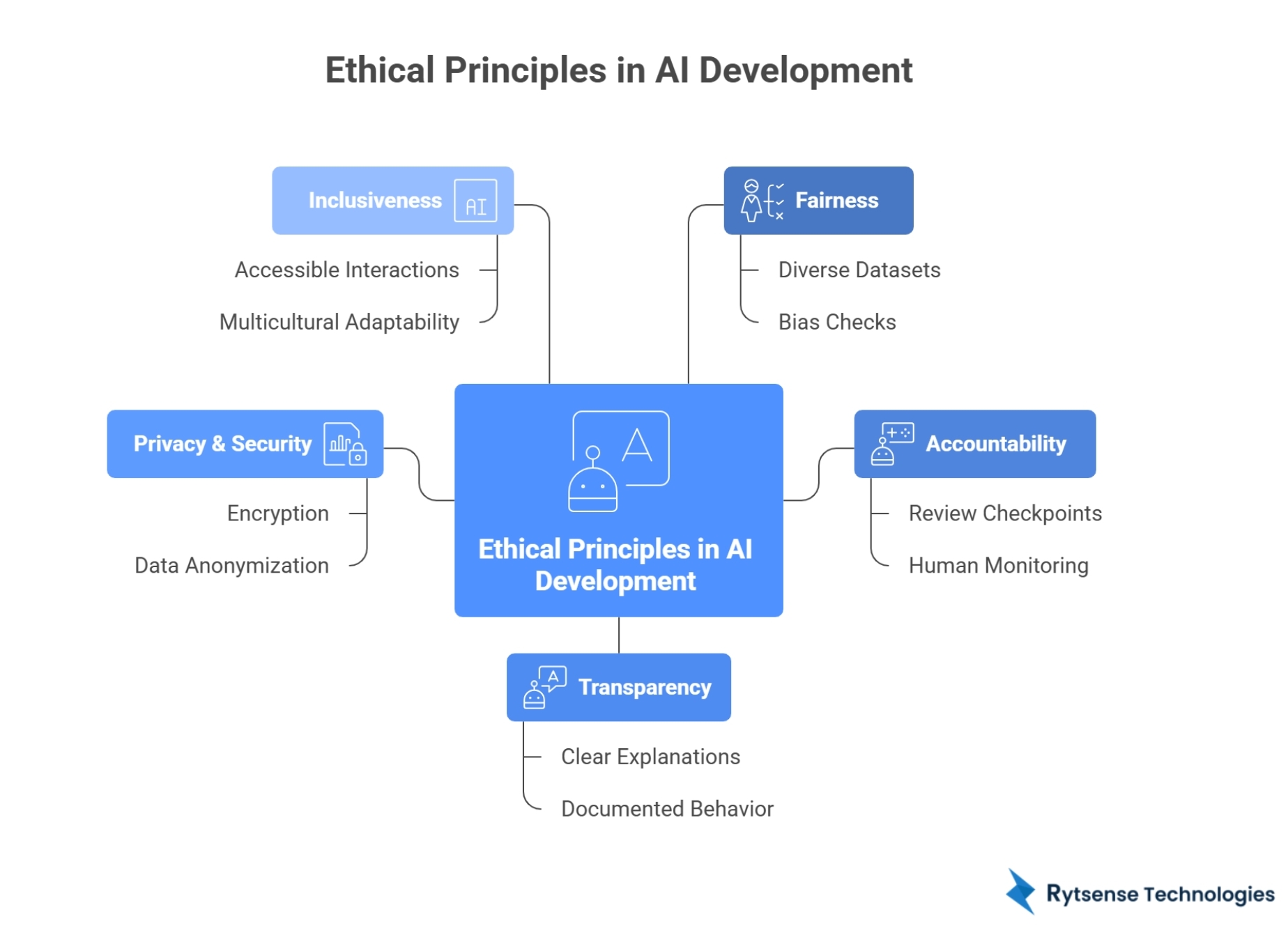
1️⃣ Fairness — Equal Outcomes for Everyone
AI must make decisions without discrimination. Machine learning models learn from real-world data, which may contain historical biases. If not addressed, AI can unintentionally reinforce unfair outcomes such as biased hiring or loan approvals.
Responsible developers ensure:
- Diverse and clean training datasets
- Regular bias checks during the model lifecycle
- Clear rules and constraints for fairness
Goal → AI should empower all users equally, regardless of gender, race, location, or background.
2️⃣ Accountability — Humans Stay in Charge
AI systems can automate decisions, but ownership always remains with humans.
Key accountability practices include:
- Review and approval checkpoints for high-impact decisions
- Human-in-the-loop monitoring
- Traceability for every outcome AI generates
Goal → AI assists, humans control. Humans must be able to reverse or correct AI decisions at any time.
3️⃣ Transparency — No “Black Box” Systems
Businesses need to understand why AI makes a decision, especially in sectors like finance, law, insurance, and healthcare.
Transparency ensures:
- Clear explanations behind AI actions
- Documented model behavior
- Interpretable outputs for stakeholders
Goal → Trust comes from clarity, not mystery. When users can see how AI arrives at decisions, adoption increases and risks decrease.
4️⃣ Privacy & Security — Protecting Data at Every Layer
AI systems rely on data — often sensitive data. That’s why robust security measures are critical:
- End-to-end encryption
- Secure data handling and anonymization
- Strict compliance with GDPR, CCPA, and industry standards
- Continuous monitoring for threats
Goal → Data remains confidential, protected, and used only for clear business value.
5️⃣ Inclusiveness — AI That Benefits Everyone
AI solutions should be designed for broad usability, ensuring:
- Accessible interactions for all users
- Multilingual and multicultural adaptability
- Consideration for diverse physical and cognitive needs
Goal → No one is left behind in the AI-powered future.
6️⃣ Real-World Examples of the Golden Rule in Action
AI technologies improve industries without eliminating the human factor:
✔ Healthcare
Doctors use predictive analytics & NLP tools to diagnose diseases early.
✔ Finance
AI fraud detection enhances security while humans oversee decision-making.
✔ Retail & E-Commerce
Personalization engines improve customer satisfaction and sales.
✔ Manufacturing
AI robotics handle dangerous, repetitive tasks humans manage innovation.
✔ Real Estate
AI models analyze market trends for property investment decisions.
✔ Education
AI apps offer personalized learning, while teachers guide moral and practical understanding.
Every use case shows the same thing: AI systems assist people not replace them.
7️⃣ How Startups & Enterprises Can Apply the Golden Rule
| Business Size | Strategy That Works |
|---|---|
| Startups | Build Minimum Viable AI products (AI MVPs) that enhance user experience |
| SMBs | Adopt AI integration into existing systems for automation |
| Large Enterprises | Develop AI applications tailored to decision-making and long-term scalability |
Key questions to ask before adopting AI:
- ❓ What value does the AI application create for people?
- ❓ Does it reduce workload or complexity?
- ❓ Is transparency maintained in decision-making?
- ❓ Is the AI solution easy to control, audit, correct, or override?
If the answers are yes, you are aligned with the golden rule.
Pro Tip
Partnering with a Top AI development company ensures compliance, efficiency, and strategic outcomes, especially when dealing with data migration, model training, and integration.
Consult With Our AI Specialists8️⃣ Top Challenges in AI Adoption
While Artificial Intelligence delivers remarkable benefits, implementing it successfully isn’t always easy. Even the most advanced AI solutions face hurdles during development and deployment. Understanding these challenges early helps prevent delays, unexpected costs, and failed projects.
Below are the most common roadblocks companies encounter - and why strategic planning is essential:
| Challenge | Impact |
|---|---|
| Limited High-Quality Data | Poor model accuracy |
| Technical Complexity | Slow development cycle |
| Cost & Infrastructure | Cloud + compute expenses |
| AI Skill Shortage | Hard to scale AI teams |
| Compliance Needs | Privacy + security risks |
| Organizational Resistance | Fear of automation |
The solution is strategic planning + expert AI integration.
Future of AI (2025 & Beyond)
AI is not slowing down — it’s evolving into a more powerful and accessible force that will redefine how businesses operate. As markets demand real-time intelligence, automation, and personalized digital experiences, AI development services are pushing innovation to the next level. The organizations embracing these advancements today will become the industry leaders of tomorrow.
Here are the major trends shaping the future of AI:
| Trend | Future Impact |
|---|---|
| Generative AI | Creativity powered by machine learning |
| Autonomous Decision Systems | Faster business operations |
| AI in Software Development | Automated coding & testing |
| Hyper-personalization | Better marketing and user experience |
| AI-powered Analytics | Real-time business intelligence |
As AI systems mature, they will enhance every industry as long as the golden rule continues to guide innovation.
Conclusion
The success of AI doesn’t depend on replacing humans. It depends on how well AI and humans work together.
Golden Rule Recap:
AI should empower humans — making life smarter, safer, and more innovative.
The more responsibly we build intelligent systems, the more value AI delivers to organizations, society, and the future workforce.
Meet the Author

Co-Founder, Rytsense Technologies
Karthik is the Co-Founder of Rytsense Technologies, where he leads cutting-edge projects at the intersection of Data Science and Generative AI. With nearly a decade of hands-on experience in data-driven innovation, he has helped businesses unlock value from complex data through advanced analytics, machine learning, and AI-powered solutions. Currently, his focus is on building next-generation Generative AI applications that are reshaping the way enterprises operate and scale. When not architecting AI systems, Karthik explores the evolving future of technology, where creativity meets intelligence.